
24 October 2026 · TJ Smile Studio
Whitening With Bonding: What to Do First and Why
Can you whiten bonded teeth? Learn why composite doesn't lighten, the right order for whitening and bonding, and what it costs in Glasgow.
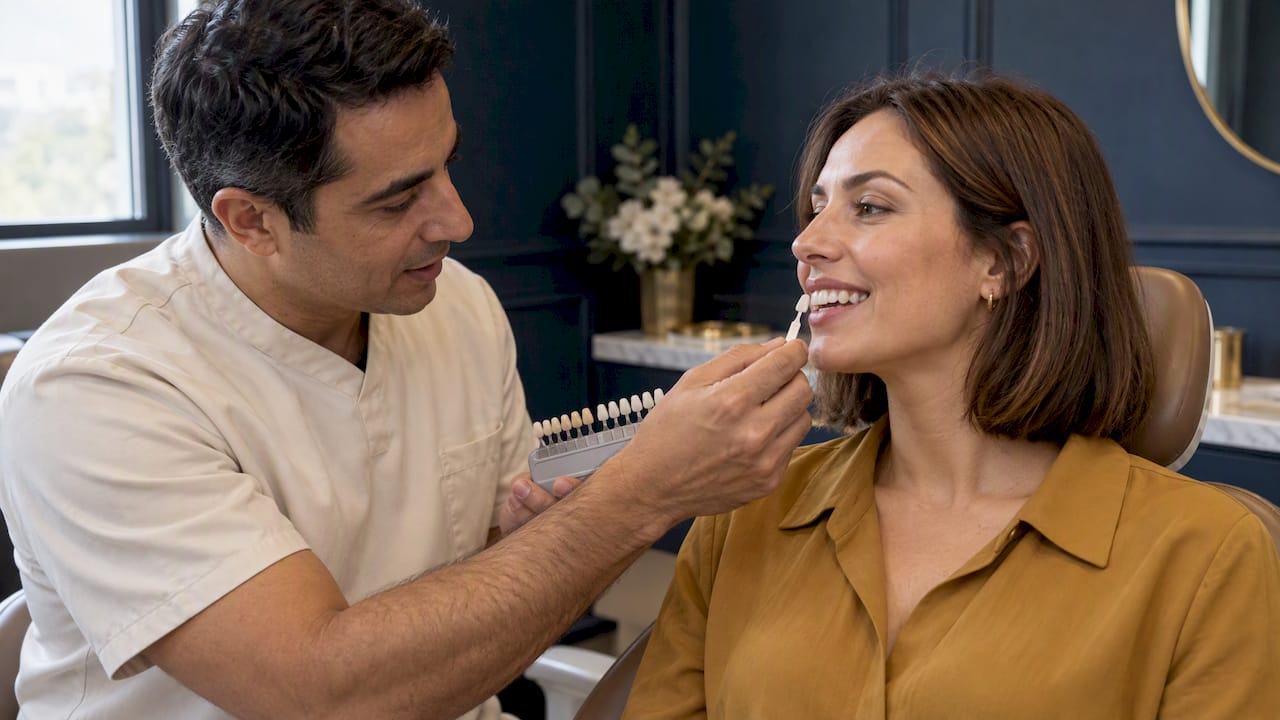
If you want whitening and composite bonding, whiten first and bond second. Whitening gel lightens natural tooth structure, but it does not lighten composite resin. So bonding placed before whitening can end up looking darker than the teeth around it. Bonding placed after whitening, once the shade has settled, can be matched to your final colour.
This guide covers the right order, what to do if you already have bonding and want brighter teeth, how long to wait, what the evidence says about whitening over resin, and what each step costs at our Glasgow studio.
TL;DR
- Whitening changes the colour of natural enamel and dentine. It does not change composite, fillings or veneers, according to Leeds Teaching Hospitals NHS Trust.
- Best order: examination, professional whitening, a settling period of about two weeks, then bonding matched to the new shade.
- Already have bonding? You can still whiten, but the bonded teeth may need polishing, refreshing or replacing so they match.
- In the UK, whitening gel must be supplied through a registered dental professional. Over-the-counter strong products are not the safe route.
- At TJ Smile Studio, whitening starts at £299 and composite bonding from £200 per tooth. A consultation is £50.
Table of Contents
- Why whitening and bonding behave so differently
- The right order: whiten first, bond second
- Already have bonding and want whiter teeth?
- Home, in-office or both: which fits a bonding plan?
- Who can legally whiten your teeth in the UK?
- What this looks like at TJ Smile Studio
- Our perspective
- Keeping both results looking good
- FAQ
- Sources
Why whitening and bonding behave so differently
They solve two different problems. Whitening is a chemical process: a peroxide gel works into the tooth and lightens the pigment inside it. Bonding is a sculpting process: tooth-coloured resin is built onto the tooth to close gaps, repair chips or reshape edges.
Once the resin has been cured, it is a fixed shade. The gel has nothing to lighten. Leeds Teaching Hospitals states that whitening will not alter fillings or veneers, and that an old restoration may need replacing if it no longer matches your teeth.
In practice, that creates a familiar problem. You whiten your teeth by several shades, and the bonded corner of a front tooth now looks yellower or greyer than its neighbours. Nothing has gone wrong with the bonding. It just stayed the same colour while everything around it moved on.
A quick word about whitening toothpaste and hacks
Whitening toothpastes, charcoal powders and abrasive home remedies do not lighten composite either. Abrasives can dull the polished surface of resin and make it hold stains more easily. If your bonding looks stained, the sensible step is a dental polish or assessment, not scrubbing harder.
The right order: whiten first, bond second
For anyone planning both treatments, this is the sequence we recommend and that the clinical literature supports:
- Examination and shade planning. Your dentist checks gums, existing fillings and any decay. Whitening is unsuitable where teeth or gums are unhealthy, and the NHS notes it is not available on the NHS, so it is a private treatment.
- Professional whitening. Either custom trays at home, an in-office session, or both.
- A settling period. A 2018 review of whitening and restorations recommends waiting two weeks after bleaching before adhesive procedures such as bonding.
- Bonding matched to the whitened shade. The dentist can now pick a resin colour against your stable, final tooth colour.
Why the wait? Freshly bleached teeth are still changing slightly in colour, and bleaching can interfere with how well resin sticks to the surface. Waiting gives a stable shade to match and a better surface to bond to. The same review is honest that the evidence on how bleaching affects restorations is mostly laboratory-based and not fully consistent, so we treat two weeks as a sensible minimum rather than a magic number.
What if you whiten after bonding instead?
It is not dangerous, but it often means paying twice. You would whiten, see which bonded teeth no longer match, then have those teeth refreshed or redone. If you are not yet booked for bonding, reverse the order and save yourself that step.
Already have bonding and want whiter teeth?
You have three realistic options, and which suits you depends on how many teeth are bonded and how much lighter you want to go.
| Situation | Likely approach |
|---|---|
| Small bonded edge, you want a slight lift | Whiten gently, then have the bonding assessed and polished |
| Several bonded teeth, you want a clear change | Whiten, wait, then replace the bonding that no longer matches |
| Bonding is old, stained or chipped anyway | Replace it after whitening, matched to the new shade |
None of these is a failure. Composite is designed to be a maintainable material. A ten-year British Dental Journal study of 283 composite restorations in 26 patients found a median survival of 5.8 years, with wear, fracture and marginal discolouration among the common failure modes. Biological complications were rare and patient satisfaction stayed high despite deterioration. Polishing, repair and eventual replacement are a normal part of owning bonding.
The University of Bristol’s patient leaflet on composite build-ups gives a similar picture of average lifespans of around five to six years for that type of treatment.
Does whitening damage bonding?
It can have an effect, and it depends on the material, the gel and its strength. The 2018 literature review found laboratory changes that varied between composites, including possible effects on hardness, surface roughness, staining susceptibility, microleakage and bond strength. Higher peroxide concentrations tended to have a greater effect, and polishing, rebonding or replacement was sometimes needed after whitening.
That is a good reason to avoid aggressive, unsupervised whitening. If you have bonding, tell your dentist before choosing a gel strength. Our own explainer on whitening gel strengths covers how a gentler starting point works.
Home, in-office or both: which fits a bonding plan?
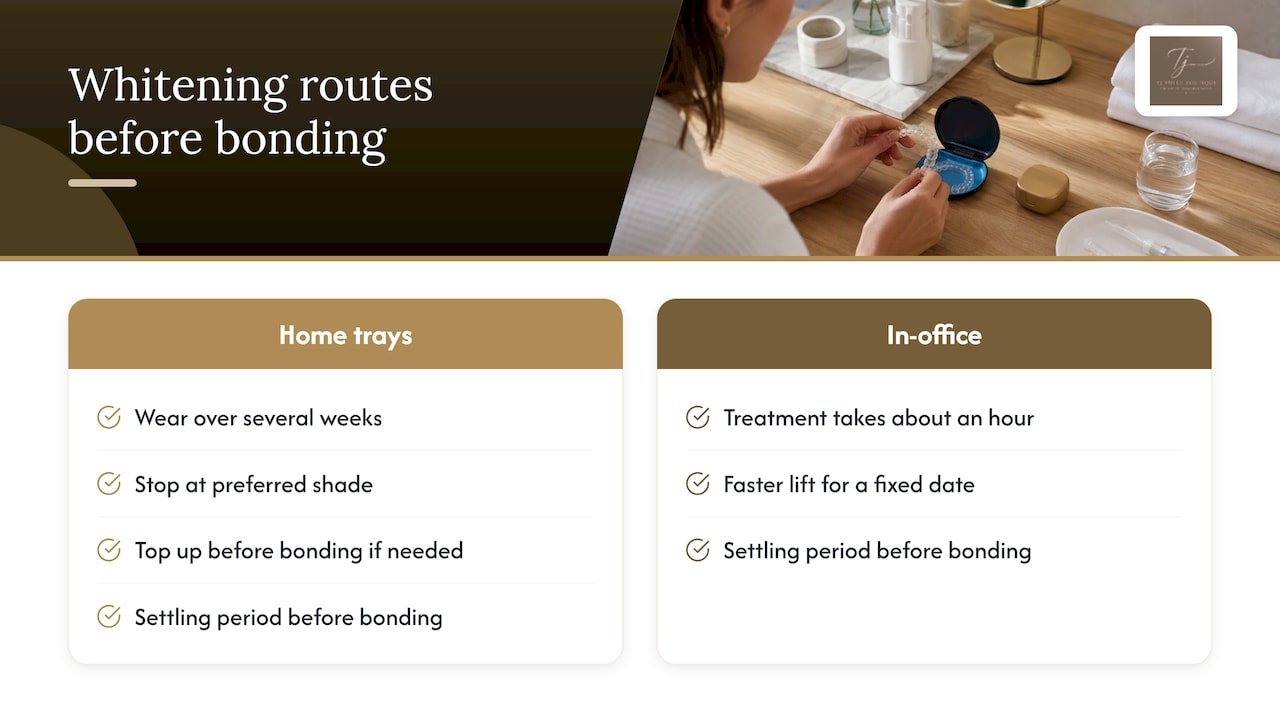
The NHS describes whitening options as a dentist-made mouthguard with bleaching gel at home, or treatment in the practice. Power whitening in a practice takes about an hour, whereas tray-based whitening is usually worn over several weeks, and the exact timetable depends on the prescribed system and your assessment.
For people heading towards bonding, tray whitening has a practical advantage: you can stop when you reach the shade you like, then top up before bonding if needed. In-office whitening gives a faster lift, which suits a fixed date such as a wedding, but you still need the settling period before bonding. Our home versus in-office whitening comparison sets out the trade-offs.
How long will the result last? NHS guidance suggests dentist-supervised whitening is not permanent and may last around three years when advice is followed. We go into what affects that in our article on how long whitening lasts.
Sensitivity
Whitening can cause short-lived sensitivity or gum irritation. If your teeth are already sensitive, say so at the consultation, because it changes the gel strength and schedule. See our guide to whitening sensitive teeth and what usually settles within a week in easing whitening sensitivity.
Who can legally whiten your teeth in the UK?
Only a registered dental professional. The British Dental Association explains that products containing or releasing 0.1% to 6% hydrogen peroxide may only be supplied to patients through treatment by a registered dental professional. The General Dental Council’s leaflet on considering tooth whitening explains what to expect, the risks, and who is allowed to carry it out.
The NHS also states that whitening is not offered to people aged 17 or under, and is unsuitable where teeth or gums are unhealthy. Before booking anywhere, check the clinician’s name on the GDC register. That applies to beauty salons and kits ordered online just as much as to dental practices.
What this looks like at TJ Smile Studio
Here is the pricing as published on our site, so you can plan the combined cost.
| Treatment | Price |
|---|---|
| Smile Consultation | £50 |
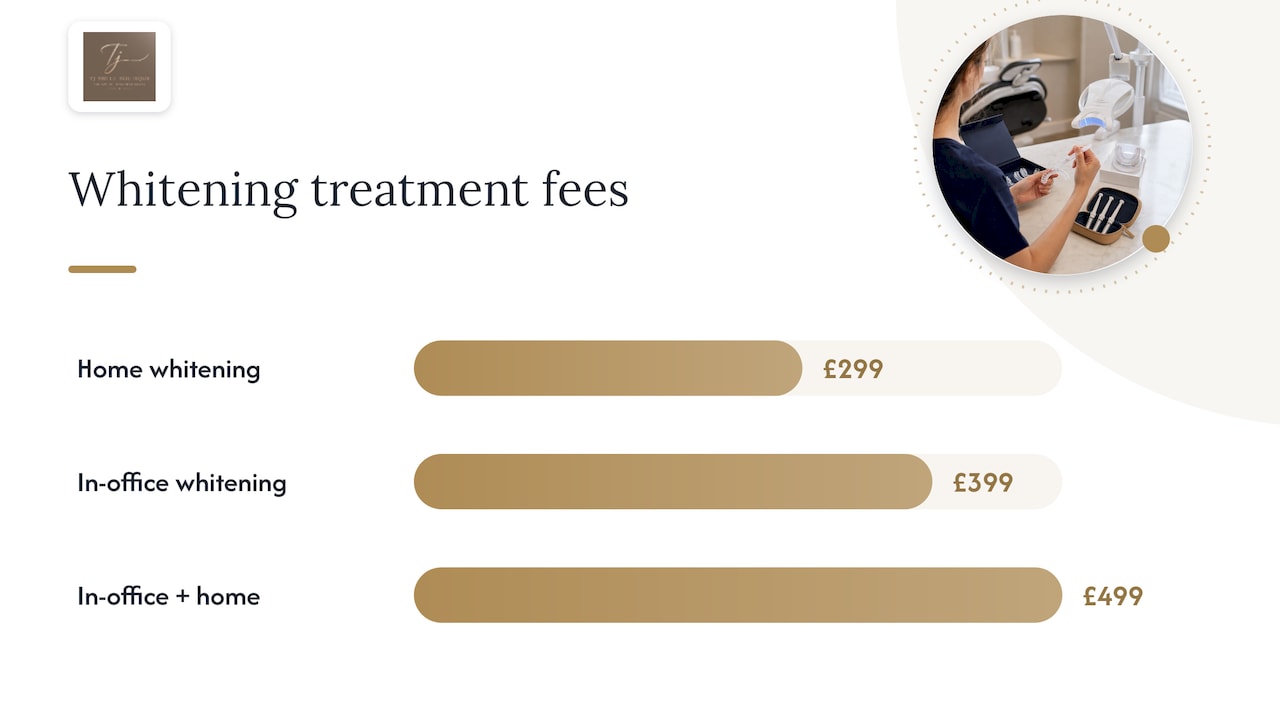
| Bespoke Home Teeth Whitening | £299 |
| Professional In-Office Teeth Whitening | £399 |
| Professional In-Office + Home Teeth Whitening | £499 |
| Composite Bonding | from £200 per tooth |
| Additional Composite Bonding, per tooth | £245 |
| Additional Edge Bonding, per tooth | £199 |
| Composite Bonding Review | £45 |
| Composite Polish & Maintenance | £95 |
| Composite Repair Assessment | £75 |
| Whitening Review | £35 |
See the full pricing page for every listed fee. Some treatments need a non-refundable booking deposit, and larger packages can be financed, so ask about this when you book.
As a worked example, someone who wants whiter teeth and two bonded front teeth would see the whitening fee of £299, £399 or £499 depending on the route chosen, plus bonding priced per tooth. The exact figure is confirmed at consultation, after we have seen the teeth, because the number of teeth and the shape work involved vary.
Promo: plan whitening and bonding in one consultation
If you are weighing up both treatments, book a £50 Smile Consultation. We will check your teeth and gums, look at any existing bonding, and set out a timeline: whitening first, a settling period, then bonding. You can read more about composite bonding in Glasgow or teeth whitening in Glasgow, then see our pricing to book. We also offer flexible appointment times including evenings and weekends, which helps if you are fitting this around work.
Our perspective
The most common mistake we see is not choosing the wrong treatment. It is choosing the right treatments in the wrong order. A patient comes in wanting bonding to close a gap, and has been planning to whiten “at some point” afterwards. By then the resin is a fixed shade and the smile has two colours in it.
We plan the whole smile before we touch a tooth. Every treatment here is led personally by one dentist, so the person who assesses your shade at consultation is the person who matches the bonding at the end. That continuity matters most in precisely this situation, where colour decisions made in week one affect the result in week four.
We also try to be straightforward about maintenance. Bonding is conservative and often completed quickly, and a digital workflow helps us plan shape and proportion carefully. But composite is not a one-off, maintenance-free purchase. It can stain, chip and wear, and the evidence says to expect polishing, repair and eventual replacement. We would rather you know that at consultation than discover it in year five.
If you have existing bonding and are unsure whether whitening will leave it behind, come in and we will tell you plainly which teeth are likely to need attention afterwards.
— Dr Tashfeen Jamil BDS, MFDS RCS Ed, AssocFCGDent - GDC 286427
Keeping both results looking good
- Whitening review. A short check on how your shade has settled, and whether a top-up is sensible. Ours is £35.
- Polish and maintenance. Composite benefits from periodic professional polishing, which removes surface stain and restores shine. Ours is £95.
- Repair quickly. If a bonded edge chips, get it assessed rather than leaving it. A repair assessment is £75, and our page on same-day composite repair explains what that involves.
- Avoid heavy staining in the first days. Dark drinks and smoking are most likely to undo a fresh result, and both stain composite over time.
If you are comparing options more widely, our guides on composite bonding versus veneers and teeth whitening versus veneers may help you decide whether bonding is the right tool at all. If whitening cannot fix your discolouration because the stain comes from inside a single tooth, the article on internal tooth whitening is worth reading.
FAQ
Can you whiten bonded teeth?
Yes, you can whiten the natural teeth around bonding, but the bonding itself will not change colour. If the shade gap becomes noticeable, the bonded teeth can be polished, refreshed or replaced to match.
How long should you wait to bond after whitening?
A 2018 review recommends about two weeks after bleaching before adhesive procedures. Your dentist may advise longer depending on how your shade settles, so the decision is made at your review.
Is it better to whiten before or after composite bonding?
Before, in almost every case. Whitening first lets the dentist match the resin to your final tooth colour. Whitening afterwards risks leaving bonded teeth looking darker than the rest.
Will whitening toothpaste lighten my bonding?
No. Whitening toothpaste cannot lighten resin, and abrasive formulas can roughen the surface so it stains more easily. A professional polish is the better way to refresh stained bonding.
How long does bonding last?
It varies, but UK evidence points to a few years rather than decades. A ten-year British Dental Journal study found a median survival of 5.8 years, and good care and regular polishing support the best outcome.
Sources
- Tooth Whitening, Leeds Teaching Hospitals NHS Trust
- What adverse effects does tooth-whitening have on dental restorations?
- Survival analysis of composite Dahl restorations, British Dental Journal
- Composite build-ups for tooth wear, University of Bristol
- Teeth whitening, NHS
- Dental treatments, NHS
- Tooth whitening, British Dental Association
- Considering tooth whitening?, General Dental Council
Recommended
This article is general information, not personal dental advice. What’s right for your teeth depends on a clinical examination — the condition of your enamel, gums, bite and any existing dental work — and no article can assess that. Outcomes vary between patients, and all treatment at TJ Smile Studio is subject to assessment and clinical suitability.
- Dr Tashfeen Jamil BDS, MFDS RCS Ed, AssocFCGDent, PGDip Restorative and Aesthetic Dentistry — GDC registration 286427
This article is general information, not personal dental advice. What's right for your teeth depends on a clinical examination — the condition of your enamel, gums, bite and any existing dental work — and no article can assess that. Outcomes vary between patients, and all treatment at TJ Smile Studio is subject to assessment and clinical suitability.
Clinically reviewed by Dr Tashfeen Jamil BDS, MFDS RCS Ed, AssocFCGDent, PGDip Restorative and Aesthetic Dentistry — GDC registration 286427, Principal Dentist at TJ Smile Studio, 1 Spiersbridge Way, Thornliebank, Glasgow G46 8NG.
If you have dental pain, swelling or an injury, call the practice on 07728 808510. Out of hours in Scotland, call NHS 24 on 111.