
10 September 2026 · TJ Smile Studio
Ease Whitening Sensitivity Within a Week With a UK Clinic Plan
UK clinic led plan explaining why whitening sensitivity happens, NHS and GDC advice, and tray plus toothpaste steps to ease pain in about a week.
Mild, short-lived sensitivity after teeth whitening is common and usually nothing to worry about. If your teeth ache after a whitening session, pause treatment, switch to a desensitising toothpaste, and avoid very hot, cold, or acidic food and drink for a day or two. Seek same-day dental review if pain is severe, confined to one tooth, or comes with swelling.
TL;DR:
- Sensitivity from whitening gels is common, especially with heat, high concentration, or poor tray fit, but it usually remains temporary and resolves within a week.
- Most severe or persistent pain, especially if it worsens or is confined to one tooth, indicates underlying issues like cracked teeth or leaking fillings that need professional assessment.
- Using desensitising toothpaste for at least two weeks before treatment and applying sensitive gel in trays on off nights can significantly reduce discomfort.
- Cutting back wear time and avoiding hot, cold, or acidic foods during treatment helps prevent sharp reactions and speeds up recovery.
- Proper pre-treatment evaluation by a dentist is essential to minimize sensitivity and ensure safe, effective whitening tailored to individual dental conditions.
Table of Contents
- What causes whitening sensitivity in the first place?
- How long does it last, and when is it not normal?
- Reducing pain during and after whitening
- Preparing your teeth before you start whitening
- What the evidence and the regulator say
- A dentist’s view on managing whitening pain
- Whiten with a plan, not a guess
- Sources
- FAQ
What causes whitening sensitivity in the first place?
Whitening gels work by pushing peroxide through the enamel into the dentine underneath, the layer packed with microscopic tubules that lead straight to the nerve. That temporary passage is exactly why teeth feel a twinge afterwards. A British Dental Journal review found sensitivity is one of the most frequently reported side effects of vital bleaching, with rates climbing when hydrogen peroxide is combined with heat or a whitening lamp.
The gel itself isn’t the whole story. Your own dental history matters just as much:
- Thinner enamel or a history of grinding leaves less of a barrier between the gel and the nerve.
- Gum recession that exposes root surfaces creates a shortcut straight to the dentine.
- Hairline cracks or leaking old fillings let peroxide in faster than intact enamel allows.
- Higher-strength gels, heat-assisted or laser whitening, poorly fitted trays, and simply overusing the product all raise the odds of a reaction.
None of this means your enamel is being damaged. Research on whitening-induced hypersensitivity suggests the peroxide temporarily increases enamel porosity rather than eroding it, which is part of why the discomfort tends to fade once treatment stops.
How long does it last, and when is it not normal?
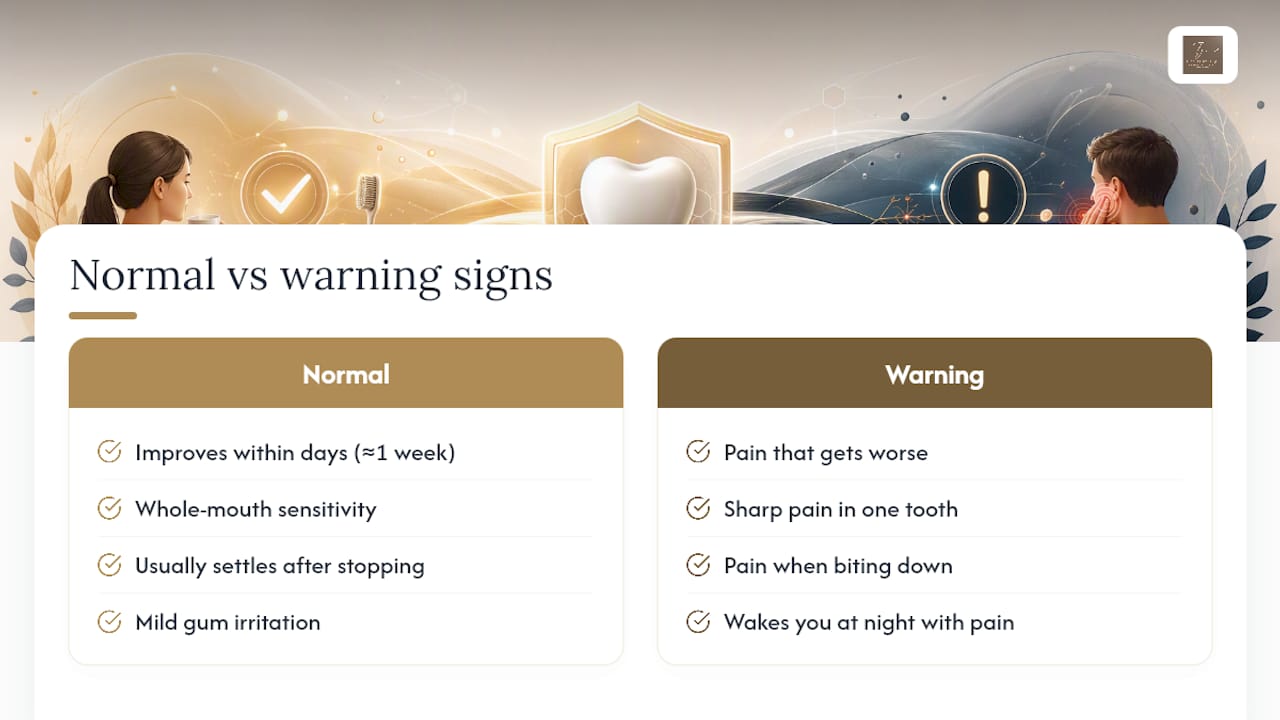
Most people feel the worst of it within a few days, and it usually settles within about a week or so. Leeds Teaching Hospitals describes transient sensitivity and gum irritation as the expected side effects of professionally prescribed whitening, typically resolving within a few days of stopping treatment.
That’s the pattern for normal, whole-mouth sensitivity. It looks different when something else is going on. Watch for pain that gets worse rather than better, sharp pain confined to a single tooth, pain when you bite down, being woken at night by toothache, or swollen or bleeding gums. Sensitivity that sits in one tooth rather than spreading across several is a particular red flag: it often means the whitening has simply exposed a crack or a leaking filling that was already there, and that needs assessment before you carry on with cosmetic treatment.
Reducing pain during and after whitening
You don’t have to just tolerate discomfort until it passes. A few adjustments make a real difference to how much sensitivity you feel and how long it sticks around.
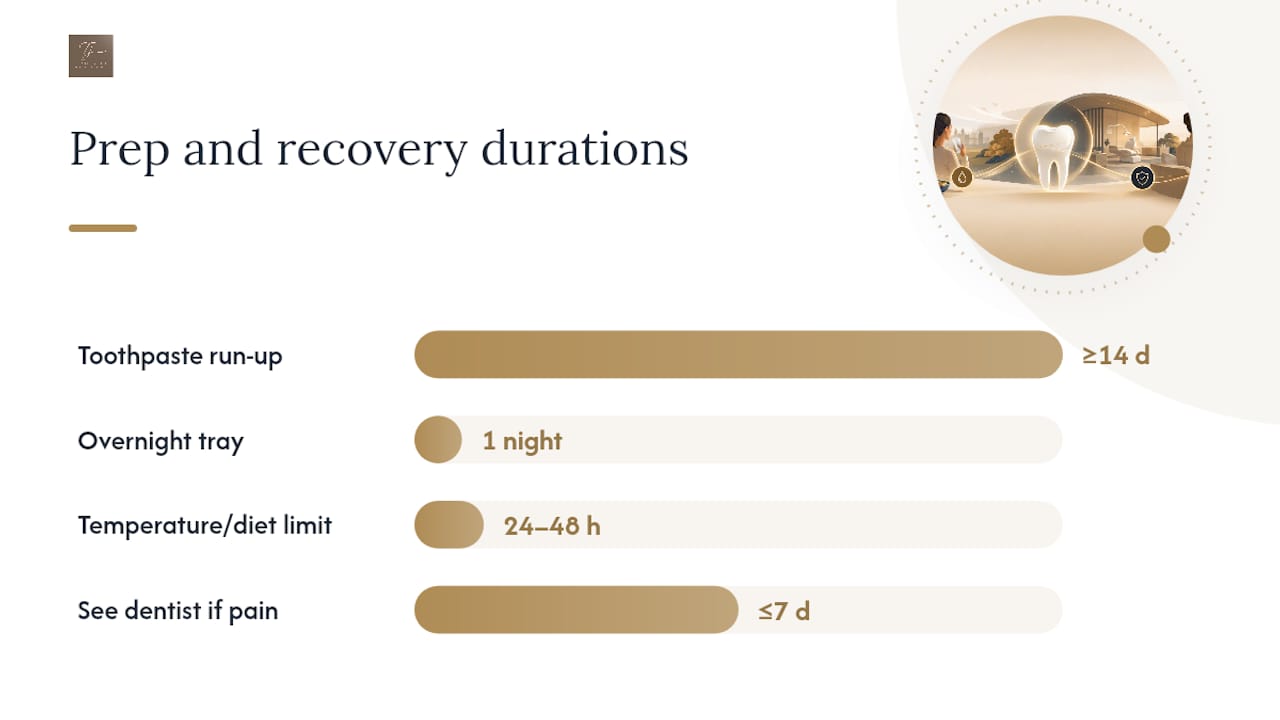
- Start with a desensitising toothpaste. Look for one containing potassium nitrate or stannous fluoride, and use it for at least two weeks before treatment begins, not just once symptoms appear. Guidance on caring for sensitive teeth during whitening backs this run-up period as genuinely useful, not just a marketing line.
- Use your tray strategically on off nights. On nights you’re not whitening, load your custom tray with sensitive toothpaste and wear it overnight. This concentrates the desensitising agent right at the sites the bleaching has opened, which tends to bring quicker relief than brushing alone.
- Cut back your wear time rather than stopping entirely. Alternating nights, or shortening each session, keeps progress moving while giving nerves time to settle. A lower-concentration gel under supervision is another option worth discussing with your dentist.
- Mind your temperature and diet for 24 to 48 hours. Lukewarm drinks, soft brushing, and steering clear of acidic or heavily staining foods reduce the chance of a sharp reaction while the enamel is still more porous than usual.
- Use an over-the-counter analgesic if you need to. Standard pain relief is fine for the odd uncomfortable evening, but it’s a short-term fix, not a substitute for adjusting your whitening routine.
Pro Tip: If a single tooth feels far worse than the rest, stop whitening and get it checked before you resume. Isolated pain almost never means “more sensitive teeth” and almost always means “something specific needs a look.”
Contact your dentist without delay if pain doesn’t ease within a week, if it’s getting worse rather than better, or if you notice swelling. That’s no longer typical whitening sensitivity.
Preparing your teeth before you start whitening
The best time to deal with sensitivity is before you’ve begun, not after your first uncomfortable evening. A proper dental assessment beforehand catches the issues that make sensitivity worse: untreated decay, ageing fillings, gum recession, and enamel wear from grinding or acidic diets. Fixing those first means the whitening gel is working on healthy tissue, not aggravating an existing problem.
Building a two-week routine before treatment starts pays off in comfort later:
- Switch to a sensitive toothpaste and use it morning and night, not just occasionally.
- Add a fluoride mouthwash to strengthen enamel ahead of exposure to peroxide.
- Flag any history of sensitivity, cracked teeth, or gum problems at your consultation, so your dentist can tailor the gel strength and wear schedule to you rather than applying a standard protocol.
Discussing realistic expectations matters too. Supervised whitening under a registered dental professional allows for adjustments mid-course, something an unsupervised kit simply can’t offer. Choosing the right cosmetic dentist for that initial assessment is worth the time it takes, particularly if you know your teeth run sensitive.
What the evidence and the regulator say
Clinical literature is consistent on one point: sensitivity is common but transient when whitening is done properly. The British Dental Journal review found a wide range of patients report increased sensitivity with carbamide or hydrogen peroxide gels, with incidence rising further when heat is added to the process. That’s a strong enough pattern that no reputable dentist would call sensitivity “rare.”
It’s also why UK regulation treats whitening as dentistry, not a cosmetic add-on. The NHS is explicit that whitening uses strong chemicals which should only be used by dental professionals, and recommends contacting a dentist if side effects persist. The General Dental Council goes further, stating that only registered dental professionals may prescribe or first apply products releasing between 0.1% and 6% hydrogen peroxide.
Whitening-induced sensitivity is well documented in peer-reviewed dental literature precisely because it is common, predictable, and manageable when a qualified professional controls the concentration, timing, and aftercare plan around it.
At TJ Smile Studio, that regulatory framework isn’t a formality. It’s the difference between a whitening plan built around your enamel and gum history, and a generic kit that treats every mouth the same way.
A dentist’s view on managing whitening pain
Most sensitivity I see follows the same pattern: it peaks in the first day or two, then fades on its own. What changes the experience isn’t luck, it’s preparation. Patients who mention a sensitivity history at consultation get a gentler protocol from day one, and rarely need to pause treatment at all.
Be upfront about cracked teeth, old fillings, or grinding habits before you start. A tailored plan avoids most of the discomfort other patients assume is unavoidable.
— Dr Tashfeen Jamil BDS, MFDS RCS Ed, AssocFCGDent - GDC 286427
Whiten with a plan, not a guess
Every whitening treatment should be built around a proper assessment first, checking for decay, gum recession, and enamel wear before any gel touches your teeth. That single step is what separates supervised whitening from the online kits and unregulated “whitening parties” that skip it entirely, often leaving people with sensitivity they didn’t need to have.
Patients can benefit from a wear schedule matched to their own sensitivity risk, rather than a one-size-fits-all timer, alongside clear guidance on desensitising toothpaste and tray use for the weeks either side of treatment. If whitening is part of a bigger goal, a digital smile makeover can combine it with other cosmetic work planned around your mouth’s actual condition rather than guesswork. Book a free smile assessment to find out what your teeth need before you commit to any whitening plan.
Sources
- A review of tooth sensitivity and bleaching (British Dental Journal/Nature)
- Tooth whitening information for adult patients — Leeds Teaching Hospitals NHS Trust
- Teeth whitening — NHS
- Put patients’ interests first — GDC FAQ
FAQ
Will sensitivity after whitening go away on its own?
Yes, for most people it fades within a few days of stopping treatment, and rarely lasts beyond a week without a dentist checking for another cause.
How do I fix sensitivity once it’s started?
Switch to a potassium nitrate or stannous fluoride toothpaste, wear it in your tray overnight on non-whitening nights, and avoid very hot, cold, or acidic food until it settles.
Can yellow or heavily stained teeth actually be whitened?
Yes, most staining responds to professional bleaching, though the shade change and speed depend on whether the discolouration sits in the enamel or deeper in the dentine, something a dentist can assess before treatment.
How can I whiten teeth that are already very sensitive?
Start desensitising toothpaste at least two weeks beforehand, ask about a lower-concentration gel under supervision, and use shorter or alternate-night sessions rather than the standard schedule. A registered dental professional can build this into your plan from the outset.
Recommended
- Teeth Whitening in Glasgow
- Same Day Smile in Glasgow
- Digital Smile Makeover in Glasgow
- Pricing & Packages, Glasgow
This article is general information, not personal dental advice. What’s right for your teeth depends on a clinical examination — the condition of your enamel, gums, bite and any existing dental work — and no article can assess that. Outcomes vary between patients, and all treatment at TJ Smile Studio is subject to assessment and clinical suitability.
- Dr Tashfeen Jamil BDS, MFDS RCS Ed, AssocFCGDent, PGDip Restorative and Aesthetic Dentistry — GDC registration 286427
This article is general information, not personal dental advice. What's right for your teeth depends on a clinical examination — the condition of your enamel, gums, bite and any existing dental work — and no article can assess that. Outcomes vary between patients, and all treatment at TJ Smile Studio is subject to assessment and clinical suitability.
Clinically reviewed by Dr Tashfeen Jamil BDS, MFDS RCS Ed, AssocFCGDent, PGDip Restorative and Aesthetic Dentistry — GDC registration 286427, Principal Dentist at TJ Smile Studio, 1 Spiersbridge Way, Thornliebank, Glasgow G46 8NG.
If you have dental pain, swelling or an injury, call the practice on 07728 808510. Out of hours in Scotland, call NHS 24 on 111.