
19 September 2026 · TJ Smile Studio
From £75: Same Day Composite Bonding Repair for UK Patients
Get clinic backed advice on first aid after a chip, how to tell repair from replacement, and same‑day diagnosis. Composite repair assessments from £75.
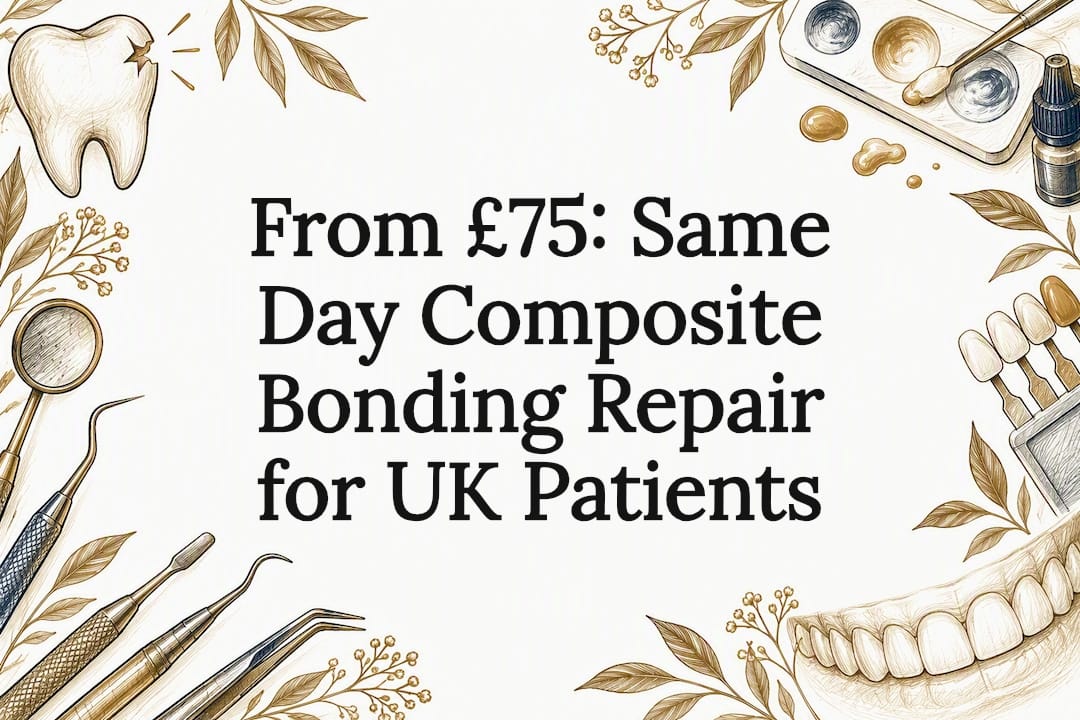
Most small chips and surface problems in composite bonding can be repaired quickly by a dentist. Only extensive adhesive failure, recurrent decay, or repeated breakage tends to need partial or full replacement. If a piece breaks off, keep the fragment, avoid biting on that tooth, and contact your dentist promptly, unless there’s severe pain or bleeding, in which case seek urgent care.
TL;DR:
- Minor surface issues in composite bonding can usually be repaired with a simple addition of composite and polishing, avoiding full replacement.
- Damage caused by everyday wear, biological factors, or trauma requires different repair strategies, with extensive failure often needing complete removal and reapplication.
- Prompt action within the first ten minutes after a chip occurs, such as avoiding biting and keeping the fragment, can simplify the repair process.
- Repeated repairs should be approached cautiously, and underlying causes like bite issues or grinding must be addressed to prevent recurring damage.
- Regular maintenance, including gentle brushing, avoiding staining foods, and using a night guard if needed, extends the longevity of repaired bonding.
Table of Contents
- What is composite bonding and why does it fail?
- What are the signs your bonding needs attention?
- What should you do immediately after a chip or crack?
- What repair options exist for damaged bonding?
- How do you maintain repaired bonding for longer?
- When should you see a dentist, and what does repair cost?
- What can you expect from a specialist cosmetic dentist?
- Clinical perspective: repair versus replacement
- How TJ Smile Studio can help with composite bonding repair
- Sources
- FAQ
What is composite bonding and why does it fail?
Composite bonding uses a tooth-coloured resin, bonded directly to the enamel surface using an adhesive system that creates a microscopic “hybrid layer” where resin tags interlock with the etched tooth structure. Done well, that bond can hold for years. Done under the wrong conditions, or simply worn down by everyday chemistry, it starts to give way.
The interface between tooth and composite isn’t inert. Oral biofilm and salivary esterases attack that adhesive layer over time, breaking it down chemically rather than just physically wearing it away, and this is one of the main drivers of restoration failure and recurrent decay at the margins. Add in water sorption, hydrolysis, and enzymatic activity from matrix metalloproteinases, and you get a slow erosion of the bond itself, which explains why composite restorations show higher failure rates than older materials like amalgam, largely because bacteria find their way in once that margin starts to open.
Mechanical causes sit alongside the biological ones:
- Direct trauma, biting something unexpectedly hard like a fork tine or an olive stone
- Uneven bite forces concentrating stress on one edge of the restoration
- Bruxism, grinding or clenching that repeatedly loads the bonded surface
- Unsupported margins, where too little natural tooth is left backing the composite
Understanding which of these caused the damage matters more than most people assume. A chip from a one-off accident and a chip from years of grinding get treated very differently, even though they can look identical in the mirror.
What are the signs your bonding needs attention?
Not every mark on your bonding means trouble. Some issues are purely cosmetic and can wait for a routine polish; others signal that the adhesive interface has already failed underneath. Learning to tell them apart saves you an unnecessary trip, or worse, a delayed one.
Visual and tactile signs worth noting:
- A visible chip or fracture line, even a small one at the edge
- Rough or dull patches where the surface used to feel smooth
- A gap or step where the composite meets the natural tooth
- A dark line running along the margin, often a sign of staining or leakage underneath
Functional signs tend to show up before you spot anything in the mirror:
- Sudden sensitivity to hot, cold, or sweet foods on that tooth
- Food repeatedly trapping in the same spot
- Floss shredding or catching at one particular point
- A rough edge that catches your lip or tongue when you talk or eat
Red flags that need prompt assessment rather than a “wait and see” approach include persistent pain, any swelling of the gum near the tooth, bleeding that isn’t linked to brushing, or a visible dark cavity forming beneath the bonded margin.
Pro Tip: Run your tongue slowly along the bonded tooth each morning after brushing. You’ll notice a snag or rough patch weeks before it becomes visible, and catching it early usually means a same-day polish rather than a full repair.
What should you do immediately after a chip or crack?
The first ten minutes after damage matter more than most people realise. What you do, and what you avoid doing, affects how straightforward the repair turns out to be.
- Stop using that tooth. Shift chewing to the other side and avoid anything hard, sticky, or crunchy until it’s assessed.
- Rinse gently with warm water to clear any debris and get a clear look at the damage.
- Keep the broken fragment if you can find it, wrapped in damp tissue or a small container. It occasionally helps a dentist confirm exactly what’s failed.
- Check for exposed dentine or a sharp edge. A tooth that suddenly feels rough or is cutting your tongue needs attention sooner rather than later.
- Call your dentist promptly, describing what happened and how the tooth feels now.
- Stick to a soft diet in the meantime, soups, eggs, pasta, anything that doesn’t demand heavy biting force on the affected side.
What not to do matters just as much. Don’t attempt to glue the fragment back on with household adhesive; it’s not biocompatible and will make the professional repair harder. Don’t probe the area with a pin, toothpick, or fingernail trying to smooth it yourself. And don’t ignore it simply because it doesn’t hurt; adhesive failure is often painless until decay sets in underneath.
Seek urgent care rather than a routine appointment if you have exposed dentine that’s causing sharp pain, active bleeding, or swelling. Over-the-counter pain relief following the packet instructions can help in the short term, but it’s a bridge to treatment, not a substitute for it.
What repair options exist for damaged bonding?
Once a dentist has assessed the damage, the treatment usually falls into one of four categories, ranging from a five-minute polish to a full rebuild. Which one applies depends almost entirely on how much sound, well-bonded composite and tooth structure remains.
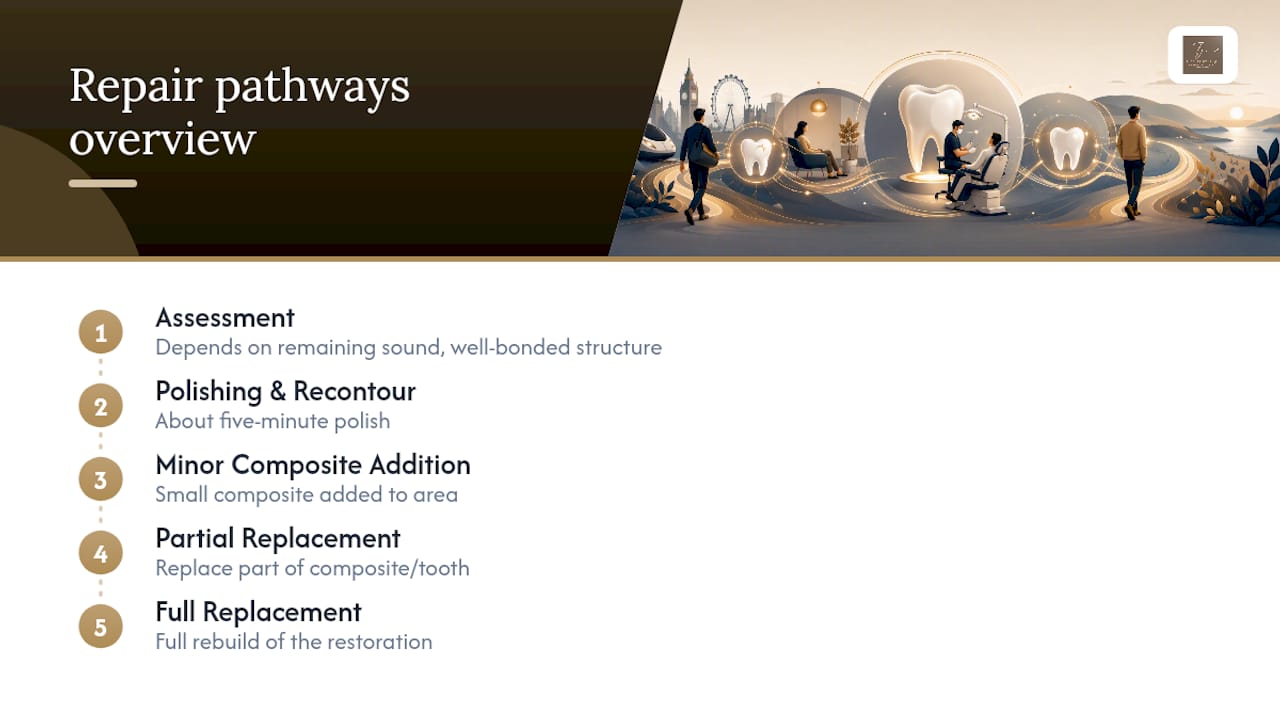
Minor repairs: adding composite back
This is the most common scenario, and the one most people hope for. The dentist roughens the existing composite surface, applies a fresh adhesive layer, and builds new resin directly onto the old restoration in thin layers, shaping and curing each one before adding the next. The final step is contouring to match the natural tooth anatomy, followed by polishing to blend the new material seamlessly with the old.
The workflow typically runs:
- Clinical assessment of the defect and surrounding margin
- Mechanical surface preparation (roughening, sometimes selective etching)
- Adhesive application following the manufacturer’s bonding protocol
- Incremental layering and curing of new composite
- Contouring to restore natural shape and bite contact
- Final polishing for shine and a smooth, plaque-resistant surface
Because the bond of new composite to old composite is generally weaker than composite to natural enamel, this option works best when the damage is localised and the surrounding restoration is otherwise sound.
Polishing and recontouring
Sometimes nothing has actually broken, the surface has just lost its shine or picked up surface staining. A polish with fine abrasive discs and pastes can restore gloss and smooth out minor roughness without adding any new material at all. This is quick, inexpensive, and often done at a routine review appointment.
Partial replacement
When damage extends beyond a small area but some of the original bonding is still well-adhered and free of decay, a dentist may remove just the affected section rather than the whole restoration. This sectional approach preserves sound material while rebuilding the compromised part, striking a balance between conservation and reliability.
Full replacement
Full replacement becomes necessary when there’s recurrent decay beneath the restoration, widespread adhesive failure across the margin, or not enough remaining tooth structure to support a partial rebuild. This means removing the entire old restoration and starting again, which takes longer and costs more, but avoids papering over a failure that will only resurface.
Pro Tip: If you’re being offered “just another polish” for the third time on the same tooth, ask your dentist directly whether the underlying cause, usually bite alignment or grinding, has actually been addressed. Repairing the symptom without treating the cause tends to bring you back sooner each time.
A few factors consistently affect how well any of these repairs hold up afterwards: how much of the original bonded tooth structure remains intact, whether your bite distributes force evenly across the restoration, whether bruxism is present and managed, and how consistent your oral hygiene is at the margins. Diagnosing the actual failure mechanism before choosing a repair rather than automatically defaulting to “add more composite” is what separates a repair that lasts from one that fails again within months. Readers weighing repair against a different long-term approach altogether might also find it useful to compare composite bonding against porcelain veneers for teeth with more extensive wear.
How do you maintain repaired bonding for longer?
A repair is only as good as what you do with it afterwards. The same biological and mechanical forces that caused the original chip are still at work, they just need a slightly different management approach once new material is in place.
Daily care is the foundation:
- Brush with a non-abrasive, low-RDA toothpaste; whitening toothpastes are often too gritty for composite surfaces
- Floss carefully around the margins rather than snapping the floss through, which can chip a fresh edge
- Use an antiseptic mouthwash where your dentist recommends it, particularly if plaque control has been an issue
Managing staining takes a two-speed approach. Immediately after a repair, avoid strongly pigmented foods and drinks, coffee, tea, red wine, curry, for around 24 to 48 hours while the surface fully sets and hardens. Long term, cutting back on those same items and avoiding smoking entirely keeps the composite looking closer to its original shade for years rather than months.
Wear protection matters especially if grinding or clenching played any part in the original damage. A night guard, fitted and reviewed by your dentist, absorbs forces that would otherwise concentrate on the bonded edges. The NHS guidance on teeth grinding notes that occlusal splints are a standard management option, and getting your bite checked afterwards is just as important as the guard itself.
Professional upkeep rounds it off. Routine polishing at review appointments removes superficial staining and refreshes the surface gloss before it becomes a deeper problem, and a periodic check lets your dentist catch a failing margin while it’s still a five-minute fix rather than a full rebuild. Some general hygiene fundamentals, covered in this practical hygiene guide, apply just as much to bonded teeth as to natural ones.
Pro Tip: Ask specifically for a soft-bristled toothbrush review at your next hygiene visit. Many people unknowingly brush too hard at the gumline, which accelerates wear at exactly the margin where bonding is most vulnerable.
When should you see a dentist, and what does repair cost?
Any chip, roughness, or sensitivity is reason enough to book an assessment rather than wait for your next routine check-up. Early diagnosis usually means a smaller, cheaper fix.
A proper assessment covers a clinical examination of the defect and surrounding tooth, radiographs where decay under the margin is suspected, an occlusal check to see whether your bite is contributing to the damage, and an overall diagnosis of what actually caused the failure. Skipping straight to “just add some composite” without that diagnostic step is how repeated repairs happen.
Appointment length varies with the work involved:
- A simple polish or minor chip repair often fits into a short appointment, sometimes the same day it’s noticed
- Partial replacement typically needs a longer single visit for removal and rebuild
- Full replacement can require more time, occasionally split across more than one appointment depending on complexity
Private cost in the UK varies with the number of teeth involved, the complexity of the repair, and whether radiographs or additional diagnostic work are needed. As a general guide, a single-tooth polish or minor repair sits at the lower end of the price range, while multi-tooth or full replacement work costs considerably more. TJ Smile Studio publishes its own composite bonding assessment and repair pricing for anyone wanting exact figures before booking.
As for how many times bonding can be redone: there’s no fixed number, but each repair typically bonds slightly less reliably to the previous layer than the original bond did to natural enamel. Practically, this means two or three sensible repairs over a restoration’s lifetime is common, but if you’re being offered repair after repair on the same tooth without any change in your bite or habits, that’s the point to ask harder questions about replacement.
What can you expect from a specialist cosmetic dentist?
Assessment quality varies enormously between practices, and for composite bonding repair specifically, the person doing the diagnosis matters as much as the material they use. TJ Smile Studio, led by Dr Tashfeen Jamil BDS, MFDS RCS Ed, AssocFCGDent, is registered with the General Dental Council under GDC number 286427, a registration you can verify directly and a useful checkpoint when choosing anyone to repair cosmetic work.
The clinic’s fully digital workflow supports same-day diagnosis and, where clinically appropriate, same-day minor repairs, because the assessment, imaging, and treatment planning happen in one continuous visit rather than being split across multiple bookings. That matters for a chipped tooth: the sooner the failure mechanism is identified, the smaller the fix usually needs to be.
If you’re heading into a composite bonding review or repair assessment, it helps to bring a few things:
- A note of when the original bonding was placed, if known
- Any fragment that’s broken off, kept safe rather than discarded
- A description of when the problem started and what you were doing (or eating) at the time
- Awareness of whether you grind or clench, even if it’s never been formally diagnosed
During consultation, treatment choices should be explained clearly, including why a minor repair is being recommended over replacement, or vice versa, and what the realistic longevity of that choice looks like. Anyone unsure what to look for in that conversation can find useful pointers in this guide to choosing a cosmetic dentist.
Clinical perspective: repair versus replacement
Repair is the conservative option, and conservative is usually right. When the remaining restoration is sound and only a localised area has failed, adding fresh composite preserves far more natural tooth structure than starting again, and it costs less time and money for a comparable result.
Where I’d push back on common practice is the habit of repeating repairs without ever asking why the first one failed. A chip that recurs on the same tooth, in the same spot, within a year or two isn’t bad luck. It’s usually an unaddressed bite problem, undiagnosed grinding, or a margin that’s already leaking and inviting decay underneath. Repairing that repeatedly without treating the cause doesn’t preserve the tooth; it just delays a bigger intervention and often makes it more complex when it finally arrives.
The right approach is to diagnose the failure mechanism properly before deciding whether repair number three is genuinely appropriate, or whether it’s time to look at partial or full replacement instead.
— Dr Tashfeen Jamil BDS, MFDS RCS Ed, AssocFCGDent - GDC 286427
How TJ Smile Studio can help with composite bonding repair
Some clinics offer assessments led by the same dental professional and use digital workflows to enable diagnosis and repair of minor dental issues within a single visit.
The clinic offers a dedicated Composite Repair Assessment at £75, alongside a standalone Composite Bonding Review at £45 for routine checks, and Composite Polish & Maintenance at £95 for refreshing surface shine and removing staining. If a tooth needs fresh material added rather than just a polish, Additional Composite Bonding is priced from £245 per tooth. For anyone starting completely fresh, the Composite Bonding service page outlines the full treatment from £200 per tooth. Full pricing across every service sits on the pricing and packages page, including options for financing larger treatment plans. Book a Composite Repair Assessment to get a clear diagnosis and a same-day plan for fixing your bonding properly.
Sources
- Proteins, pathogens, and failure at the composite-tooth interface — PMC
- NHS — Teeth grinding (bruxism)
- General Dental Council — registration and guidance
FAQ
Can you repair composite bonding?
Yes, most small chips, rough edges, and surface staining can be repaired by adding fresh composite and polishing it to match the surrounding tooth. Extensive adhesive failure or recurrent decay underneath the restoration is the main reason a dentist would recommend replacement instead.
How much does it cost to fix composite bonding?
Cost depends on whether the fix is a simple polish, a minor repair, or a fuller rebuild. TJ Smile Studio’s Composite Repair Assessment is £75, its Composite Polish & Maintenance service is £95, and adding fresh composite to an existing tooth starts from £245 per tooth.
How many times can dental bonding be redone?
There’s no strict limit, but each repair generally bonds a little less reliably than the layer before it, since composite bonds better to natural enamel than to older composite. Two or three sensible repairs over a restoration’s lifetime is typical, provided the underlying cause of the damage, such as an uneven bite, is also being managed.
Can composite bonding fix a chipped tooth?
Yes, composite bonding is one of the most common ways to fix a chipped tooth, whether the chip is in the natural enamel or in existing bonding. A dentist assesses the size and location of the chip and either builds fresh composite directly onto it or, for a larger defect, plans a partial or full rebuild.
Recommended
This article is general information, not personal dental advice. What’s right for your teeth depends on a clinical examination — the condition of your enamel, gums, bite and any existing dental work — and no article can assess that. Outcomes vary between patients, and all treatment at TJ Smile Studio is subject to assessment and clinical suitability.
- Dr Tashfeen Jamil BDS, MFDS RCS Ed, AssocFCGDent, PGDip Restorative and Aesthetic Dentistry — GDC registration 286427
This article is general information, not personal dental advice. What's right for your teeth depends on a clinical examination — the condition of your enamel, gums, bite and any existing dental work — and no article can assess that. Outcomes vary between patients, and all treatment at TJ Smile Studio is subject to assessment and clinical suitability.
Clinically reviewed by Dr Tashfeen Jamil BDS, MFDS RCS Ed, AssocFCGDent, PGDip Restorative and Aesthetic Dentistry — GDC registration 286427, Principal Dentist at TJ Smile Studio, 1 Spiersbridge Way, Thornliebank, Glasgow G46 8NG.
If you have dental pain, swelling or an injury, call the practice on 07728 808510. Out of hours in Scotland, call NHS 24 on 111.