25 September 2026 · TJ Smile Studio
Start at CP10%: UK rules and risks of whitening gel strengths
Evidence led UK guide to whitening gel strengths. Learn legal limits (0.1%–6%), why CP10% can match stronger gels, and dentist supervised safety steps.
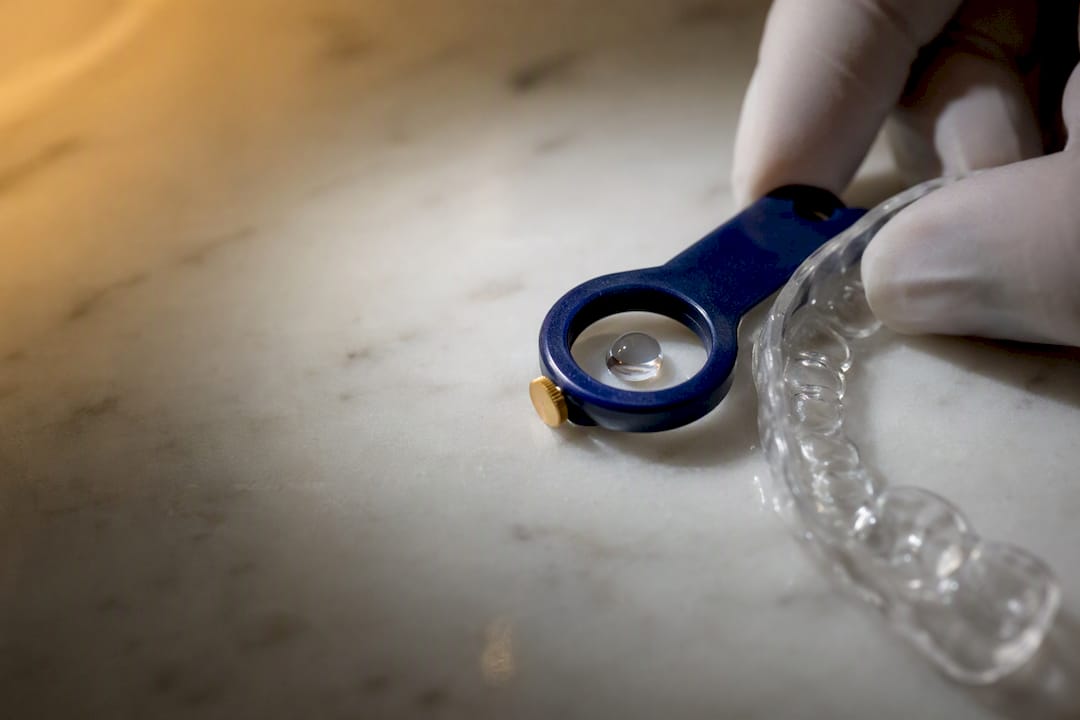
Most whitening gels fall into three practical bands: under 6% hydrogen peroxide (HP) for professionally supplied home use, roughly 10 to 22% carbamide peroxide (CP) for supervised nightly or daily wear, and higher HP formulas reserved for in-office sessions. UK law caps cosmetic hydrogen peroxide at 6%, and anything above 0.1% must be supplied and first used under dental supervision. Get assessed before you buy anything stronger than a shop shelf strip.
TL;DR:
- Carbamide peroxide at 10% often achieves similar whitening results as higher concentrations like 20% or 22%, with significantly less tooth sensitivity.
- In the UK, products containing more than 0.1% hydrogen peroxide can only be supplied or used under dental supervision, with 6% as the legal maximum for cosmetic use.
- Higher concentrations like 16% CP or 14–16% HP deliver faster results but increase discomfort, and their use without professional oversight poses health risks.
- The effectiveness of whitening gels depends more on application method and individual factors than solely on concentration, with tray fit and stain type also critical.
- Starting with the lowest effective concentration and adjusting based on response is the safest, most reliable approach to whitening, especially without dentist supervision.
Table of Contents
- Whitening gel concentration: HP vs CP and what the label actually means
- Common whitening gel strengths and what each is actually used for
- The UK legal position on whitening gel concentration
- What the evidence actually shows about strength and results
- Why sensitivity happens and how it’s actually managed
- How dentists actually choose a strength for you
- Application protocols: what a realistic timeline looks like
- Aftercare and knowing when it’s time for a review
- The clinical perspective behind this guidance
- Why conservative, supervised whitening beats chasing the highest number
- Book a supervised whitening plan at TJ Smile Studio
- Sources
- FAQ
Whitening gel concentration: HP vs CP and what the label actually means
Every whitening gel is built around one of two active ingredients, and mixing them up is the single most common mistake people make when comparing products online.
Hydrogen peroxide (HP) is the direct bleaching agent. It breaks down quickly once applied, releasing oxygen molecules that work through the enamel and dentine to lighten stain compounds. Carbamide peroxide (CP) is a more stable compound that breaks down slowly into hydrogen peroxide and urea, releasing roughly a third of its labelled percentage as active HP. So a 16% CP gel behaves, very roughly, like a 5 to 6% HP gel spread over a longer wear time, while a 10% CP gel sits closer to 3% HP. This is why you’ll see dentists talk about “HP equivalents” rather than treating the two numbers as directly comparable.
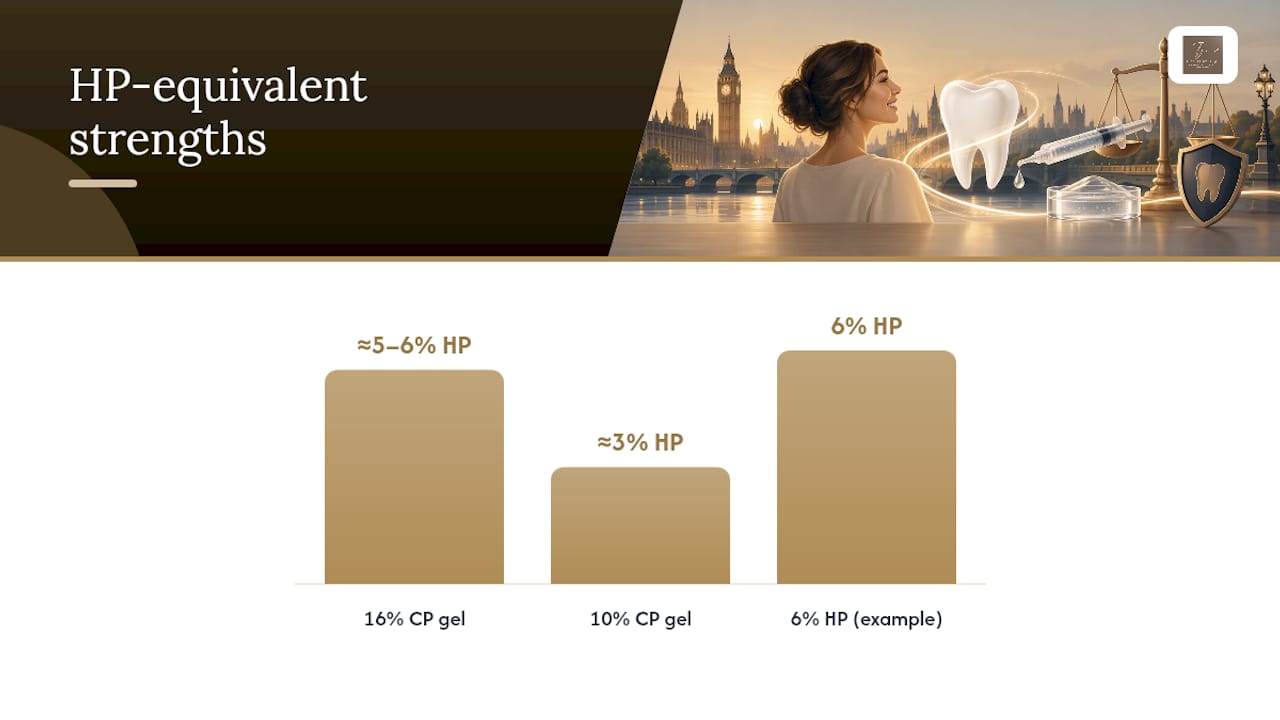
That conversion is a working rule of thumb, not a precise chemical equation, because release rates vary with gel formulation, temperature and application time. Reading a percentage on a box without knowing which compound it refers to tells you almost nothing useful.
When you’re comparing products, watch for:
- The compound named, not just the number. “16%” means very different things depending on whether it’s CP or HP.
- Thickening agents (carbopol or similar). These keep the gel from running off teeth or trays and affect how evenly it spreads.
- pH buffers. Some formulations add these to reduce enamel demineralisation risk during longer wear.
- Potassium nitrate or fluoride additions. Common in gels marketed as “sensitivity-friendly”, these don’t change the whitening strength but change how your teeth feel during treatment.
- “Professional strength” on retail packaging. This phrase carries no legal weight in the UK. It’s marketing language, not a regulatory category.
The PMC review of dental whitening gels notes that in-office products commonly use high-percentage hydrogen peroxide formulations, while at-home products are far more likely to be carbamide peroxide based, precisely because CP’s slow release suits unsupervised or lightly supervised overnight wear.
Common whitening gel strengths and what each is actually used for
Strength doesn’t exist in a vacuum. It’s matched to a delivery method, a wear time, and a level of supervision, and understanding that pairing is more useful than memorising numbers.
- Retail/OTC strips and pens (up to 0.1% HP). These are the only whitening products UK consumers can legally buy and use without dental supervision. Effects are modest and mostly cosmetic, useful for maintaining a shade rather than shifting one.
- Bespoke at-home trays with CP 10–16% (typical range). Supplied by a dentist after a fitting, these are worn overnight or for a few hours daily, usually across one to three weeks depending on the target shade. A King’s College Hospital patient leaflet describes 10% carbamide peroxide as a commonly used bleaching agent for exactly this kind of tray-based home treatment.
- Higher home-use CP, 20–22%. Still legal when dispensed by a dental professional, these shorten daily wear time to compensate for the stronger concentration but come with a noticeably higher sensitivity trade-off, discussed further below.
- In-office HP formulations, applied and monitored by the dentist. These sit at the upper end of what’s legally permitted for cosmetic use and deliver faster visible change within a single appointment, precisely because the clinical setting allows for gum protection, light-curing, and immediate intervention if sensitivity spikes.
The one constant across every legitimate route: nothing above 0.1% hydrogen peroxide can be sold directly to consumers for cosmetic use in the UK, and nothing between 0.1% and 6% can be used at all without a dentist’s first-use supervision.
The UK legal position on whitening gel concentration
Products that contain or release more than 0.1% and up to 6% hydrogen peroxide are permitted for cosmetic tooth whitening only when supplied to, and first used by, a dental professional. Products above 0.1% cannot legally be sold directly to the public.
That’s the operative rule set out in The Cosmetic Products (Safety) (Amendment) Regulations 2012, and it’s worth reading twice because so much online marketing glosses over it.
The numbers, precisely:
- 6% HP is the absolute ceiling for cosmetic tooth whitening in the UK, and it’s only accessible via professional supply.
- 0.1% HP is the retail threshold. Anything sold on a shelf or a website direct to a consumer must sit at or below this.
- First use of anything between 0.1% and 6% must happen under, or be directly supervised by, a registered dental professional, even for products the patient later takes home to continue using.
There’s a reason this line is drawn where it is. Higher concentrations carry a materially higher risk of soft tissue burns, uneven whitening from poor tray fit, and masking of undiagnosed dental problems, which is precisely what direct dental supervision is designed to catch before it becomes harmful. Belfast City Council’s public guidance on tooth whitening warns explicitly that non-dental providers supplying higher-strength products risk both patient harm and unlawful practice. If you’ve seen “salon whitening” advertised at a beauty bar rather than a dental clinic, that’s the regulation being ignored, not a loophole.
What the evidence actually shows about strength and results
Here’s the part that surprises most people: going stronger doesn’t reliably mean whiter teeth, and it reliably means more discomfort.
A network meta-analysis on carbamide peroxide concentrations for at-home bleaching pooled results across multiple randomised trials and found that lower concentrations, particularly CP10%, often achieved whitening outcomes comparable to CP20–22%, while carrying a substantially lower risk of tooth sensitivity. That’s a genuinely counterintuitive finding if you assume percentage and performance move in lockstep. They don’t, at least not linearly.
What the data actually breaks down to:
- CP10% formulations frequently match higher concentrations on final shade change in trial comparisons, while producing meaningfully less reported sensitivity.
- Some higher concentrations such as CP20–22% and HP14–16% can result in a larger overall colour shift in some cases, although the certainty of this effect across studies is low to moderate.
- A separate systematic review and network meta-analysis on at-home bleaching agents and tooth sensitivity confirms the sensitivity gradient runs upward with concentration, though most reported sensitivity across all strengths was mild and temporary rather than severe or lasting.
The honest caveat here is that whitening research is genuinely messy to compare. Trials use different tray designs, different wear schedules, different baseline shades, and different ways of measuring sensitivity (some ask patients to self-report on a scale, others use cold-air stimulus testing). That heterogeneity is exactly why the meta-analyses rate their own certainty as low to moderate rather than high. Treat any single trial’s headline number with caution, and pay more attention to the pattern repeated across multiple studies: moderate concentrations tend to deliver a strong result-to-comfort ratio, and the jump to higher percentages buys you diminishing extra whitening at a rising sensitivity cost.
This is also where intrinsic versus extrinsic staining matters. Surface stains from coffee, tea, red wine or smoking (extrinsic) respond well to almost any concentration, because the bleaching agent only has to reach the outer enamel. Deeper, intrinsic discolouration, from tetracycline exposure, ageing, or trauma to a tooth’s internal structure, sits within the dentine and often needs longer exposure time rather than simply a higher percentage to shift. A dentist assessing your stain type before choosing a strength is doing more than ticking a box.
Why sensitivity happens and how it’s actually managed
Sensitivity isn’t a side effect of “using too much” whitening gel in a loose sense. It has a specific mechanism: peroxide molecules diffuse through enamel and dentine toward the pulp, the nerve-rich centre of the tooth, and can trigger a temporary inflammatory response there. Higher concentrations diffuse faster and more completely, which is the biological reason strength and sensitivity risk track together, though not perfectly, because individual factors like enamel thickness, existing recession, and cracked or worn enamel change how much peroxide actually reaches the pulp regardless of the percentage on the box.
The evidence on managing this is more nuanced than most marketing suggests. A randomised clinical trial testing an experimental desensitiser applied before 35% hydrogen peroxide in-office sessions found it made no measurable difference to sensitivity outcomes in that protocol. Desensitisers aren’t a guaranteed fix, particularly against the higher end of in-office strengths, and any clinic promising otherwise is overselling a genuinely uncertain intervention.
What tends to help in practice:
- Desensitising toothpastes containing potassium nitrate, used for one to two weeks before starting treatment, not just during it.
- Reduced nightly wear time on higher CP concentrations, spreading the same total exposure across more nights rather than fewer.
- Careful gel quantity control in the tray, since overfilling pushes excess gel onto gum tissue and increases irritation without adding whitening benefit.
- Alternating a “rest night” with plain tray-wear or a desensitiser between whitening applications if sensitivity builds.
Pro Tip: If sensitivity appears within the first two or three nights, don’t push through at the same strength hoping it settles. Drop the wear time in half for two nights, then reassess, rather than stopping altogether, most sensitivity from home gels is genuinely transient and manageable.
How dentists actually choose a strength for you
A good dentist isn’t picking a percentage off a chart. They’re running through a short mental checklist that weighs your specific case against what the evidence supports.
- Target shade and current baseline. A modest two to three shade lift needs far less concentration and time than someone chasing maximum brightness from a heavily discoloured baseline.
- Enamel and restoration status. Existing crowns, veneers, or composite bonding won’t whiten, so the plan has to account for shade-matching restorations after natural teeth lighten, not before. This is a point often missed by DIY approaches.
- Sensitivity history. Anyone with a track record of sensitive teeth, exposed root surfaces, or recent dental work usually starts at the lowest effective concentration regardless of how quickly they want results.
- Age and medical history. Whitening isn’t typically recommended for under 18s except in specific clinical circumstances, and certain medical conditions or medications warrant a more conservative approach.
- Treatment structure. In-office sessions suit patients wanting visible change before a single event; bespoke home trays suit gradual, self-paced whitening; combined protocols (in-clinic top-up plus a home maintenance kit) suit patients wanting both speed and longevity.
Genuine contraindications include active gum disease, untreated decay, pregnancy or breastfeeding (as a precaution, given limited safety data rather than known harm), and teeth with cracks or exposed dentine that haven’t been assessed. Any dentist worth seeing will check for these before discussing strength at all, and if you’re also considering composite bonding alongside whitening, the sequencing matters, since bonding is usually colour-matched after whitening is complete, not before.
Application protocols: what a realistic timeline looks like
Wear time and concentration are a trade-off, and the protocols reflect that directly.
- Overnight CP10% trays: typically worn six to eight hours nightly, for one to two weeks, with visible change often noticeable by the end of week one.
- Daily CP16–22% trays: shorter sessions, often 30 to 90 minutes, for a similar one to two week course, chosen when a patient can’t commit to overnight wear or wants a faster daily routine.
- Single in-office session: one to two hours in the chair, often producing a visible shift immediately, sometimes paired with a take-home kit to extend and maintain the result.
- Combined protocol: an in-office session for an initial jump, followed by a shorter home maintenance course, a common structure for patients wanting both speed and a longer-lasting outcome.
Whatever the strength, first use of anything above 0.1% HP must happen under direct dental supervision. At that appointment, the dentist checks tray fit against your actual teeth (not a generic mould), confirms there’s no gum contact when the tray seats, and reviews baseline sensitivity before you take anything home. Tray fit matters more than most patients expect: a poorly sealed edge lets gel leak onto gum tissue, which causes irritation that has nothing to do with the gel’s strength and everything to do with the tray.
Aftercare and knowing when it’s time for a review
Whitening results aren’t permanent, and how long they last depends more on your habits afterwards than on which strength you started with.
Coffee, tea, red wine, smoking and pigmented foods will gradually re-stain teeth over months, typically faster at the front teeth that see the most exposure. Realistic maintenance includes a touch-up course every six to twelve months for regular home-tray users, and rinsing or brushing soon after strongly pigmented food or drink rather than letting stains set in. This external guide to maintaining whitening results covers some sensible day-to-day habits worth building into a routine.
Return to your dentist if:
- Sensitivity persists beyond a few days after stopping treatment rather than settling.
- You notice uneven whitening, particularly patchy areas near the gumline.
- A tray feels loose or no longer seats properly, since fit changes over time.
- You’re considering a stronger concentration than originally supplised, which always needs a fresh professional check first.
A dedicated Whitening Review appointment exists precisely for this kind of check-in, rather than guessing whether it’s safe to simply restart a course at home.
The clinical perspective behind this guidance
Dr Tashfeen Jamil BDS, MFDS RCS Ed, AssocFCGDent — GDC 286427 leads treatment planning at TJ Smile Studio, where whitening strength and protocol are set individually rather than applied as a default package. That means reviewing enamel condition, restoration status, and sensitivity history before any gel percentage is discussed, and adjusting wear time or concentration mid-course if a patient’s response calls for it.
[Patient testimonials illustrating this personalised approach to be added]
[Before-and-after case examples demonstrating different strength protocols to be added]
Why conservative, supervised whitening beats chasing the highest number
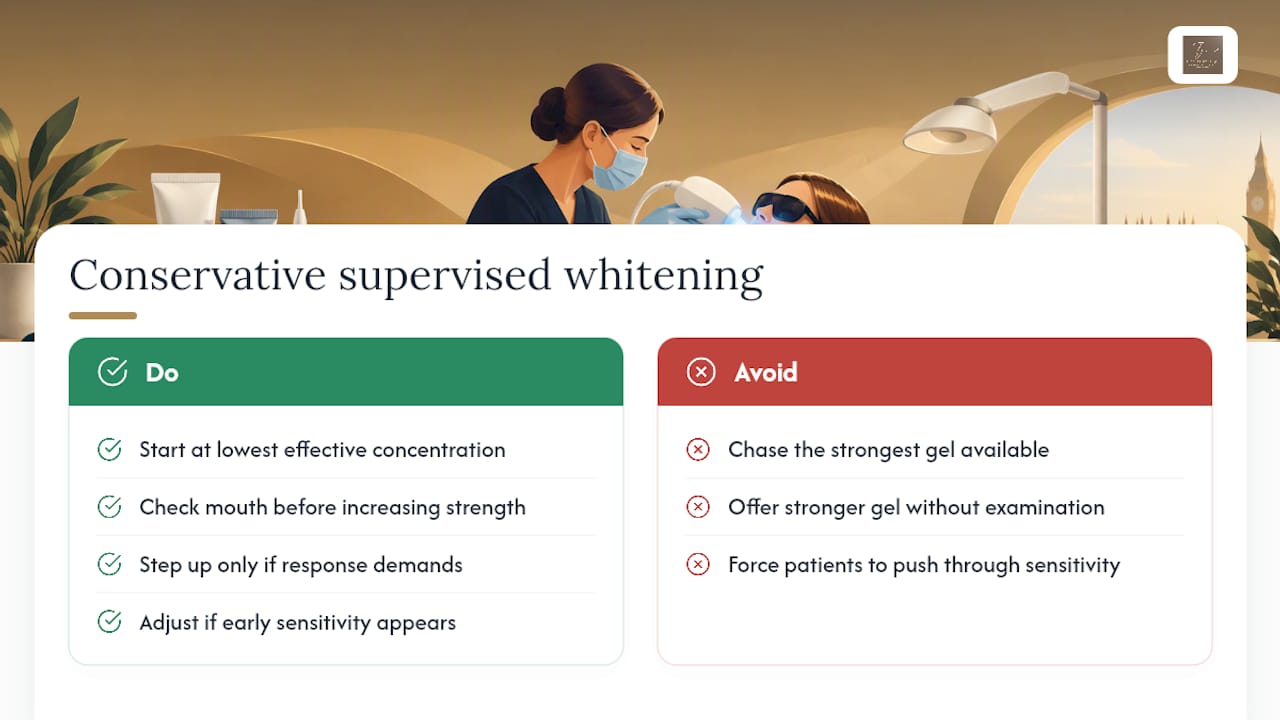
The evidence doesn’t reward reaching for the strongest gel available. Repeatedly, trials show moderate concentrations delivering results close to their stronger counterparts while sparing patients unnecessary sensitivity, and the UK’s legal framework exists precisely because unsupervised use of anything above a very low threshold carries real risk of harm.
My practical stance: start at the lowest concentration likely to hit your target shade, and only step up if the response genuinely calls for it. Sensitivity that shows up early is a signal to adjust, not a hurdle to push through. Anyone offering you a stronger gel without first checking your mouth is skipping the part of the process that actually protects you.
— Dr Tashfeen Jamil BDS, MFDS RCS Ed, AssocFCGDent - GDC 286427
Book a supervised whitening plan at TJ Smile Studio
TJ Smile Studio is the alternative to guessing your way through gel percentages online: every whitening plan here starts with Dr Tashfeen Jamil personally assessing your enamel, staining pattern and sensitivity history before any strength is recommended, with continuity from that first consultation through to your final result.
The clinic offers Bespoke Home Teeth Whitening at £299, Professional In-Office Teeth Whitening at £399, and a combined Professional In-Office + Home Teeth Whitening package at £499 for patients who want a fast initial result backed by a maintenance kit. A whitening consultation generally reviews your current shade, checks for restorations that won’t respond to bleaching, and confirms tray fit before treatment, providing supervision in line with UK regulations for higher-strength products.
Full pricing across all treatments, including Composite Bonding and Veneers if you’re planning whitening alongside restorative work, is listed on the TJ Smile Studio pricing page. Book a Smile Consultation to get your strength and protocol assessed properly, rather than working it out from a product label alone.
Sources
- The Cosmetic Products (Safety) (Amendment) Regulations 2012 (UK statutory instrument)
- What is the optimal concentration of carbamide peroxide for at‑home bleaching? A systematic review and network meta‑analysis
This article is general information, not a substitute for advice from a qualified doctor. Consult a qualified healthcare professional about your own circumstances before acting on anything here.
FAQ
Is 6% whitening gel stronger than 16%?
Only if both are measured in the same compound.
What is the best strength of teeth whitening gel?
There’s no single best strength; it depends on your stain type, sensitivity history, and how quickly you want results. Evidence from a network meta-analysis on carbamide peroxide concentrations suggests CP10% often matches higher concentrations on final whitening outcome while causing significantly less sensitivity, which is why many dentists recommend starting there.
Is 35% teeth whitening gel too strong?
A trial testing this exact strength in-office found that even a dedicated desensitiser didn’t prevent sensitivity, underlining why it’s never appropriate for unsupervised or at-home use.
Is 10% or 16% carbamide peroxide stronger?
But strength doesn’t automatically mean a better outcome: trial data shows the two often deliver comparable final shade results, with 10% carrying a lower risk of sensitivity, which is why it’s frequently the preferred starting point.
Recommended
This article is general information, not personal dental advice. What’s right for your teeth depends on a clinical examination — the condition of your enamel, gums, bite and any existing dental work — and no article can assess that. Outcomes vary between patients, and all treatment at TJ Smile Studio is subject to assessment and clinical suitability.
- Dr Tashfeen Jamil BDS, MFDS RCS Ed, AssocFCGDent, PGDip Restorative and Aesthetic Dentistry — GDC registration 286427
This article is general information, not personal dental advice. What's right for your teeth depends on a clinical examination — the condition of your enamel, gums, bite and any existing dental work — and no article can assess that. Outcomes vary between patients, and all treatment at TJ Smile Studio is subject to assessment and clinical suitability.
Clinically reviewed by Dr Tashfeen Jamil BDS, MFDS RCS Ed, AssocFCGDent, PGDip Restorative and Aesthetic Dentistry — GDC registration 286427, Principal Dentist at TJ Smile Studio, 1 Spiersbridge Way, Thornliebank, Glasgow G46 8NG.
If you have dental pain, swelling or an injury, call the practice on 07728 808510. Out of hours in Scotland, call NHS 24 on 111.