25 October 2026 · TJ Smile Studio
Golden Ratio Smile: What It Means and Where It Falls Short
Does the golden ratio make a perfect smile? See how dentists use 1.618, why natural teeth rarely follow it, and what we do instead in Glasgow.
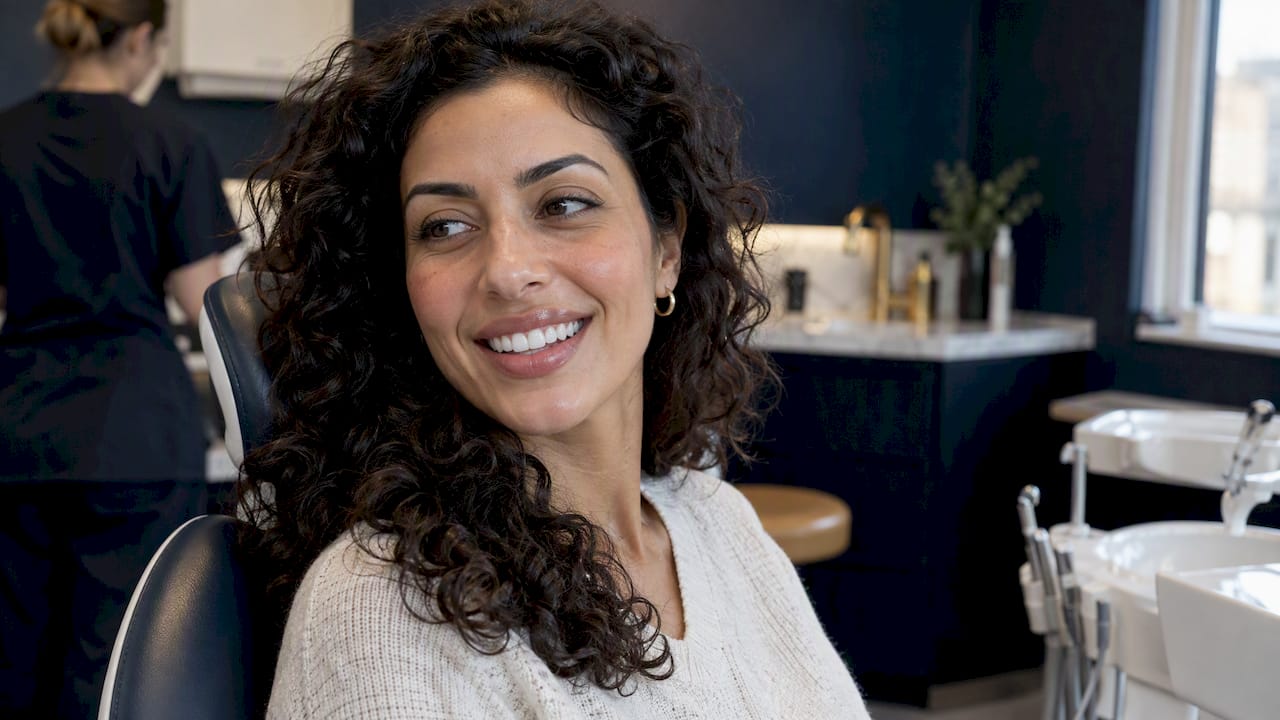
A golden ratio smile is one where the front teeth, seen from the front, step down in width by a factor of about 1.618, so each tooth looks roughly 62% as wide as the one in front of it. It is a useful way to talk about proportion, but it is not a rule that natural teeth follow, and it is not a promise of a better result. Here is how dentists use it, what the research says, and how we plan smiles at TJ Smile Studio in Glasgow.
TL;DR
- The golden ratio (1.618) is a design guide for how wide your upper front teeth appear from the front, not a pass mark.
- A systematic review in The Journal of Prosthetic Dentistry found no standardised, universal use of the golden proportion in natural teeth.
- Applied blindly, the formula can make side teeth look too narrow. Dentists use alternatives and adjust to your face.
- In the UK, claims of a “perfect” or “golden” smile must be backed by a clinical assessment, so be wary of any clinic that promises one.
- The best plan starts from your face, lips and existing teeth, previewed before anything is changed.
Table of Contents
- What the golden ratio means for teeth
- Do natural smiles follow the golden proportion?
- Why a strict formula can go wrong
- The alternatives dentists use alongside it
- Your face matters more than the formula
- Our perspective: proportion as a starting point
- How a proportion-led smile is planned
- Which treatments can change tooth proportions
- What it costs at TJ Smile Studio
- Planning a smile with us
- Be careful with “perfect smile” promises
- FAQ
- Sources
What the golden ratio means for teeth
The golden ratio is the number 1.618, often called phi. Two lengths are in golden proportion when the larger divided by the smaller gives 1.618. Flip the sum around and the smaller is 0.618 of the larger.
In dentistry the idea is applied to the upper front teeth as you see them in a front-on photograph. The central incisors (the two big front teeth) are the starting point. The lateral incisors next to them should look about 62% as wide as the centrals, and the canines next to those about 62% as wide as the laterals. The theory is that this stepped narrowing gives the eye a pleasing, balanced rhythm.
Two details matter here:
- It is about apparent width. Teeth curve around the arch, so the width you see from the front is shorter than the true width of the tooth. Measurements taken from the front view are what count.
- It is one measurement. It says nothing about tooth length, colour, gum levels, lip line or how much you show when you laugh, which together decide whether a smile looks good on you.
Do natural smiles follow the golden proportion?
Mostly, no. That is the finding that surprises people who have seen the ratio presented as a law of beauty.
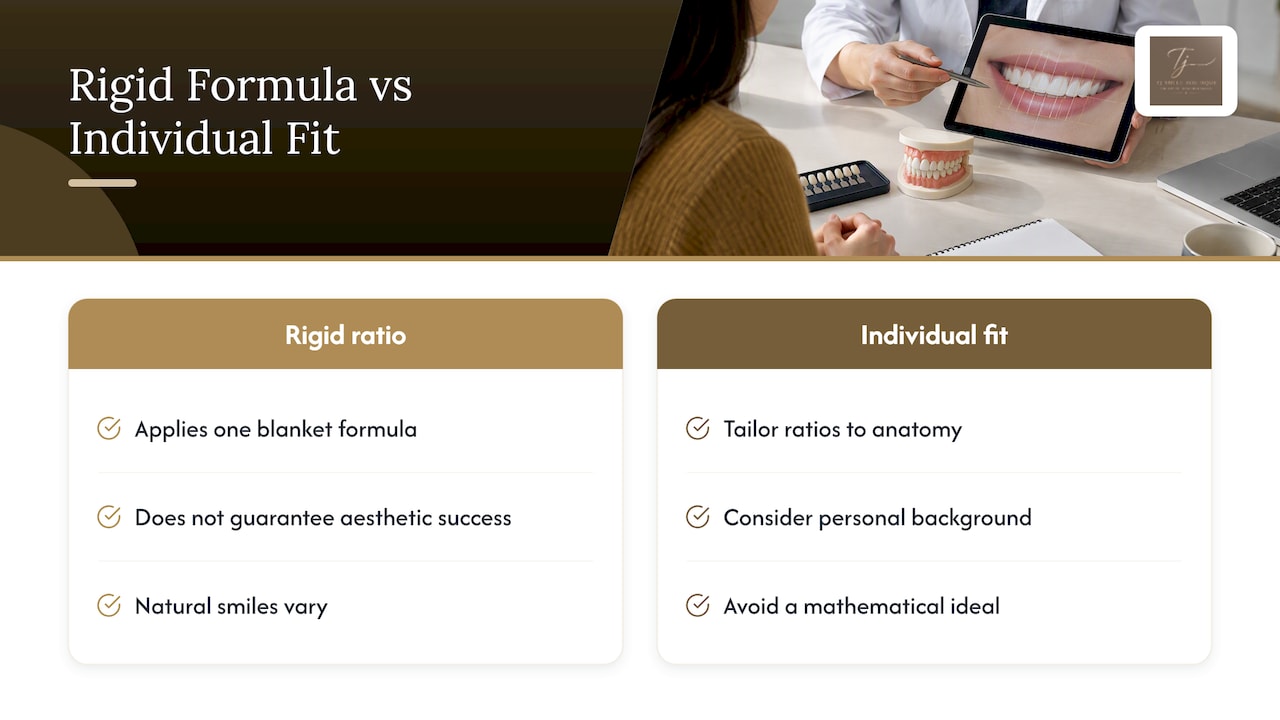
The Journal of Prosthetic Dentistry systematic review and meta-analysis looked at how often the golden proportion appears in natural dentition. Its conclusion, in plain terms: there is no standardised, universal application, and using it as a rigid guide for cosmetic work does not guarantee aesthetic success. The authors point towards tailoring ratios to each patient’s own anatomy and background rather than applying one blanket formula.
A later meta-analysis covering individuals from different countries examined the golden proportion, the golden percentage and the RED proportion across populations, which tells you the question is still being tested rather than settled.
So if you measure the front teeth of friends whose smiles you admire, do not expect 1.618 to appear. Attractive smiles are varied, and many of the best ones sit comfortably away from the formula.
Why a strict formula can go wrong
The common failure is the narrow lateral incisor. If the central incisors are a certain width and the laterals are forced to 62% of that, the laterals can end up looking small and the canines can almost disappear from the front view.
Here is a simple worked example, and it is arithmetic, not a patient case. Say your central incisors appear 8.0 mm wide from the front:
| Tooth (from the front) | Golden proportion width | Comment |
|---|---|---|
| Central incisor | 8.0 mm | Starting point |
| Lateral incisor | about 4.9 mm | 62% of the central |
| Canine | about 3.0 mm | 62% of the lateral |
A canine that shows only 3 mm from the front would be unusually slim for most people, which is exactly why the narrative review of maxillary anterior teeth dimensions discusses other proportion systems alongside the golden one. Applied without thought, the formula produces the kind of smile that looks designed rather than natural.
The alternatives dentists use alongside it
The golden proportion is one of several tools. A systematic review of mathematical tooth proportions compares three of the best known:
| Framework | Idea | Practical effect |
|---|---|---|
| Golden proportion | Each tooth appears about 62% as wide as its neighbour | Strong step-down; can make laterals look narrow |
| Golden percentage | Fixed share of the total width of the six front teeth for each tooth | Gentler than the strict ratio |
| RED proportion | Recurring Esthetic Dental proportion: the same ratio repeats from tooth to tooth, but dentist chooses the value | More flexible; suits different face shapes |
None of them replaces judgement. They give the dentist and you a shared vocabulary for proportions so you can discuss, for example, whether the lateral incisors should be a touch wider. As one source puts it, the main value of the ratio is helping clinicians visualise and communicate proportion improvements while keeping a natural, individual look.
Your face matters more than the formula
Teeth sit inside a face. The width of your smile, the shape of your lips, the position of your gum line and the shape of your face all change which tooth proportions look right.
Research discussed in aesthetics commentary suggests that symmetry, averageness of features and skin quality often correlate more strongly with perceived attractiveness than matching phi. A famous face that scores well against the golden ratio in a media ranking tells you little about what suits your own mouth. Treat those lists, and the most-beautiful-people stories built on golden ratio mapping, as entertainment rather than a design brief.
If you enjoy the numbers, a measured facial analysis report can show how your overall facial proportions look from a photo, which is a helpful way to think about balance before a consultation. The things a dentist needs to see in person, such as how your upper lip moves, how much tooth shows at rest and how your bite works, a photo cannot tell you.
Our perspective: proportion as a starting point
We use proportion rules at the planning stage, never as the finish line. When someone comes in asking for “golden ratio teeth”, what they usually want is teeth that look balanced, even and natural for their face. The ratio is one way to get a conversation going about that.
Our approach rests on three things:
- Every treatment is led personally by me. The person who plans your smile is the person who delivers it, so what we agree in the consultation is what you get in the chair.
- We work digitally. A fully digital workflow lets us design proportions on screen, adjust widths and lengths, and show you the result before anything is changed. You can ask for wider laterals or longer centrals and see the effect straight away.
- We would rather adjust the formula than your face. If your canines look better a little wider than the maths says, we go with what looks right on you.
For small or narrow teeth, proportion is often the whole issue, and our guides on veneers for small teeth and peg lateral veneers show how we approach it. If you want to understand how designs are previewed, our digital smile design questions page covers what to ask any clinic.
— Dr Tashfeen Jamil BDS, MFDS RCS Ed, AssocFCGDent - GDC 286427
How a proportion-led smile is planned
Whether the final treatment is bonding, veneers or aligners, the planning follows a similar path. Our step by step smile makeover process goes into more depth; in outline:
- Consultation. We look at your teeth, gums, bite and the way you smile and speak. We talk about what you like and dislike in photos of yourself.
- Digital scans and photographs. These give us the real front-view widths and lengths to work from, not guesses.
- Proportion design. We test the golden proportion, golden percentage and RED approaches against your face, and choose what looks natural, which is often a blend.
- Preview. You see the design on screen or as a mock-up. Changes are cheap at this stage.
- Treatment. Only once you are happy do we move to treatment. Many of our patients can complete theirs in a single visit thanks to the digital workflow.
The mock-up step is also how we keep enamel preparation to a minimum where veneers are involved; read about how mock-ups cut enamel shaving.
Which treatments can change tooth proportions
Different options reshape different things, and the right one depends on what is actually off in your proportions.
- Composite bonding adds tooth-coloured material to widen, lengthen or reshape teeth, usually without drilling. It is well suited to small adjustments such as widening a lateral incisor. See our composite bonding page.
- Invisalign moves teeth so spacing and crowding no longer distort how wide the teeth appear. Our Invisalign page explains the process, and cosmetic dentistry vs orthodontics helps you choose between moving teeth and reshaping them.
- Whitening changes colour, not proportion, but colour affects how big teeth look. See teeth whitening vs veneers.
Often the best result combines two of these, for example aligners to create space followed by bonding to refine the shape.
What it costs at TJ Smile Studio
Our published prices are below. Final cost depends on how many teeth are involved and what your plan needs, which we confirm at your consultation.
| Treatment | Price |
|---|---|
| Smile Consultation | £50 |
| Invisalign Consultation | £50 |
| Composite Bonding | from £200 per tooth |
| Veneers | from £399 per tooth |
| Same-Day Hybrid Veneers | from £2,995 |
| Invisalign | from £1,800 |
| Additional 3D Hybrid Veneer | £350 per tooth |
| Additional Edge Bonding | £199 per tooth |
The full list, including whitening and review appointments, is on our pricing page.
Planning a smile with us
If you would like to see how your own proportions compare, and what could realistically be improved, book a Smile Consultation at £50. We will look at your smile from the front and in motion, talk through the proportion options above, and show you a digital preview where it is suitable. If a single-visit transformation is what you are after, read about Same-Day Hybrid Veneers or our digital smile makeover service. We offer flexible appointments, including evenings and weekends.
Be careful with “perfect smile” promises
If a clinic advertises a “golden ratio” or “perfect” smile, read it as marketing. The General Dental Council’s guidance on advertising says information must be accurate and not misleading, and the same guidance covers promotional material such as before and after images. In practice that means claims need clinical backing and a result cannot be promised before you have been assessed.
The Faculty of Dental Surgery at the Royal College of Surgeons of England has also written about cosmetic demand, noting that aesthetic trends change and that long-term oral health and realistic expectations should come before chasing a mathematical ideal.
Practical checks when you compare clinics:
- Is the dentist named, with a GDC number you can look up?
- Do before and after photos come with a note that results vary?
- Will you see a preview of the design before treatment?
- Does the clinic explain what might not suit you, not just the benefits?
Our guides on how to choose a cosmetic dentist and reading before and after photos go through this in more detail.
FAQ
What is the golden proportion in dentistry?
It is a guideline that the upper front teeth, viewed from the front, should each look about 62% as wide as the tooth beside them, working outwards from the centrals. It is used as a design aid for discussing balance. Research shows it is not a rule natural teeth follow.
Why is 1.618 considered golden?
It is the number you get when a whole is divided so the larger part relates to the smaller as the whole relates to the larger. It turns up in geometry and has long been linked to aesthetics, which is why designers and dentists borrow it. Its popularity is cultural and mathematical, not proof that it is the most attractive proportion.
Do I need golden ratio teeth to have a good smile?
No. The systematic review of natural dentition found no universal pattern, and many attractive smiles sit outside the formula. What matters is that your teeth look balanced with your face, lips and gums.
Can bonding or veneers give me golden ratio proportions?
Both can change tooth width and shape, so they can move your teeth closer to any proportion we agree on. Whether that is a good idea depends on your face and your existing teeth. We design on screen first so you can judge it before treatment.
How much does a smile consultation cost in Glasgow?
Our Smile Consultation is £50, and the Invisalign Consultation is also £50. Treatment prices depend on your plan, and published starting prices are on our pricing page.
Sources
- Evaluation of the golden proportion in the natural dentition: systematic review and meta-analysis, The Journal of Prosthetic Dentistry
- Evaluation of golden ratio parameters in individuals from different countries, The Journal of Prosthetic Dentistry
- Mathematical Tooth Proportions: A Systematic Review
- Maxillary Anterior Teeth Dimensions and Relative Width Proportions: A Narrative Literature Review
- The Face Report: Golden Ratio tool
- The Indian Express: golden ratio ranking of beautiful people
- General Dental Council: Guidance on advertising
- Royal College of Surgeons of England, Faculty of Dental Surgery Journal
Recommended
This article is general information, not personal dental advice. What’s right for your teeth depends on a clinical examination — the condition of your enamel, gums, bite and any existing dental work — and no article can assess that. Outcomes vary between patients, and all treatment at TJ Smile Studio is subject to assessment and clinical suitability.
- Dr Tashfeen Jamil BDS, MFDS RCS Ed, AssocFCGDent, PGDip Restorative and Aesthetic Dentistry — GDC registration 286427
This article is general information, not personal dental advice. What's right for your teeth depends on a clinical examination — the condition of your enamel, gums, bite and any existing dental work — and no article can assess that. Outcomes vary between patients, and all treatment at TJ Smile Studio is subject to assessment and clinical suitability.
Clinically reviewed by Dr Tashfeen Jamil BDS, MFDS RCS Ed, AssocFCGDent, PGDip Restorative and Aesthetic Dentistry — GDC registration 286427, Principal Dentist at TJ Smile Studio, 1 Spiersbridge Way, Thornliebank, Glasgow G46 8NG.
If you have dental pain, swelling or an injury, call the practice on 07728 808510. Out of hours in Scotland, call NHS 24 on 111.