11 September 2026 · TJ Smile Studio
0.3–0.7mm: How Mockups Cut Enamel Shaving for Veneers in Glasgow
Most porcelain veneers remove about 0.3–0.7mm of enamel. A clinician led, evidence based guide explains mockup planning, depth controlled reduction, and...
Yes, most porcelain veneers require some enamel to be removed, but the amount is usually small. Conservative preparation typically takes off between 0.3mm and 0.7mm of enamel, roughly the thickness of a fingernail, and modern minimal-prep techniques can sometimes go lower. Composite bonding and certain no-prep veneers avoid reduction almost entirely, so the honest answer depends on your teeth, your goals, and which type of veneer your dentist recommends.
TL;DR:
- Most porcelain veneers require removing between 0.3mm and 0.7mm of enamel, depending on the desired cosmetic outcome and shade change needed.
- Proper planning with digital mock-ups and depth-guided reduction techniques can significantly minimize unnecessary enamel removal.
- Preparing the tooth for veneers enhances fit, appearance, and color masking, but excessive reduction exposes dentine, risking longer-term failure.
- Conservative approaches, such as no-prep veneers and composite bonding, are suitable only for specific cases with well-aligned, smaller, or less discolored teeth.
- Long-term success depends on careful preparation, with enamel not regrown, making initial planning and minimally invasive methods crucial for durability and tooth health.
Table of Contents
- What “shaving teeth for veneers” actually means
- Why dentists prepare teeth for veneers in the first place
- Which type of veneer needs the most preparation?
- What actually happens at each stage of treatment
- What happens long-term after enamel is removed
- When to consider orthodontics or bonding instead
- What clinical evidence says about protecting enamel
- Clinic perspective: why we lean conservative
- Booking a consultation at TJ Smile Studio
- Sources
- FAQ
What “shaving teeth for veneers” actually means
“Shaving” is the everyday term for what dentists call enamel reduction or tooth preparation. It means removing a thin layer of the tooth’s outer surface so a veneer has room to sit flush against the tooth rather than bulging outward. This is not the same as the deeper cutting involved in preparing a tooth for a crown, which removes enamel from every surface to create a full-coverage cap. Veneer preparation is usually limited to the front and sometimes the biting edge of the tooth.
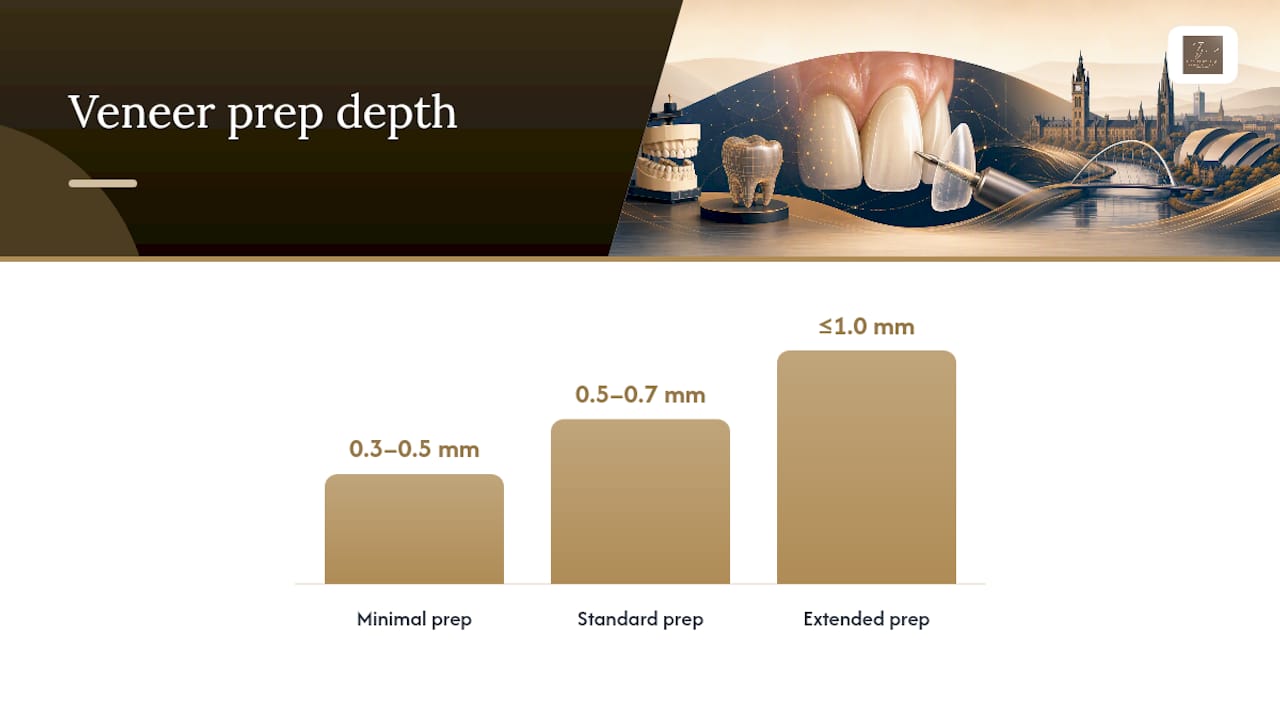
How much comes off depends on what the tooth needs to achieve cosmetically. A tooth that only needs a subtle contour change or a shade or two lighter might need very little reduction. A tooth with heavy staining, a rotated position, or a chip that needs rebuilding will usually need more room for the ceramic to do its job.
Typical ranges clinicians work within:
- Minimal preparation: around 0.3mm to 0.5mm, common for small shade or shape corrections
- Standard preparation: around 0.5mm to 0.7mm, the most frequently used range for classic porcelain veneers
- Extended preparation: up to around 1mm, needed when the incisal edge (biting edge) needs coverage or when masking a heavily discoloured tooth
Shade change is one of the biggest drivers of thickness. Guidance from porcelain veneer preparation literature suggests around 0.2mm to 0.3mm of porcelain is needed for each shade change you want to achieve, so a dramatic whitening effect on a dark tooth demands more material, and therefore more space, than a one-shade lift. Tooth position matters too. A tooth sitting slightly further forward in the arch may need more reduction simply to bring it back in line with its neighbours, while a tooth already well-positioned might need barely any adjustment at all.
Why dentists prepare teeth for veneers in the first place
Preparation is not done for its own sake. It solves specific problems that show up the moment porcelain meets tooth.
The first is fit. Without space, a veneer sits on top of the existing tooth surface rather than integrated with it, creating what dentists call a bulky emergence profile, a tooth that looks fuller and less natural than the ones around it, and one that traps plaque along the gumline more easily. Even a small overhang can leave the gum irritated within months.
The second is colour masking. Porcelain has a translucent quality, which is what makes it look convincing, but that same translucency means thin veneers let the underlying tooth colour show through. A tooth with significant discolouration or old, dark fillings behind it needs thicker porcelain to properly hide that colour, and thicker porcelain needs more room.
Reasons a dentist may recommend more than minimal reduction:
- The tooth is noticeably out of alignment and needs reshaping to sit flush with its neighbours
- The biting edge needs coverage to correct wear, chips, or length
- Heavy staining or a dark core (often from old root canal treatment) needs masking
- The existing tooth shape is unusually bulky and needs reducing before a veneer can look proportionate
The trade-off runs the other way too. Preparation that goes too deep exposes dentine, the softer layer beneath enamel, and that changes the entire long-term picture for the restoration, which is exactly why depth control matters so much at the planning stage rather than being left to guesswork mid-appointment.
Which type of veneer needs the most preparation?
Not every veneer demands the same commitment from your natural teeth. The four main categories sit on a sliding scale from most invasive to essentially non-invasive.
-
Traditional porcelain veneers. These need the most reduction, typically 0.5mm to 0.7mm, sometimes more for incisal coverage. They suit patients wanting a significant, durable change in shape or colour, and they remain the standard choice for correcting heavier discolouration or more pronounced misalignment. Expect this option when a tooth needs real reshaping rather than a subtle refresh.
-
No-prep or “prepless” veneers. These involve little to no enamel removal at all, but the indications are narrow. They work best on smaller, slightly recessed, or thinner teeth where the extra thickness of an unreduced veneer won’t look overbuilt. Patients with already-prominent teeth are usually poor candidates, since adding porcelain without removing tooth structure first can leave teeth looking oversized.
-
Composite bonding. Technically not a veneer in the ceramic sense, but relevant here because it usually needs no reduction whatsoever. The resin is built up directly onto the tooth surface. It’s more affordable, fully reversible in the sense that it can be removed without permanent tooth alteration, and easy to repair chip by chip. The trade-off is longevity: composite typically wears and stains faster than porcelain and needs more frequent maintenance.
What actually happens at each stage of treatment
The preparation appointment is only one step in a longer sequence, and the steps before it matter more than most people expect.
-
Consultation and records. Photographs, X-rays, and impressions or a digital scan establish the starting point. This is also where your dentist talks through what’s realistically achievable given your bite, gum health, and the condition of the teeth involved.
-
Diagnostic wax-up or digital mock-up. Rather than shaving first and hoping the final shape works, conservative practice builds the intended result first, either as a physical wax model or a digital design, then works backwards to figure out the minimum reduction needed to achieve it. Planning reduction from the wax-up rather than the original tooth is one of the clearest ways to avoid taking off more enamel than necessary, a principle supported by depth-controlled preparation techniques used in modern veneer planning.
-
Depth-controlled reduction. This is where the mock-up earns its keep. Dentists often prepare through a putty or bis-acryl copy of the mock-up, or use depth-limiting burs cut to a specific millimetre depth, so the handpiece physically cannot remove more than planned. Freehand shaving without these guides is where over-preparation tends to happen.
-
Impressions or digital scan. Once the teeth are shaped, a precise impression or intraoral scan is taken and sent to the lab for the final veneers to be fabricated.
-
Provisional veneers. Temporary veneers protect the prepared teeth, maintain aesthetics, and let you trial the shape and length before committing to the final version.
-
Try-in and bonding. The final veneers are checked for fit and shade, the tooth surface is cleaned and isolated, and the veneer is bonded using a light-cured resin cement.
Pro Tip: Ask specifically whether your treatment plan uses a mock-up-guided reduction or freehand preparation. It’s a fair question, and a dentist confident in a conservative approach will usually explain exactly how they’re controlling depth before touching a bur to your tooth.
Immediately after bonding, mild sensitivity to cold or pressure is common and usually settles within a few days as the tooth adjusts.
What happens long-term after enamel is removed
Enamel does not grow back. Whatever is removed at the preparation stage is gone permanently, which is the single fact every patient should sit with before booking treatment. It also means the tooth will need a veneer, or some other restoration, indefinitely, since the reduced surface is no longer in its original protective state.
Sensitivity is the most immediate consequence for most patients, generally caused by the temporary opening of tiny channels in the dentine when enamel is thinned close to that layer. It typically fades within one to two weeks as the tooth adapts and the bonded veneer seals the surface, though a small number of patients notice mild sensitivity persisting longer, especially to cold.
The deeper long-term concern is where the preparation margin ends up. Placing the finish line within enamel rather than exposed dentine gives the bond a meaningfully better chance of lasting, because enamel provides a stronger, more predictable surface for adhesive resin cement to grip. Dentine is more flexible and less uniform, and bonding to it carries a higher risk of the veneer eventually failing at the edge under normal biting forces. This is one reason conservative preparation isn’t just about comfort. It is about the mechanics of how long the restoration will survive.
Common causes of veneer failure over time include:
- Chipping from biting hard foods or objects (ice, pen lids, fingernails)
- Debonding at the margin, more likely where preparation exposed dentine
- Gum recession exposing the original margin line years later
- Wear from teeth grinding, which is why a night guard is often recommended
Well-maintained porcelain veneers commonly last a decade or more, though individual results vary with bite force, hygiene, and material choice. Treating them as permanent from day one, both in terms of care and in terms of accepting they are not reversible, sets realistic expectations from the start.
When to consider orthodontics or bonding instead
Preparation is not always the right first move, and a thorough consultation should surface the less invasive route before it defaults to veneers.
Misalignment is the clearest example. If crowding or rotation is the actual problem, orthodontics, whether fixed braces or clear aligners, moves the teeth into a better position without removing any enamel at all. Veneers can sometimes be used to disguise minor misalignment, but using them to mask what orthodontics could correct means accepting permanent tooth reduction for a problem that had a reversible solution. It’s worth reading how cosmetic dentistry compares with orthodontic treatment before ruling either option out.
Composite bonding covers a lot of the same cosmetic ground as veneers, chips, gaps, minor shape corrections, at a fraction of the tooth alteration and cost, and exploring options like dental insurance can help manage expenses. It won’t match porcelain’s longevity or stain resistance over many years, but it can be added to, repaired, or removed without the same permanence.
Discolouration deserves its own conversation before jumping to veneers. Professional whitening or micro-abrasion can resolve a large share of shade complaints with zero enamel removal, and it’s usually the first thing worth ruling out.
- Crowding or rotation → orthodontics first
- Minor chips, gaps, small shape tweaks → composite bonding
- Discolouration without shape issues → whitening or micro-abrasion
- Structural damage, larger shade shifts, or multiple issues together → veneers become the more efficient option
Clinicians weigh aesthetics against function and tooth preservation on a case-by-case basis, and a good consultation should walk through why one route was chosen over another, not just present veneers as the default.
What clinical evidence says about protecting enamel
Clinical literature on veneer preparation converges on one consistent theme: enamel is worth protecting, and doing so improves outcomes rather than simply looking more conservative on paper. Guidance published in the British Dental Journal on porcelain laminate veneers recommends placing preparation margins within enamel wherever the clinical situation allows, using light chamfer finish lines rather than aggressive shoulders, precisely because enamel margins bond more reliably and resist plaque accumulation better at the gumline.
Tooth preparation for veneers should conserve enamel wherever possible, since irreversible reduction carries long-term restorative consequences and alternatives deserve consideration before committing to it.
That principle, drawn from established guidance on ceramic veneers in general practice, underpins why depth-controlled techniques and diagnostic wax-ups have become standard rather than optional extras. Working from a wax-up or digital mock-up, then preparing through a guide built from that plan, consistently produces less enamel loss than freehand reduction based on estimation alone. The 0.2mm to 0.3mm per shade change figure from porcelain thickness guidance gives clinicians a genuine planning tool rather than a rule of thumb, turning “how much do I need to take off” into a calculation rather than a guess.
Clinic perspective: why we lean conservative
Every patient who sits in the chair for a veneer consultation deserves to leave understanding exactly what is reversible and what isn’t before a single bur touches their teeth. That is the standard informed consent should meet, not a signature on a form after the fact.
My preference, and the reason we build treatment plans around digital mock-ups rather than freehand estimation, is that patients should see the intended result before we commit to removing anything permanent. Being AssocFCGDent qualified and registered with the GDC (286427) matters to me because it means accountability sits behind every recommendation I make, not just enthusiasm for the treatment.
If you’re weighing veneers, ask about the mock-up stage specifically, and ask what the more conservative option would look like before assuming the traditional route is the only one on the table.
— Dr Tashfeen Jamil BDS, MFDS RCS Ed, AssocFCGDent - GDC 286427
Booking a consultation at TJ Smile Studio
TJ Smile Studio’s approach centres on the same principle covered throughout this guide: plan before you prepare. Every veneer consultation at our Glasgow clinic includes a full assessment of your teeth, gums, and bite, followed by a digital smile makeover mock-up so you can see your proposed new smile before any enamel is touched. That mock-up becomes the working guide for the whole case, meaning reduction is measured against a specific planned outcome rather than left to estimation on the day.
A consultation covers whether traditional, minimal-prep, or no-prep veneers suit your teeth, or whether composite bonding achieves the same goal with less permanent change. Many patients leave with a finished result in a single visit, thanks to our fully digital workflow, without multiple weeks of provisional stages. If you want a clear, honest read on what your own teeth need before committing to anything irreversible, book a smile assessment and see the mock-up for yourself.
This article is general information, not a substitute for advice from a qualified doctor. Consult a qualified healthcare professional about your own circumstances before acting on anything here.
Sources
- Dentistry
- Crowns and other extra-coronal restorations: Porcelain laminate veneers | British Dental Journal
- Depth-controlled preparation and clinical considerations (PMC article)
- Porcelain veneer preparations (clinical guidance)
FAQ
Is shaving teeth for veneers worth it?
For most patients wanting a durable, significant cosmetic change, yes, the trade-off of permanent minimal enamel loss for a controlled, natural-looking result is usually worthwhile, particularly when preparation is depth-controlled and mock-up guided rather than freehand.
Do you need your teeth shaved for veneers?
Traditional and most minimal-prep porcelain veneers need some enamel removed, typically between 0.3mm and 0.7mm, though no-prep veneers and composite bonding can avoid reduction almost entirely depending on your tooth shape and position.
How long do shaved teeth for veneers last?
The veneers themselves commonly last a decade or more with good care, but the underlying tooth preparation is permanent. Once enamel is removed, that tooth will always need some form of restoration going forward.
How much do you shave teeth for veneers?
Minimal preparation runs around 0.3mm to 0.5mm, standard porcelain veneer preparation around 0.5mm to 0.7mm, and cases needing incisal coverage or heavier stain masking can require up to around 1mm, guided by how many shade changes and how much reshaping the case needs.
Recommended
This article is general information, not personal dental advice. What’s right for your teeth depends on a clinical examination — the condition of your enamel, gums, bite and any existing dental work — and no article can assess that. Outcomes vary between patients, and all treatment at TJ Smile Studio is subject to assessment and clinical suitability.
- Dr Tashfeen Jamil BDS, MFDS RCS Ed, AssocFCGDent, PGDip Restorative and Aesthetic Dentistry — GDC registration 286427
This article is general information, not personal dental advice. What's right for your teeth depends on a clinical examination — the condition of your enamel, gums, bite and any existing dental work — and no article can assess that. Outcomes vary between patients, and all treatment at TJ Smile Studio is subject to assessment and clinical suitability.
Clinically reviewed by Dr Tashfeen Jamil BDS, MFDS RCS Ed, AssocFCGDent, PGDip Restorative and Aesthetic Dentistry — GDC registration 286427, Principal Dentist at TJ Smile Studio, 1 Spiersbridge Way, Thornliebank, Glasgow G46 8NG.
If you have dental pain, swelling or an injury, call the practice on 07728 808510. Out of hours in Scotland, call NHS 24 on 111.