
14 September 2026 · TJ Smile Studio
Peg Lateral Veneers at TJ Smile Studio: Same Day Mockups and Team Planning
TJ Smile Studio's clinic-led guide to peg lateral veneers. See when veneers suit, how same day digital mockups and team planning improve results, costs,...
Veneers restore peg-shaped lateral incisors effectively in most patients who have adequate enamel and space, with direct composite bonding as the main conservative alternative. A dentist may recommend orthodontics or clear aligner therapy first if the tooth is malpositioned, and digital smile design helps both parties agree on the final shape before anything permanent happens. Occasionally, a crown or implant-based solution suits severe cases better than TJ Smile Studio’s usual veneer route.
TL;DR:
- Porcelain veneers offer the longest lifespan and most natural look but involve more invasive prep and higher costs, especially if orthodontics is required first.
- Composite bonding is a cheaper, reversible option with a shorter lifespan that suits minor shape adjustments or as a trial before committed veneer placement.
- Proper case planning, including mock-ups or digital smile design, reduces the risk of over-contouring and ensures the final shape matches patient expectations before irreversible procedures.
- Orthodontic treatment is often recommended first to align the tooth and create space, preventing bulky restorations and potential occlusal or phonetic issues.
- Successful veneer treatment depends on factors like enamel thickness, root length, and gum line position; meeting these criteria allows for more predictable, minimally invasive restorations.
Table of Contents
- What peg lateral incisors are and why their treatment matters
- Treatment options overview: veneers, bonding, crowns and beyond
- When veneers are appropriate: a clinical suitability checklist
- Why orthodontics often comes before restoration
- The veneer process for peg laterals, step by step
- Risks, longevity and aftercare you should plan for
- What peg lateral veneers cost and what changes the price
- Why mock-ups and joined-up planning change the outcome
- Should you trial bonding first or commit to veneers straight away?
- How TJ Smile Studio plans and treats peg lateral cases
- Sources
- FAQ
What peg lateral incisors are and why their treatment matters
A peg lateral incisor is a small, tapered, cone-shaped tooth, usually the second tooth from the front. It sits at the milder end of a condition called microdontia, where one or more teeth develop smaller than their normal proportions. In more severe cases, the same underlying genetic pattern (hypodontia) causes the lateral incisor to fail to develop at all, leaving a gap rather than a peg. That distinction matters clinically: a peg tooth gives a dentist something to build on, whereas a missing lateral usually means choosing between space closure, a bridge, or an implant.
Tooth size isn’t the only variable at play. Root length, gum position (the gingival zenith), and how the tooth emerges from the gum line all influence what a veneer or bonding can realistically achieve. A short or thin root limits how much a dentist can reshape the crown without compromising strength.
- Peg laterals are one of the more common dental developmental anomalies, alongside missing laterals and other microdontia patterns.
- They can appear on one side only or affect both lateral incisors.
- The condition is frequently hereditary, so a parent or sibling with a peg lateral is a useful clue during assessment.
Treatment options overview: veneers, bonding, crowns and beyond
Restorative dentistry offers several routes to correct a peg lateral, and the right one depends on how much of the tooth actually needs to change.
Porcelain veneers, typically made from lithium disilicate (branded as IPS e.max), are thin ceramic shells bonded to the front and sometimes the incisal edge of the tooth. They give the most natural translucency and hold their shade well over time, though they generally involve some enamel reduction and lab fabrication.
Direct composite bonding uses tooth-coloured resin sculpted directly onto the enamel in a single visit. It’s reversible, repairable chairside, and considerably cheaper, but it wears and stains faster than porcelain.
Crowns or three-quarter coverage restorations come into play when the tooth structure is compromised beyond what a veneer can mask, though they require more aggressive preparation.
Orthodontic approaches, including short clear aligner courses or interproximal reduction (IPR), reposition the tooth or create space before any restorative work begins.
Implants or bridges replace the tooth entirely, an option reserved for cases where a peg lateral is extracted or where hypodontia has left a true gap.
- Porcelain veneers: longest lifespan, highest cost, least reversible, hardest to repair chairside.
- Composite bonding: shortest lifespan, lowest cost, fully reversible, easiest to repair.
- Crowns: most invasive preparation, used only when enamel quantity is insufficient for a veneer.
- Implants/bridges: chosen when the tooth itself is lost rather than restored.
Many treatment plans combine approaches. A short orthodontic phase to align the tooth, followed by a veneer or bonding to finish the shape, is a common sequence in multidisciplinary rehabilitation protocols for peg-shaped laterals.
When veneers are appropriate: a clinical suitability checklist
Not every peg lateral is a good veneer candidate straight away. Dentists work through a specific set of criteria before recommending porcelain over other options, and understanding them helps you ask better questions at your own assessment.
- Width at the cervical margin should sit within roughly 3mm of the ideal tooth width; anything further off usually needs orthodontic space adjustment first.
- Enamel quantity must be sufficient to bond to, since veneers rely on a strong enamel surface rather than dentine alone.
- Root length and periodontal health need to support the extra visual bulk a veneer can add to a naturally small tooth.
- Bucco-palatal position and occlusion should allow the restored tooth to sit comfortably within the bite without interference.
- Gingival zenith alignment, the highest point of the gum line, needs to roughly match the adjacent teeth for a symmetrical result.
These criteria come directly from restorative decision frameworks published for hypodontia and peg lateral cases, which stress minimising lifetime treatment burden over quick fixes. When most boxes are ticked, minimal-prep or no-prep veneers are often feasible. When the tooth is significantly undersized or malpositioned, more coverage, or orthodontics beforehand, tends to give a better long-term result.
Pro Tip: At your assessment, ask specifically about the space available, whether a mock-up will be used to preview the shape, and what happens if your case turns out better suited to bonding than porcelain. A dentist who welcomes these questions is doing the planning properly.

Why orthodontics often comes before restoration
Restoring a peg lateral without first checking its position can backfire aesthetically. If the tooth sits noticeably behind or in front of the arch, a veneer built to disguise the peg shape often ends up over-contoured, looking bulky rather than natural.
Short clear aligner therapy, often somewhere in the 8 to 16 week range for these limited corrections, can bring the tooth into better alignment before any veneer or bonding work begins. That shorter runway reduces how much restorative bulk is needed, which in turn protects the natural emergence profile and avoids the phonetic issues (a lisp or whistle on certain sounds) that over-built veneers sometimes cause.
- Malpositioned teeth restored without alignment risk occlusal interference when biting or chewing.
- Space closure orthodontics is sometimes chosen instead of restoring the peg at all, particularly when the gap is minimal.
- In cases of significant crowding or hypodontia, extracting the peg and closing the space orthodontically can outperform trying to build up a tooth that was never going to look proportionate.
Restoring the peg without addressing adjacent alignment is one of the more common planning mistakes; clinicians increasingly emphasise sorting out position and space before touching the tooth’s shape at all.
The veneer process for peg laterals, step by step
Getting from a peg-shaped tooth to a finished veneer usually follows a fairly predictable sequence, whether the lab work is done traditionally or produced digitally in-house.
- Consultation and diagnostic records: digital scans, photographs and X-rays establish root length, enamel thickness and bite relationship.
- Digital smile design and mock-up: a wax-up or digital preview shows roughly how the finished tooth will look, giving you a chance to request changes before anything is prepared.
- Tooth preparation: minimal enamel is reshaped, guided by the approved mock-up.
- Fabrication: either sent to a dental laboratory (traditional workflow) or milled in-house using a same-day digital system.
- Try-in and bonding: the veneer is checked for fit, shade and comfort before being permanently bonded.
- Early follow-up: a short review appointment checks the bite and margins settle correctly.
A traditional lab-based workflow typically runs 3 to 6 weeks from first consultation to final bonding. Digital in-house systems can compress that considerably, sometimes to a single visit, though the mock-up approval stage still matters. Research on digital smile design and mock-up technique confirms that this preview step is what keeps rapid workflows from sacrificing accuracy for speed.
Risks, longevity and aftercare you should plan for
Porcelain veneers typically last around 10 to 15 years with good care, while composite bonding usually holds up for 3 to 7 years before it needs refreshing or replacing. Both figures shift depending on habits, particularly grinding, biting nails, or chewing ice.
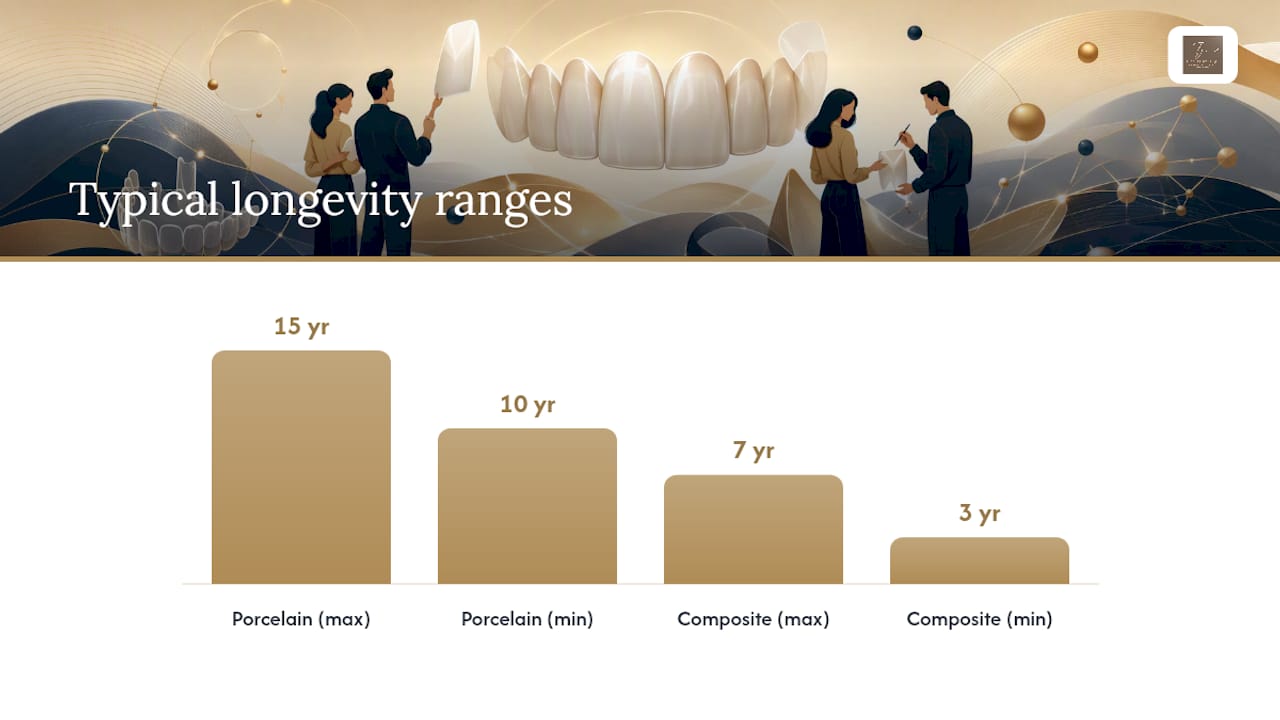
Statistic in context: the roughly two-to-threefold longevity gap between porcelain and composite is the single biggest factor in the cost-versus-durability decision most patients face, according to comparisons of resin composite restoration outcomes against ceramic alternatives.
Composite bonding is more prone to surface staining and chipping over time, though both are usually fixable chairside without replacing the whole restoration. Porcelain veneers are more likely to fail at the margin if the underlying tooth structure shifts or decays underneath, which is why regular check-ups matter regardless of material.
- Get veneers and bonding polished at routine check-ups to keep the surface smooth and stain-resistant.
- Wear a nightguard if you grind your teeth. Both materials are vulnerable to fracture under sustained pressure.
- Attend recall appointments so small chips or margin issues get spotted and repaired early, rather than left until full replacement is the only option.
What peg lateral veneers cost and what changes the price
Cost for correcting a peg lateral varies considerably depending on material choice, how many teeth are involved, and whether preparatory orthodontics is needed. Porcelain veneers involve laboratory or digital fabrication fees on top of the clinical appointment, while composite bonding is generally the cheaper single-visit option since no external lab work is required.
Diagnostic and mock-up fees, when charged separately, add a modest amount but can save money later by catching design issues before the tooth is prepared. If a short course of clear aligner therapy is recommended first, that adds its own cost and time to the overall plan, though it often reduces how elaborate the final veneer needs to be.
- Single-tooth composite bonding sits at the lower end of the price range compared with a porcelain veneer on the same tooth.
- Treating both lateral incisors, rather than one, roughly doubles material and lab costs.
- Financing options and staged treatment plans are worth asking about if orthodontics plus veneers is the recommended combination.
Treat any figure you see quoted online as illustrative only. Actual quotes depend on your dentist’s assessment, so a proper consultation is the only reliable way to get a number that applies to your case.
Why mock-ups and joined-up planning change the outcome
Clinical guidance is consistent on one point: permanent restorative work on a peg lateral should follow a mock-up, not precede it. A wax-up or digital preview lets both patient and dentist agree on the finished shape, incisal edge position, and gum line before any enamel is touched, and that agreement step is what separates predictable results from disappointing ones.
- Digital smile design reduces the risk of over-contouring by testing proportions virtually first.
- Multidisciplinary planning, coordinating restorative and orthodontic input, produces more stable long-term results than restorative work alone.
- A same-day digital workflow, where the clinic supports it, can preserve the mock-up approval stage without extending the timeline unnecessarily.
The mock-up stage is built into peg lateral cases specifically because it catches proportion problems before they become permanent. The principle holds regardless of which clinic delivers it: patient-centred, multidisciplinary treatment planning consistently outperforms rushing straight to preparation.
Should you trial bonding first or commit to veneers straight away?
The honest answer depends less on the tooth and more on the patient. If you’re young, still finishing orthodontic movement, or simply unsure whether a slightly wider or more squared-off shape will suit your face, composite bonding as a reversible trial is the sensible starting point. You can test phonetics, lip support, and how the shape feels when you speak or smile widely, all without touching enamel permanently.
If you already know what you want and value stain resistance over decades rather than years, porcelain earns its higher cost. Either way, ask your dentist directly about repairability and what future retreatment looks like once the current restoration eventually wears out.
— Dr Tashfeen Jamil BDS, MFDS RCS Ed, AssocFCGDent - GDC 286427
How TJ Smile Studio plans and treats peg lateral cases
An advantage for peg lateral cases is a fully digital workflow that lets patients go from consultation to finished smile in a single visit, without sacrificing the mock-up stage that proper planning depends on.
A typical visit starts with a consultation and digital scan, followed by a design preview so you can see and approve the proposed shape before any preparation happens. Where a case suits porcelain veneers rather than composite bonding, Dr Tashfeen Jamil will explain why, and staged treatment (short orthodontic alignment through Invisalign followed by restoration) is discussed openly where it improves the outcome. Larger cases can be planned through a full digital smile makeover, with financing available and a booking deposit required to secure appointment slots. If you’re ready to find out which route fits your peg lateral, booking a consultation with a cosmetic dental clinic can provide a personalised assessment and mock-up preview.
Sources
The clinical detail in this guide draws on peer-reviewed restorative decision frameworks for hypodontia and peg lateral incisors, evidence on digital smile design and mock-up planning, a case report on composite resin correction techniques, and broader guidance on patient-centred treatment planning. Readers wanting more on digital planning specifically can also see this partner resource on smile visualisation.
This article is general information, not a substitute for advice from a qualified doctor. Consult a qualified healthcare professional about your own circumstances before acting on anything here.
- Treatment planning is patient-centred and often multidisciplinary
- Restorative dentistry clinical decision-making for hypodontia: peg and missing lateral incisor teeth
- Aesthetic correction of peg lateral with resin composite using putty index: case report
FAQ
How can I fix a peg-shaped lateral tooth?
The two main routes are porcelain veneers, which reshape the tooth with a bonded ceramic shell, and direct composite bonding, which sculpts resin onto the tooth in a single visit. Which one suits you depends on enamel quantity, tooth position, and how long you want the result to last.
How rare are peg laterals?
Peg laterals are one of the more frequently seen dental developmental variations, often running in families, and they can affect one or both lateral incisors.
Can you show before-and-after examples of peg lateral treatment?
Clinics typically hold case galleries showing veneer and bonding outcomes for peg laterals. TJ Smile Studio’s patient stories page is a place to view real treatment outcomes before booking a consultation.
Should I ask my dentist to pre-prepare my peg lateral for veneers?
No decision on preparation should happen before a proper assessment and mock-up review. Ask your dentist to confirm cervical width, enamel quantity, and gum position first, since these determine whether minimal-prep, standard preparation, or an alternative like bonding is the better fit.
Is orthodontics always needed before treating a peg lateral?
Not always. It’s typically recommended when the tooth is malpositioned or when space needs adjusting, since restoring a misaligned peg without addressing that first risks an over-built, unnatural-looking result.
Recommended
This article is general information, not personal dental advice. What’s right for your teeth depends on a clinical examination — the condition of your enamel, gums, bite and any existing dental work — and no article can assess that. Outcomes vary between patients, and all treatment at TJ Smile Studio is subject to assessment and clinical suitability.
- Dr Tashfeen Jamil BDS, MFDS RCS Ed, AssocFCGDent, PGDip Restorative and Aesthetic Dentistry — GDC registration 286427
This article is general information, not personal dental advice. What's right for your teeth depends on a clinical examination — the condition of your enamel, gums, bite and any existing dental work — and no article can assess that. Outcomes vary between patients, and all treatment at TJ Smile Studio is subject to assessment and clinical suitability.
Clinically reviewed by Dr Tashfeen Jamil BDS, MFDS RCS Ed, AssocFCGDent, PGDip Restorative and Aesthetic Dentistry — GDC registration 286427, Principal Dentist at TJ Smile Studio, 1 Spiersbridge Way, Thornliebank, Glasgow G46 8NG.
If you have dental pain, swelling or an injury, call the practice on 07728 808510. Out of hours in Scotland, call NHS 24 on 111.