
27 October 2026 · TJ Smile Studio
How Often to Change Invisalign Trays: A UK Guide
Most Invisalign trays change every one to two weeks, but your own schedule is set by your dentist. Here is how to switch trays, check fit and fix mistakes.
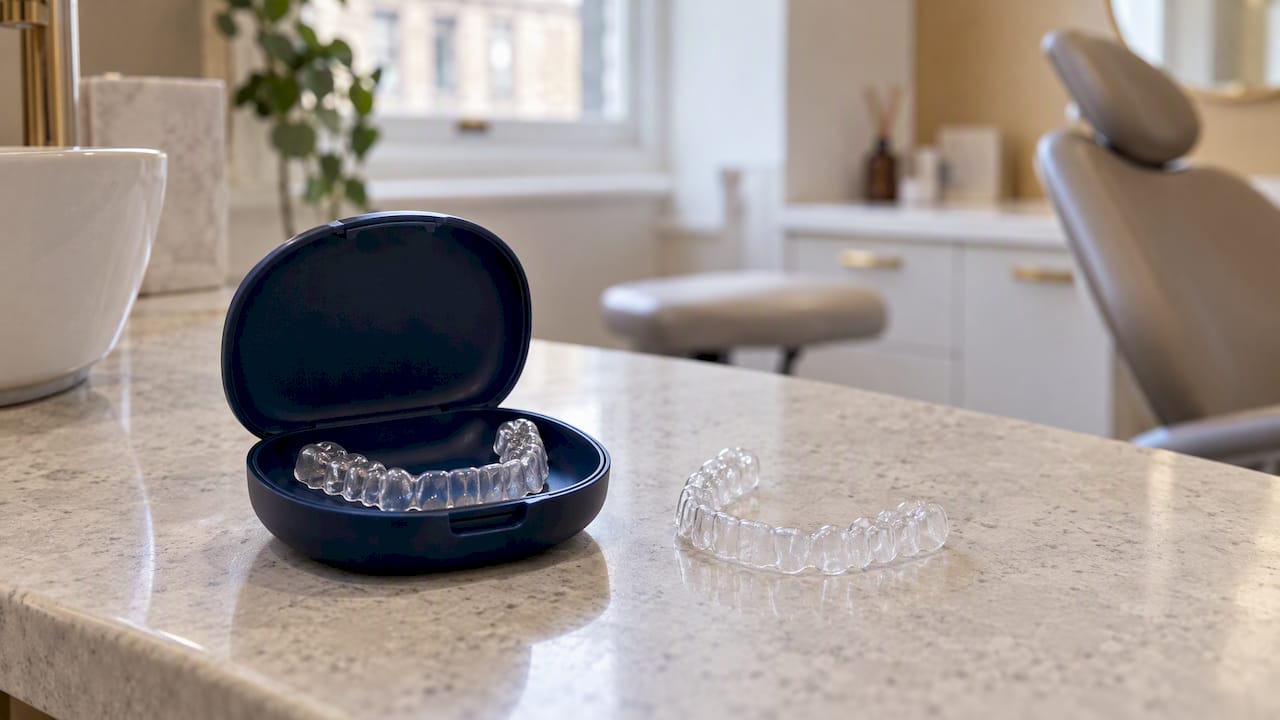
Most people change to a new Invisalign tray every one to two weeks, but the right interval for you is the one your dentist wrote into your treatment plan. Invisalign UK says patients generally wear each aligner for one to two weeks, with timing varying from patient to patient. Below we explain what sets that schedule, how to make the switch, what to do if a tray feels wrong or goes missing, and why changing early rarely speeds anything up.
TL;DR
- Typical Invisalign schedules are 7, 10 or 14 days per tray. Follow the number on your plan, not a general rule.
- Wear each tray for 20 to 22 hours a day. Time out of the mouth matters as much as the calendar.
- Changing early does not shorten treatment. It can leave teeth behind the plan and cause tracking problems.
- Keep your previous tray. If the new one is lost or broken, tell your dentist straight away.
- Soreness for a few days after a switch is normal. Pain that lingers or a tray that clearly does not fit needs a call to your clinic.
Table of Contents
- How often Invisalign trays change
- What decides your tray schedule
- How to change to your next tray
- How many hours a day each tray should be in
- What happens if you change trays too early
- What happens if you change late, or forget
- Is the new tray fitting properly?
- Soreness after a switch
- Lost, cracked or ill-fitting trays
- Our perspective on tray timing
- Thinking about Invisalign in Glasgow?
- FAQ
- Sources
How often Invisalign trays change
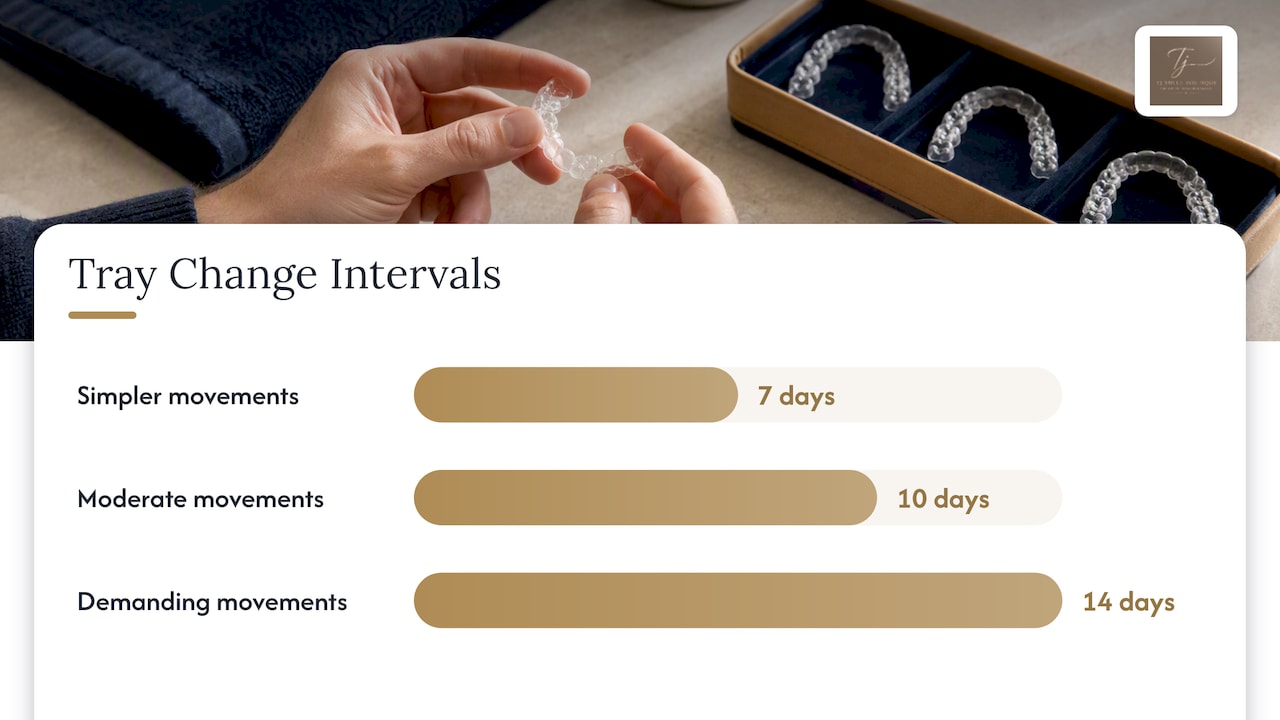
The commonly quoted range is one to two weeks per tray. Invisalign’s own UK guidance describes one to two weeks per aligner and says the exact pattern depends on the patient and the treating dentist’s instructions. Invisalign’s patient guidance adds that people typically move to a new set weekly or every two weeks, depending on their provider.
In practice that means three common rhythms:
| Schedule | What it usually suits | What to remember |
|---|---|---|
| Every 7 days | Simpler movements, small rotations or tipping | Only if your dentist has planned it that way |
| Every 10 days | A middle path for moderate movements | Mark the change date, because it falls on different weekdays |
| Every 14 days | More demanding movements and cautious plans | Often chosen where teeth need longer to respond |
The rhythm is not a convenience setting. A 2026 review in the Australasian Orthodontic Journal reports that aligner companies commonly recommend full-time wear of at least 22 hours a day for 10 to 14 days per aligner, while weekly changes may be acceptable for simpler movements. The same review found insufficient evidence for a single universal one-week protocol, and suggests complex cases, particularly those involving extractions, may warrant a conservative two-week approach.
So if a friend changes weekly and you change fortnightly, neither of you is wrong. You simply have different plans.
What decides your tray schedule
Your dentist sets the interval when they plan your treatment. Several things feed into it:
- How far each tooth has to move at each stage. Plans are built from small steps. Bigger or more difficult steps usually get more time.
- The type of movement. Tilting a tooth is generally quicker than rotating a rounded canine or bringing a tooth into line vertically.
- How reliably you wear the trays. A plan assumes near full-time wear. If you have been struggling with hours, your dentist may slow you down rather than push on.
- How your teeth are actually tracking. At review appointments your dentist checks whether each tray is seating properly before releasing the next set. We cover this in more detail in our guide to Invisalign tracking.
- Your dentist’s own judgement and experience. Two clinicians can reasonably prescribe different intervals for similar teeth.
This is also why your total treatment length depends on the number of trays multiplied by the interval. If you are trying to estimate how long you will be in aligners overall, our page on Invisalign treatment time walks through the pieces.
How to change to your next tray
The mechanics are simple. The habits around them are what make the switch comfortable.
- Check the date. Use a phone reminder or tick off a calendar. Do not rely on memory, because it is easy to lose a day or two.
- Check the number. Trays are numbered. Confirm you are taking the next one in sequence, not skipping ahead.
- Clean your teeth first. Brush before putting in the new set so you are not trapping plaque against your teeth.
- Remove the old tray and insert the new one. Seat it with your fingertips, working from the front teeth back, rather than biting it into place.
- Consider doing it at bedtime. Invisalign notes that switching before bed can make the initial pressure less noticeable.
- Store the old tray safely. More on that below.
If you are ever unsure about fit or timing, ask your provider before carrying on.
How many hours a day each tray should be in
The calendar only counts if the tray is in your mouth. Invisalign UK says you might need to wear aligners for 22 hours per day, and its wider patient guidance puts the range at 20 to 22 hours daily, with trays out for eating, drinking anything other than water, and brushing. UK clinical guidance in Dentistry magazine similarly says patients should ideally wear aligners for at least 20 hours, with 22 hours as the goal.
Two practical points follow:
- Eating and drinking. Invisalign’s patient instructions say to take aligners out for everything except cool or tepid water, partly to avoid staining, cavities and warping. Our guide to eating with Invisalign shows how to keep the hours up without cutting back on meals.
- Wearing a tray longer does not mean you can change sooner. The aim is to give teeth the time the plan calls for, with the tray actually applying force. Hours and days both count; neither replaces the other.
What happens if you change trays too early
It is tempting. A tray feels loose, a holiday is coming, or you want to finish sooner. But each aligner is designed around a specific small movement. The 2026 review makes the point that the movements programmed into each aligner must be achieved sufficiently within the prescribed wear interval, or tracking is compromised.
In plain terms, if you move on before your teeth have caught up:
- The next tray may not seat fully, because your teeth are not where it expects them to be.
- A small lag in one stage can carry into the following stages and add up.
- You may need refinements, extra trays or a longer overall treatment, which is the opposite of what you were after.
If you suspect your teeth have fallen behind, see our page on what to do when an aligner is not tracking. It explains when to call your clinic and what a dentist may do about it.
What happens if you change late, or forget
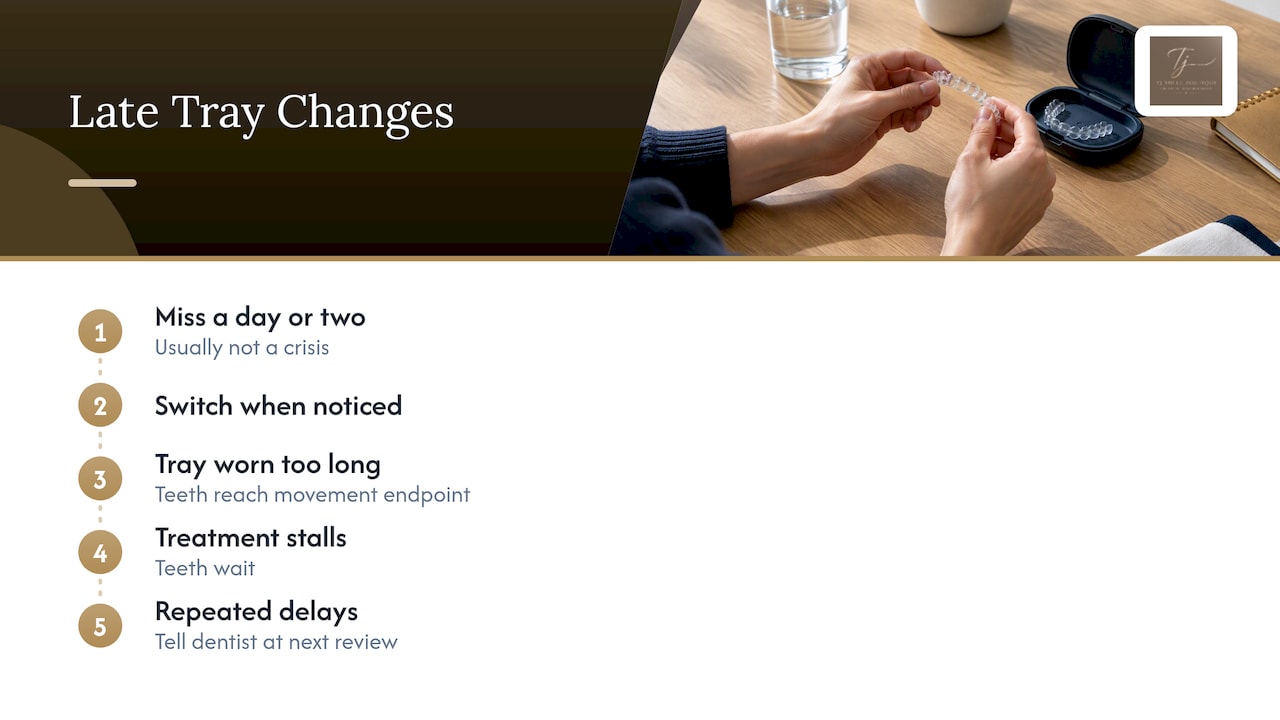
Forgetting for a day or two is common and usually not a crisis. Simply switch when you notice, and tell your dentist at your next review if it happens repeatedly. Staying in one tray for a long stretch does not push teeth further. They reach the end of that tray’s movement and then wait, so your treatment simply stalls.
If you have lost track of which tray you are on, do not guess. Compare the numbers on the trays you have kept, and contact your clinic if you cannot work it out.
Is the new tray fitting properly?
A new tray should feel snug, and pressure is expected. According to Invisalign’s patient instructions, small discrepancies between a new aligner and your current tooth position are normal, but significant fit problems should be reported to your doctor.
What dentists look for is described in UK clinical guidance: aligner fit is assessed at the incisal edges and gingival margins, and a close fit there indicates the teeth are tracking well. You can do a rough version at home:
- Look at the biting edges of your front teeth. There should be no obvious gap between tooth and plastic.
- Look along the gum line. The tray should sit close, not float away.
- Press gently and check the tray clicks over any attachments you have.
A small gap that closes within a day or two of wear is usually the pressure doing its job. A gap that stays, or a tray that will not seat at all, is worth a phone call. The same guidance says that when tracking is imperfect, a clinician may advise continued chewies, longer wear and monitoring rather than moving straight on.
Soreness after a switch
Every new tray resets the pressure on your teeth, so the first days of a stage are typically the tenderest. The Invisalign patient instructions describe soreness for a few days after starting a new stage as common and should gradually ease, and advise contacting your doctor promptly if it persists. For a fuller picture of what the first 72 hours feel like and how to cope, read our guide to Invisalign pain.
Switching in the evening, using a soft diet for the first day and keeping the tray in rather than taking it out for relief are the usual coping habits. Taking the tray out repeatedly can make each re-insertion feel worse.
Lost, cracked or ill-fitting trays
It will probably happen at some point: a tray left in a napkin, chewed by a dog, or cracked in a bag. The patient instructions say to inform your doctor immediately if an aligner is lost or broken. They may advise wearing your last set or your next one, and possibly order a replacement.
Do not decide this yourself. Jumping to the next tray without your dentist’s agreement is the same as changing early. Equally, going without any tray for days lets teeth drift.
Keep your old trays
Do not bin your previous set. The patient instructions say to keep the most recently used aligners, or further stages if your doctor directs, in a clean plastic bag or as instructed. They are your fallback if the current tray goes missing. Keep them in a case, not wrapped in tissue, and well away from heat, which can warp plastic.
Does replacing a tray cost extra?
That depends on the clinic and on your agreement, so ask before treatment starts rather than after a tray goes missing. At TJ Smile Studio we are happy to explain how replacements work during your consultation.
Our perspective on tray timing
The question we hear most is whether patients can speed things up by changing sooner. We understand the instinct, but a tray schedule is the most important part of the plan after the digital design itself. Teeth respond to steady, gentle force over time, and the interval is chosen with that in mind.
Because I personally lead every treatment from consultation to completion, I know how each patient’s plan was built and why each interval was chosen. That continuity matters when something unexpected happens: a tray that does not seat, a missed day, a lost aligner. Instead of generic advice, you get a decision from the person who designed your plan.
Our advice is simple. Wear the trays for as many hours as you can, stay within your interval, tell us early if something feels wrong, and use flexible appointment times, including evenings and weekends, so a review never has to be postponed because of work. Patients who do that tend to have the smoothest treatments.
— Dr Tashfeen Jamil BDS, MFDS RCS Ed, AssocFCGDent - GDC 286427
Thinking about Invisalign in Glasgow?
If you are still deciding whether aligners are right for you, start with a conversation. At TJ Smile Studio an Invisalign consultation costs £50, and Invisalign treatment starts from £1,800. We will look at your teeth, explain how many trays you are likely to need and what interval we would plan, and answer the practical questions about wear time and appointments. You can see all our consultation fees on our pricing page. If you want to understand how the process works first, our guide to what to expect from aligner treatment is a good starting point, and Invisalign for UK adults covers the adult-specific questions.
FAQ
How soon can you change Invisalign trays?
Not sooner than your plan says. Invisalign UK describes one to two weeks per aligner, varying by patient. If you feel your tray is loose before the date, mention it at your next review rather than switching on your own.
What happens if you switch Invisalign trays too quickly?
Your teeth may not have completed the movement the current tray was designed for. The next tray can then fit poorly, and small delays can accumulate into refinements or longer treatment. Contact your clinic if you have already switched early.
Can I just throw away my old Invisalign trays?
It is better not to, at least until your treatment is finished or your dentist says otherwise. Invisalign’s instructions advise keeping the most recent set, because it can act as a temporary fallback if your current tray is lost or broken.
How much does it cost to replace an Invisalign tray?
There is no single UK price, because it depends on the clinic and the terms of your treatment plan. Ask your dentist at the start what happens if a tray is lost, so you are not caught out later.
Does wearing a tray longer let me change sooner?
No. Extra hours help the tray work properly, but your schedule is still set by your dentist. Wearing 20 to 22 hours a day keeps you on track for the planned interval rather than shortening it.
Sources
- Your guide to clear aligners, Invisalign UK
- How often should clear aligners be changed? A review, Australasian Orthodontic Journal
- Invisalign Week 1 vs Week 2: Your First Two Weeks Journey
- Invisalign use and care instructions, patient IFU
- Invisalign treatment monitoring: a step-by-step guide, Dentistry
Recommended
- Peaks in 24–72 Hours
- 48 Hours: When UK Patients Should Act on
- Retainers After Invisalign
- Evidence Backed Invisalign Refinements
This article is general information, not personal dental advice. What’s right for your teeth depends on a clinical examination — the condition of your enamel, gums, bite and any existing dental work — and no article can assess that. Outcomes vary between patients, and all treatment at TJ Smile Studio is subject to assessment and clinical suitability.
- Dr Tashfeen Jamil BDS, MFDS RCS Ed, AssocFCGDent, PGDip Restorative and Aesthetic Dentistry — GDC registration 286427
This article is general information, not personal dental advice. What's right for your teeth depends on a clinical examination — the condition of your enamel, gums, bite and any existing dental work — and no article can assess that. Outcomes vary between patients, and all treatment at TJ Smile Studio is subject to assessment and clinical suitability.
Clinically reviewed by Dr Tashfeen Jamil BDS, MFDS RCS Ed, AssocFCGDent, PGDip Restorative and Aesthetic Dentistry — GDC registration 286427, Principal Dentist at TJ Smile Studio, 1 Spiersbridge Way, Thornliebank, Glasgow G46 8NG.
If you have dental pain, swelling or an injury, call the practice on 07728 808510. Out of hours in Scotland, call NHS 24 on 111.