
08 October 2026 · TJ Smile Studio
Invisalign for UK Adults: 22 Hours Daily, Guided by a Clinician
Considering Invisalign as an adult in the UK? Learn who may qualify, why wear time matters, what treatment involves, and how clinicians guide care.
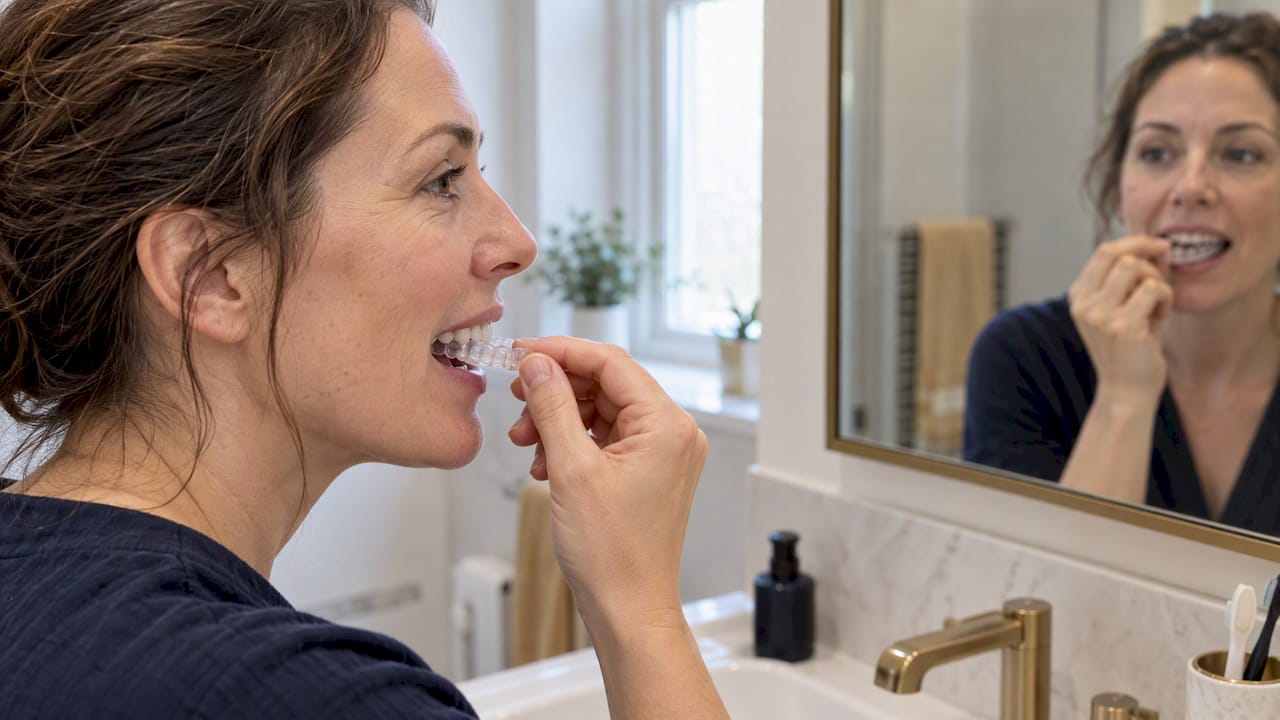
Invisalign is often a suitable option for adults with mild to moderate crowding or spacing, provided you can commit to wearing the aligners for around 22 hours a day and attending regular checks. It is not automatically right for every smile, and more complex movements sometimes need a different approach. The next sections explain what clear aligners are, how they work, and how to tell whether your case fits.
TL;DR:
- A full clinical assessment should rule out severe crowding, major bite discrepancies, complex movements, active gum disease, or untreated decay before aligners begin.
- Adult treatment usually lasts six to eighteen months, with clinician reviews every six to eight weeks; missed wear time commonly extends the schedule.
- NHS orthodontic treatment is rarely available to adults, while private adult treatment in the UK commonly costs £2,000 to £6,000, depending on complexity.
- After treatment, removable retainers, fixed wires, or both help prevent teeth from drifting; clinicians often recommend nightly removable wear on a reducing schedule.
Table of Contents
- What Invisalign is and how clear aligner therapy works
- Who is a suitable candidate and what cases may need other approaches
- Treatment timeline and patient commitment: wear time, appointments and duration
- Practical care: cleaning aligners, oral hygiene and handling common problems
- How aligners compare with fixed braces for adult patients: practical pros and trade-offs
- Our approach to clinician-led, fully digital Invisalign care
- Which retainers come after Invisalign, and how do you look after them
- Attachments and interproximal reduction: the adjuncts that make aligners work harder
- How 3D scanning sharpens precision and comfort during treatment
- How Invisalign affects eating, speaking and daily oral hygiene
- Same-day and accelerated treatment options for adult patients
- How to prepare for your first Invisalign consultation
- Book your Invisalign consultation at TJ Smile Studio
- FAQ
- Sources
What Invisalign is and how clear aligner therapy works
Invisalign belongs to a category of appliances called clear aligners: thin, custom-moulded plastic trays that apply gentle, controlled force to shift teeth into a planned position. Rather than one appliance doing all the work, as a fixed brace does, you move through a series of aligners, each one slightly different from the last, with every stage nudging your teeth a fraction closer to the final result.
Before any aligner is made, a clinician takes digital scans of your teeth and builds a full treatment plan, mapping out every stage of movement from your starting position to the target outcome. Small tooth-coloured attachments are often bonded to specific teeth partway through treatment. These act as anchor points, giving the aligner something to grip so it can apply more precise, targeted force where it is needed most.
- Clear aligners are manufactured in sequence, usually changed every one to two weeks as directed by your clinician.
- Attachments help with movements that aligners alone cannot manage reliably, such as rotations or extrusion.
- A digital treatment plan lets you see a simulation of how your smile is expected to change before you commit.
This staged, planned approach is why clinical oversight matters more than the aligner material itself.
Who is a suitable candidate and what cases may need other approaches
Invisalign tends to suit adults with mild to moderate crowding or spacing, or minor bite irregularities, particularly those who want a discreet option and can realistically commit to near-constant wear. Lifestyle matters here: if you can remove aligners briefly for meals and put them straight back in, you are already halfway to being a good candidate.
Not every case fits this mould. The British Orthodontic Society notes that clear aligners suit many mild to moderate orthodontic problems but require a full clinical assessment, and some cases, particularly those involving severe crowding, significant bite discrepancies, or complex tooth movements, are better managed with fixed appliances, deliberate extractions, or in rare cases, surgical input. Healthy gums and teeth are a precondition rather than a detail: periodontal disease should be stabilised before any orthodontic movement begins, since moving teeth through inflamed or compromised gum tissue raises the risk of further damage.
- Mild to moderate crowding or spacing responds well to aligner therapy in most adults.
- Severe crowding, significant jaw discrepancies, or complex rotations may need fixed braces or combined techniques.
- Active gum disease or untreated decay should be addressed before starting any aligner programme.
Pro Tip: Book a full clinical assessment before assuming aligners are right for you. A short consultation will tell you far more than any online quiz.
Treatment timeline and patient commitment: wear time, appointments and duration
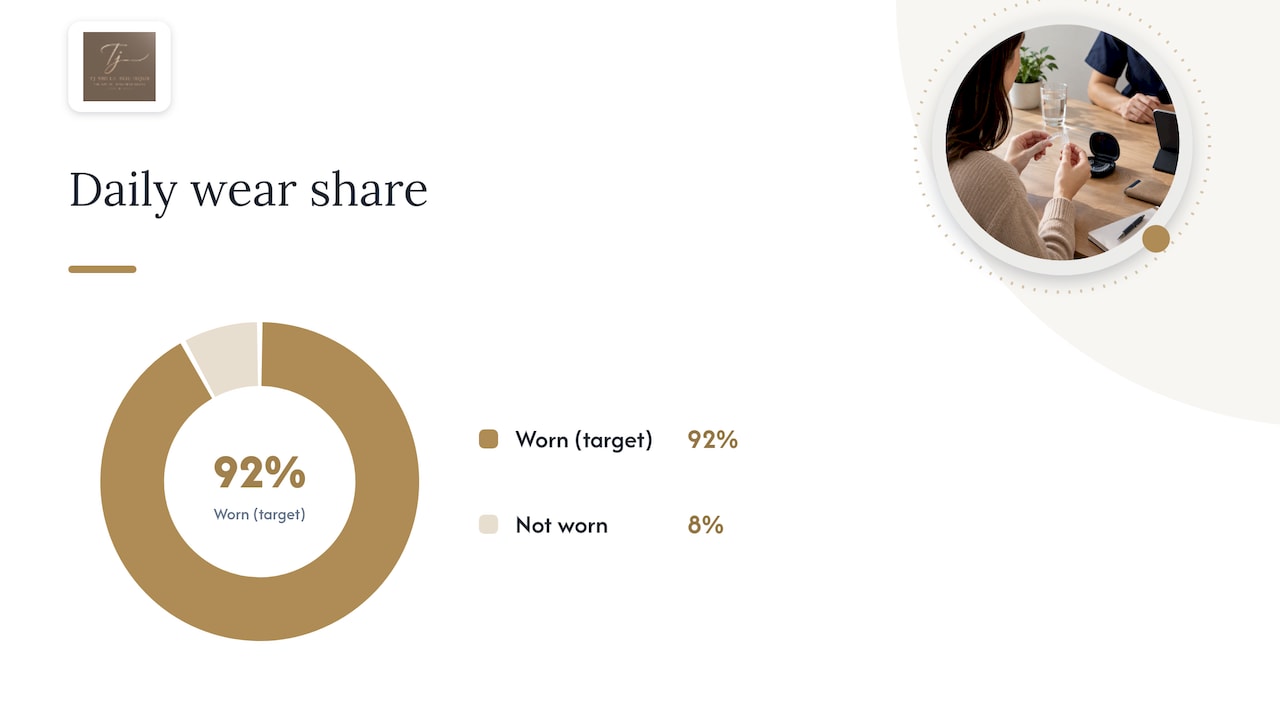
The single biggest predictor of success with Invisalign is wear time, not the appliance itself. Guidance from All Health and Care puts the target at around 22 hours a day, which leaves roughly two hours for eating and cleaning. Treatment reviews typically happen every six to eight weeks, giving your clinician the chance to check progress, swap you onto new aligner stages, and catch any issues early.
Most adult courses run for somewhere between six and eighteen months, depending on case complexity; straightforward spacing or mild crowding often resolves towards the shorter end, while more involved movements take longer.
- Wear each aligner for close to the full 22 hours, removing it only for eating, drinking anything other than water, and cleaning.
- Attend reviews roughly every six to eight weeks so your clinician can confirm fit and progress.
- Expect some virtual monitoring options between visits, where photos or scans are reviewed remotely to flag problems sooner.
Falling short on wear time is the most common reason treatment overruns. Aligners that sit in a drawer rather than on your teeth cannot move anything, and skipped hours tend to push the whole timeline back rather than simply delaying one stage.
Statistic callout: NHS guidance confirms that NHS orthodontic treatment is rarely available to adults, meaning most adult aligner treatment is arranged privately. That single fact shapes almost every other decision in this article, from cost to where you book your consultation.
Practical care: cleaning aligners, oral hygiene and handling common problems
Good aligner hygiene is simple once it becomes routine. Clean your aligners with a soft toothbrush and plain water or a clinician-recommended cleaning solution, never hot water, which can warp the plastic. Brush and floss your own teeth before refitting the aligner after meals, since trapped food particles sitting against your teeth for hours can encourage decay.
- Remove aligners before eating or drinking anything other than water, and rinse them before putting them back in.
- Store aligners in their case when out of your mouth rather than loose in a pocket or wrapped in tissue.
- Avoid denture-cleaning tablets, toothpaste, or abrasive cleaners, which can scratch or cloud the plastic.
If an aligner is lost or damaged, BOS guidance advises wearing your previous aligner to hold tooth position until you can be seen, rather than skipping aligner wear entirely. Mild soreness in the first day or two of a new stage is common and usually settles on its own.
Pro Tip: Keep every previous aligner until treatment finishes. Each one doubles as a backup retainer if a current aligner goes missing.
How aligners compare with fixed braces for adult patients: practical pros and trade-offs
Discretion is usually the deciding factor for adults choosing between Invisalign and fixed braces: clear aligners are far less visible day to day, while fixed braces remain fixed in place and visible throughout treatment. That visibility cuts both ways, since fixed braces cannot be removed and so remove the compliance question entirely, whereas aligners rely on you putting them back in after every meal.
Our comparison of Invisalign and fixed braces sets out these trade-offs in more depth, but the core pattern holds across most adult cases:
- Appearance: aligners are discreet; fixed braces are visible but unaffected by removal habits.
- Compliance: aligners depend on consistent wear; fixed braces work continuously regardless of patient behaviour.
- Complexity: fixed braces or combined techniques often suit more severe movements that aligners alone cannot achieve.
- Cost: both options vary with case complexity, with private adult orthodontics in the United Kingdom commonly ranging from £2,000 to £6,000 depending on the treatment required.
Neither option is universally better. The right choice depends on how complex your case is and how realistic near-constant aligner wear is for your daily life.
Our approach to clinician-led, fully digital Invisalign care
Every Invisalign plan is led personally by the assessing clinician, who oversees your treatment from consultation through to your final retainer. We plan every case using a fully digital workflow: 3D scans replace old-style impressions, and treatment simulations let you see a predicted outcome before any aligner is made.
- Digital scanning removes the need for messy impression trays and gives a more accurate starting record.
- Treatment visualisations show you the expected movement stage by stage, before you commit to a plan.
- Continuity with one named clinician means fewer handoffs and a consistent point of contact for every review.
A first consultation focuses on assessing suitability honestly, including gum health and bite, before any plan is proposed.
Which retainers come after Invisalign, and how do you look after them
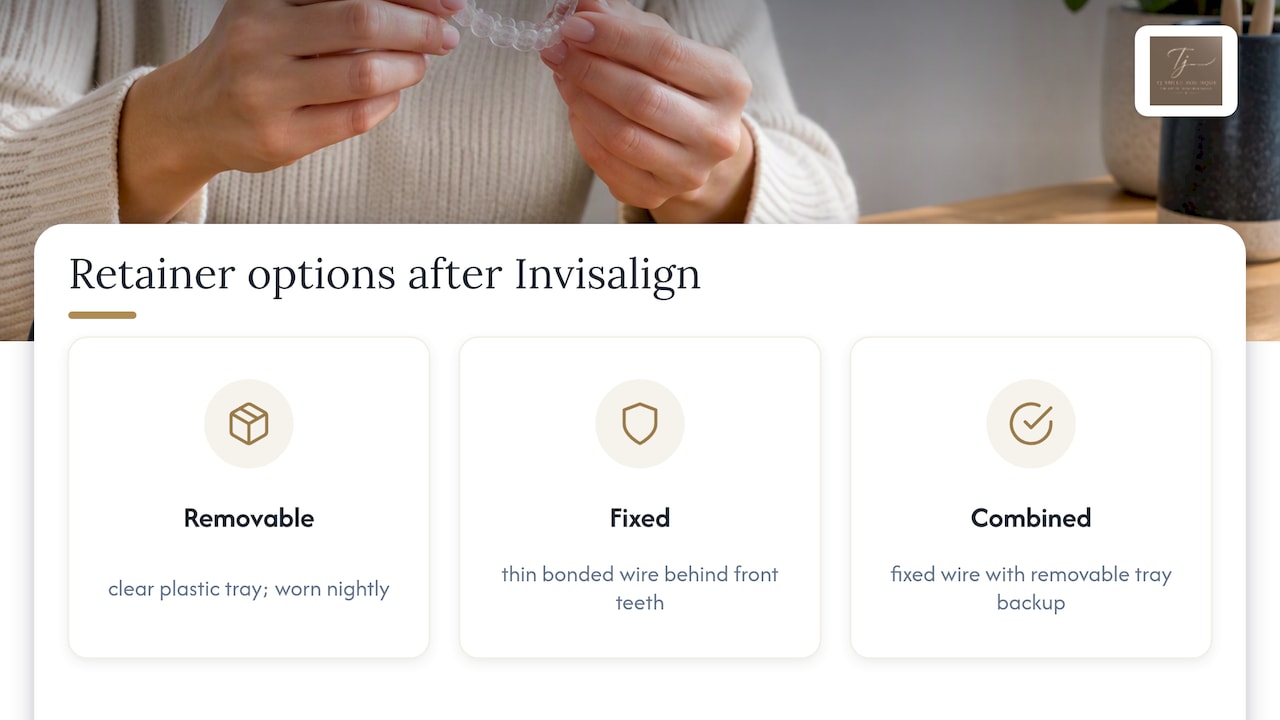
Finishing your last aligner stage is not the end of treatment. Teeth can continue to shift throughout life, so NHS guidance on braces stresses that retention afterwards is essential, usually through removable retainers, a fixed bonded wire behind the front teeth, or a combination of both.
Removable retainers are clear plastic trays similar in appearance to your last aligner, worn on a reducing schedule, often nightly, as directed by your clinician. Fixed retainers are thin wires bonded discreetly to the back of your front teeth and left in place permanently unless a dentist removes them. Many adults are given both, a fixed wire for long-term stability and a removable tray as backup.
Caring for retainers mirrors aligner care: clean them with a soft brush and water, avoid hot water or abrasive cleaners, and store removable retainers in their case when not worn. Fixed retainers need careful flossing underneath the wire and a dental check if the bond ever feels loose.
Skipping retainer wear is one of the most common reasons teeth drift back towards their original position. A retainer review, which we offer as a standalone appointment, is a useful way to check that a retainer still fits and is doing its job months or years after treatment ends.
Attachments and interproximal reduction: the adjuncts that make aligners work harder
Clear aligners rarely work entirely on their own for every movement, which is why adjuncts are built into most adult treatment plans rather than added as an afterthought. The British Orthodontic Society confirms that attachments and interproximal reduction, sometimes called slenderising, are routine parts of many aligner courses.
Attachments are small, tooth-coloured composite shapes bonded temporarily to specific teeth. They give the aligner a grip point, allowing it to apply rotational or lifting force that a smooth aligner surface alone could not generate reliably. They are typically removed once that stage of movement is complete, leaving no permanent mark on the tooth.
Interproximal reduction involves very slightly reshaping the contact point between two teeth, removing a small amount of enamel to create space without extraction. It is a precise, controlled procedure used to resolve mild crowding or to fine-tune spacing between aligner stages.
Neither adjunct signals that something has gone wrong with your plan. They are simply tools that extend what aligners alone can achieve, and your clinician will flag in advance whether your case is likely to need them.
How 3D scanning sharpens precision and comfort during treatment
Digital scanning has changed what a clinician can see before treatment even starts. A 3D scan captures the exact shape and position of every tooth, which feeds directly into the software used to plan each aligner stage. That precision matters because a plan built on an inaccurate starting record risks aligners that fit poorly or movements that do not track as predicted.
Scanning also replaces the traditional impression tray, which many adults find uncomfortable and messy. A few minutes of scanning gives a clearer, more detailed record than a putty impression ever could, and it means a remake, if one is ever needed, does not require sitting through the process again.
Beyond comfort, the digital record supports the treatment visualisation shown to patients at consultation, letting you see a simulated progression of your own teeth towards the planned outcome. It also gives your clinician a precise baseline to compare against at every review, making it easier to confirm that tooth movement is tracking the plan rather than relying on visual judgement alone.
How Invisalign affects eating, speaking and daily oral hygiene
Aligners change a few daily habits, mostly in the first week or two of a new stage before you adjust. Eating requires removing the aligner first, since biting down on the tray can crack it and chewing with it in traps food against your teeth. Most adults get into a quick habit of taking the aligner out before meals and rinsing it before putting it back in.
Speech can sound slightly different for the first day or two of a new aligner, a mild lisp that tends to settle quickly as your tongue adjusts to the plastic. It is usually barely noticeable to anyone else.
Oral hygiene actually tends to improve for many adults during aligner treatment, since removing the tray to brush and floss after meals becomes routine, compared with navigating brackets and wires on a fixed brace. The trade-off is discipline: skipping that post-meal clean, even briefly, means food particles sit against your teeth under the aligner for hours.
A few habits make the adjustment smoother: carry a travel toothbrush and the aligner case for meals out, drink water rather than sugary or acidic drinks while the aligner is in, and keep a spare case so a forgotten aligner is never left loose in a napkin or pocket.
Same-day and accelerated treatment options for adult patients
Not every adult wants to wait months to see a visible change, which is part of why some cosmetic cases are better suited to a different route entirely. Our Same Day Smile service and Same-Day Hybrid Veneers, from £2,995 one-off, offer an immediate transformation for adults whose goals are cosmetic rather than purely about tooth alignment, completed in a single visit using our fully digital workflow.
For adults who specifically want gradual, gum-friendly repositioning rather than an immediate cosmetic change, Invisalign remains the more appropriate route, and the two approaches are sometimes combined: aligners to correct alignment first, followed by cosmetic refinement once teeth are in their final position. Which path fits best depends on your starting smile, your timeline, and whether the priority is moving teeth or changing their shape and colour. That question is exactly what a consultation is designed to answer.
How to prepare for your first Invisalign consultation
Bring any recent dental records or X-rays you have, and come ready to discuss retention after treatment and how you plan to pay, whether in full or through financing. Ask directly about likely attachments, how often you will be seen, and whether a visualisation of your predicted outcome will be shown.
Be wary of DIY aligner kits ordered online without an in-person assessment. The British Orthodontic Society has repeatedly warned that these skip the clinical checks a hands-on assessment provides, and that gap matters most for adults with gum or bite concerns.
— Dr Tashfeen Jamil BDS, MFDS RCS Ed, AssocFCGDent - GDC 286427
Book your Invisalign consultation at TJ Smile Studio
A dedicated Invisalign Consultation is offered, where your suitability is assessed, attachments and likely timeline discussed, and a treatment plan built on digital scans and visualised outcomes, personalised to you.
- A consultation includes a full assessment of gum health, bite, and candidacy for aligner treatment.
- Treatment plans are built on 3D digital scans with a visualisation of your predicted outcome.
- Full Invisalign pricing from £1,800 and payment details are available before you commit to anything.
Book a consultation to find out whether Invisalign fits your case and get a plan built specifically around your smile.
This article is general information, not a substitute for advice from a qualified doctor. Consult a qualified healthcare professional about your own circumstances before acting on anything here.
FAQ
Is it worth getting Invisalign as an adult?
For adults with mild to moderate crowding or spacing, Invisalign is often worth considering, particularly if discretion and removability matter to you. Suitability depends on a full clinical assessment, since more complex cases may need a different approach, as BOS guidance sets out.
What is the 30 minute rule for Invisalign?
The so-called ‘waiting period rule’ refers to the common clinical advice to avoid eating or drinking anything other than water shortly after refitting an aligner, giving the plastic time to set fully against your teeth. It is a practical habit rather than a strict clinical threshold, and your own clinician’s guidance always takes precedence.
Did Kate Middleton use Invisalign?
There is no verified, publicly documented information confirming this, so we cannot state it as fact here.
Is 35 too old for Invisalign?
No. Age alone is not a barrier to aligner treatment, and suitability depends far more on gum health, bite, and the complexity of movement needed than on how old you are. Many adults in their thirties, forties and beyond complete aligner treatment successfully once a clinical assessment confirms their case is suitable.
Sources
For independent, UK-specific guidance beyond this article, the NHS page on orthodontics and the British Orthodontic Society’s clear aligner guidance both cover candidacy, cost expectations, and safety considerations in more detail.
- Orthodontics - NHS
- Clear aligners - British Orthodontic Society (BOS)
- Invisalign and clear aligners in UK - All Health and Care
Recommended
- Peaks in 24–72 Hours
- Invisalign Treatment Time
- UK patients: Wait 1–3 months before
- 48 Hours: When UK Patients Should Act on
This article is general information, not personal dental advice. What’s right for your teeth depends on a clinical examination — the condition of your enamel, gums, bite and any existing dental work — and no article can assess that. Outcomes vary between patients, and all treatment at TJ Smile Studio is subject to assessment and clinical suitability.
- Dr Tashfeen Jamil BDS, MFDS RCS Ed, AssocFCGDent, PGDip Restorative and Aesthetic Dentistry — GDC registration 286427
This article is general information, not personal dental advice. What's right for your teeth depends on a clinical examination — the condition of your enamel, gums, bite and any existing dental work — and no article can assess that. Outcomes vary between patients, and all treatment at TJ Smile Studio is subject to assessment and clinical suitability.
Clinically reviewed by Dr Tashfeen Jamil BDS, MFDS RCS Ed, AssocFCGDent, PGDip Restorative and Aesthetic Dentistry — GDC registration 286427, Principal Dentist at TJ Smile Studio, 1 Spiersbridge Way, Thornliebank, Glasgow G46 8NG.
If you have dental pain, swelling or an injury, call the practice on 07728 808510. Out of hours in Scotland, call NHS 24 on 111.