
04 October 2026 · TJ Smile Studio
Peaks in 24–72 Hours: UK Clinician on Invisalign Pain and Fixes
UK clinician explains why Invisalign soreness peaks in 24–72 hours, offers evidence based relief you can use, and tells when to contact your clinic.
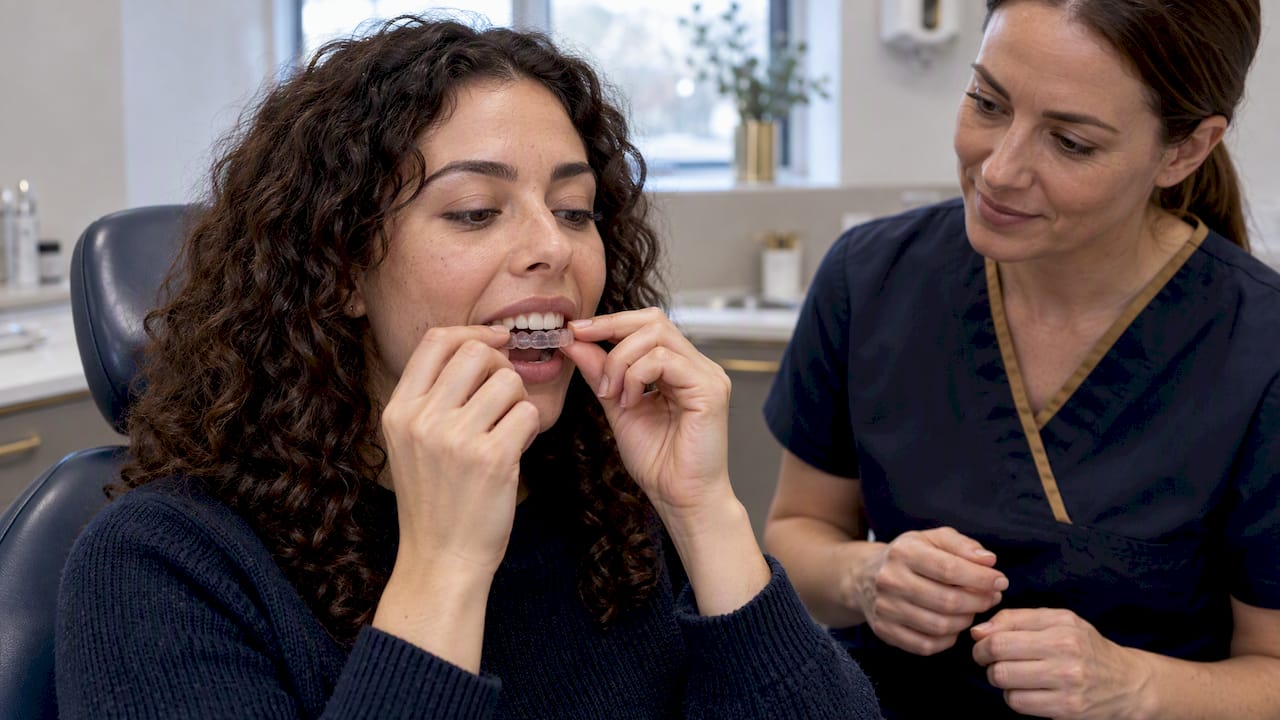
Invisalign causes mild to moderate soreness for most people, not sharp or lasting pain. Discomfort tends to peak in the first 24 to 72 hours after fitting a new aligner and settles within a few days as teeth adjust to the pressure. If you are weighing up treatment or already wearing trays, that pattern is your benchmark: anything beyond brief, manageable soreness is worth a second look.
TL;DR:
- Discomfort from Invisalign peaks within the first 24 to 72 hours after fitting a new tray and usually diminishes quickly within a few days.
- Attachments and elastics can cause localized pressure and increased discomfort, especially if attachments are placed on visible teeth or near the gumline.
- Mild, short-lived soreness is normal, but severe pain, swelling, or pain unresponsive to usual remedies require immediate professional assessment.
- Simple self-care measures like over-the-counter painkillers, cold compresses, and orthodontic wax effectively manage typical soreness.
- Consistently wearing aligners as prescribed, especially overnight, helps minimize overall discomfort and prevent prolonging the adjustment period.
Table of Contents
- Why Invisalign can cause discomfort
- What to expect: typical timeline and severity by stage
- Practical pain relief and self-care
- When pain is not normal: red flags and what to do next
- Clinician perspective and clinic practices
- Impact of tooth movement stages on pain intensity
- How different types of attachments influence discomfort
- Adjustment period for new patients
- Long-term pain management strategies over the entire treatment course
- Switching trays at night made the difference for me
- Get support with Invisalign discomfort in Glasgow
- FAQ
- Sources
Why Invisalign can cause discomfort
Invisalign works by applying gentle, continuous pressure to specific teeth, nudging them along a planned path set out before treatment begins. That pressure stimulates the periodontal ligament, the soft tissue anchoring each tooth to the jawbone, and a short bout of soreness is the ligament’s normal response to being asked to remodel. It is not a sign of damage. It is a sign the aligner is doing its job.
Attachments, the small tooth-coloured bumps bonded to certain teeth to help the aligner grip and rotate them, can add a bit more localised pressure in the areas where they sit. Elastics, when used to correct bite alignment, work the same way: they add force in a specific direction, which tends to produce more noticeable discomfort than tooth movement alone. Interproximal reduction, the light filing done between some teeth to create space, can also leave teeth feeling sensitive for a day or two afterwards.
Separately from tooth movement, the aligner itself is a hard plastic shell sitting against soft tissue. A sharp edge near the gumline or an attachment that catches the inside of the lip can cause rubbing rather than the deep ache of tooth movement. This kind of irritation is usually easy to sort out: a thin layer of orthodontic wax over the spot, or a quick buff with an emery board on the aligner’s edge, often solves it within minutes. It is worth telling these two types of discomfort apart, because one settles on its own as the ligament adapts, and the other is a fit issue you can usually fix yourself or with a quick call to your clinic.
What to expect: typical timeline and severity by stage
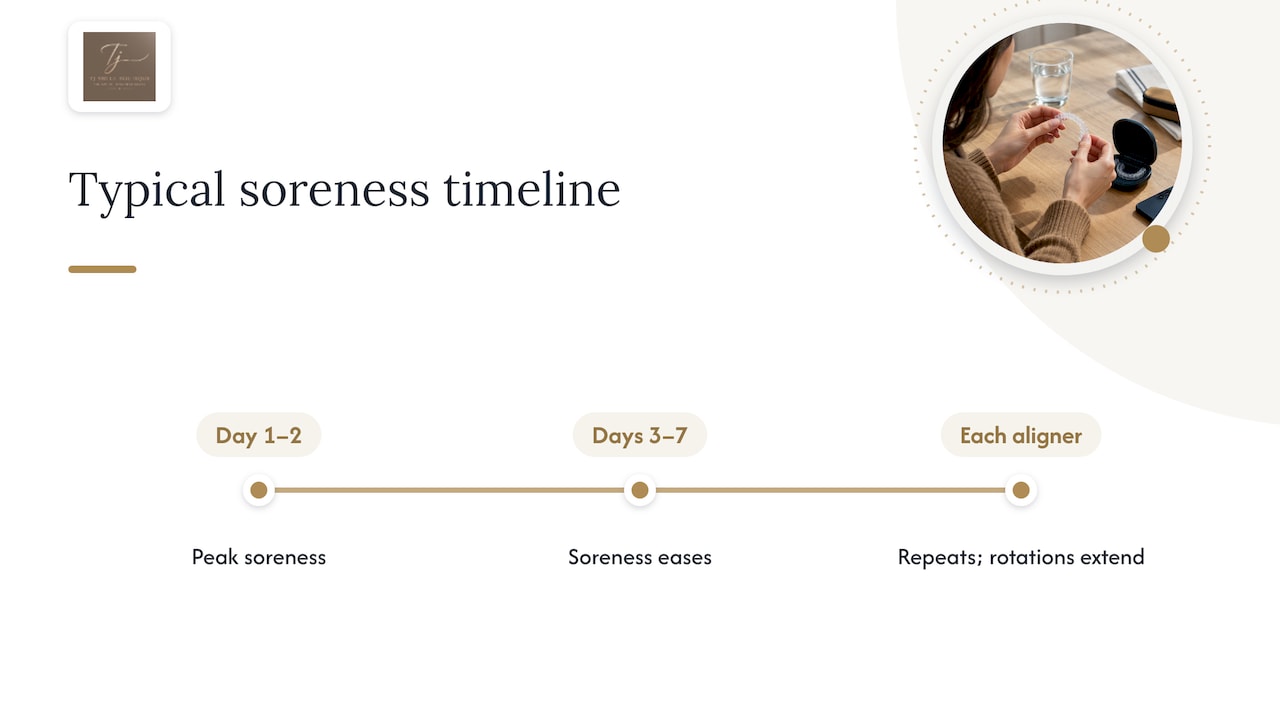
For most patients, soreness peaks within the first day or two of fitting a new tray and eases over the following several days, according to a systematic review of Invisalign discomfort. That pattern tends to repeat with every new aligner in the series, though some stages, particularly those involving rotation or more significant movement, can stretch the soreness window slightly longer than others.
If you have compared notes with someone wearing fixed braces, the experience often looks different. A comparative study of pain perception between clear aligners and fixed appliances found that aligner patients reported lower pain scores, less anxiety and better short-term quality of life than fixed-brace patients during the early days of treatment. A separate systematic review of pain levels across appliance types reached a similar conclusion: clear aligners tend to produce less discomfort than fixed appliances in the first few days, though the gap narrows once both groups settle into longer-term treatment.
None of this means Invisalign is pain-free. It means the discomfort tends to be shorter and milder than many people expect, and it follows a predictable rhythm you can plan around. Knowing roughly when soreness will peak, and when it should start fading, makes the whole experience far less unsettling than facing it blind. For a fuller walkthrough of what the process looks like stage by stage, our guide on what to expect from aligner treatment covers the sequence in more detail.
Practical pain relief and self-care
Most soreness responds well to simple, well-established measures. The key is using them consistently in the first few days after each new tray, rather than waiting until discomfort becomes distracting.
- Take paracetamol or ibuprofen at standard adult doses following the product instructions, and check with a pharmacist if you take other medication or have any health conditions.
- Hold a cold compress against the outside of your jaw for 10 to 15 minutes to reduce swelling and numb the area.
- Rinse with warm salt water a few times a day to soothe irritated gum tissue.
- Bite down gently on an orthodontic chewie for a few minutes to help seat a new aligner fully and reduce the pressure points that cause sharper discomfort.
- Apply a small piece of orthodontic wax over any edge that rubs against your cheek or lip.
- Smooth a rough aligner edge yourself with a clean emery board if it catches on soft tissue.
NHS guidance on dental pain recommends paracetamol or ibuprofen for toothache-type discomfort, and the same dosing principles apply to the soreness that follows a new aligner.
Stick to softer foods, soup, pasta, scrambled eggs, for the first 48 to 72 hours after switching trays, and hold off on very hard or chewy foods until the worst of the soreness has passed. Clean your aligners properly at each removal, since a build-up of residue along the edges can itself cause gum irritation that compounds any pressure-related soreness.
Switching to a new aligner just before bed is a widely used trick: you sleep through much of the peak discomfort window and wake up partway through the adjustment. Keep wearing your aligners for the prescribed hours each day rather than removing them to get a break. Taking them out resets the soreness clock rather than pausing it, since the teeth relax back slightly and the pressure has to start again when you put the aligner back in.
Pro Tip: Keep your previous aligner after switching to a new one. If the new tray feels unusually uncomfortable or doesn’t seat properly, reverting to the last one for a day while you contact your clinic is far better than skipping wear altogether.
A small kit goes a long way: a pack of chewies, orthodontic wax, a nail file or emery board, your chosen analgesic, and a mental list of soft foods for the first couple of days after each new tray.
When pain is not normal: red flags and what to do next
Mild, short-lived soreness is expected. Severe or worsening pain, facial swelling, fever, difficulty breathing or swallowing, ulcers that will not heal, or pain that does not respond to standard painkillers are not. These point to something beyond normal tooth movement and need professional attention rather than more wax and painkillers.
If a new aligner does not seat properly or causes pain that feels wrong rather than just uncomfortable, do not push on to the next tray in the sequence. Revert to wearing the previous aligner and contact your clinic for advice. For anything that feels urgent outside clinic hours, NHS 111 can advise on when dental pain needs same-day attention, and facial swelling with fever or breathing difficulty warrants emergency care.
A clinician dealing with unusual pain will typically check the fit, smooth any sharp edges, confirm attachments are correctly placed, and in some cases rescan and remake an aligner that is not tracking as planned. The British Orthodontic Society notes that while mild soreness is a normal part of treatment, persistent or severe pain should always prompt a review rather than being managed indefinitely at home.
Clinician perspective and clinic practices
I’m Dr Tashfeen Jamil, BDS, MFDS RCS Ed, AssocFCGDent, registered with the General Dental Council under number 286427. In clinic, the pain concerns patients raise about Invisalign are almost always the predictable, short-lived kind described above, and they settle with the same simple measures: wax over a rubbing edge, a chewie to help a tray seat, and sensible use of over-the-counter analgesia in the first day or two after each change.
Where the picture looks different, a tray that will not seat, an attachment that has come loose, or discomfort that is not easing after several days, the right step is a quick in-clinic check rather than persevering alone. That might mean smoothing an edge, rescanning for a replacement aligner, or adjusting the plan for a tooth that is moving more slowly than expected. Catching these issues early keeps treatment on schedule and avoids the discomfort dragging on unnecessarily. If you are considering treatment and want a plan built around your own teeth rather than a generic timeline, our Invisalign page outlines how that assessment works.
Impact of tooth movement stages on pain intensity
Not every stage of Invisalign treatment feels the same. Early aligners, which handle initial alignment of crowded or mildly rotated teeth, tend to produce the most noticeable soreness simply because the teeth are moving away from a more established position for the first time.
Rotational movements, turning a tooth around its own axis, often feel different again: more of a localised ache around that specific tooth rather than the broader jaw tenderness of early alignment. Extrusion, where a tooth is being drawn further out of the socket, can bring a different sensation still, sometimes described as a dull, sustained pressure rather than sharp soreness, because the force is sustained in one direction over a longer stretch of the aligner series.
As treatment progresses and movements become smaller and more refined, many patients find each new aligner feels less dramatic than the ones before it. This is partly because later-stage adjustments are often finer in scale, and partly because you have simply learned what to expect and how to manage it. Knowing that soreness has a different character at different stages helps you judge whether what you are feeling fits the pattern for where you are in treatment, rather than assuming every twinge signals a problem.
How different types of attachments influence discomfort
Attachments are not all the same, and the type fitted to a tooth affects how much discomfort it tends to produce. A small round attachment used mainly for grip creates a gentle, even pressure point, generally among the least noticeable. Rectangular or optimised attachments, designed to help with rotation or more significant movement, concentrate more force into a smaller area and can feel more tender, particularly in the first day or two after a new tray engages them.
Attachments placed on more visible front teeth sometimes feel more noticeable simply because those teeth have thinner gum coverage and more nerve sensitivity than back teeth. Where an attachment sits close to the gumline, it can also catch on the inside of the lip or cheek before you adjust to its shape, producing rubbing-type irritation on top of the pressure-related soreness.
None of this means more attachments mean more total pain. It means the discomfort profile shifts depending on what each attachment is doing and where it sits. If a particular attachment is consistently uncomfortable well beyond the usual adjustment window, that is worth flagging at a review rather than assuming it is simply the cost of treatment.
Adjustment period for new patients
The first week or two of Invisalign treatment is as much a psychological adjustment as a physical one. New patients often notice every sensation acutely simply because the aligner is unfamiliar, and it is common to interpret normal pressure as a bigger problem than it is during this early phase.
Research on orthodontic treatment suggests that anxiety and expectation shape how pain is perceived, meaning patients who understand what is normal tend to report less distress than those going in without that context. This mirrors what plays out in clinic conversations: once someone has been through one or two tray changes and recognises the pattern, the same level of soreness feels far less alarming the second time round.
By the third or fourth aligner, most patients have built a working sense of what their own soreness looks like: roughly how long it lasts, what helps, and what a normal “new tray day” feels like compared with the rest of the week. That familiarity is often what turns Invisalign from something to brace for into a routine part of the week. If dental anxiety is part of what is making this feel daunting, our piece on feeling nervous about dental treatment covers ways to manage that alongside the physical side.
Long-term pain management strategies over the entire treatment course
Across months of treatment, the goal shifts from managing one sore patch to building a routine that keeps discomfort predictable and short. Switching each new aligner at night remains one of the most consistent strategies, since it lets sleep absorb much of the peak soreness window.
Keeping a small, consistent kit on hand, wax, chewies, your usual analgesic, means you are never caught without relief on the evening you switch trays. Regular reviews with your clinician throughout treatment also matter: these check-ins catch minor fit issues before they become a pattern of discomfort, and they are the right place to flag if a particular stage feels more uncomfortable than previous ones.
Consistency in wear time matters more over the long course of treatment than in any single week. Removing aligners to avoid soreness, even occasionally, tends to prolong the overall adjustment period because teeth drift back slightly each time, meaning the next insertion has to redo some of the work already done. Treating each new tray the same way, wear it as prescribed, use your kit for the first couple of days, flag anything unusual at your next review, keeps discomfort firmly in the mild, short-lived category for the full course rather than letting it build.
Switching trays at night made the difference for me
Short bursts of soreness are genuinely the norm, not the exception, and most people find their own rhythm for managing it within the first couple of aligners. Switching to a new tray just before bed meant I slept through the worst of it more than once, waking up to soreness that was already fading rather than just starting.
The habit that mattered most was simply not taking the aligner out to get a break from the ache. Every time I was tempted to, I reminded myself that skipping wear just meant starting the soreness over later. If something feels off rather than just uncomfortable, a quick call to your clinic beats pushing through alone.
— Dr Tashfeen Jamil BDS, MFDS RCS Ed, AssocFCGDent - GDC 286427
Get support with Invisalign discomfort in Glasgow
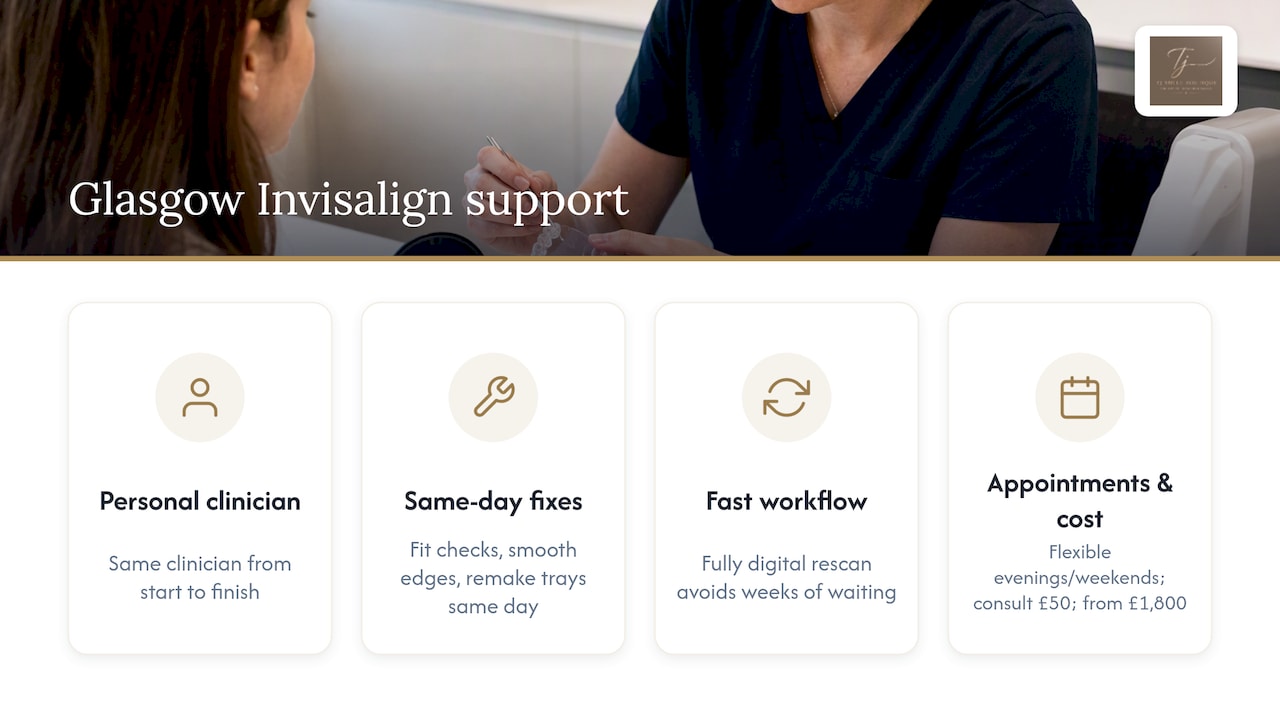
Understanding what normal Invisalign soreness feels like is one thing, and knowing about clear aligners cost and financing options can help you plan for treatment. Having a clinician on hand who can check a fit, smooth an edge or remake a tray the same day is another, and that direct access is what shapes how we run Invisalign treatment. Every plan is led personally by Dr Tashfeen Jamil from your first consultation through to your final aligner, so the same person who mapped out your tooth movements is the one you speak to if a tray feels wrong.
Our fully digital workflow means a rescan or a replacement aligner does not mean weeks of waiting, and flexible appointment times, including evenings and weekends, make it easier to get a quick review without reshuffling your whole week around it. An Invisalign consultation costs £50 and gives you a tailored view of your own treatment plan, including what level of discomfort to expect at each stage given your specific tooth movements.
If you are ready to find out whether Invisalign suits your case, our Invisalign page outlines pricing from £1,800 and what the assessment involves.
This article is general information, not a substitute for advice from a qualified doctor. Consult a qualified healthcare professional about your own circumstances before acting on anything here.
FAQ
What is the most painful stage of Invisalign?
Many patients find the initial alignment stage, typically during the first several days, the most noticeable stage, since teeth are shifting away from an established position for the first time. Stages involving rotation or extrusion can also feel more intense than straightforward alignment, though the pattern varies between individuals.
What is the 30 minute rule for Invisalign?
This generally refers to limiting how long aligners are left out at a time, typically during meals, so that overall daily wear time stays on track. Keeping removals brief matters because consistent wear is what prevents soreness from resetting with each reinsertion.
What is the biggest complaint with Invisalign?
Short-lived soreness after fitting a new aligner is the complaint patients raise most often, alongside occasional rubbing from an attachment or aligner edge against the cheek or lip. Both are normal parts of treatment and usually resolve with simple measures like wax, chewies and standard analgesia.
Does Invisalign pain ever go away?
Yes, soreness from each new aligner typically peaks within the first few days and eases soon afterwards, according to clinical research Pubmed and https://pubmed.ncbi.nlm.nih.gov/38001455/, with the cycle repeating at a milder level as treatment progresses. Pain that does not ease, or that worsens instead of settling, is not typical and should prompt a check with your clinician.
Sources
- Discomfort from Invisalign is generally mild and temporary (systematic review)
- British Orthodontic Society — clear aligners guidance
- Comparison of pain perception, anxiety, and OHRQoL between clear aligners and fixed appliances
- NHS — toothache: when to seek help and how to ease pain
Recommended
This article is general information, not personal dental advice. What’s right for your teeth depends on a clinical examination — the condition of your enamel, gums, bite and any existing dental work — and no article can assess that. Outcomes vary between patients, and all treatment at TJ Smile Studio is subject to assessment and clinical suitability.
- Dr Tashfeen Jamil BDS, MFDS RCS Ed, AssocFCGDent, PGDip Restorative and Aesthetic Dentistry — GDC registration 286427
This article is general information, not personal dental advice. What's right for your teeth depends on a clinical examination — the condition of your enamel, gums, bite and any existing dental work — and no article can assess that. Outcomes vary between patients, and all treatment at TJ Smile Studio is subject to assessment and clinical suitability.
Clinically reviewed by Dr Tashfeen Jamil BDS, MFDS RCS Ed, AssocFCGDent, PGDip Restorative and Aesthetic Dentistry — GDC registration 286427, Principal Dentist at TJ Smile Studio, 1 Spiersbridge Way, Thornliebank, Glasgow G46 8NG.
If you have dental pain, swelling or an injury, call the practice on 07728 808510. Out of hours in Scotland, call NHS 24 on 111.