23 October 2026 · TJ Smile Studio
Teeth Whitening for Smokers: What Works and What to Expect
Can smokers whiten their teeth? What professional whitening does for tobacco stains, how long results last, what it costs in Glasgow and how to protect them.
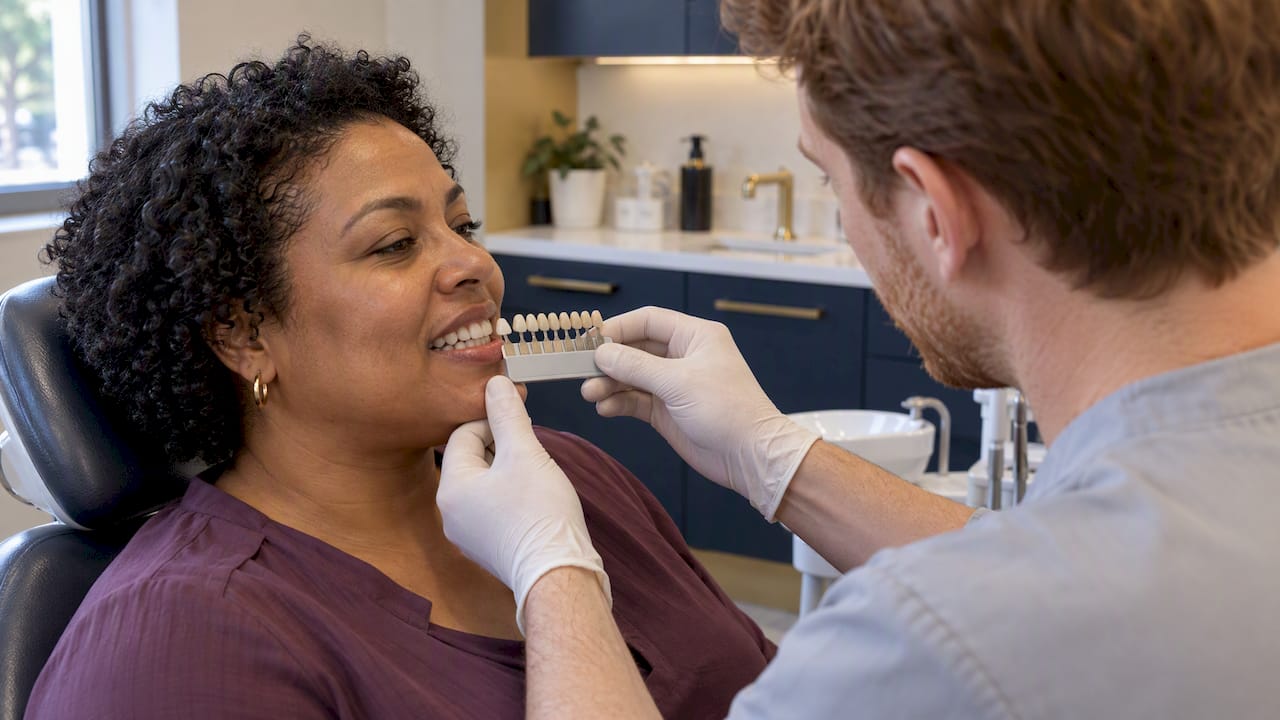
Yes, smokers can whiten their teeth, and professional whitening works on tobacco stains. The honest caveats are that results fade faster if you keep smoking, that supermarket whitening toothpaste will not shift years of nicotine staining, and that in the UK the effective products can only legally come from a registered dental professional. This guide explains what to expect, in what order to do things, and what it costs at our Glasgow studio.
TL;DR
- Professional peroxide whitening gives smokers a colour change comparable to non-smokers, without more sensitivity on average.
- Smoking shortens how long the result lasts, so plan for top-ups and a cleaning before you start.
- Whitening toothpastes, strips and kiosk treatments are the wrong tool for deep tobacco staining, and kiosk whitening is illegal in the UK.
- Whitening does not change veneers or bonding, so sequence matters if you are planning other cosmetic work.
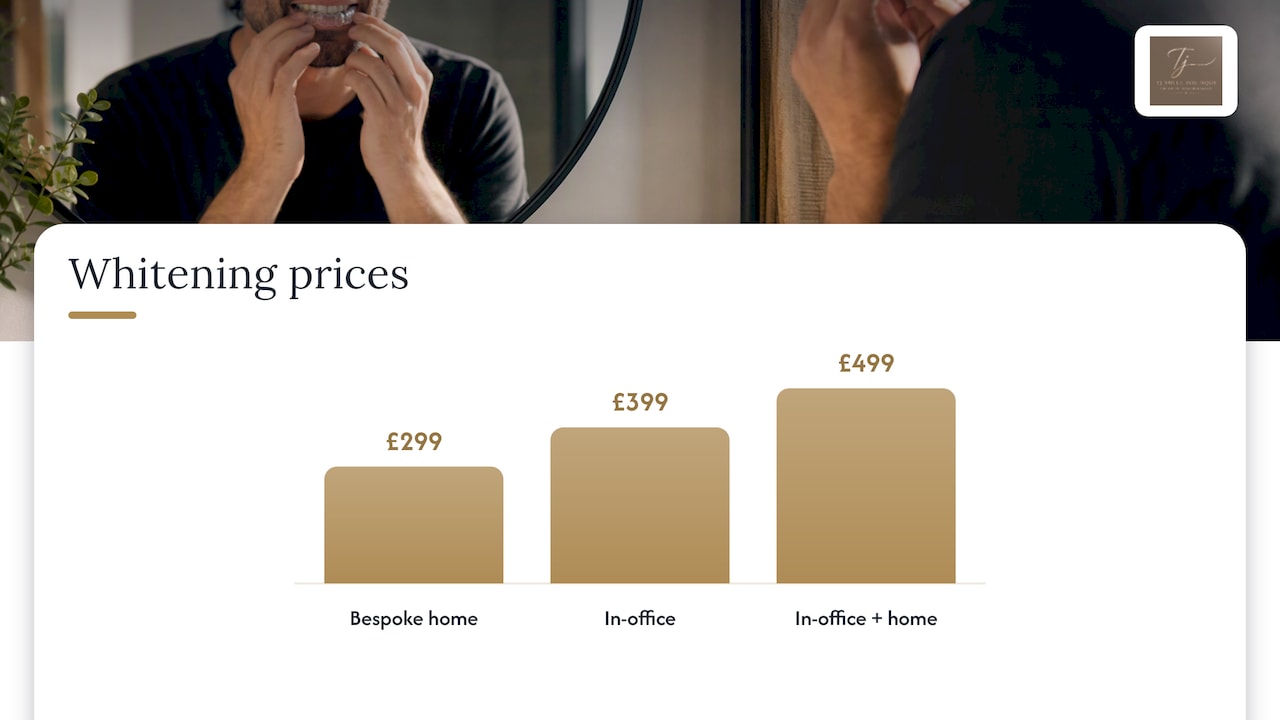
- At TJ Smile Studio, whitening runs from £299 to £499, after a £50 consultation.
Table of Contents
- Why smoking stains teeth in the first place
- Does whitening actually work on smokers’ teeth?
- Why whitening toothpaste is not the answer
- What the law says about whitening in the UK
- The right order: clean, check, whiten
- Home, in-office or both: what suits a smoker
- What to expect, and how long it lasts
- Whitening and other cosmetic work: the two-tone trap
- Keeping the result: a practical routine
- The health conversation we will not skip
- Our perspective
- Whitening at TJ Smile Studio
- FAQ
- Sources
Why smoking stains teeth in the first place
Tobacco leaves two kinds of discolouration. The first sits on the surface: tar and nicotine deposits that build up in the microscopic texture of enamel and in plaque, turning teeth yellow, then brown. The second is deeper, where pigments work into the enamel over years. That is why a smoker’s teeth often look uneven, darker near the gums and between the teeth, where deposits linger.
This split matters because each layer needs a different fix. Surface staining responds to professional cleaning. Deeper staining needs a peroxide gel that breaks pigment molecules down. The best results come from doing both, in that order.
Does whitening actually work on smokers’ teeth?
The research says yes. A multicentre clinical trial of at-home bleaching in smokers and non-smokers found a colour improvement of 4.1 shade guide units after one month, with no meaningful difference in sensitivity between the two groups. Overall, around 47% of participants reported some sensitivity, so it is common whether or not you smoke, and usually temporary.
A more recent prospective study on smoking and at-home bleaching points to where smokers differ: the immediate result is similar, but the colour regresses faster. In other words, smokers are not poor candidates. They are candidates who need a maintenance plan.
What “works” looks like in practice:
- Teeth usually become several shades lighter, though very dark, long-standing staining can take longer or stop short of the brightest shade.
- The result is not permanent for anyone. The NHS says whitening can last up to three years with good care, but smoking is one of the lifestyle factors that cuts that down.
- Results vary person to person, and we will not promise a particular shade before we have examined your teeth.
Why whitening toothpaste is not the answer
The top of the search results is full of “smokers’ toothpastes”. They work by mild abrasion, scrubbing surface stain. The American Dental Association explains that such products do not change the intrinsic colour of the tooth. Using abrasive pastes heavily in the hope of faster results can wear enamel, which is the last thing you want when your teeth are already stained.
A fair role for a good low-abrasion toothpaste is day-to-day upkeep after professional treatment. It is not a substitute for it.
What the law says about whitening in the UK
This is the part that catches people out online. Under the Cosmetic Products (Safety) Regulations 2012, products containing or releasing more than 0.1% hydrogen peroxide may only be supplied to a registered dental practitioner’s patients, after a clinical examination. Anyone legally allowed to use up to 6% hydrogen peroxide has to be a General Dental Council registrant. Local authority trading standards teams repeat the point: only GDC-registered professionals may carry out whitening.
That rules out beauty salons, mall kiosks and most online “strong” kits. The risks include chemical burns and gum damage. Over-the-counter options at or below 0.1% are legal but weak. A 2019 study in the British Dental Journal found that some non-peroxide products caused surface etching and reduced enamel hardness while lightening less than a 10% carbamide peroxide control. For heavy tobacco staining, they are poor value.
The right order: clean, check, whiten
For smokers, sequence has more influence on the result than almost anything else.
- Professional cleaning first. Research on smokers’ bleaching recommends a professional prophylaxis immediately before whitening, because it removes the surface stain that would otherwise leave an uneven starting shade.
- A proper examination. Decay, gum disease or worn fillings should be dealt with before gel goes anywhere near them. Smoking raises the odds of gum disease, which can make teeth more sensitive.
- Whitening itself, at home, in the chair, or both.
- A review and a maintenance plan. This is where smokers gain the most.
Home, in-office or both: what suits a smoker
We offer three routes, and the choice depends on how stained your teeth are and how much time you have. Our fuller comparison is in home vs in-office teeth whitening.
| Option | Price | Best for |
|---|---|---|
| Bespoke Home Teeth Whitening | £299 | Gradual, controlled whitening with custom trays, easy to top up later |
| Professional In-Office Teeth Whitening | £399 | A quick visible lift in one appointment |
| Professional In-Office + Home Teeth Whitening | £499 | Heavier staining, or when you want an immediate lift plus trays for top-ups |
For many smokers, the combined option is the sensible one. The in-office session does the heavy lifting; the custom trays then mean you can refresh the colour when it begins to creep back, without booking a full session. Home whitening on its own also works well: the trial above used at-home bleaching. If you are curious about gel strength and how we build up to it, we explain why we start at CP10% for most patients.
Our teeth whitening in Glasgow page covers the process in more detail.
What to expect, and how long it lasts
Be realistic about three things.
Speed. In-office whitening gives a visible change in a single visit. Home whitening builds over days to a couple of weeks.
Depth. Years of heavy smoking can leave stubborn staining. Whitening will usually improve it markedly, but we would rather tell you in the consultation that you may end up a shade or two short of a “Hollywood” white than let you find out afterwards.
Durability. Because tobacco pigments keep arriving, colour regresses sooner. Our article on how long teeth whitening lasts explains the usual timeline, and for smokers it is best treated as the upper limit. A £35 Whitening Review lets us check the colour and your trays and advise on a top-up before the shade slips far.
Whitening and other cosmetic work: the two-tone trap
Bleach lightens natural tooth structure only. It will not change the colour of porcelain veneers, composite bonding or crowns, as the Canadian Dental Association’s position statement notes. If you whiten around existing restorations, you can end up with a patchy, two-tone smile.
The reverse also applies. Veneers and bonding resist staining, but your natural teeth do not. If you continue to smoke, the teeth around a veneer can darken over time, leaving the restoration looking brighter than its neighbours.
The practical rule: whiten the natural teeth first, let the shade settle, then colour-match any restoration to the new shade. We follow that logic in our piece on whitening before veneers or braces. If you are weighing the two approaches, teeth whitening vs veneers sets out the trade-offs. For a single dark tooth, internal whitening may be an option.
Keeping the result: a practical routine
- Book regular hygiene visits. Professional polishing manages the surface stain that whitening does not address.
- Use your trays for top-ups as advised, rather than improvising with stronger products.
- Go easy on abrasive pastes. Gentle, consistent brushing beats scrubbing.
- Rinse with water after smoking or coffee, and keep tea, red wine and dark sauces from piling on top.
- Reduce or stop smoking, which is the single biggest factor in how long the result lasts.
The health conversation we will not skip
Tobacco staining is a visible sign of what smoking does to the mouth as a whole: gum disease, bad breath and a higher risk of oral cancer. The government’s dental prevention toolkit on smoking advises that the best route to quitting combines specialist behavioural support with medication. Smoking also slows healing, which matters if you are considering surgical treatment later.
If you are in Glasgow and thinking about stopping, Quit Your Way is the free NHS Greater Glasgow and Clyde service for anyone aged 16 and over, with advisors available face to face, by phone or through an app. We will never make whitening conditional on quitting, and we will not lecture you. But if you want to bring it up, we are happy to talk. If you notice a mouth ulcer that has not healed in three weeks, a persistent lump or a white or red patch, see your dentist or GP promptly rather than waiting for a cosmetic appointment.
Our perspective
Patients who smoke often arrive apologetic. They shouldn’t. Staining is a very treatable problem, and the people we see have usually tried a toothpaste or two and wondered why nothing moved.
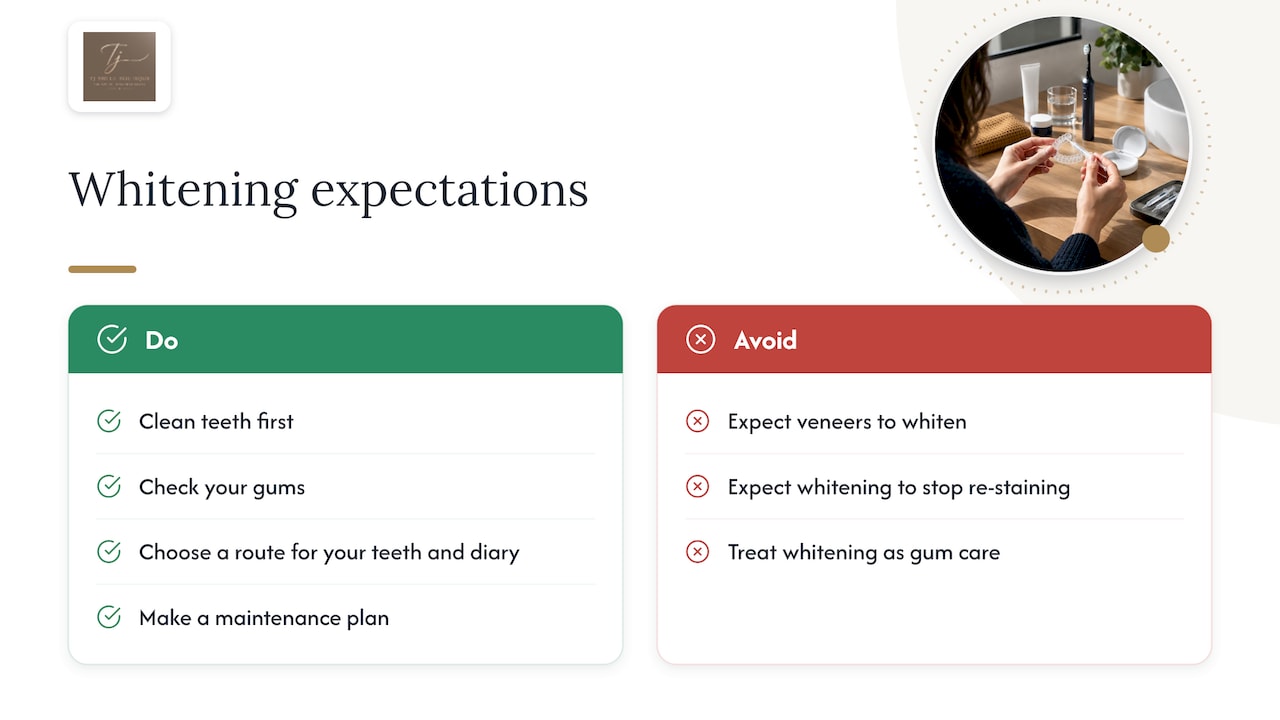
What we do is slow the process down just enough to get it right. Every treatment at the studio is personally led by me, so the person who examines your teeth at the consultation is the person who plans and carries out your whitening. We clean first, check your gums, then choose the route that fits your teeth and your diary, with evening and weekend appointments available for busy schedules.
We also say plainly what whitening cannot do. It will not make veneers lighter, it will not stop tobacco re-staining, and it is not a replacement for good gum health. The patients who are happiest a year later are those who understood that on day one, and who have a maintenance plan. If you smoke and want the best realistic result, that plan is the treatment.
— Dr Tashfeen Jamil BDS, MFDS RCS Ed, AssocFCGDent - GDC 286427
Whitening at TJ Smile Studio
Start with a £50 Smile Consultation. We examine your teeth and gums, discuss how much staining there is and which route suits you, and give you a clear plan. Whitening then costs £299 for bespoke home whitening, £399 for professional in-office whitening, or £499 for in-office plus home. All prices are listed on our pricing page. If whitening turns out to be only part of what you want, we also offer veneers and composite bonding, and we can plan them around your whitened shade.
FAQ
Is it possible to whiten a smoker’s teeth?
Yes. Peroxide whitening supervised by a dentist lightens smokers’ teeth to a similar degree as non-smokers’. The difference is that smokers’ teeth tend to re-stain sooner, so a maintenance plan matters.
How do I keep my teeth white if I smoke?
Have a professional clean before whitening and regular hygiene visits afterwards, and use your custom trays for top-ups as advised. Avoid heavily abrasive toothpastes. Cutting down or stopping smoking will do more for longevity than any product.
What is the best teeth whitening for smokers?
For most smokers, a dentist-supervised course: a professional clean, then in-office whitening, custom home trays or both. We often suggest the combined £499 option for heavier staining, but we confirm the right route at your consultation.
Does whitening toothpaste work on nicotine stains?
Only on the surface, and only a little. Whitening toothpastes work by abrasion rather than changing tooth colour. They will not shift deep tobacco staining, and overusing them can wear enamel.
Sources
- Effectiveness of and tooth sensitivity with at-home bleaching in smokers: a multicentre clinical trial
- The influence of smoking on the effectiveness of at-home bleaching: a prospective clinical study
- Teeth whitening, NHS
- American Dental Association: whitening
- Cosmetic Products (Safety) Regulations 2012
- Tooth whitening, Causeway Coast & Glens Borough Council
- British Dental Journal, 2019 study on over-the-counter whitening products
- Canadian Dental Association position statement on tooth bleaching and whitening
- Delivering better oral health, chapter 11: smoking and tobacco use, GOV.UK
- Quit Your Way, NHS Greater Glasgow and Clyde
Recommended
- Internal Tooth Whitening
- Up to Three Years
- Ease Whitening Sensitivity Within a Week
- Home vs In-Office Teeth Whitening
This article is general information, not personal dental advice. What’s right for your teeth depends on a clinical examination — the condition of your enamel, gums, bite and any existing dental work — and no article can assess that. Outcomes vary between patients, and all treatment at TJ Smile Studio is subject to assessment and clinical suitability.
- Dr Tashfeen Jamil BDS, MFDS RCS Ed, AssocFCGDent, PGDip Restorative and Aesthetic Dentistry — GDC registration 286427
This article is general information, not personal dental advice. What's right for your teeth depends on a clinical examination — the condition of your enamel, gums, bite and any existing dental work — and no article can assess that. Outcomes vary between patients, and all treatment at TJ Smile Studio is subject to assessment and clinical suitability.
Clinically reviewed by Dr Tashfeen Jamil BDS, MFDS RCS Ed, AssocFCGDent, PGDip Restorative and Aesthetic Dentistry — GDC registration 286427, Principal Dentist at TJ Smile Studio, 1 Spiersbridge Way, Thornliebank, Glasgow G46 8NG.
If you have dental pain, swelling or an injury, call the practice on 07728 808510. Out of hours in Scotland, call NHS 24 on 111.