
16 October 2026 · TJ Smile Studio
Repairing Veneers: Act Within an Hour for Teeth; Protect Furniture
Learn what to do when a dental veneer chips or furniture veneer lifts, from saving tooth fragments and avoiding glue to choosing a dentist or conservator.
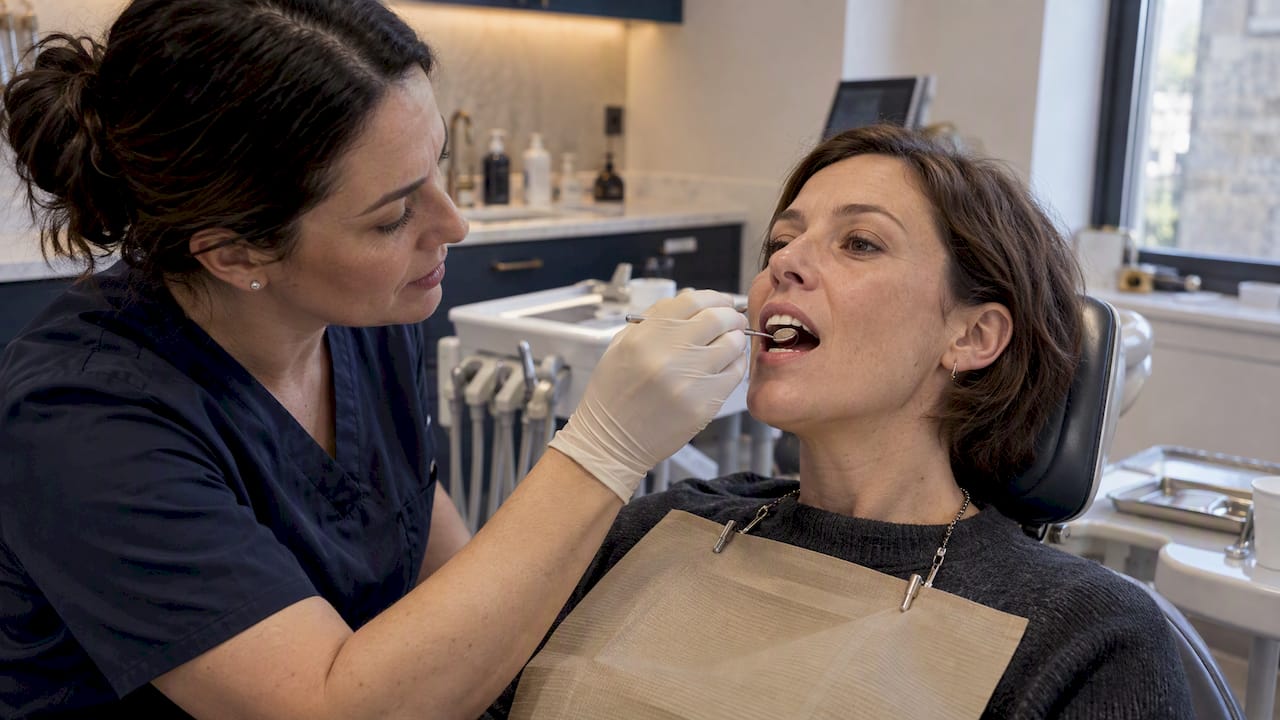
A damaged veneer is usually repairable if you act quickly and avoid DIY fixes. For a tooth, keep any fragment in milk or saliva and see a dentist urgently, because 30 minutes to 1 hour can matter. For furniture, stabilise the loose area and avoid sanding or aggressive glues, especially on antiques.
TL;DR:
- Store a broken fragment in milk or saliva and call a dentist promptly; reattachment may be possible within 30 minutes to 1 hour.
- Composite chips often take fresh resin, but fractured porcelain usually needs replacement; rebonding works only when the veneer is intact and enough enamel remains.
- Seek urgent dental care for severe pain, persistent bleeding, a visible pink or dark spot, swelling, or a loose fragment you could swallow or inhale.
- NHS rules may allow free repair or replacement by the same practice within 12 months in certain circumstances, but exclude private treatment.
- For furniture, avoid sanding thin veneer and stabilize loose areas gently; antiques need reversible hide glue, while swollen or soft base wood needs repair first.
Table of Contents
- What should you do straight after a dental veneer chips or comes off?
- How do dentists repair a damaged veneer?
- Should you repair or replace a damaged veneer?
- When is a broken veneer an emergency, and what happens at the appointment?
- How do you assess damaged veneer on a piece of furniture?
- How do you repair furniture veneer step by step?
- Which adhesive should you use, and when should you call a conservator?
- Who is behind this guidance?
- What does repairing veneers really come down to?
- Can we help if your veneer has chipped or come off?
- FAQ
- Sources
What should you do straight after a dental veneer chips or comes off?
Start by working out what has happened. A small chip on the edge is the most forgiving. A crack running through the veneer is more worrying, and a partial or full debond, where the veneer lifts away from the tooth, needs prompt attention because the tooth underneath is exposed to bacteria and sensitivity.
Then take these steps:
- Keep any fragment or the whole veneer in milk or in your own saliva, never in water or tissue that dries it out.
- Rinse your mouth gently with lukewarm water and press clean gauze on any bleeding.
- Avoid biting on the tooth and steer clear of very hot, cold or sticky food.
- Take your usual over-the-counter pain relief as the packet directs, if you can safely do so.
- Never use superglue or household adhesive. These can irritate the gum, discolour the tooth and make a clean professional repair much harder.
The NHS advice on chipped, broken or cracked teeth says a significant broken piece may sometimes be reattached if it reaches a dentist within about 30 minutes to 1 hour. When you call, expect to be asked about pain, bleeding and whether the fragment is safe. Ring first rather than turning up unannounced, so the team can prepare.
How do dentists repair a damaged veneer?
What we can do depends mostly on what the veneer is made of. For composite veneers and small chips, repair is often straightforward. We add fresh composite resin, shape it to match the neighbouring teeth and polish it. This restores both appearance and function when the damage is limited and the bonding surface is healthy. Our composite bonding service covers exactly this kind of work.
A veneer that has simply come away can sometimes be rebonded. That depends on three checks:
- The veneer is intact, with no hidden cracks.
- The tooth surface can be cleaned and prepared properly.
- Enough sound enamel remains to give a reliable bond.
If any of those fail, rebonding is a short-term fix at best.
Porcelain is less forgiving. Because it cannot be reshaped chairside the way resin can, a fractured porcelain veneer is more often replaced than patched, although minor chips can sometimes be polished smooth. A retrospective study of feldspathic ceramic veneers found a 91.77% survival rate at seven years, with most failures down to fracture or chipping, and some minimal chipping managed by polishing alone.
Cause matters too. If you clench or grind your teeth, a repair can fail again quickly. Dental treatment guidance from the NHS notes that habits such as bruxism strongly affect how veneers perform, and a night-time splint can protect the work. We cover this further in our post on veneers and bruxism.
Worth knowing: Chipping is the most common complication of porcelain veneers, at roughly 4% over five years, according to a systematic review and meta-analysis.
Should you repair or replace a damaged veneer?
There is no single rule, but dentists weigh a handful of factors:
- Material: composite repairs easily, porcelain often needs replacing.
- Extent of damage: a small edge chip is a different job from a cracked or missing veneer.
- What lies beneath: bonding to enamel holds far better than bonding to exposed dentine.
- Repair history: a veneer that has been patched several times may be better replaced.
- Your habits: grinding, nail biting and chewing hard objects all raise the odds of repeat failure.
The long-term evidence helps set expectations. The same meta-analysis of veneer survival reports porcelain veneers commonly surviving above 90% after 7 to 10 years, while composite veneers show lower long-term survival and more fracture and wear over a decade. That does not make composite a poor choice, since it is cheaper and easier to fix, but it explains why repeated repairs can add up. Our comparison of composite vs porcelain veneers goes into this in more detail.
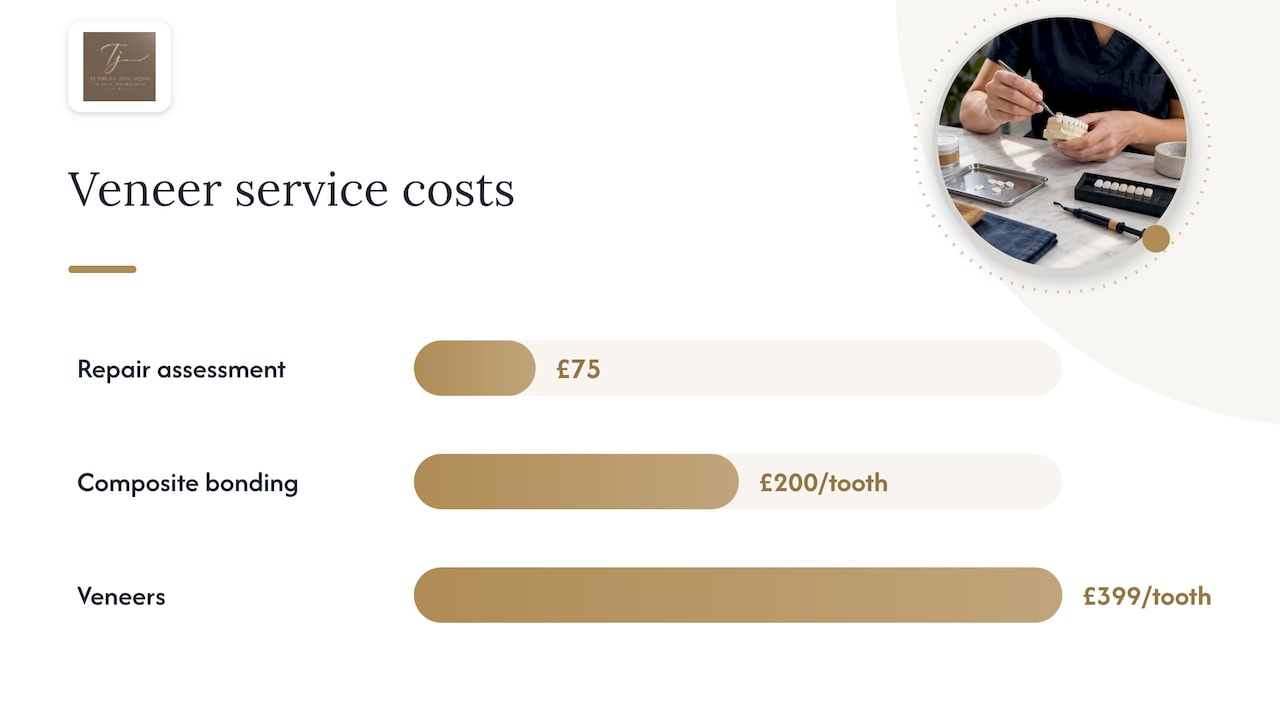
On cost, our own repair assessment is listed at £75, and composite bonding starts from £200 per tooth, and veneers start from £399 per tooth. On the NHS side, rules allow free repair or replacement of a veneer by the same practice within 12 months in certain circumstances, and NHS cover does not apply to private treatment. Whichever route you take, ask what follow-up is included and whether any guarantee applies.
When is a broken veneer an emergency, and what happens at the appointment?
Seek urgent help if you notice any of the following:
- Severe pain or bleeding that will not settle.
- A visible pink or dark spot in the tooth, which can mean the pulp is exposed.
- A loose piece you might swallow or inhale.
- Swelling in the gum or face.
At an urgent visit the dentist will assess the tooth and the veneer, then protect the area so it is comfortable. Often that means a composite repair. Where replacement is needed, we agree a plan, and our emergency cosmetic appointment exists for exactly this situation. Our own guide explains what to do if a veneer breaks.
To make the visit count, bring the fragment in milk, photos of the damage, and a note of what treatment you have had before.
How do you assess damaged veneer on a piece of furniture?
Furniture veneer damage can take several forms, and you can often tell them apart by eye and touch:
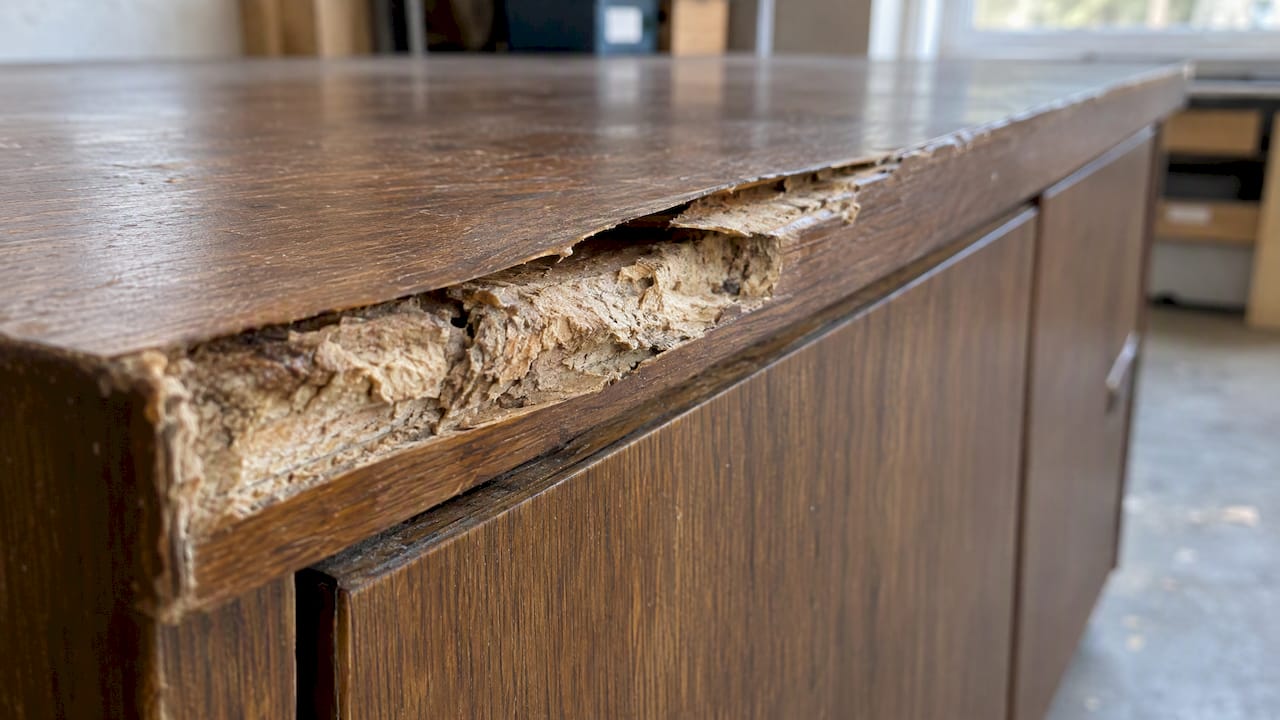
- Blister or bubble: a raised, hollow-sounding patch where the glue has failed under the surface.
- Lifting edge: a corner or edge that has curled away from the base wood.
- Chip: a small piece broken from the surface, with the base still intact.
- Missing patch: a gap where the veneer has gone completely.
Whatever you find, the first move is to stop it getting worse. Keep the piece away from damp and heat, and weight a loose area gently so it does not catch and tear further. Do not sand, because veneer is often thinner than a sheet of card and sanding can cut straight through it.
Check the base too. If the wood beneath is swollen, crumbling or soft, a surface fix will not hold, and the substrate needs dealing with first.
How do you repair furniture veneer step by step?
For a loose area, work through these steps:
- Clean out dust and old glue from under the lifted section with a thin blade.
- Work a thin layer of suitable glue underneath with a palette knife or a fine syringe.
- Press the veneer flat, cover it with greaseproof paper to protect it, and clamp or weight it with a flat board.
- Wipe away squeezed-out glue with a damp cloth and leave it to cure fully.
For a missing section, cut a patch from matching veneer, trying to follow the grain direction. Cut the damaged area to a clean shape, trace it onto the patch, trim to fit, then glue it in and press it flat. A neatly shaped patch often hides better than a jagged repair. Small chips can be filled with a colour-matched filler and finished with stain.
Pro Tip: Be patient with the clamping. Rushing the cure time is the most common reason a repair lifts again or shows a visible ridge.
For large areas, a veneer press or vacuum clamping gives more even pressure than books or weights, which helps avoid bubbles. Practical advice from a veneer supplier’s repair guide also recommends stabilising the surrounding substrate before patching and levelling with planes or scrapers, taking care not to sand through aged patina.
Which adhesive should you use, and when should you call a conservator?
The adhesive you choose can decide whether a future repairer thanks you or curses you. Conservators favour animal or hide glue for antique veneer because it is water-soluble and reversible, as set out in NHS-hosted guidance listed on dental services. Modern permanent adhesives, strong epoxies in particular, can form bonds that cannot be undone and complicate later restoration.
A simple way to decide:
- Modern furniture of little historic value: a good wood glue is usually fine and easier to work with.
- Antiques or pieces with sentimental value: use reversible hide glue, or leave the job to someone who does.
- Mixed or unknown age: assume it matters and go gently.
Call a conservator or an experienced cabinetmaker if the piece has historic value, if a large area needs replacing, or if the structure itself is unstable.
Who is behind this guidance?
This guide is written by Dr Tashfeen Jamil. At TJ Smile Studio, our services relevant to this topic include emergency cosmetic appointments, composite bonding, veneers and same-day hybrid veneers. You can read more in our posts on veneer lifespan and same-day composite repair.
What does repairing veneers really come down to?
Most advice on this topic treats repair as a technique problem. I think it is mostly a timing and honesty problem. With teeth, prompt action can help preserve your options, and no amount of clever bonding rescues a tooth that has been left in water. With furniture, the worst damage I would expect comes not from the original fault but from the eager fix: the sanded-through patina, the epoxy that cannot be undone.
The conventional wisdom also falls short on cost. A cheap patch that fails twice is not cheap. Where a porcelain veneer has fractured, or a composite one has been repaired repeatedly, replacement is often the more economical decision, and it is worth asking the question openly at your consultation.
What should you do first? Stop, protect and assess. Do not glue, sand or experiment, and get a professional opinion when the piece matters, whether it is a front tooth or a family heirloom.
— Dr Tashfeen Jamil BDS, MFDS RCS Ed, AssocFCGDent - GDC 286427
Can we help if your veneer has chipped or come off?
If a veneer has chipped, cracked or come away, we can assess it and tell you plainly whether repair or replacement makes sense. We offer:
- A composite repair assessment at £75.
- Composite bonding from £200 per tooth, and veneers from £399 per tooth.
- Same-day hybrid veneers from £2,995 where a quick replacement is the right answer.

At the visit we examine the tooth and discuss options and costs. To book, see our pricing page or our veneers service page and arrange an appointment.
This article is general information, not a substitute for advice from a qualified doctor. Consult a qualified healthcare professional about your own circumstances before acting on anything here.
FAQ
Can a dental veneer be repaired?
Yes, often. Small chips in composite veneers can usually be repaired in one visit, and some minor chips in porcelain can be polished. Where porcelain has fractured more seriously, replacement is often the better option.
How can I fix damaged veneer on furniture?
Stabilise the damage first, then re-glue loose areas, patch missing sections with matching veneer, or fill small chips. Avoid sanding and use reversible hide glue on antiques.
How much does it cost to repair a veneer?
It depends on the extent of the damage. At our clinic a composite repair assessment is £75 and composite bonding starts from £200 per tooth, with full pricing on our pricing page.
Can veneers be reattached?
Sometimes. If the veneer is intact and the tooth surface is healthy, rebonding may be possible, and the NHS advises getting dental care within about 30 minutes to 1 hour for a significant broken piece.
Sources
- [Chipped, broken or cracked tooth
- Retrospective Long-Term Clinical Outcome of Feldspathic Ceramic Veneers - PMC
- Faq
Recommended
This article is general information, not personal dental advice. What’s right for your teeth depends on a clinical examination — the condition of your enamel, gums, bite and any existing dental work — and no article can assess that. Outcomes vary between patients, and all treatment at TJ Smile Studio is subject to assessment and clinical suitability.
- Dr Tashfeen Jamil BDS, MFDS RCS Ed, AssocFCGDent, PGDip Restorative and Aesthetic Dentistry — GDC registration 286427
This article is general information, not personal dental advice. What's right for your teeth depends on a clinical examination — the condition of your enamel, gums, bite and any existing dental work — and no article can assess that. Outcomes vary between patients, and all treatment at TJ Smile Studio is subject to assessment and clinical suitability.
Clinically reviewed by Dr Tashfeen Jamil BDS, MFDS RCS Ed, AssocFCGDent, PGDip Restorative and Aesthetic Dentistry — GDC registration 286427, Principal Dentist at TJ Smile Studio, 1 Spiersbridge Way, Thornliebank, Glasgow G46 8NG.
If you have dental pain, swelling or an injury, call the practice on 07728 808510. Out of hours in Scotland, call NHS 24 on 111.