
08 November 2026 · TJ Smile Studio
Whitening and Coffee: How Long to Wait and How to Protect Your Smile
Can you drink coffee after teeth whitening? What the research says, how long to wait, and practical ways to keep your whitened smile bright if you love coffee.

You can keep drinking coffee after teeth whitening, but the first couple of days are when it pays to be careful. Most UK dentists suggest leaving dark drinks alone for around 48 hours, and the research shows why a sensible pause is worth it: a randomised clinical trial found that coffee consumed after bleaching affected the result, even though coffee during the treatment period did not. After that window, a few small habits let you enjoy your flat white and keep the shade you paid for.
This guide explains what coffee does to teeth, how long to wait, what the studies really say, and what to do if you cannot face a morning without a cup.
TL;DR
- Plan to avoid coffee, tea and other dark drinks for about 48 hours after whitening, and follow the exact advice your own dentist gives you.
- Coffee contains colour compounds that bind to the tooth surface, so staining is a real, if gradual, risk, especially in the early days.
- If you do have a cup, use a straw where practical, add milk if you like it that way, and rinse with water afterwards.
- Daily coffee drinkers can still whiten their teeth, and the results can last for years with good aftercare and regular check-ups.
- Whitening in the UK must be prescribed by a dentist and provided by a registered professional.
Table of Contents
- Why coffee stains teeth
- How long to wait before your first coffee
- Do you really need a “white diet”? What the research says
- How to enjoy coffee and keep your results
- How long do whitening results last for a coffee drinker?
- Can you whiten your teeth if you drink coffee every day?
- Why whitening should be done by a dental professional
- Our perspective on coffee and whitening
- Whitening at TJ Smile Studio in Glasgow
- FAQ
- Sources
Why coffee stains teeth
Coffee is rich in chromogens, tannic acids and chlorogenic acids. Laboratory research on coffee-stained teeth describes how the acids roughen the enamel surface while the chromogens bind to the thin protein film (the pellicle) that coats it. The result is a yellow-brown layer that builds up cup by cup.
This is why the NHS lists regularly having drinks such as coffee, tea or red wine as a common cause of teeth becoming darker. The Oral Health Foundation says the same: tea, coffee, red wine and smoking can make staining return more quickly after whitening.
A few details are worth knowing:
- Milk changes the picture. A 2022 study found that coffee with milk still stained teeth compared with water, but milk altered the stain layer and made it less resistant to brushing, so it came off more easily.
- Coffee is not the worst offender. In a 2014 laboratory study on bleached teeth, coffee caused less colour change than a cola-based drink at every time point from 10 minutes to 72 hours. It still produced a measurable change, though.
- Coffee is not the same as an acid drink. A 2011 study found that coffee did not reduce enamel surface hardness, unlike soft drinks, sports drinks and juices. Other work points the other way on enamel, so the colour is the more reliable concern.
How long to wait before your first coffee
The most common advice from UK clinics is to wait at least 48 hours after whitening before having coffee, tea, red wine or other strongly coloured foods and drinks. This is guidance rather than a law of nature, and the precise window depends on your treatment, your enamel and your dentist’s instructions.
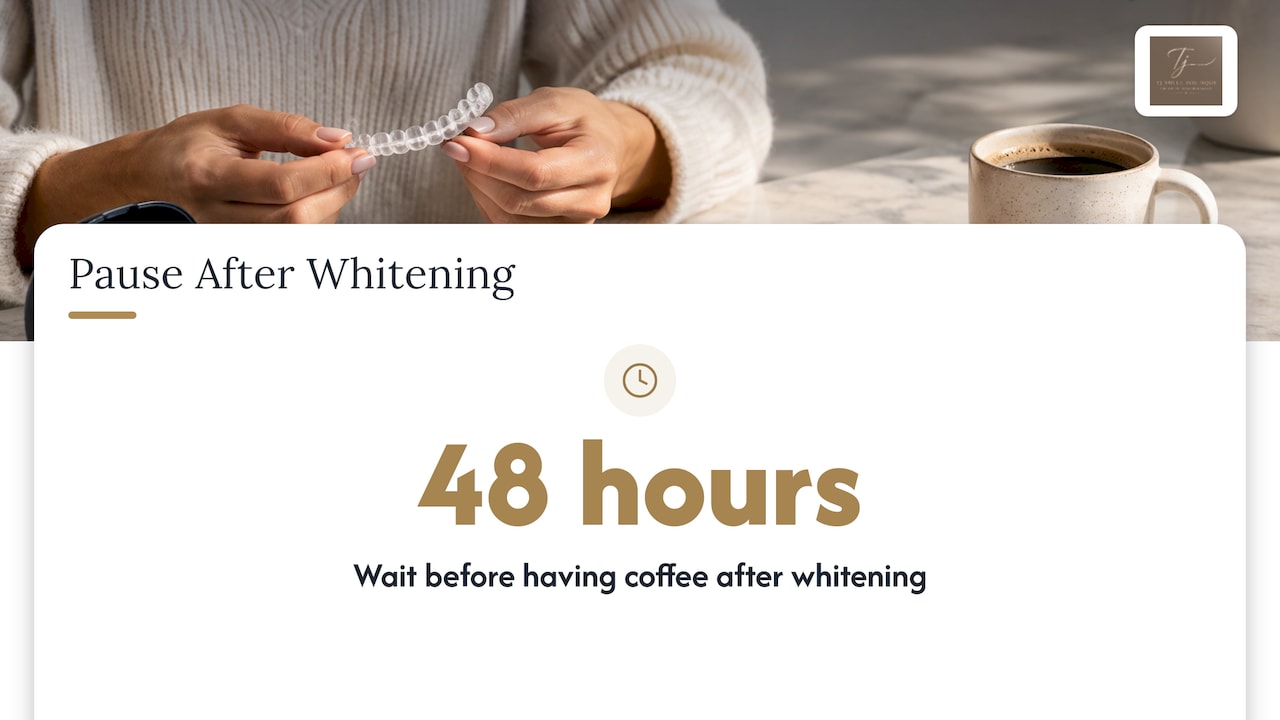
The reasoning is simple. Right after whitening, your teeth are freshly cleaned and, for a short while, many people feel they are more receptive to pigment. Whether or not that is the whole mechanism, the clinical trial above supports the practical point: coffee in the period after treatment is what mattered, not coffee during the course.
What about the “two-hour coffee rule”?
You may have seen a two-hour rule mentioned online. We would not rely on it as a universal standard. We have not found an authoritative UK source that sets it down for every treatment, and different whitening systems, from a home tray kit to an in-chair session, carry different aftercare instructions. Treat any single number as a minimum at best, and go with the written aftercare from the dentist who treated you. If you are unsure, ask at your whitening review, which is a short check-in rather than a full appointment.
The “white shirt” test
A handy way to judge what to avoid in the early days: if it would stain a white T-shirt, it can stain your teeth. An NHS pharmacy dental fact sheet uses exactly this idea, naming red wine, tomatoes and curries alongside the usual suspects. Coffee and tea sit firmly on that list.
In the first 48 hours, that means choosing:
- Water, as your main drink
- Clear or pale options such as lightly flavoured water, if your dentist is happy with them
- Foods like white fish, chicken, rice, pasta, potatoes, cauliflower and bananas
And steering clear of:
- Coffee, black tea, cola and red wine
- Curry, tomato sauces, soy sauce and balsamic vinegar
- Berries, beetroot and dark chocolate
- Smoking and vaping, which stain and are bad for your gums
Do you really need a “white diet”? What the research says
Here the evidence is more nuanced than many online guides suggest, and an honest article should say so.
Two 2024 systematic reviews looked at whether restricting your diet changes the outcome of bleaching. One network meta-analysis of seven clinical studies found that drinking coffee, cola, black tea, grape juice or red wine did not significantly affect bleaching effectiveness compared with a strict white diet. Another review, in the journal Foods, concluded that a white diet is not mandatory and that restricting diet did not significantly improve in-office results at one month.
So why do dentists still advise caution? A few reasons:
- Those studies measure the whitening effect itself. They do not tell you how quickly everyday staining builds up over months of daily coffee.
- Not every trial agrees. The randomised trial mentioned earlier concluded that clinicians should advise patients to refrain from coffee, at least to some extent, after bleaching.
- Caution costs very little. Two days without coffee is a small trade for protecting an investment in your smile.
The practical reading: you do not need a monastic diet for two weeks, but a short, sensible pause followed by good habits is a low-effort way to get the most from your treatment. Pay particular attention to the first two days, then relax into a routine.
How to enjoy coffee and keep your results
Once the first window has passed, you do not have to give up coffee. These habits help.
Drink it in one go, not all morning
Sipping the same mug for two hours bathes your teeth in pigment again and again. A cup finished in 15 to 20 minutes gives staining compounds far less time to settle.
Rinse with water straight afterwards
Swill plain water around your mouth after your coffee. It dilutes pigment and washes away residue. Wait about 30 minutes before brushing, because brushing straight after an acidic drink can be harsh on softened enamel.
Use a straw for iced coffee
A straw cuts contact with your front teeth, which is where stains are most visible. It works best with iced drinks and is less practical for a hot latte.
Choose your coffee style
Black coffee is not the only culprit. Milky coffees stain too, but as the research above showed, a milk-based stain adheres less firmly. Sugary syrups add a different problem for your gums and enamel, so keep them occasional.
Brush well and keep up your hygiene
The Oral Health Foundation notes that good brushing and regular professional cleaning help maintain a whitening result. Brush twice a day with fluoride toothpaste, clean between your teeth daily, and see your dentist or hygienist as often as they recommend.
Consider a stain-fighting toothpaste
In a 2024 laboratory study, a toothpaste containing sodium hexametaphosphate recovered more of the lost lightness in coffee-stained samples, about 81% compared with roughly 71% for peroxide and bicarbonate pastes. That was in a lab on prepared specimens, so treat it as a promising hint rather than a guarantee. Your dentist can suggest a paste that suits your teeth.
Use your top-up trays as advised
If your whitening included custom trays, your dentist may suggest an occasional top-up. Our guides to post-whitening care and how long whitening lasts go through typical routines.
How long do whitening results last for a coffee drinker?
The NHS says whitening is not permanent, but the effect may last around three years if you follow your dentist’s advice. A heavy daily coffee habit will usually shorten that, because the pigment builds up faster. The British Dental Association adds that results and long-term stability vary with the type of stain, your age, the concentration of the active agent and the treatment time and frequency.
That is why a coffee drinker’s best strategy is not avoidance forever, but maintenance: a gentle top-up now and then and regular cleaning, rather than waiting until your teeth have visibly darkened again.
Can you whiten your teeth if you drink coffee every day?
Yes. The NHS says whitening may be worth considering when teeth have become stained or darker from regularly having drinks like coffee. Coffee staining is largely extrinsic, which means it sits on or near the surface, and that tends to respond well to professional whitening.
A few points apply before you start:
- Your dentist should check that your teeth and gums are healthy first. The NHS advises this because whitening can cause sensitivity to cold or sweet food and drink, sore gums or throat, and white patches on the gums. If you are prone to sensitivity, read our guides on whitening for sensitive teeth and easing sensitivity within a week.
- Whitening cannot change the colour of crowns, veneers or fillings, so tell your dentist what restorations you have.
- Under 18s cannot be treated with these products. The GDC confirms that products releasing between 0.1% and 6% hydrogen peroxide cannot be used on anyone under 18.
Why whitening should be done by a dental professional
In the UK, tooth whitening counts as dentistry. The General Dental Council states that a dentist must prescribe it, and it can be provided by a dentist or by a registered hygienist, dental therapist or clinical dental technician on the dentist’s prescription. Anyone not registered with the GDC who offers it is breaking the law. The BDA adds that products with 0.1% to 6% hydrogen peroxide can only be supplied via a registered dental professional.
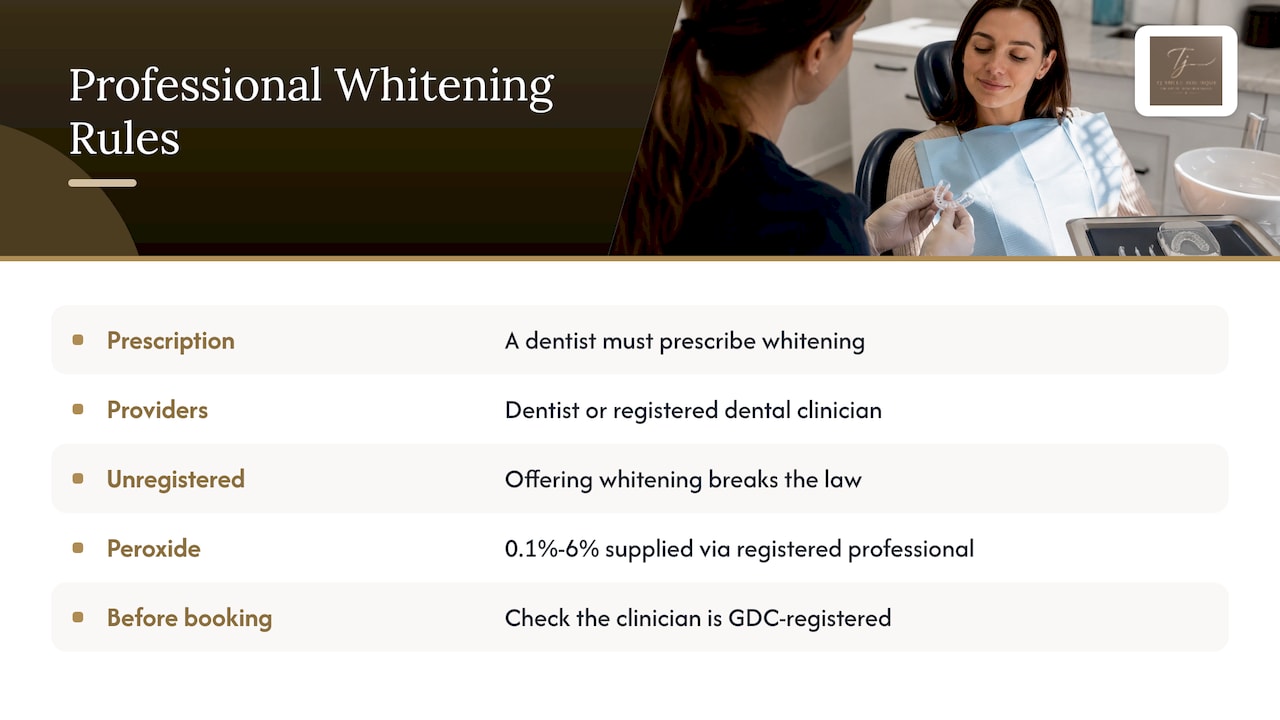
So before booking, check that the person treating you is on the GDC register. If you are comparing professionally provided whitening options, look for the same fundamentals: an examination first, a clinician who explains aftercare, and a choice between in-chair and take-home approaches. Our own page on whitening safety explains what to expect, and the guide to home versus in-office whitening helps you choose between them.
Our perspective on coffee and whitening
At TJ Smile Studio, we see plenty of coffee lovers, and we never ask anyone to give up their morning cup for life. What we do ask is for a little planning around the first 48 hours.
Every whitening plan we design is personal. We look at your enamel, your sensitivity, your habits and your schedule, then recommend a treatment and an aftercare routine that fits. A commuter who drinks three flat whites before noon needs different advice from someone who has one espresso a week.
Because each treatment is personally led by me from consultation to completion, you get one consistent set of instructions rather than a leaflet. That includes when to have your first coffee, how to rinse, and when a top-up makes sense. We offer evening and weekend appointments, so you can book your whitening before a quiet couple of days rather than squeezing it into a busy working week.
Whitening works best as part of a wider plan. If coffee has also left you unhappy with the shape or edges of your teeth, we can talk through bonding, veneers or aligners at the same visit.
Dr Tashfeen Jamil BDS, MFDS RCS Ed, AssocFCGDent - GDC 286427
Whitening at TJ Smile Studio in Glasgow
If coffee has dulled your smile, we offer three whitening routes at our Glasgow studio, each with a bespoke plan from Dr Jamil:
- Bespoke Home Teeth Whitening: £299
- Professional In-Office Teeth Whitening: £399
- Professional In-Office + Home Teeth Whitening: £499
A Smile Consultation is £50, and a Whitening Review is £35. You can see every price on our pricing page, and read about the treatment itself on our teeth whitening in Glasgow page.
We will tell you exactly when your first coffee is safe for your chosen treatment, and what to do if you have a deadline-heavy week. If your teeth are stained from within, rather than by coffee, our guide to internal tooth whitening explains the alternative, and how dentists grade tetracycline teeth covers a more complex case.
FAQ
Can I drink coffee after teeth whitening?
Yes, but not straight away. Most dentists advise waiting about 48 hours, and a clinical trial found that coffee after bleaching did affect the result. After that, enjoy it with the habits above and follow your dentist’s own aftercare.
Can I eat after teeth whitening?
Yes. Choose pale, non-staining foods for the first couple of days: chicken, white fish, rice, pasta and potatoes. If it would stain a white shirt, avoid it for now. If your teeth feel sensitive, pick lukewarm rather than very hot or cold food.
Can yellow teeth become white again?
Often, yes, if the yellowing is surface staining or natural darkening. The NHS says whitening can lighten teeth that have become darker from drinks like coffee, though results vary and it is not permanent. A dentist should check your teeth first to confirm the cause.
Does decaf coffee stain teeth?
Decaf still contains many of the same colour compounds, so we would treat it like regular coffee in the first 48 hours. Afterwards, the same rinsing and brushing habits apply.
Sources
- Short-term effects of stain-causing beverages on tooth bleaching (randomised clinical trial)
- Effect of coffee and a cola-based soft drink on the colour of bleached teeth
- Whitening efficacy of toothpastes on coffee-stained teeth (PMC)
- Whitening efficacy of toothpastes on coffee-stained teeth (ScienceDirect)
- The impact on dental staining caused by beverages
- Analysis of the erosive effect of different dietary substances and medications
- Teeth whitening, NHS
- Tooth whitening, Oral Health Foundation
- Tooth whitening, British Dental Association
- White diet is not necessary during dental bleaching (systematic review)
- Is a white diet necessary for tooth bleaching procedures?
- NHS pharmacy dental fact sheet: tooth whitening
- Tooth whitening and illegal practice, General Dental Council
- General Dental Council FAQ on whitening products and under 18s
- Professionally provided teeth whitening options
Recommended
This article is general information, not personal dental advice. What’s right for your teeth depends on a clinical examination — the condition of your enamel, gums, bite and any existing dental work — and no article can assess that. Outcomes vary between patients, and all treatment at TJ Smile Studio is subject to assessment and clinical suitability.
- Dr Tashfeen Jamil BDS, MFDS RCS Ed, AssocFCGDent, PGDip Restorative and Aesthetic Dentistry — GDC registration 286427
This article is general information, not personal dental advice. What's right for your teeth depends on a clinical examination — the condition of your enamel, gums, bite and any existing dental work — and no article can assess that. Outcomes vary between patients, and all treatment at TJ Smile Studio is subject to assessment and clinical suitability.
Clinically reviewed by Dr Tashfeen Jamil BDS, MFDS RCS Ed, AssocFCGDent, PGDip Restorative and Aesthetic Dentistry — GDC registration 286427, Principal Dentist at TJ Smile Studio, 1 Spiersbridge Way, Thornliebank, Glasgow G46 8NG.
If you have dental pain, swelling or an injury, call the practice on 07728 808510. Out of hours in Scotland, call NHS 24 on 111.