
17 September 2026 · TJ Smile Studio
Wait 4–6 Weeks: How UK Patients Safely Whiten After Braces
Dentist led plan for UK patients: wait 4–6 weeks, treat white spot lesions first, then use custom trays or in clinic whitening to avoid patchy results.

Yes, you can whiten your teeth after braces, but not straight away. Most dentists advise waiting a minimum of 4 to 6 weeks after debonding, and up to 3 months where there’s residual adhesive, sensitivity, or white spot lesions. The first step isn’t a whitening kit. It’s a dental assessment with a General Dental Council (GDC)-registered dentist, since whitening must legally be prescribed or supervised by one.
TL;DR:
- Waiting at least 4 to 6 weeks after debonding is essential to allow enamel rehydration and gum recovery before whitening.
- Residual adhesive, surface stain, white spot lesions, and sensitivity all require assessment and different treatments prior to bleaching.
- Custom take-home trays offer the most even and safe whitening for teeth with uneven shades or residual demineralization.
- In-practice power whitening provides faster results but increases the risk of sensitivity and may be less suitable shortly after braces removal.
- White spot lesions do not respond to whitening and often need remineralisation or restorative treatments to prevent uneven aesthetics.
Table of Contents
- Why teeth look patchy or yellow after braces
- How long should you wait, and what are the risks?
- Which whitening method actually suits post-braces teeth?
- Spotting and treating white spot lesions before you whiten
- Keeping your smile bright after whitening
- How TJ Smile Studio approaches whitening after braces
- The mistake most post-braces whitening advice makes
- Ready to whiten safely after braces?
- Where to check the rules and the clinical detail
- Sources
- FAQ
Why teeth look patchy or yellow after braces
That first glimpse of your teeth without brackets rarely matches expectations. Instead of a uniform shade, most people see patches, a duller tone than hoped for, or chalky white marks scattered around where the brackets sat. None of that means something has gone wrong. It’s the combined result of several ordinary processes finally becoming visible.
Plaque tends to build up around bracket bases throughout treatment, since brushing around fixed appliances is genuinely harder than brushing a clear run of enamel. That plaque causes surface staining that’s been hidden by the hardware for months, sometimes years. Then there’s the adhesive itself: small amounts of bonding resin often remain on the tooth surface after debonding until a dentist polishes it away, and until that happens, the tooth can look uneven under normal light.
Enamel also dehydrates slightly during the debonding process. This changes how light reflects off the tooth in the days immediately after braces come off, so a shade that looks off on day one often settles closer to normal within a couple of weeks as the enamel rehydrates.
The one that catches people out is white spot lesions: patches of demineralised enamel that look chalky rather than shiny, usually clustered where brackets sat closest to the gumline.
- Plaque accumulation around brackets causes extrinsic staining that becomes visible once appliances are removed
- Leftover adhesive residue creates a patchy, two-tone appearance until it’s professionally polished off
- Enamel dehydration temporarily distorts the apparent shade, correcting itself over days to weeks
- White spot lesions are actual mineral loss in the enamel, not surface stain, and they respond to different treatment than the rest
Knowing which of these you’re dealing with matters because staining and demineralisation aren’t solved the same way. Whitening lifts surface stain. It does nothing for a white spot lesion, and in some cases can make the contrast between healthy and demineralised enamel more obvious. That’s the crux of getting the timing and the method right.
How long should you wait, and what are the risks?
The safe window isn’t arbitrary. Clinicians commonly point to a minimum of 4 to 6 weeks after debonding before starting any bleaching treatment, with up to 3 months advised where adhesive removal, sensitivity, or white spot lesions are involved. That gap gives your enamel and gums time to properly recover.
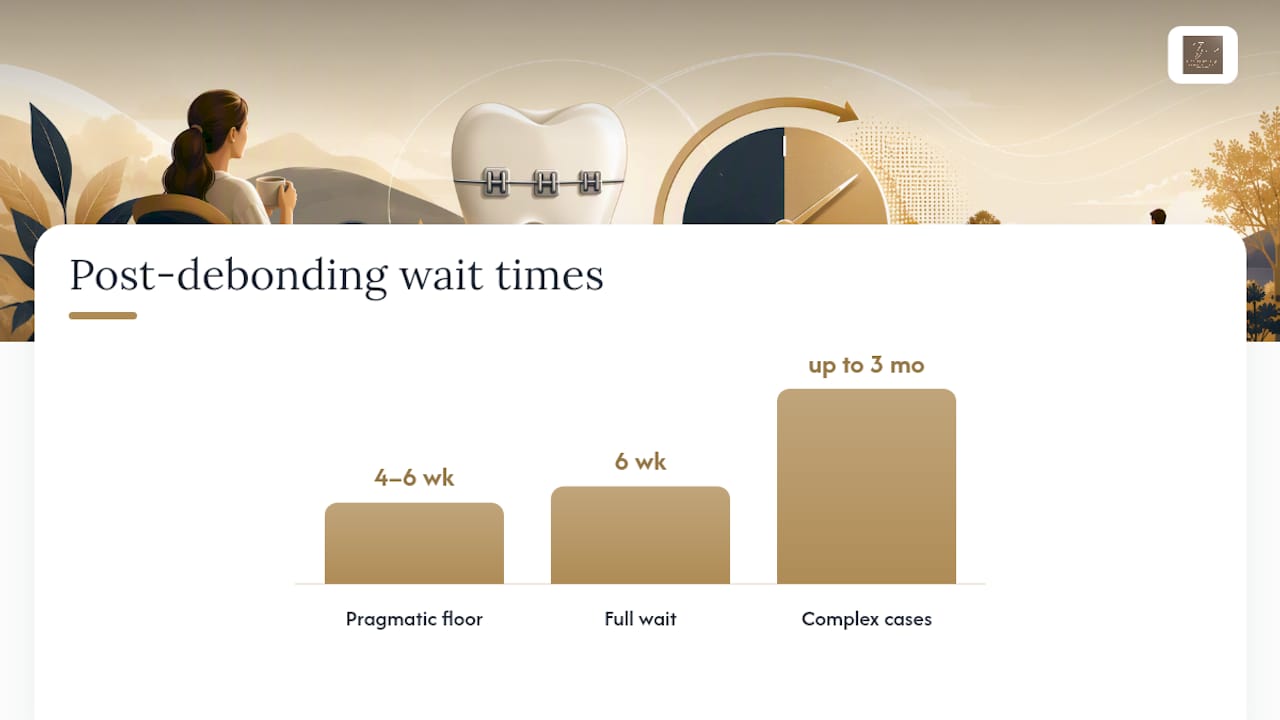
Statistic snapshot: clinical guidance published on waiting periods after orthodontic treatment treats 4 to 6 weeks as the pragmatic floor, not a hard rule. Waiting periods flex depending on enamel condition, residual sensitivity, and how much adhesive residue remains, according to a related clinical review.
Rushing whitening before that window closes causes three specific problems. First, enamel that’s still dehydrated bleaches unevenly, since the whitening gel reacts differently with tissue that hasn’t fully rehydrated. Second, any adhesive residue left on the tooth blocks the gel in patches, so you end up with a genuinely blotchy result rather than a uniform one. Third, gums that are still inflamed from months of bracket friction are far more prone to irritation from peroxide gel.
Watch for these signs that mean you should see a dentist before touching any whitening product:
- Rough, chalky white patches that feel different in texture to the surrounding enamel
- Gums that bleed easily or look swollen around former bracket sites
- Noticeable tooth sensitivity that hasn’t settled weeks after debonding
- Visible adhesive remnants still stuck to the tooth surface
If none of those apply and your dentist gives the go-ahead, waiting the full 6 weeks (or the full 3 months for more complex cases) tends to produce a far more even result than jumping in early. A dentist consultation at this stage isn’t a formality. It’s the difference between a clean, uniform outcome and a patchy one you’ll want to fix later.
Which whitening method actually suits post-braces teeth?
Not every whitening method behaves the same way on teeth that have just come out of fixed appliances, and the differences matter more here than in a general “which whitening kit is best” comparison. Newly aligned teeth often carry uneven surface texture, residual demineralisation, and a wider range of shade variation across the arch than teeth that have never had brackets on them.
Whitening toothpaste and rinses work on surface stain only, using mild abrasives or low concentrations of peroxide. They’re genuinely useful during orthodontic treatment itself, since low-abrasion formulas help control staining around brackets without any bleaching risk. Once braces are off, they can maintain results but won’t shift the deeper shade change most people want.
Over-the-counter strips and gels can lighten a few shades and they’re accessible, but they’re a poor first move straight after debonding. Standard strips are cut for average tooth width and don’t account for the shade variation newly aligned teeth often show, so results can look uneven exactly where you don’t want them: right along the visible smile line.
Custom dentist-made take-home trays are the option most clinicians favour for post-orthodontic patients, and for good reason. A tray moulded to your own teeth gives uniform gel contact across every tooth, which matters when some teeth have spent years partially hidden behind metal and others haven’t. Trays also allow gradual, lower-concentration bleaching over 2 to 4 weeks, which tends to keep sensitivity manageable.
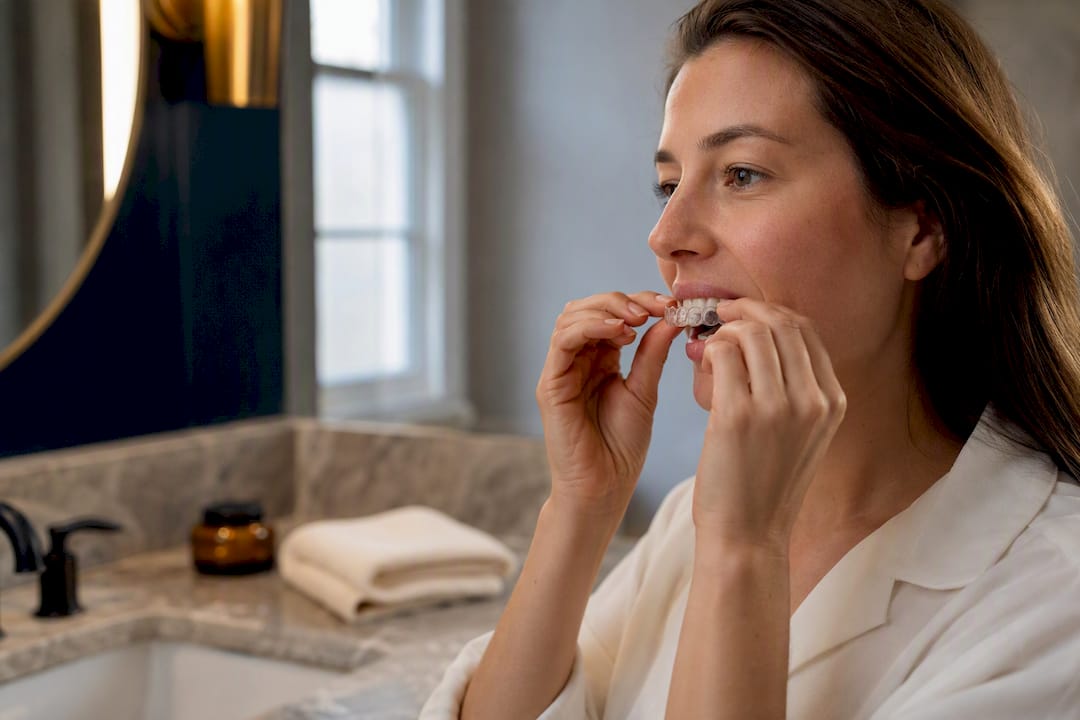
In-practice power whitening (LED or laser-accelerated) delivers faster, more dramatic shade change in a single session, often combined with a take-home phase afterwards to lock in results. It’s the quicker route, but it also carries a higher risk of sensitivity, and typically costs more than a home tray course. UK pricing for home tray courses commonly cost a few hundred pounds, whereas in-practice systems often cost more and vary widely, depending on the clinic and method.
Veneers or composite bonding become relevant when intrinsic staining or persistent white spots don’t respond to bleaching at all. These are more invasive and effectively permanent, so they’re worth discussing only once conservative options have genuinely been tried. Composite bonding can mask localised discolouration that whitening simply can’t touch.
| Method | Effectiveness | Sensitivity risk | Cost | Best suited to |
|---|---|---|---|---|
| Whitening toothpaste | Low, surface stain only | Very low | Low | Maintenance, not correction |
| OTC strips/gels | Moderate, a few shades | Moderate, uneven if rushed | Low to moderate | Mild general dulling |
| Custom take-home trays | Good, uniform result | Low to moderate | a few hundred pounds | Evening out shade after braces |
| In-practice power whitening | High, fast | Higher | more and vary widely | Quick results, tolerant enamel |
| Veneers/bonding | Permanent colour correction | Not applicable (restorative) | Higher, per tooth | Resistant intrinsic stains, white spots |
Pro Tip: If you’re torn between a fast in-practice session and a slower tray course, ask your dentist about combining both: a single in-practice session followed by a short take-home phase often gives the fast result without pushing sensitivity too far.
Spotting and treating white spot lesions before you whiten
White spot lesions are the detail conventional whitening advice tends to skip past, and it’s the detail that actually determines whether your result looks even or patchy. Here’s the sequence clinicians typically follow.
- Identify what you’re looking at. Run a finger lightly over the tooth. A stain feels smooth; a white spot lesion often feels slightly rough or matte compared with the surrounding enamel, because the mineral structure underneath has genuinely changed.
- Start a remineralisation programme. Fluoride varnishes such as Duraphat, CPP‑ACP products like MI Paste Plus, or nano‑hydroxyapatite formulations applied consistently over roughly 8 to 12 weeks can meaningfully reduce how visible these lesions are.
- Reassess before whitening. Once the remineralisation window has passed, a dentist checks whether the contrast between lesion and healthy enamel has settled enough for whitening to give an even result.
- Escalate only if needed. Persistent lesions that don’t respond to remineralisation may call for Icon resin infiltration or composite repair rather than more bleaching, since whitening can’t fill mineral loss.
A useful figure to hold onto: remineralisation programmes run over roughly 2 to 3 months can meaningfully soften the visual contrast of white spot lesions, often enough that invasive masking isn’t needed at all. The clinical sequence, in short, is hygiene visit and polish, then remineralisation, then reassessment, then whitening only if the enamel is ready for it.
Keeping your smile bright after whitening
A brighter result after braces is only worth having if it lasts, and the daily habits that protect it are fairly unremarkable. Brush twice daily with a fluoride toothpaste, keep up interdental cleaning, and don’t skip the regular hygiene visits that keep plaque from building back up around teeth that spent years in fixed appliances.
Diet plays a bigger role than most people expect. Coffee, tea, red wine, and smoking are the usual repeat offenders for staining, and rinsing with water after these (or using a straw for cold drinks) genuinely slows the rate at which colour builds back up.
Expect whitening results to hold for roughly 12 to 24 months depending on diet and hygiene habits, rather than treating it as a one-off fix. Keeping your custom tray means you can top up occasionally with a short course rather than starting from scratch. If sensitivity crops up again, dropping to a lower-concentration gel for a few sessions usually settles it, alongside a desensitising toothpaste used for a couple of weeks either side.
Pro Tip: Keep your whitening tray even after you stop using it regularly. A tray that still fits well after a year is worth far more than a fresh course booked from nothing.
How TJ Smile Studio approaches whitening after braces
Every whitening plan at TJ Smile Studio starts with a proper assessment, not a product recommendation. That assessment matters because the right sequence depends entirely on what’s actually happening in the mouth, not just on how the teeth look in a mirror.
Led by Dr Tashfeen Jamil BDS, MFDS RCS Ed, AssocFCGDent, the typical workflow runs through a hygiene and polish first to clear any residual adhesive, then a remineralisation phase if white spot lesions are present, then a decision between custom take-home trays or in-practice whitening based on sensitivity history and how much shade change is realistically achievable. Where staining proves resistant even after conservative steps, restorative options get discussed rather than pushed as a first resort. The goal throughout is balancing genuine effectiveness against sensitivity risk, never chasing the fastest result at the expense of comfort.
The mistake most post-braces whitening advice makes
The conventional advice on this topic treats whitening after braces as a timing question alone: wait a certain number of weeks, then whiten. That’s not wrong, but it’s incomplete, and it’s the incompleteness that causes most of the disappointing results I see.
The real issue is that timing solves for enamel rehydration and gum recovery. It does nothing for white spot lesions, and a lot of people whiten straight past demineralised patches without anyone flagging that bleaching can make those patches stand out more, not less. If you take one thing from this article, prioritise the assessment over the calendar. A dentist checking for white spots before you buy any whitening product will save you from a result that looks worse than the mild yellowing you started with.
Custom trays are also underrated compared with in-practice sessions. The speed of power whitening is appealing, but for teeth coming straight out of braces, with their genuinely uneven shade distribution, the gradual and uniform coverage of a tray often matters more than how fast the change happens. Slower and even beats fast and patchy almost every time.
— Dr Tashfeen Jamil BDS, MFDS RCS Ed, AssocFCGDent - GDC 286427
Ready to whiten safely after braces?
An advantage at this stage is that every whitening plan is personally led by a consistent dental professional, from the first assessment through to the finished result, rather than handed between whichever clinician happens to be free that day.
At a whitening consultation, expect an honest look at whether you’re dealing with surface staining, white spot lesions, or both, and a plan built around that rather than a generic course. The clinic offers Bespoke Home Teeth Whitening at £299, Professional In-Office Teeth Whitening at £399, and a combined Professional In-Office + Home Teeth Whitening package at £499, alongside a separate £35 Whitening Review for anyone who’s already had treatment and wants results checked. Where staining proves resistant, composite bonding starts from £200 per tooth as a restorative alternative. Every plan is prescribed and supervised by a GDC-registered dentist, in line with the legal requirement for whitening treatment in the UK. If you’ve recently had your braces off, book a consultation and get a straight answer on timing before you buy anything off a shelf.
Where to check the rules and the clinical detail
For readers who want to verify the regulatory side or dig deeper into the clinical reasoning:
- General Dental Council for confirmation that tooth whitening must be dentist-prescribed or supervised in the UK
- Timing and options guidance covering waiting periods and remineralisation windows in more detail
- A partner resource on jaw clenching and its dental effects, relevant for anyone experiencing bite discomfort alongside sensitivity after debonding
This article is general information, not a substitute for advice from a qualified doctor. Consult a qualified healthcare professional about your own circumstances before acting on anything here.
Sources
- General Dental Council (GDC)
- Teeth Whitening After Braces UK: Timing & Options
- Why did my teeth turn yellow after braces? — CDHP
- Teeth whitening after braces — Teeth Whitening London
FAQ
What happens if I whiten my teeth right after braces?
Whitening too soon after debonding often produces uneven results, since dehydrated enamel and leftover adhesive residue can block the gel unevenly. It also raises the risk of sensitivity, because gums and enamel haven’t fully settled from months under fixed appliances.
How long after braces can you get your teeth whitened?
Most dentists recommend waiting a minimum of 4 to 6 weeks after braces come off, with up to 3 months advised where there’s sensitivity, adhesive residue, or white spot lesions. A dental assessment beforehand confirms which timeline applies to your case.
Is it a good idea to whiten your teeth with braces still on?
No. Bleaching around fixed brackets creates a two-tone effect, since the covered enamel underneath the bracket won’t lighten with the rest of the tooth. Low-abrasion whitening toothpaste is a safer option to manage surface staining while braces are still in place.
How do you get rid of yellow teeth after braces?
Start with a professional hygiene visit to remove plaque and residual adhesive, then address any white spot lesions with a remineralisation programme before considering bleaching. Once your dentist confirms your enamel is ready, custom take-home trays or in-practice whitening at TJ Smile Studio can even out the remaining discolouration.
Recommended
This article is general information, not personal dental advice. What’s right for your teeth depends on a clinical examination — the condition of your enamel, gums, bite and any existing dental work — and no article can assess that. Outcomes vary between patients, and all treatment at TJ Smile Studio is subject to assessment and clinical suitability.
- Dr Tashfeen Jamil BDS, MFDS RCS Ed, AssocFCGDent, PGDip Restorative and Aesthetic Dentistry — GDC registration 286427
This article is general information, not personal dental advice. What's right for your teeth depends on a clinical examination — the condition of your enamel, gums, bite and any existing dental work — and no article can assess that. Outcomes vary between patients, and all treatment at TJ Smile Studio is subject to assessment and clinical suitability.
Clinically reviewed by Dr Tashfeen Jamil BDS, MFDS RCS Ed, AssocFCGDent, PGDip Restorative and Aesthetic Dentistry — GDC registration 286427, Principal Dentist at TJ Smile Studio, 1 Spiersbridge Way, Thornliebank, Glasgow G46 8NG.
If you have dental pain, swelling or an injury, call the practice on 07728 808510. Out of hours in Scotland, call NHS 24 on 111.