
21 September 2026 · TJ Smile Studio
How UK Dentists Grade Tetracycline Teeth and When Whitening Fails
UK clinician s guide to tetracycline teeth whitening: why bleaching often takes months, how dentists grade severity, and when veneers or composite bonding...
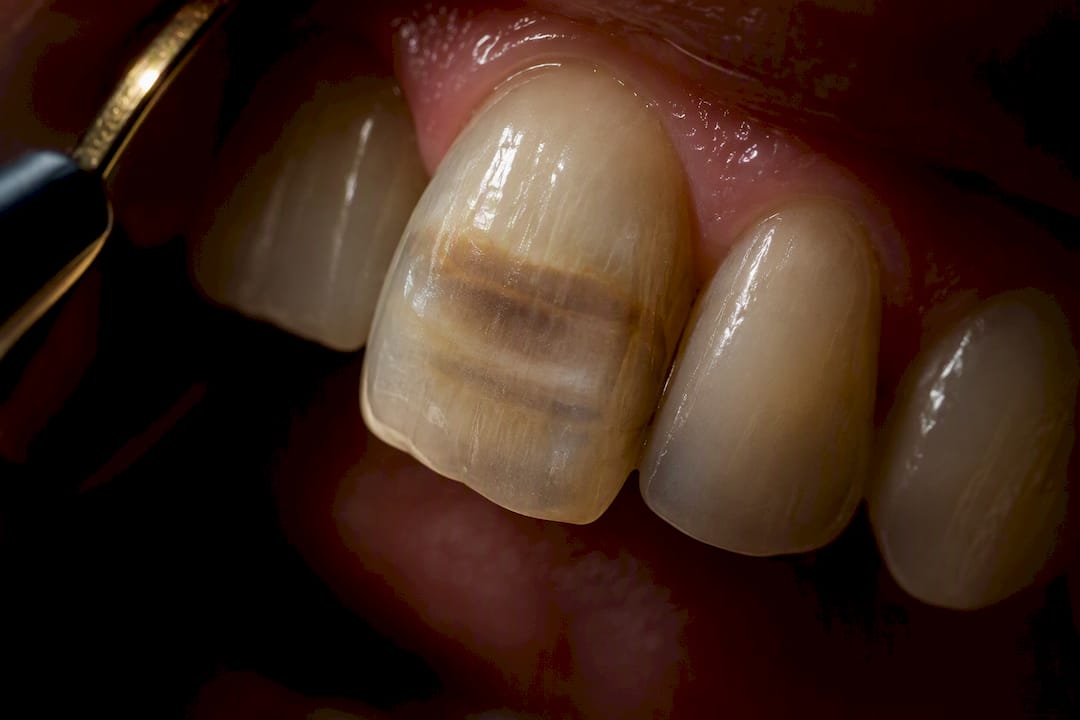
Bleaching can lighten some tetracycline stains, but results are slow, often incomplete, and depend heavily on how dark and grey the discolouration runs. Overnight tray bleaching is the sensible first step for many patients, sometimes taking many months to plateau. When it cannot lift the colour enough, particularly in the gum-line third of the tooth, veneers, crowns, or composite bonding take over. A dentist needs to grade the case before anyone can say which route applies to you.
TL;DR:
- Lightening tetracycline stains with bleaching may take several months, especially in darker or grey cases, and often requires a combined approach with restorations.
- Deep, grey or blue-grey stains respond poorly to bleaching alone and commonly need veneers or composite bonding for a satisfactory appearance.
- Dark grey banding near the gum line and extensive existing restorations significantly reduce the likelihood of successful bleaching and favor immediate restoration.
- Accurate assessment of stain origin, severity, and patient expectations is critical before choosing bleaching or restorative routes.
- Longer treatment timelines and multiple steps, including digital planning, are typical for tailored, effective results.
Table of Contents
- What tetracycline staining is and how it affects tooth structure
- How dentists assess severity and decide a treatment plan
- Bleaching options: protocols, expected outcomes and timeline
- Restorative options: veneers, crowns and composite bonding
- How to choose a dentist and what to ask at consultation
- How TJ Smile Studio approaches tetracycline-stained teeth
- Why the standard advice on tetracycline whitening oversimplifies things
- Getting a personalised plan for your stained teeth
- Selected clinical papers and guidance
- Sources
- FAQ
What tetracycline staining is and how it affects tooth structure
Tetracycline stains are not surface marks you can polish off. The antibiotic binds into the dentine and enamel while teeth are still forming, then oxidises with light exposure over years, producing bands of yellow, brown, or grey running through the tooth itself rather than sitting on top of it.
That distinction matters for anyone shopping for a fix. Whitening toothpaste, charcoal powders, and strips work by lifting surface pigment, which is precisely what tetracycline staining is not. A patient explainer from Cleveland Clinic confirms that over-the-counter products typically make no meaningful difference to this kind of intrinsic discolouration, and that any serious attempt at bleaching needs a dentist involved.
A few factors decide how bad the staining gets and how it responds to treatment later:
- Age at exposure: tetracycline taken while teeth are developing, in the womb or in early childhood, causes far more staining than exposure once teeth are fully formed.
- Dose and duration: higher doses and longer courses of the antibiotic produce darker, more widespread banding.
- Colour matters more than most people realise: yellow and light brown stains respond reasonably well to bleaching. Grey and blue-grey stains, caused by a different tetracycline derivative, are the hardest of all to shift and sometimes barely move at all.
That last point is worth sitting with, because it is the single biggest predictor of whether bleaching alone will get you where you want to go.
How dentists assess severity and decide a treatment plan
Before recommending anything, a dentist needs a clear picture of what caused the staining and how deep it runs. That assessment usually follows a set order:
- History taking: when the tetracycline exposure happened (childhood, in utero, or as an adult), and for how long, since earlier and longer exposure predicts worse staining.
- Clinical examination and photography: recording the exact shade, the pattern of banding, and whether the staining is even across the mouth or worse on certain teeth.
- Classification against established grading systems, most commonly the Jordan and Boksman or Feinman scales, which rank severity from mild yellow-brown through to severe grey-black banding and help set a realistic prognosis.
- Vitality testing and a check of existing restorations, including any large amalgam fillings, since some clinicians prefer to address those before committing a patient to months of bleaching.
- A decision point: mild to moderate yellow-brown cases are usually offered bleaching first; severe grey cases, or teeth with extensive existing restorations or structural damage, often go straight to a restorative discussion.
Bleaching is generally considered a poor bet, or outright contraindicated, when the staining is very dark grey, when a tooth has a large filling or crack, or when a patient’s expectations do not match what the grading suggests is achievable.
Bleaching options: protocols, expected outcomes and timeline
Overnight tray bleaching with 10% carbamide peroxide remains the most researched, most conservative approach for tetracycline-stained teeth, and it is where most treatment plans start. A randomised controlled trial on home bleaching for tetracycline staining found that patients typically see the bulk of their improvement within the first three to four months, though some cases needed as long as fifteen months of consistent wear before the colour stopped changing.
Pro Tip: Photograph your teeth against a neutral background before you start any bleaching course. Tetracycline whitening moves so slowly that you will not trust your own memory of “before” by month four.
In-office sessions using higher-concentration hydrogen peroxide can accelerate the early stages of lightening, but on their own they rarely clear severe intrinsic staining. Most dentists treat in-office whitening as a booster alongside, not instead of, extended tray wear at home.
Laser-assisted methods, including KTP laser protocols, sit further out on the evidence curve. A published case report on KTP laser bleaching recorded a faster result than chemical bleaching alone achieved in that patient, but this sort of evidence comes from individual cases rather than large trials, so treat any claim of a dramatically shorter timeline with some scepticism.
Expect these practicalities along the way:
- Sensitivity and gum irritation are the two most common side effects, usually transient and manageable with desensitising gel and a short pause in wear.
- Tray design matters over months of nightly use: many clinicians favour non-scalloped, no-reservoir trays for tetracycline cases specifically because they reduce gum contact with the gel during extended wear.
- Large posterior amalgam fillings are sometimes replaced before a long bleaching course begins, a precaution some dentists take based on research into amalgam and bleaching interactions.
- The endpoint is genuinely unpredictable: two patients with similar starting shades can land in different places after the same protocol.
Longer-term follow-up data on extended nightguard bleaching has not shown lasting pulp damage when the process is properly supervised, though short-term sensitivity is common and expected. Professional guidance in the British Dental Journal backs bleaching as the sensible initial move for many tetracycline cases, partly because a successful course reduces how much healthy tooth structure needs to be cut away if veneers turn out to be necessary later.
Restorative options: veneers, crowns and composite bonding
When bleaching stalls, or when the staining is severe grey banding that reaches into the gum-line third of the tooth, restoration takes over as the more reliable route to a genuinely even, bright result.
- Composite bonding is the most conservative restorative step. A resin is sculpted directly onto the tooth to mask moderate discolouration, at a lower cost than porcelain and with little to no tooth reduction, though the material needs periodic polishing and occasional repair over the years.
- Porcelain veneers (feldspathic, pressed, or zirconia-backed) offer the strongest masking power for severe or grey staining. Techniques like an opaque composite sublayer beneath the porcelain, or building the veneer in thicker, stratified layers, let a ceramist block out even grade IV grey banding, a method documented in a case report on restoring severely stained teeth with ceramic veneers. Mock-ups beforehand let patients preview the shade and shape before any tooth is touched.
- Crowns offer full coverage and come into play mainly when a tooth already has structural damage or heavy existing restorations, not staining alone; they remove more tooth structure than veneers or bonding and should be reserved for teeth that need it for reasons beyond colour.
The sequencing that tends to work best is to attempt conservative bleaching first wherever the grading supports it, then move to porcelain or composite veneers only where bleaching cannot reach deep enough, particularly along the gum line, or where the stain is grey rather than yellow-brown.
How to choose a dentist and what to ask at consultation
Getting this right depends as much on the dentist’s experience with tetracycline cases specifically as on the technology in the surgery. At your first consultation, work through this list:
- Ask what improvement is realistic for your specific stain colour, not a generic promise, since grey stains and yellow stains have very different ceilings.
- Ask for a timeline in months, not weeks, and ask what “plateau” looks like for your case.
- Ask what the risks and side effects are, and how sensitivity or gum irritation would be managed if they occur.
- Ask whether any existing fillings need replacing before bleaching starts, and why.
- Ask about maintenance and retreatment: bonding needs periodic polishing, whitening needs top-up courses, and veneers eventually need replacing.
Look for GDC registration, relevant postgraduate qualifications, genuine before-and-after photography of tetracycline cases specifically (not just general whitening), and a written plan that sets out stages and costs before you commit to anything.
Pro Tip: Ask to see a mock-up of the proposed veneer shade next to your natural teeth in daylight, not under surgery lighting. Grey stains can look deceptively lighter under warm dental lamps.
A clear written plan should record your baseline shade, photographs, each treatment stage, and a follow-up schedule. If you are looking at veneers as part of the plan, ask about finance options for the total cost upfront, since restorative work is usually the larger investment.
How TJ Smile Studio approaches tetracycline-stained teeth
Some clinics offer personal assessment and treatment planning for tetracycline cases using a digital workflow to plan treatment before any dental work begins.
The typical pathway starts with a full assessment and shade grading, followed by a conservative bleaching attempt where the case supports it. If bleaching cannot fully resolve the discolouration, particularly with grey banding, the next step is a digital mock-up, then minimally invasive options such as composite bonding or Same-Day Hybrid Veneers. Sensitivity and gum response are monitored throughout, with review appointments built into the plan.
, and a fuller author biography for Dr Jamil sit alongside this pathway on the clinic’s own pages.
Why the standard advice on tetracycline whitening oversimplifies things
Most consumer content treats tetracycline whitening as a single decision: bleach or don’t. That framing does a disservice to patients, because it skips the grading step that actually determines the outcome. A yellow-brown grade I stain and a grey grade IV stain are, functionally, two different clinical problems wearing the same label, and no amount of enthusiasm with a whitening tray closes that gap for the darker case.
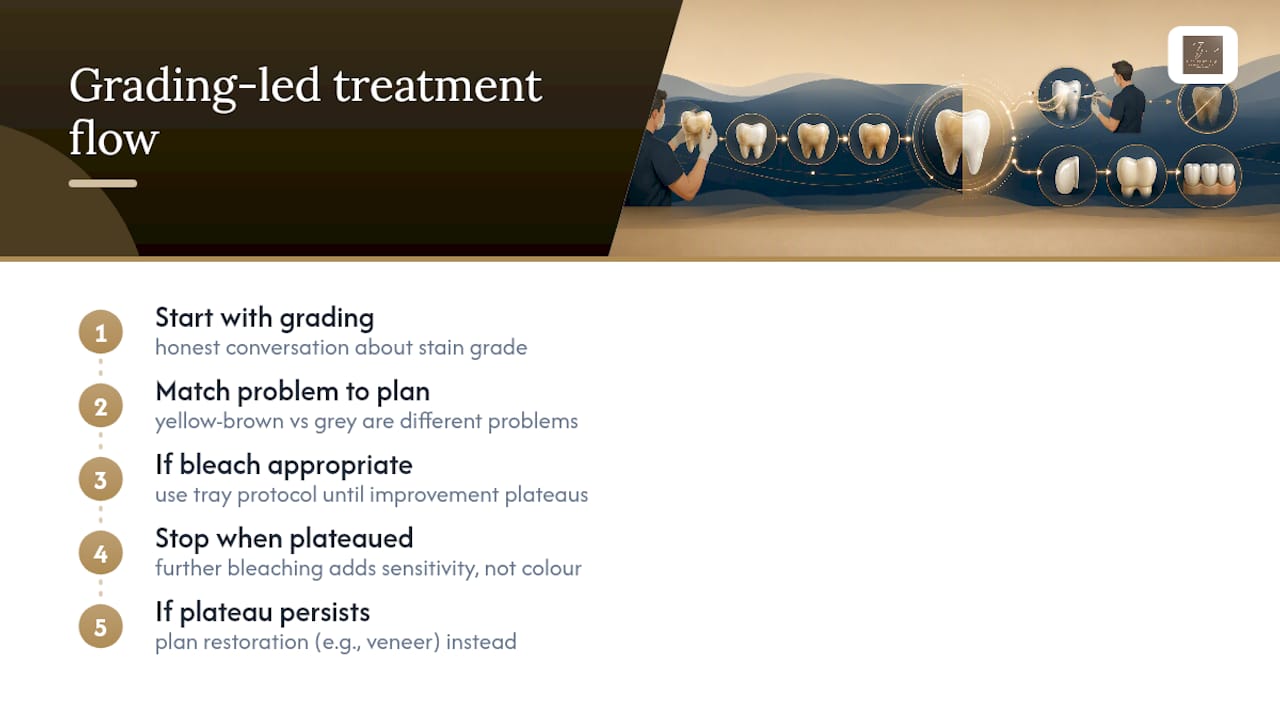
The advice I would push back on hardest is the idea that longer bleaching always means better results. Past a certain point, usually once a case has plateaued, further wear just adds sensitivity risk without adding colour change. Knowing when to stop bleaching and start planning a restoration is arguably a more valuable clinical skill than the bleaching protocol itself.
What patients should prioritise first is an honest grading conversation, before any product or protocol gets mentioned. Get that right, and the rest of the plan, whether it ends in a tray or a veneer, tends to follow logically.
— Dr Tashfeen Jamil BDS, MFDS RCS Ed, AssocFCGDent - GDC 286427
Getting a personalised plan for your stained teeth
Some dental clinics offer graded, staged plans rather than one-size-fits-all whitening kits. A proper assessment with an experienced dentist can help you understand whether bleaching is likely to work for your specific shade or whether restoration is the more realistic route, and roughly what that will cost.

A Smile Consultation costs £50 and gives you that grading and a written plan. From there, Bespoke Home Teeth Whitening is priced at £299, Professional In-Office Teeth Whitening at £399, and the combined In-Office + Home Teeth Whitening package at £499. If bleaching alone will not get you far enough, Composite Bonding starts from £200 per tooth, and Veneers start from £399 per tooth, with Same-Day Hybrid Veneers available from £2,995 for patients who want a full result in a single visit. Book a Smile Consultation to find out which pathway actually fits your case.
Selected clinical papers and guidance
- Bleaching as the initial treatment for tetracycline-stained teeth, British Dental Journal
- KTP laser case report for tetracycline bleaching
- Restoring severe tetracycline staining with veneers, case report
- Vital bleaching guidance, Dentistry Online
This article is general information, not a substitute for advice from a qualified doctor. Consult a qualified healthcare professional about your own circumstances before acting on anything here.
Sources
- Vital bleaching of tetracycline-stained teeth by using KTP laser: a case report
- Bleaching: the initial treatment consideration for tetracycline-stained teeth | British Dental Journal
- Restoring severely tetracycline-stained teeth with home whitening and ceramic veneers (case report)
FAQ
Does tetracycline make teeth yellow?
Yes, tetracycline taken while teeth are forming commonly causes yellow, brown, or grey banding, depending on the specific drug derivative, the dose, and the age of exposure. The colour matters clinically: yellow and brown stains respond far better to bleaching than grey ones do.
What does tetracycline do to your teeth?
The antibiotic binds into the dentine and enamel as teeth develop, then darkens over years through oxidation, creating discolouration that runs through the tooth structure rather than sitting on the surface. This intrinsic nature is why surface-level whitening products rarely make a visible difference.
How can I get yellow, stained teeth white again?
For tetracycline-related yellow or brown staining, supervised overnight tray bleaching with 10% carbamide peroxide is the best-researched starting point, though it can take several months to reach its full effect. If bleaching plateaus before the colour is even, composite bonding or veneers can finish the job.
How can tetracycline stains be removed from teeth?
Stains cannot be fully “removed” in the way a surface stain can, since the discolouration sits inside the tooth structure. Extended bleaching lightens many cases, while grey or very severe staining usually needs masking with porcelain veneers or composite bonding once bleaching has run its course.
How much does whitening for tetracycline stains cost?
At TJ Smile Studio, Bespoke Home Teeth Whitening is £299 and Professional In-Office Teeth Whitening is £399, with a combined package at £499, each listed on the pricing page. Restorative options such as veneers, needed for stains bleaching cannot resolve, start from £399 per tooth.
Recommended
This article is general information, not personal dental advice. What’s right for your teeth depends on a clinical examination — the condition of your enamel, gums, bite and any existing dental work — and no article can assess that. Outcomes vary between patients, and all treatment at TJ Smile Studio is subject to assessment and clinical suitability.
- Dr Tashfeen Jamil BDS, MFDS RCS Ed, AssocFCGDent, PGDip Restorative and Aesthetic Dentistry — GDC registration 286427
This article is general information, not personal dental advice. What's right for your teeth depends on a clinical examination — the condition of your enamel, gums, bite and any existing dental work — and no article can assess that. Outcomes vary between patients, and all treatment at TJ Smile Studio is subject to assessment and clinical suitability.
Clinically reviewed by Dr Tashfeen Jamil BDS, MFDS RCS Ed, AssocFCGDent, PGDip Restorative and Aesthetic Dentistry — GDC registration 286427, Principal Dentist at TJ Smile Studio, 1 Spiersbridge Way, Thornliebank, Glasgow G46 8NG.
If you have dental pain, swelling or an injury, call the practice on 07728 808510. Out of hours in Scotland, call NHS 24 on 111.