
01 October 2026 · TJ Smile Studio
When to Monitor, Seal or Restore: UK Minimally Invasive Dentistry
UK evidence led guide to minimally invasive dentistry: prevention, sealing, selective removal and monitoring, with Dr Tashfeen Jamil's clinic view.
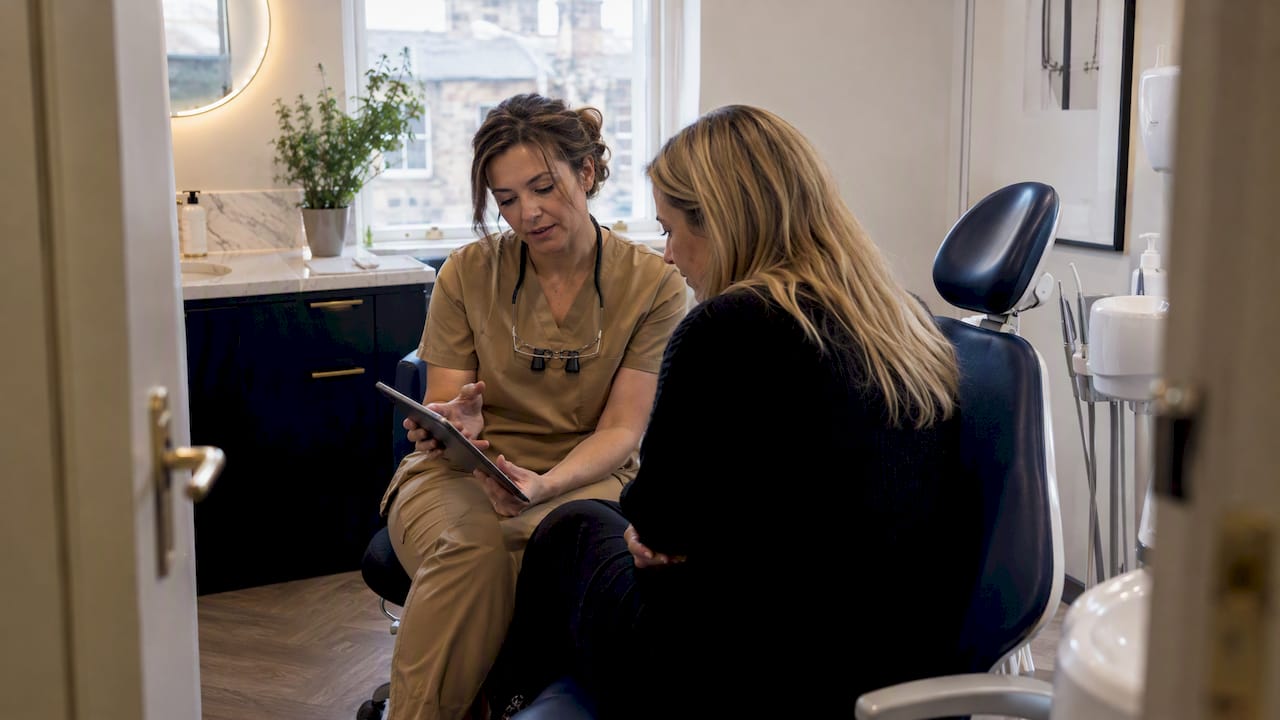
Minimally invasive dentistry is a tooth-preserving, disease-management approach that prioritises prevention, monitoring and conservative treatment to keep natural teeth longer. Rather than treating a cavity as a one-off repair job, it treats decay as an ongoing disease process that can often be slowed, arrested or reversed. Consensus guidance and UK prevention toolkits back this tissue-preserving strategy, which aims to delay or avoid the cycle of repeated fillings, replacements and eventual tooth loss.
TL;DR:
- Less invasive techniques like fluoride varnish and resin infiltration can effectively arrest early decay without drilling, especially in non-cleanable lesions.
- Selective removal reduces the risk of pulp exposure compared to aggressive excavation, but relies on ongoing monitoring to ensure lesions remain inactive.
- Daily habits such as brushing twice with fluoride toothpaste and reducing sugary food frequency are crucial for preventing lesion progression outside the dental office.
- Deep or symptomatic lesions near the pulp generally require conventional restoration rather than sealing or monitoring alone.
- Long-term success depends on patient adherence to review schedules, as seal failure or lesion reactivation can occur without regular follow-up.
Table of Contents
- Core principles of minimally invasive dentistry
- Common minimally invasive treatments and how they work
- How dentists decide whether to monitor, seal or restore a lesion
- Prevention, home care and evidence-backed measures to arrest early lesions
- What to expect during a minimally invasive appointment
- Limitations, risks and what the evidence does and does not yet show
- Author and clinic perspective on minimally invasive care
- Why minimally invasive dentistry matters for the long term
- Discussing minimally invasive options at TJ Smile Studio
- Sources
- FAQ
Core principles of minimally invasive dentistry
Minimally invasive dentistry (MID) starts from a simple idea: caries is a disease, not just a hole that needs filling. Treating the disease activity, rather than only the cavity it leaves behind, changes what a dentist does at each visit. A lesion that is inactive and sealed from the mouth might need nothing more than watching, while an active, open lesion needs intervention to stop it spreading.
This disease-led thinking shapes several practical habits in modern dental care.
- Preserve any tissue that can still remineralise rather than removing it on sight.
- Avoid unnecessary pressure on the tooth’s nerve (the pulp), since aggressive drilling raises the risk of irreversible damage.
- Try non-operative options first: controlling plaque, encouraging remineralisation and sealing lesions before reaching for a drill.
- Delay entry into what dentists call the “restorative cycle”, the pattern where one filling eventually fails, gets replaced by a bigger one, and so on until the tooth is lost.
Every extra year a tooth stays unrestored, or minimally restored, is a year it keeps its strength and its options open.
Common minimally invasive treatments and how they work
MID covers a spectrum of techniques, from no drilling at all to small, targeted restorations.
- Non-operative measures come first: high-fluoride toothpaste, professionally applied fluoride varnish, dietary advice and better plaque control can arrest early lesions without any restoration.
- Microinvasive techniques include fissure sealants, which physically block the grooves where decay starts, and resin infiltration, which uses a light-cured resin to strengthen early enamel lesions, typically on the surfaces between teeth. Cochrane-level evidence summarised in a minimal intervention umbrella review rates these as moderate-quality options for slowing lesion progression.
- Minimally invasive operative treatment removes only the decay that needs to go. Selective removal stops at soft or firm dentine rather than hard, healthy tissue, and stepwise removal treats deep lesions in two stages, sealing the tooth temporarily before a final restoration.
- The Hall Technique and atraumatic restorative treatment (ART) fit decayed primary or hard-to-access teeth without local anaesthetic or drilling, using a preformed crown or a hand-placed glass ionomer filling.
- Silver diamine fluoride (SDF) can arrest caries in primary teeth without drilling at all, and is considered when a child cannot tolerate conventional treatment or when a filling is not yet practical.
How dentists decide whether to monitor, seal or restore a lesion
The deciding question is often whether a lesion is “cleansable”: can the patient’s toothbrush and fluoride routine actually reach it and keep it inactive? A lesion on a smooth, accessible surface with good oral hygiene can sometimes be monitored rather than filled.
- Radiographs and visual or tactile checks establish how deep the lesion runs and whether it looks active or arrested.
- The International Caries Consensus Collaboration recommends selective removal to soft or firm dentine, or stepwise removal for deep lesions, rather than complete excavation down to hard dentine.
- Restorative treatment becomes the right call when a lesion is not cleansable, a seal is not technically feasible, or the decay is close enough to the pulp that monitoring carries real risk.
Trials supporting selective removal show it reduces the risk of exposing the tooth’s nerve during treatment compared with more aggressive removal, according to the rationale behind the SCRiPT trial. That matters because an exposed pulp often means root canal treatment instead of a simple filling.
Prevention, home care and evidence-backed measures to arrest early lesions
Most of the work in minimally invasive dentistry happens outside the dental chair. Daily habits set the ceiling on what any in-clinic treatment can achieve.
- Brush twice daily with a fluoride toothpaste containing 1,350 to 1,500 ppm fluoride.
- Cut the frequency of sugary food and drink rather than just the total amount, since frequency drives acid attacks on enamel.
- Attend for professional fluoride varnish application, typically twice yearly, as part of a prevention plan.
- Ask about fissure sealants or resin infiltration for teeth at higher risk of decay.
Twice-yearly fluoride varnish can reduce caries increments by around 33% in primary teeth and 46% in permanent teeth, according to the Delivering Better Oral Health toolkit. That toolkit also underpins the brushing recommendation above.
When a child cannot tolerate the drying and etching steps resin sealants need, glass ionomer sealants or temporary glass ionomer restorations are a practical substitute, as UK preventive guidance for children sets out. Whichever option is chosen, regular review is what keeps a sealed or monitored lesion inactive.
What to expect during a minimally invasive appointment
A typical MID-led appointment follows a predictable pattern, whether the visit is a routine check or a planned treatment.
- The dentist assesses caries risk, examines the teeth visually and with radiographs where needed, and discusses which lesions, if any, need action.
- Many lesions are treated in a single visit: a sealant placed, a small area of decay selectively removed and filled, or simply a decision to monitor.
- Deeper lesions may be staged, with a temporary seal placed first and a final restoration completed at a later visit once the tooth has settled.
- A follow-up schedule is agreed, since even a successfully sealed or arrested lesion needs periodic review to confirm it stays inactive.
Comfort-focused choices, such as avoiding drilling where it is not needed, tend to reduce anxiety as well as preserve tooth structure.
Limitations, risks and what the evidence does and does not yet show
Consensus bodies support minimally invasive approaches, but the evidence base is stronger for some techniques than others. Selective and stepwise removal have reasonable trial support for reducing pulp exposure, yet long-term, patient-centred outcome data remain limited for several MID techniques, a gap acknowledged by SCRiPT trial researchers themselves.
Sealing an early lesion can arrest progression without removing any tissue, but the approach only works if it is followed by ongoing surveillance: an intact seal keeps a lesion inactive, while a failed one needs attention before decay resumes.
Seal failure, the need for closer recall intervals and occasional retreatment are realistic trade-offs rather than guarantees. Where a lesion is already deep, symptomatic or clearly not cleansable, a more conventional restorative approach can be the more sensible clinical choice.
Author and clinic perspective on minimally invasive care
This article is written from the clinical perspective of Dr Tashfeen Jamil BDS, MFDS RCS Ed, AssocFCGDent, GDC 286427. In practice, minimally invasive principles sit alongside conservative restorations such as composite bonding and digital assessment tools that help identify lesions early, without steering every patient towards treatment they do not yet need. Readers considering their own options are welcome to raise MID specifically at a consultation.

Why minimally invasive dentistry matters for the long term
Minimally invasive dentistry is less a technique than a long-term bet: every bit of natural tooth preserved now keeps more options open later, and every filling avoided is one less cycle of repair and replacement down the line. It depends on shared decision-making between dentist and patient, and on patients actually turning up for the reviews that let monitoring and sealing work as intended. Skip the recall visits and the whole approach loses its footing.
— Dr Tashfeen Jamil BDS, MFDS RCS Ed, AssocFCGDent - GDC 286427
Discussing minimally invasive options at TJ Smile Studio
If you would rather preserve what you have than jump straight to a filling, that conversation starts with a consultation, not a prescription. At TJ Smile Studio in Glasgow, every treatment plan is personally led by Dr Tashfeen Jamil, which means conservative options are weighed against more extensive ones before anything is recommended.
The services most relevant to minimally invasive and preventive care include:
- A Smile Consultation where risk, lesion activity and treatment options are discussed before anything is committed to.
- Composite bonding, often used for conservative repair once a decision to restore has been made.
- Digital smile assessment tools that support early identification and planning.
- A full view of our treatments for anyone weighing conservative care against more comprehensive work, such as full mouth rehabilitation.
Book a Smile Consultation to talk through what a minimally invasive approach could look like for your own teeth.
This article is general information, not a substitute for advice from a qualified doctor. Consult a qualified healthcare professional about your own circumstances before acting on anything here.
Sources
- Delivering Better Oral Health: an evidence-based toolkit for prevention — Chapter 9: Fluoride
- Contemporary operative caries management: consensus recommendations on carious tissue removal (ICCC)
- Selective Caries Removal in Permanent Teeth (SCRiPT) — trial protocol and rationale
- Minimal intervention dentistry for managing carious lesions into dentine in primary teeth: an umbrella review (University of Liverpool repository)
FAQ
What is minimally invasive dentistry?
Minimally invasive dentistry manages tooth decay as a disease process, using prevention, monitoring and conservative treatment to preserve as much natural tooth tissue as possible. It favours selective removal, sealing and remineralisation over complete excavation wherever the lesion allows it, as set out in ICCC consensus recommendations.
What is the 2 year dentist rule?
There is no recognised clinical guideline called the “2 year dentist rule” in UK dental practice. Review intervals are set individually based on caries risk and oral health rather than a fixed universal rule, so this term is not a standard the article can confirm.
What is the 3-3-3 dental rule?
This is not a term used in UK clinical guidance or the consensus documents behind minimally invasive dentistry, so there is no definition to confirm here. Patients wanting a recall schedule are better served asking their own dentist, since intervals depend on individual risk rather than a fixed formula.
What do holistic dentists recommend instead of a root canal?
This article does not cover “holistic dentistry” as a defined clinical framework, and no SDCEP, ICCC or NHS guidance cited here recommends an alternative to root canal treatment. Where a tooth’s pulp is already compromised, minimally invasive approaches aim to prevent that situation arising rather than replace standard endodontic care once it has.
Recommended
This article is general information, not personal dental advice. What’s right for your teeth depends on a clinical examination — the condition of your enamel, gums, bite and any existing dental work — and no article can assess that. Outcomes vary between patients, and all treatment at TJ Smile Studio is subject to assessment and clinical suitability.
- Dr Tashfeen Jamil BDS, MFDS RCS Ed, AssocFCGDent, PGDip Restorative and Aesthetic Dentistry — GDC registration 286427
This article is general information, not personal dental advice. What's right for your teeth depends on a clinical examination — the condition of your enamel, gums, bite and any existing dental work — and no article can assess that. Outcomes vary between patients, and all treatment at TJ Smile Studio is subject to assessment and clinical suitability.
Clinically reviewed by Dr Tashfeen Jamil BDS, MFDS RCS Ed, AssocFCGDent, PGDip Restorative and Aesthetic Dentistry — GDC registration 286427, Principal Dentist at TJ Smile Studio, 1 Spiersbridge Way, Thornliebank, Glasgow G46 8NG.
If you have dental pain, swelling or an injury, call the practice on 07728 808510. Out of hours in Scotland, call NHS 24 on 111.