
06 September 2026 · TJ Smile Studio
Invisalign With Veneers: 6 to 12 Months and How to Avoid Rework
A clinic backed roadmap for Invisalign with veneers. Learn sequencing, attachment workarounds, CAD/CAM options, and why most combined cases take 6 to 12...
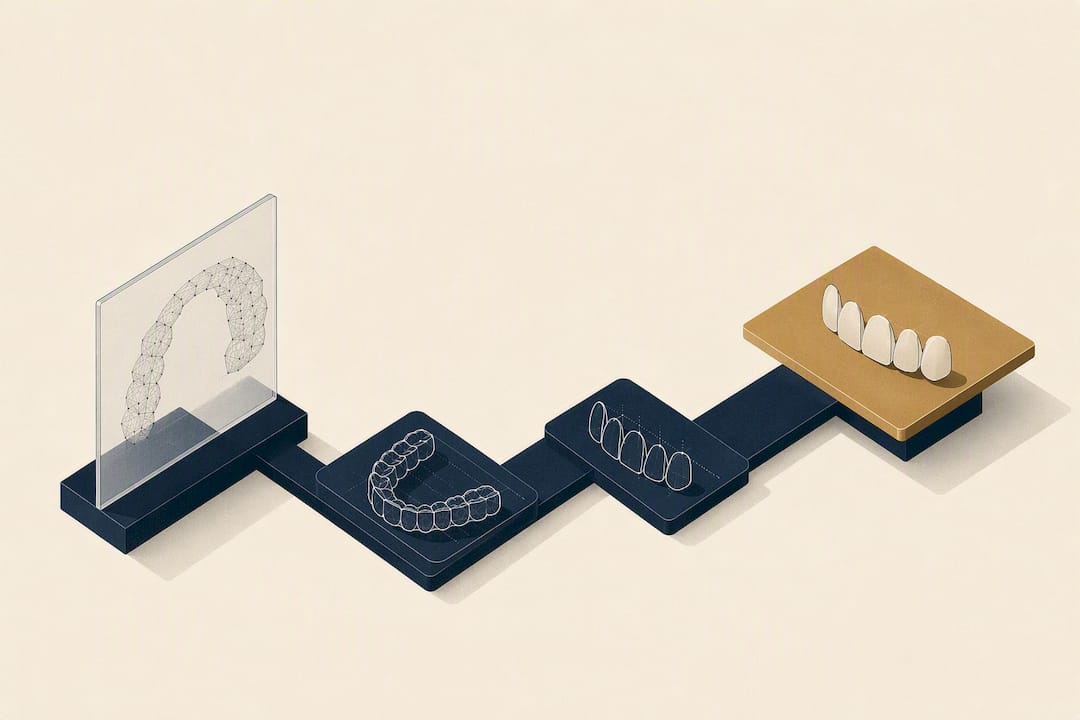
Yes, in most cases Invisalign can be planned alongside existing or future porcelain veneers, and plenty of patients do both. The decisive factor is the condition of any veneers already in the mouth and how carefully your dentist sequences the two treatments. Get that planning wrong and you risk cracked porcelain or veneers that need redoing; get it right, and each treatment does the job the other cannot.
TL;DR:
- Combining Invisalign and porcelain veneers is possible if careful planning considers the condition and bonding of existing veneers.
- Aligners should generally be used before veneers to avoid over-reduction and costly rework caused by shifting teeth after veneer placement.
- Attachments bonded directly to porcelain veneers have a higher risk of failing, so plans often involve bonding to adjacent natural teeth instead.
- Treatment duration typically spans six to twelve months for orthodontics, plus additional appointments for veneer preparation and bonding.
- An assessment of existing veneers’ margins and bonding surfaces is crucial before designing any aligner or veneer plan to prevent complications.
Table of Contents
- What do Invisalign and porcelain veneers actually fix?
- Who actually needs both treatments?
- Why Invisalign usually comes before veneers
- The technical challenges when veneers already exist
- How long does combined treatment take?
- What happens after treatment, and how do you protect the result?
- How a specialist clinic plans a combined Invisalign and veneer case
- Why the “veneers fix everything” mindset gets patients into trouble
- Ready to plan your Invisalign and veneer treatment?
- Sources
- FAQ
What do Invisalign and porcelain veneers actually fix?
Invisalign moves teeth. The aligners apply gentle, sustained pressure to correct crowding, gaps, rotations and bite problems, gradually shifting teeth into a healthier position over a series of custom trays. Porcelain veneers do something entirely different: they are thin ceramic shells bonded to the front of a tooth to change its shape, length, or shade, correcting chips, discolouration, or uneven proportions that alignment alone can never touch.
That difference is why the two treatments are complementary rather than competing. Invisalign’s own guidance draws this distinction clearly, noting that orthodontics addresses the underlying bite and position while veneers refine the finished look.
- Invisalign: fixes position, spacing, and bite alignment
- Porcelain veneers: fix shape, size, surface texture, and colour
- Together: a straight foundation with a polished cosmetic finish
Neither treatment substitutes for the other. A veneer bonded onto a crowded tooth simply masks the crowding temporarily; it does not resolve it.
Who actually needs both treatments?
Not everyone considering a smile makeover needs the full combination. Working out which camp you fall into saves time, money, and a lot of unnecessary appointments.
- You likely need both if you have visible crowding, gaps, or rotated teeth alongside worn edges, chips, or discolouration that whitening cannot fix. Alignment sorts the structure; veneers sort the finish.
- Veneers alone may be enough if your teeth are already reasonably well positioned and your main concern is shade, minor unevenness, or tooth shape. There is little point moving teeth that do not need moving.
- Treat with caution if you have extensive existing restorations, multiple veneers already bonded, dental implants, or veneer margins that look lifted or discoloured at the edge. These cases need a specialist eye before anyone commits to an aligner plan, because implants do not respond to orthodontic force at all and have to be treated as fixed anchor points rather than teeth that can shift.
Why Invisalign usually comes before veneers
Clinicians overwhelmingly favour one order: align first, veneer second. The logic is straightforward. Veneers are custom shells shaped to fit a tooth’s final position, so building them before that position is settled means shaping them to a layout that is about to change.
- Foundation first: aligning roots and crowns means the veneer technician designs restorations for the actual final smile, not a moving target
- Avoiding over-reduction: veneering crowded or rotated teeth often forces heavier enamel removal to mask the misalignment, which is rarely necessary once teeth are straight
- Reworking risk: veneers placed before orthodontics frequently need replacing afterwards anyway, doubling the cost and the chair time
Case-based clinical guidance backs this consistently, pointing to more conservative preparation and better long-term aesthetics when straightening happens first.
There are exceptions. Someone needing only a very minor cosmetic tweak, or a case built around dental implants that cannot move regardless of sequence, might follow a different order. These are the minority, not the rule.
Pro Tip: If you already have veneers and are only now considering Invisalign, tell your dentist the age and condition of every veneer at your first consultation, not just the ones bothering you. Older bonding can behave differently under aligner pressure than a veneer placed last year.
The technical challenges when veneers already exist
The trickiest part of combining the two treatments is not the tooth movement itself. It is getting the aligner to grip a veneer properly.
Invisalign relies on small tooth coloured attachments bonded to certain teeth to give the aligner extra leverage for rotations or bodily movement. Those attachments bond well to natural enamel. Porcelain is a different story entirely: its glazed surface resists the etching process that lets bonding resin grip properly, so attachments on veneered teeth tend to fail or bond poorly.
- Dentists often redesign the movement plan to place attachments on adjacent natural teeth instead of the veneer itself
- Where a porcelain attachment is unavoidable, specific etching protocols and more conservative removal techniques reduce the risk of damage
- Attachment removal at the end of treatment carries a small but genuine risk of chipping or dulling the veneer’s polished surface if a clinician rushes it
Roughly one in three aligner attachments placed directly on porcelain need some adjustment during treatment, which is exactly why experienced clinicians try to avoid them from the outset. If a veneered tooth needs substantial rotation or bodily movement rather than a minor nudge, removing the old veneer, completing the orthodontics, and fitting a new one afterwards is often the safer route than fighting a shell that was never designed to move.
How long does combined treatment take?
Plan for months, not weeks. Combined cases run in two distinct phases, and each has its own rhythm.
The orthodontic phase commonly takes 6 to 12 months, sometimes longer for complex movements, depending on how much rotation, spacing, or bite correction is needed. Veneer fabrication then typically needs two to three separate appointments: preparation, impressions or scans, and final bonding, though clinics running chairside CAD/CAM milling in house can compress that into far fewer visits.
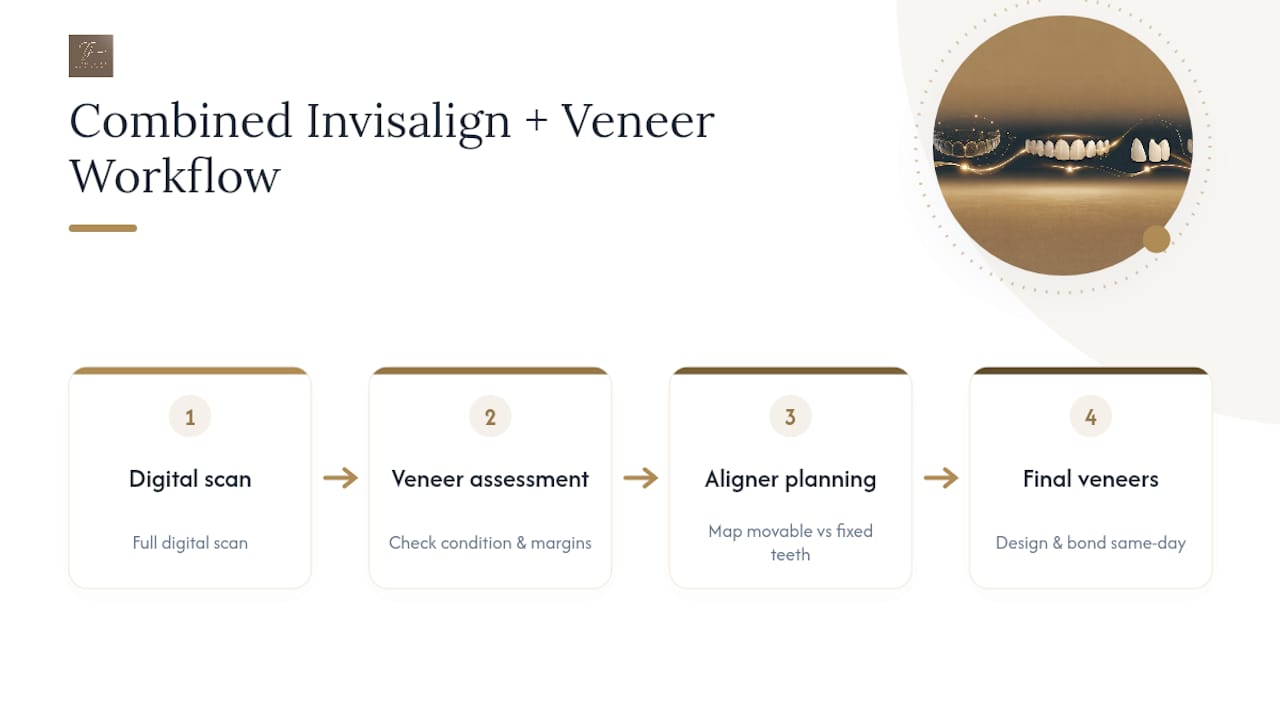
- Consultation and scanning: digital impressions, radiographs, and a full assessment of any existing veneers
- Aligner planning: a digital treatment simulation (often called ClinCheck) mapping every tooth movement in sequence
- Active aligner wear: typically 6 to 12 months, with periodic check-ins and possible mid-course refinements
- Retainer fitting: to hold the new position stable before any cosmetic work begins
- Veneer try-in and bonding: shade matching, shaping, and final cementation once teeth have settled
What happens after treatment, and how do you protect the result?
Removal of aligner attachments is the moment of highest risk to any nearby veneer, and experienced clinicians handle it slowly, checking the porcelain surface as they go rather than stripping resin off in a hurry.
Retention matters just as much as the active treatment. A well-fitted retainer, whether fixed or removable, needs to sit comfortably over veneered teeth without putting uneven pressure on the bonded margins, and lifelong retainer wear (at least at night) is what stops teeth drifting back and undoing months of alignment.
- Avoid biting hard objects (ice, pen lids, fingernails) that stress veneer edges
- Keep up six-monthly reviews so a dentist can check veneer margins and retainer fit together
- A veneer refresh may be worth discussing years later if surface polish dulls or a margin discolours
Pro Tip: Ask your dentist to check retainer fit against your veneers specifically at the first follow-up, not just general comfort. A retainer that rocks slightly against a veneer edge can wear the bonding line over time.
How a specialist clinic plans a combined Invisalign and veneer case
Combining two treatments with different biomechanics is not a job for guesswork. At TJ Smile Studio, cases like this are led by Dr Tashfeen Jamil BDS, MFDS RCS Ed, AssocFCGDent, GDC 286427, using a fully digital smile makeover workflow that maps aligner movements and veneer design together from the first visit.
A consultation typically covers a full digital scan, an assessment of any existing veneers’ condition and margins, and a discussion of which teeth can move freely versus which need a different approach. Because the clinic’s veneer fabrication runs through an in-house digital workflow, turnaround between the final aligner stage and veneer bonding is often shorter than a traditional lab-based route, with same-day hybrid veneers. Available once orthodontic movement is complete.
Why the “veneers fix everything” mindset gets patients into trouble
The biggest misconception in this whole area is thinking veneers can substitute for orthodontics if you just make them big enough. They cannot, not without sacrificing tooth structure that should never have come off in the first place. A veneer built to mask a rotated or overlapping tooth needs more aggressive shaping than one built onto a tooth that is already sitting where it should. That extra reduction is permanent.
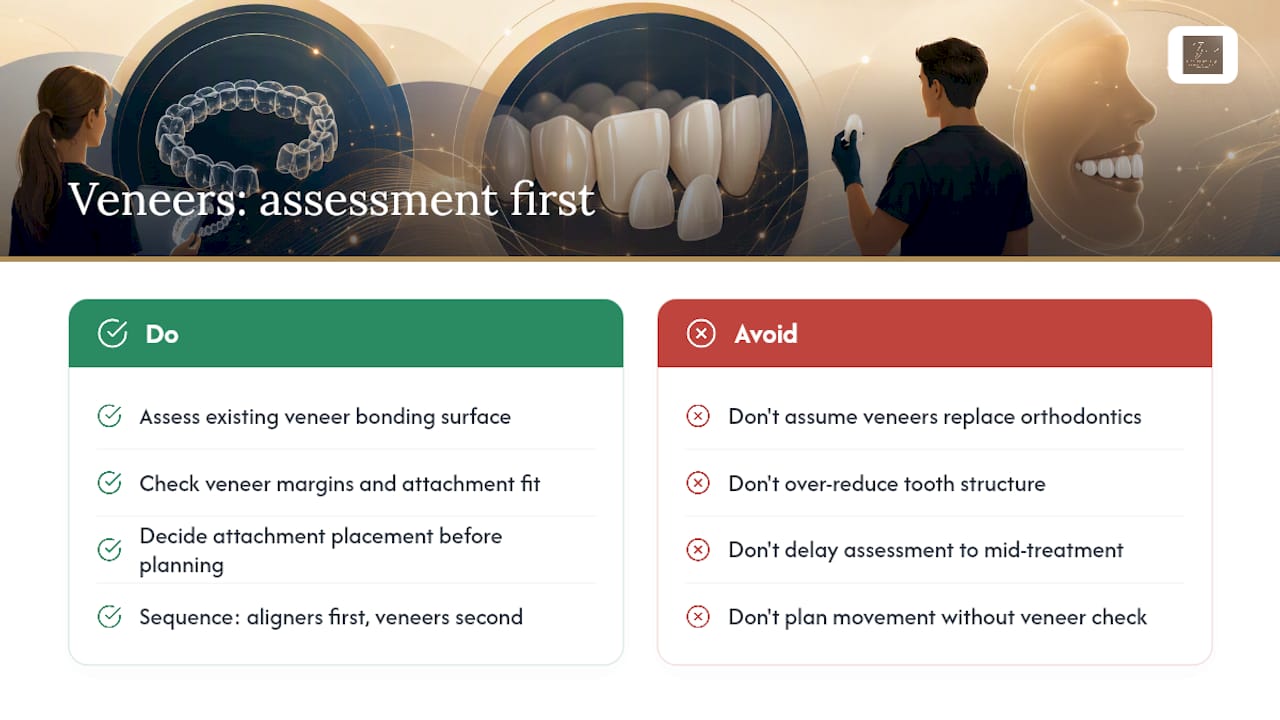
The conventional advice on sequencing, align first, veneer second, is sound, but it undersells how much the attachment problem matters in practice. Too many patients discover mid-treatment that their existing veneers cannot take an attachment properly, and by then the plan has to change. That should be caught at the consultation stage, not three months into aligner wear.
If there is one priority for anyone weighing this up, it is this: get an assessment of your existing veneers’ bonding surface and margins before anyone maps out a single tooth movement. Everything else, timeline, cost, attachment placement, follows from that one piece of information.
— Dr Tashfeen Jamil BDS, MFDS RCS Ed, AssocFCGDent - GDC 286427
Ready to plan your Invisalign and veneer treatment?
Some dental practices offer alignment and cosmetic refinement planned as one coordinated case, using a digital workflow to map aligner movements and veneer design together from the outset, which can reduce redesign problems when treatments are handled separately.
A consultation at TJ Smile Studio starts with a full digital scan and an honest look at any veneers already in your mouth, checking margins, bonding, and surface condition before any movement plan is drawn up. Bring details of previous dental work if you have them; radiographs and scans are taken on-site if needed. From there, treatment can involve Invisalign alone, veneers alone, or a combined digital smile makeover plan, with financing options available for larger packages. Book a consultation to get a clear, sequenced treatment plan rather than a guess.
Sources
Clinical guidance on combined treatment timelines came from the International Journal of Oral and Dental Research, manufacturer sequencing advice from Invisalign’s own resources, and porcelain bonding detail from a dental clinic explainer and a veneer technique overview.
This article is general information, not a substitute for advice from a qualified doctor. Consult a qualified healthcare professional about your own circumstances before acting on anything here.
- IJODR (2025) - article on combined workflows
- Porcelain Veneers vs. Invisalign®: Understanding Their Different Purposes (Invisalign)
- Can you wear aligners over veneers? | Dental Clinic London
- Can You Get Invisalign with Veneers? Which Comes First (DSM Cosmetic Dentist)
FAQ
What teeth are not suitable for Invisalign?
Teeth attached to dental implants cannot be moved by aligners because implants are fused to bone, so they need to be planned as fixed reference points rather than moving targets. Severely rotated teeth, some bridge-supported teeth, and teeth with compromised veneer margins also need specialist assessment before committing to an aligner plan.
What is the 4-8-10 rule for veneers?
This is a cosmetic dentistry guideline some practitioners use for proportion, roughly relating central incisor width, arch visibility, and smile width when designing veneer shape. It varies by practitioner and smile design philosophy, so treat it as one design reference rather than a fixed universal rule.
Why do dentists discourage veneers in some cases?
Dentists often hold off on veneers when underlying alignment issues have not been corrected first, because masking crowding or rotation with porcelain usually means removing more natural tooth structure than necessary. The conservative preparation and better long-term result that comes from straightening first is why many clinicians push back on veneers as a first step.
Can you do Invisalign with fake teeth?
Yes, Invisalign can often be used alongside veneers, crowns, or bridges, though attachments bond poorly to glazed porcelain and treatment plans usually route around veneered surfaces where possible. Implants are the exception: they cannot be moved by orthodontic force at all, regardless of aligner design.
Recommended
This article is general information, not personal dental advice. What’s right for your teeth depends on a clinical examination — the condition of your enamel, gums, bite and any existing dental work — and no article can assess that. Outcomes vary between patients, and all treatment at TJ Smile Studio is subject to assessment and clinical suitability.
- Dr Tashfeen Jamil BDS, MFDS RCS Ed, AssocFCGDent, PGDip Restorative and Aesthetic Dentistry — GDC registration 286427
This article is general information, not personal dental advice. What's right for your teeth depends on a clinical examination — the condition of your enamel, gums, bite and any existing dental work — and no article can assess that. Outcomes vary between patients, and all treatment at TJ Smile Studio is subject to assessment and clinical suitability.
Clinically reviewed by Dr Tashfeen Jamil BDS, MFDS RCS Ed, AssocFCGDent, PGDip Restorative and Aesthetic Dentistry — GDC registration 286427, Principal Dentist at TJ Smile Studio, 1 Spiersbridge Way, Thornliebank, Glasgow G46 8NG.
If you have dental pain, swelling or an injury, call the practice on 07728 808510. Out of hours in Scotland, call NHS 24 on 111.