
04 September 2026 · TJ Smile Studio
Evidence Backed Invisalign Refinements: Clinic View for Patients
Clinic backed, evidence based explainer: why many Invisalign patients need refinements, how they change timelines and what to ask.
Invisalign refinements are extra sets of aligners ordered after your original series to fine-tune tooth positions that haven’t quite landed where the plan predicted. They’re common, not a sign anything has gone wrong, and most people undergoing aligner treatment will be offered at least one round. Before you agree to one, ask your clinician two things: is it included in your original fee, and how many extra weeks or months will it add.
TL;DR:
- The majority of Invisalign patients require at least one refinement, which usually adds a few extra months to the overall treatment time.
- Refinements are triggered when teeth do not move as predicted, often due to biological variability, compliance issues, or plan design factors, with rates exceeding 70%.
- A refinement involves a new scan and plan, with the number of trays needed depending on how many teeth need correction and by how much.
- Costs vary widely; some clinics include refinements in the original fee, while others charge separately, especially for multiple or complex rounds.
- Better compliance, punctual reviews, and trusting attachments and IPR plans can significantly reduce the need for refinements.
Table of Contents
- What are Invisalign refinements and how do they differ from tracking issues
- Why refinements happen: clinical and patient causes
- How refinements are planned and delivered: the appointment workflow
- How Invisalign refinements affect treatment length and results
- Cost and billing: what to ask about inclusion and extra charges
- Can you avoid needing Invisalign refinements?
- Questions to ask if your clinician proposes a refinement
- Post-refinement care and maintenance recommendations
- Refinements versus retreatment or starting again
- Insurance coverage and payment plans for refinements
- Clinic perspective: why refinements deserve a more honest conversation
- Considering Invisalign in Glasgow? Here’s what to expect from us
- Sources
- FAQ
What are Invisalign refinements and how do they differ from tracking issues
A refinement is a formal second treatment plan. Your clinician takes a new scan, uploads it, and the lab generates a fresh ClinCheck simulation designed to move your teeth from where they actually sit to the final position originally intended. It’s not a tweak to the old plan. It’s a new one, built from your mouth’s current reality.
That’s different from a tracking problem, which is a much smaller, in-the-moment fix. If a tray isn’t seating properly or a tooth has fallen behind schedule, the usual response is a replacement tray from the existing series, or a short pause to let teeth catch up. No new scan, no new ClinCheck, no lab turnaround.
Refinements tend to get triggered at two points:
- At the end of your original aligner series, when the final tray no longer matches your bite and some teeth need a further push in a specific direction.
- Mid-course, when several teeth are drifting off-track and a repair tray won’t solve it, so the clinician decides a full replan is more efficient than patching individual trays.
Retrospective data on aligner patients shows the majority end up needing at least one refinement phase to reach the finish originally mapped out, which tells you this is closer to standard practice than an exception.
Why refinements happen: clinical and patient causes
Teeth don’t always move the way software predicts, and that gap is the single biggest driver of refinements. Rotations, torque control, and extrusion (pulling a tooth downward) are notoriously harder for a plastic aligner to achieve cleanly than simple tipping movements, so these movement types account for a disproportionate share of refinement cases.
Several factors combine to push a case towards needing a refinement:
- Biology: bone density, ligament response, and root shape vary between patients and don’t always match the software’s assumptions.
- Compliance: reduced wear time, lost trays, or attachments that came off early all throw the plan off course.
- Plan design: how movements are staged, how much force each stage asks for, and where attachments and interproximal reduction (IPR) are placed all affect accuracy.
- Digital limits: the scan taken at the start can’t always predict how bone and soft tissue will actually respond months later.
One survey-based analysis found refinement rates above 70% in several patient cohorts, with an average of roughly two to two-and-a-half refinement scans per case in some samples. Interestingly, that same research found more experienced clinicians request refinements more often, not less. Interpreting that as poor technique misses the point: it more plausibly reflects a willingness to chase a genuinely precise finish rather than stop at “close enough”.
How refinements are planned and delivered: the appointment workflow
Refinements follow a fairly predictable sequence, and knowing the steps in advance makes the conversation with your clinician far less abstract.
- Review appointment. Your clinician checks how well your teeth match the original ClinCheck target, takes photos, and usually retakes a digital scan rather than relying on old impressions.
- Scan comparison. The new scan is compared against the plan to see exactly which teeth have under or over-corrected, and by how much.
- Revised ClinCheck. A fresh digital plan is built from your current tooth positions to the intended final result, and you’ll usually get to see the simulation before trays are ordered.
- Attachments and IPR review. Some attachments may be repositioned or added, and further interproximal reduction (careful reshaping between teeth) might be recommended if space is still tight.
- New trays arrive. Most refinement rounds involve somewhere between one and several trays, though this depends entirely on how many teeth need correcting and by how much.
Remote monitoring apps can cut down the number of in-person check-ins during a refinement phase, letting your clinician track progress from photos you submit. Worth knowing, though: current evidence suggests remote monitoring doesn’t reliably reduce how often refinements are needed in the first place. It saves you visits, not necessarily extra trays.
Pro Tip: Ask to see your refinement ClinCheck simulation before the trays are made, not after. If a movement looks unrealistic or the timeline feels vague, that’s the moment to query it, not three weeks into wearing the new trays.
How Invisalign refinements affect treatment length and results
A single refinement round typically adds a few months to total treatment, depending on how many trays are needed and how quickly your teeth respond. That’s on top of whatever your original series was scheduled to take.
The research on this is fairly consistent. Most patients need at least one round to reach the finish their plan intended, and an AJODO analysis of treatment complexity and outcomes found that treatment duration climbs steadily with each additional refinement, while occlusal outcomes stop improving meaningfully once you go beyond three rounds.
The first refinement tends to deliver most of the visible improvement. Later rounds often produce smaller gains, and in some cases teeth that had already settled well can shift slightly in the opposite direction as the plan chases smaller and smaller corrections.
That plateau matters for how you think about a fourth or fifth round if it’s ever proposed. It’s a fair question to ask your clinician directly: what specific improvement is this next round expected to deliver, and is it proportionate to the extra months it will add?
Cost and billing: what to ask about inclusion and extra charges
How refinements are billed varies enormously between practices, and this is one area where assumptions cause the most frustration. Some clinics build one or two refinement rounds into the original treatment fee as standard. Others charge a separate fee per refinement set, particularly if the case has already gone through several rounds or the delay is linked to poor compliance rather than biology.
Costs tend to rise when cases are complex, require extra scans or attachments, or when poor compliance leads to additional trays being needed.
Before starting treatment, it’s worth confirming, in writing where possible:
- Whether refinements are included in the quoted fee, and if so, how many rounds.
- Whether there’s a time limit on that inclusion (some clinics cap it at 12 or 24 months from your first tray).
- What retainers cost after a refinement, since your final tooth positions may differ slightly from the original retention plan.
Clinics offering finance or payment plans for aligner treatment should be able to explain upfront whether refinements sit inside that plan or attract a separate charge.
Can you avoid needing Invisalign refinements?
You can meaningfully lower the odds, even though no aligner system removes the possibility entirely. Most of the levers sit on your side of the treatment, not on your clinician’s.
- Hit 22 hours of daily wear, consistently. Aligners only move teeth while they’re in your mouth; missed hours compound over weeks, not days.
- Flag fitting problems early. A tray that isn’t seating properly in week one is a five-minute fix. Left for a month, it can mean redoing several stages.
- Keep every review appointment. Skipped check-ins mean tracking issues get caught later, when they’re harder and slower to correct.
- Trust the attachment and IPR plan. These small tooth-coloured bumps and careful reshaping between teeth exist specifically to make difficult movements more predictable, not as an afterthought.
Some movements, particularly larger bite corrections and certain rotations, are genuinely harder for aligners to achieve cleanly. Deep bite correction shows notably lower predictability with aligners than simpler tipping movements, and most of the achievable improvement tends to happen in the first series rather than through repeated refinement. For these cases, a hybrid approach combining aligners with a fixed appliance for specific teeth can sometimes shorten the overall path.
Pro Tip: If you’re prone to losing trays or forgetting to switch them on schedule, ask about a slightly longer wear period per tray rather than a shorter one. Fewer switches with fuller compliance usually beats a faster schedule you can’t stick to.
Questions to ask if your clinician proposes a refinement
Walking into a refinement conversation with the right questions turns a vague update into a clear decision.
- What exactly is out of position, and how many trays will this round involve?
- How many months will this add to my total treatment time?
- Is meaningful improvement actually expected, or are we chasing a marginal change?
- Will this affect the cost of my treatment or my final retainers?
- What happens if I decline this round, and is that a reasonable option for my case?
Declining a refinement is usually a legitimate choice if the remaining discrepancy is minor and you’re happy with your bite and appearance as they stand.
Post-refinement care and maintenance recommendations
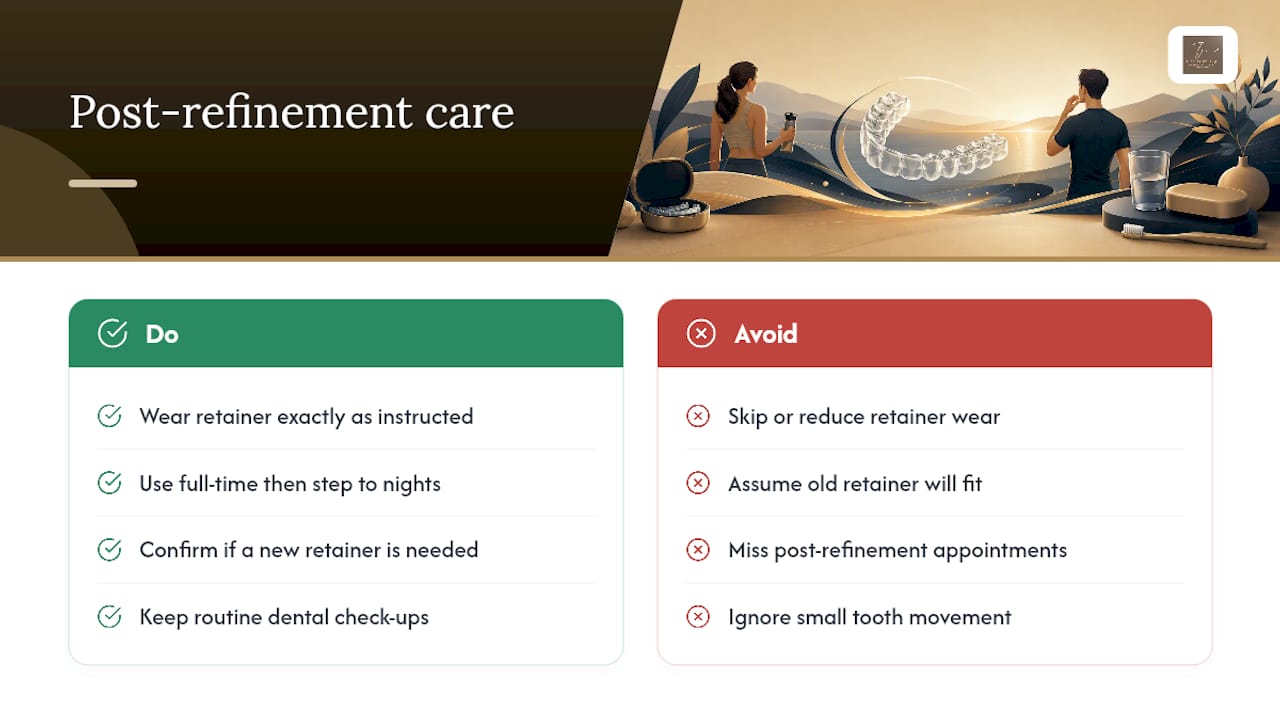
Once your refinement trays are finished, retention becomes the priority. Teeth are at their most likely to shift in the weeks immediately after any aligner phase ends, refinement or not, because the periodontal ligament is still settling.
Wear your retainer exactly as instructed, which usually means full-time for the first few months before stepping down to nights only. If your bite changed during the refinement, your final retainer may need remaking rather than reusing the one made after your original series. It’s worth confirming this specifically, since some clinics include a post-refinement retainer at no extra cost and others charge for a replacement.
Keep attending routine dental check-ups during this period. Refinement trays sometimes involve additional IPR, and your dentist will want to monitor those areas alongside your general oral health. If you notice any tooth shifting even slightly after refinements finish, contact your clinician promptly. Minor movement caught early is often manageable with a short “touch-up” retainer adjustment, whereas movement left for months can mean discussing a further refinement round.
Refinements versus retreatment or starting again
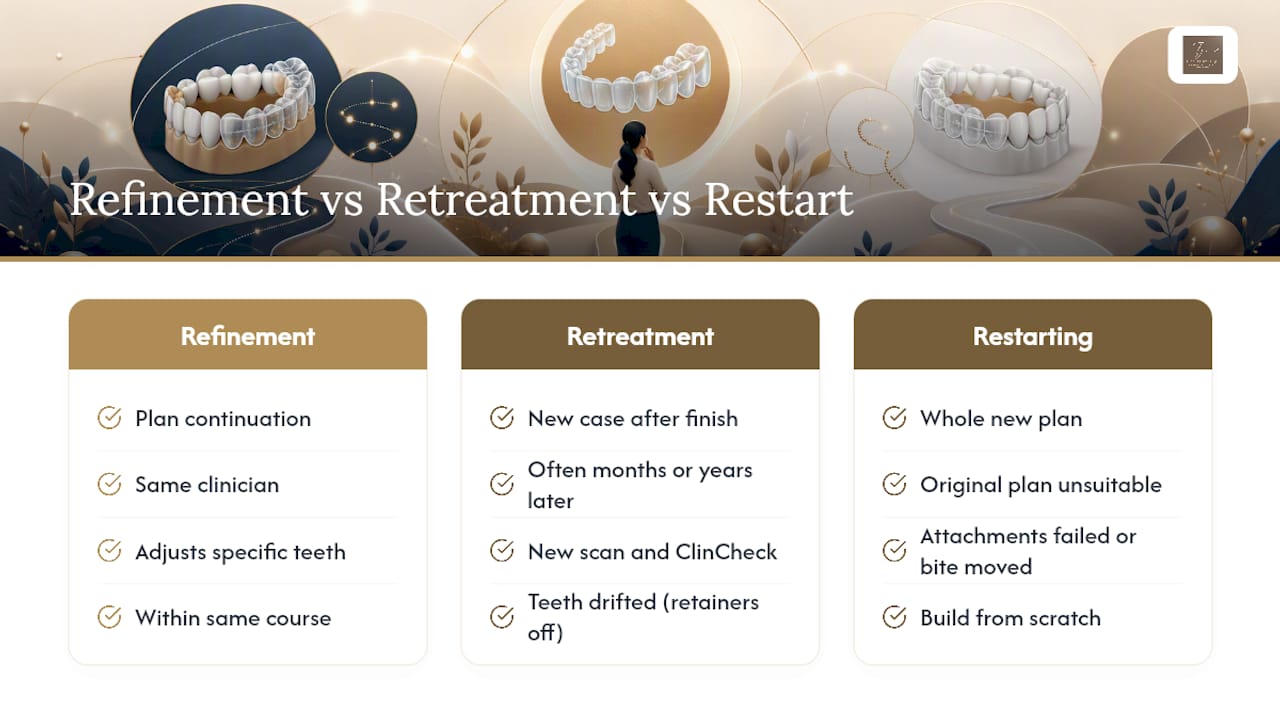
These terms get used loosely, but they describe genuinely different situations. A refinement continues your existing treatment relationship using the plan and clinician you already have, correcting specific teeth that haven’t reached their target within an otherwise successful course of treatment.
Retreatment is a broader term, sometimes used when a patient finished Invisalign months or years ago and later wants further correction, perhaps because retainers weren’t worn consistently and teeth drifted back. This is usually assessed as a new case, with its own scan, its own ClinCheck, and often its own fee structure, because it isn’t a continuation of the original treatment plan.
Restarting treatment is rarer and more serious, generally reserved for cases where the original plan was fundamentally unsuitable, attachments failed extensively, or the bite moved in a direction the original ClinCheck never anticipated. This means building an entirely new plan from scratch rather than working forward from where your teeth currently sit.
If your clinician ever uses the word “retreatment” rather than “refinement”, it’s worth clarifying which situation actually applies to you and whether a new fee is involved.
Insurance coverage and payment plans for refinements
Most standard dental insurance policies treat Invisalign, and by extension its refinements, as a cosmetic or elective procedure rather than a covered medical treatment, which means many patients pay out of pocket for the entire course including any refinement rounds. Some policies with an orthodontic benefit will contribute a fixed amount towards the total treatment cost regardless of how many refinement sets are needed, rather than paying per phase.
This makes it worth checking your policy’s wording specifically for “orthodontic lifetime maximum” language, since that figure typically applies once across your whole treatment, refinements included, rather than resetting with each new phase.
Where insurance doesn’t stretch far enough, many clinics offer structured payment plans that spread the cost of the original series and, in some cases, extend to cover refinement rounds if they’re needed later. It’s reasonable to ask at the consultation stage whether a payment plan can be adjusted if a refinement comes up, rather than assuming you’ll need to pay for it as a lump sum on top of your existing repayments.
Clinic perspective: why refinements deserve a more honest conversation
Refinements get an unfair reputation. Patients often hear the word and assume something went wrong with their original treatment plan, when the evidence points the other way: clinicians who chase a genuinely precise finish tend to request refinements more often, not less.
A fully digital workflow means a review scan and a revised plan can be turned around without the delays that come from physical impressions or lab handoffs measured in weeks rather than days. That matters most in the refinement conversation, where patients want a clear answer quickly: what’s changing, how many trays, and how long it will take.
What I’d encourage anyone considering Invisalign treatment to take from the research is this: a refinement or two is normal and often improves your result meaningfully. A fourth or fifth round deserves a direct question about what specific gain it’s actually expected to deliver, because the evidence on diminishing returns is clear enough that it shouldn’t need asking twice.
— Dr Tashfeen Jamil BDS, MFDS RCS Ed, AssocFCGDent - GDC 286427
Considering Invisalign in Glasgow? Here’s what to expect from us
Invisalign planning can use a digital workflow like that used for same-day cosmetic treatments, so scans, ClinCheck reviews, and any refinement planning can happen without back-and-forth delays that slow down clinics still relying on physical impressions.
At consultation, the clinician talks you through your digital scan, your ClinCheck simulation, and what to realistically expect in terms of timeline, including how refinements are approached if your case needs one. You’ll know upfront what’s built into your quote rather than finding out midway through treatment. If you’re ready to see what your own smile could look like, book an Invisalign consultation to get a straight answer on your treatment plan from the first visit.
This article is general information, not a substitute for advice from a qualified doctor. Consult a qualified healthcare professional about your own circumstances before acting on anything here.
Sources
- Accuracy of clear aligners: A retrospective study of patients who needed refinement
- Association between initial complexity, frequency of refinements, treatment duration, and outcome in Invisalign orthodontic treatment
FAQ
Do I have to pay extra for Invisalign refinements?
It depends entirely on your clinic’s policy: some include one or two rounds in the original fee, while others charge per refinement set, so confirm this before treatment starts.
What do Invisalign refinements actually do?
They use a new scan and a revised ClinCheck plan to move specific teeth from their current position to the finish originally intended, correcting whatever didn’t track as planned in the first series.
Recommended
This article is general information, not personal dental advice. What’s right for your teeth depends on a clinical examination — the condition of your enamel, gums, bite and any existing dental work — and no article can assess that. Outcomes vary between patients, and all treatment at TJ Smile Studio is subject to assessment and clinical suitability.
- Dr Tashfeen Jamil BDS, MFDS RCS Ed, AssocFCGDent, PGDip Restorative and Aesthetic Dentistry — GDC registration 286427
This article is general information, not personal dental advice. What's right for your teeth depends on a clinical examination — the condition of your enamel, gums, bite and any existing dental work — and no article can assess that. Outcomes vary between patients, and all treatment at TJ Smile Studio is subject to assessment and clinical suitability.
Clinically reviewed by Dr Tashfeen Jamil BDS, MFDS RCS Ed, AssocFCGDent, PGDip Restorative and Aesthetic Dentistry — GDC registration 286427, Principal Dentist at TJ Smile Studio, 1 Spiersbridge Way, Thornliebank, Glasgow G46 8NG.
If you have dental pain, swelling or an injury, call the practice on 07728 808510. Out of hours in Scotland, call NHS 24 on 111.