
09 November 2026 · TJ Smile Studio
Invisalign for Narrow Arches: What Expansion Can Achieve
Can Invisalign widen a narrow arch? See how much expansion aligners can deliver, what affects the result, when a palate needs other care, and how to keep it.
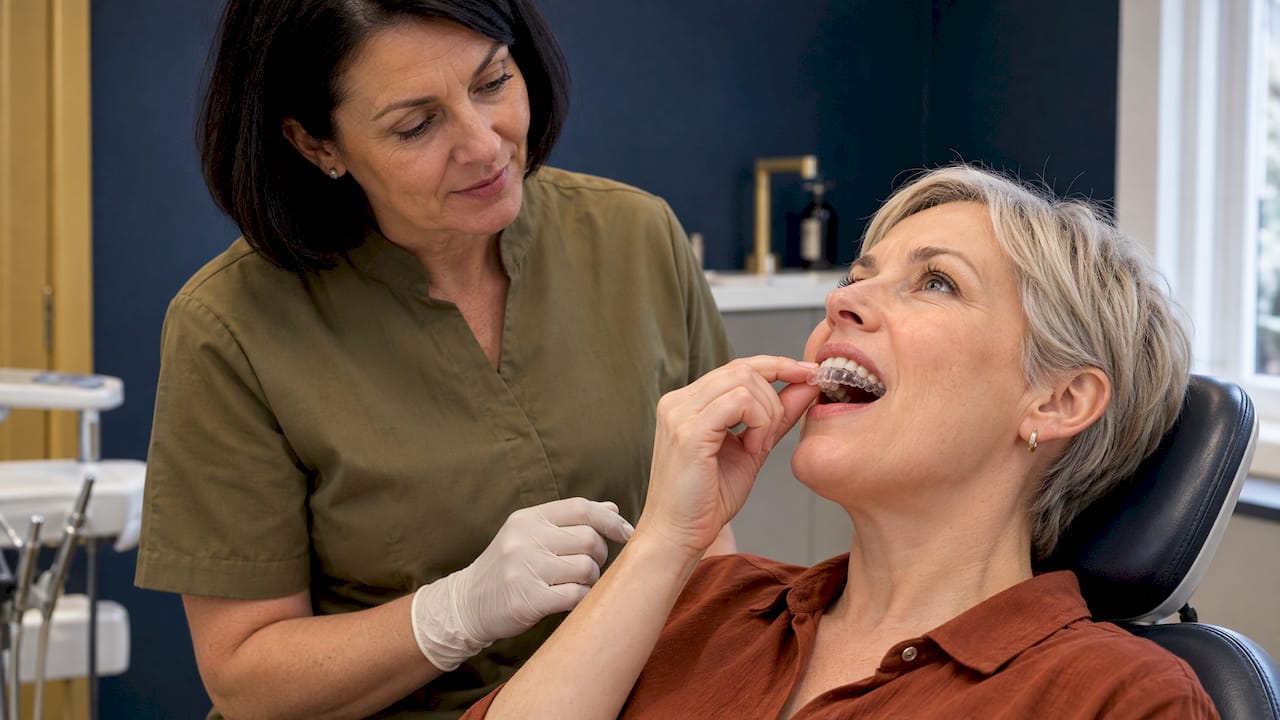
Yes, Invisalign can widen a narrow dental arch. Research shows that aligners expand the arch most effectively in the premolar area, and the result is best judged in millimetres, not in dramatic changes of jaw shape. For a narrow smile with crowding or prominent dark gaps at the corners of the mouth, a carefully planned aligner case can create room and give a fuller, more even smile. Here is how it works, how much to expect, and how we plan it at TJ Smile Studio in Glasgow.
TL;DR
- Invisalign can expand a narrow dental arch, mainly by tilting teeth outwards, with the most reliable change at the premolars.
- Realistic expansion is a few millimetres. Studies describe 2 to 4 mm of buccal expansion, and plans are usually built with some overcorrection.
- A narrow arch (the teeth) is not the same as a narrow palate (the bone). Bone-level widening needs a different type of appliance.
- Retainers are what keep the new width, so plan for them from day one.
- A £50 Invisalign consultation is where we check whether your arch is a good fit for aligners.
Table of Contents
- What a narrow arch actually means
- Can Invisalign widen a narrow arch?
- How much expansion can you expect?
- How we decide if your arch suits aligners
- How the treatment works day to day
- When a narrow palate needs something different
- Keeping the width after treatment
- Perspective: why we plan arch width carefully
- Invisalign at TJ Smile Studio
- FAQ
- Sources
What a narrow arch actually means
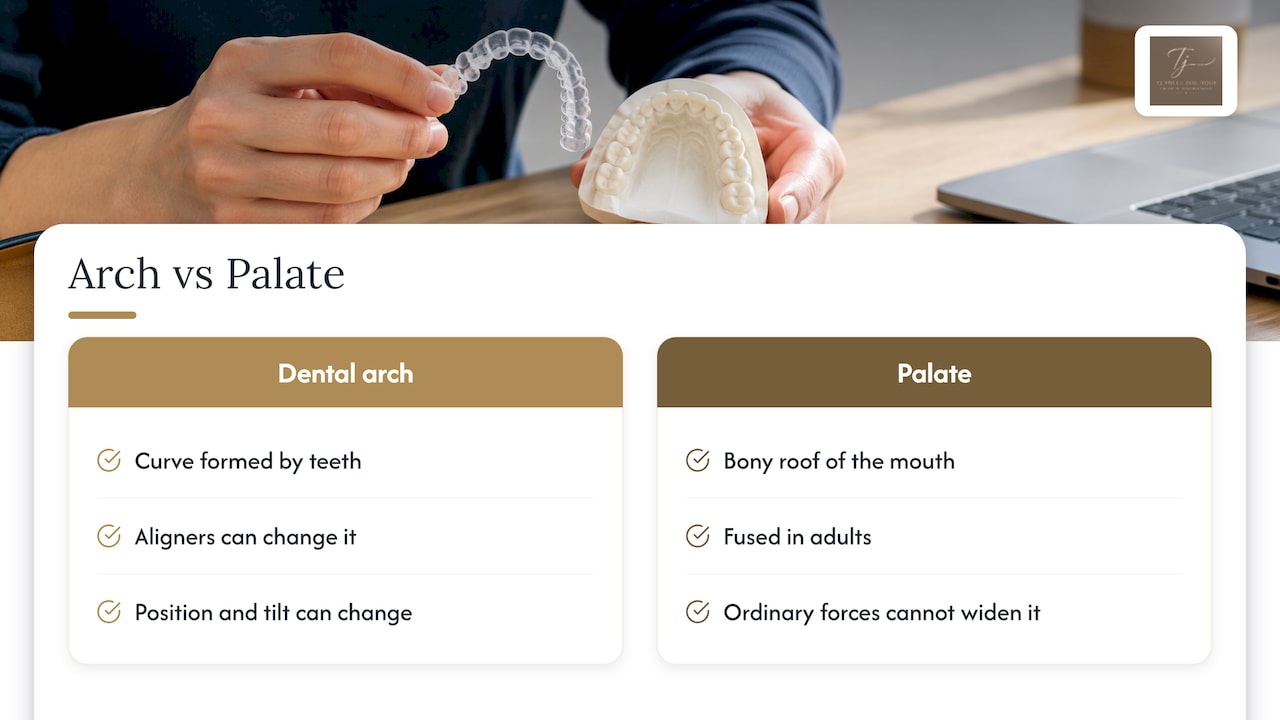
Your dental arch is the curve your teeth form in each jaw. A narrow arch is one that looks tapered or V-shaped instead of a broad, even U. Common signs are crowding, teeth that tip inwards, a crossbite where the upper back teeth sit inside the lower ones, and a smile that shows dark gaps at the sides, often called buccal corridors.
The arch is not the same as the palate. The palate is the bony roof of your mouth and the base of your upper jaw. In an adult, the palate is fused and does not widen with ordinary orthodontic forces. Aligners work on the teeth and the thin layer of bone around them, so what they change is the arch, not the skeletal palate.
This distinction decides what you can expect. If the problem is mostly the position and tilt of the teeth, expansion with aligners is a sensible route. If the upper jaw itself is narrow, you need a conversation about a different kind of treatment, covered further down.
Can Invisalign widen a narrow arch?
It can. A 2023 systematic review in BMC Oral Health pooled 15 non-randomised controlled trials and found that Invisalign effectively expands the dental arch. Expansion was greatest at the premolars and tapered off towards the back of the upper jaw. The authors also note that expansion is not completely predictable, and that overcorrection should be considered when planning.
Aligners create this width mostly by tipping the back teeth outwards. A 2025 scoping review describes the expansion as achieved primarily through buccal tipping of posterior teeth, with bodily movement (the whole tooth moving sideways, root included) remaining limited. That is why the treatment is best matched to mild to moderate cases, or to cases where auxiliary methods are added.
Manufacturer guidance agrees. Align Technology’s treatment planning guide states that Invisalign can treat transverse discrepancies including narrow arches and crossbite, and that clinicians may integrate auxiliary techniques where certain movements are less predictable.
How much expansion can you expect?
The honest answer is a few millimetres, and it is spread unevenly along the arch.
- A 2017 study cites reports that buccal expansion of 2 to 4 mm can relieve crowding or change arch form. It also cites a recommendation to limit expansion to 2 to 3 mm of arch width per quadrant, to reduce relapse and gum recession.
- The same study measured mean accuracy of 72.8% in the upper arch and 87.7% in the lower arch, and found that the digital plan overestimates bodily movement, with more tipping seen in reality.
- A 2020 PLOS One study found the digital plan overestimated expansion by a mean of 0.63 mm at the canine, 0.77 mm at the first premolar, 0.81 mm at the second premolar and 0.69 mm at the first molar. Predictability was 74.8%, 80.3%, 81% and 79.1% at those teeth respectively.
- A 2026 meta-analysis of 23 studies and 1,391 patients found average predictability of 75.5% in the upper jaw and 80.6% in the lower. Younger age, SmartTrack aligner material and lower-jaw segments were linked with higher predictability, though the authors rate the overall certainty of the evidence as very low.
What this means for your case
The figures tell us how to plan, not whether to proceed. If the digital plan shows 3 mm of widening and the average shortfall is under a millimetre at each tooth, the plan should build in a margin and be reviewed during treatment. Expansion in the lower arch tends to track the plan more closely than in the upper arch, and the premolar region is where change is most dependable.
A wider arch also shows in your smile. When the premolars move outwards, the corners of your smile fill in a little and the dark spaces at the sides shrink. The change is subtle and natural, which is exactly what most patients want.
How we decide if your arch suits aligners
A narrow arch is assessed, not guessed. At your consultation we look at several things:
- Where the narrowness sits. Is it the teeth tilting inwards, or the bone underneath? Tilted teeth respond well. A skeletally narrow upper jaw is a different problem.
- How much room is needed. Mild crowding often resolves with a couple of millimetres of widening. If a lot of space is required, expansion may be combined with other methods. Our guide to clear aligners for crowding explains the options.
- Whether there is a crossbite. Many narrow upper arches come with the upper back teeth sitting inside the lower ones. We cover this in when Invisalign fixes a crossbite.
- Gum and bone health. Moving teeth outwards loads the supporting tissue, so healthy gums matter. Tipping movements concentrate stress at the root tip and the bone crest, and a British Dental Journal opinion piece from the College of Surgeons of Edinburgh discusses this in the context of orthodontic movement generally. Careful, staged planning is how this is respected.
- Your age and habits. Younger patients tend to respond more predictably, and habits such as clenching or thumb sucking can shape the arch over time.
The Bamaga review sums up the principle well: aligners are most effective in mild to moderate transverse discrepancies, or alongside auxiliaries, and the plan should account for each patient’s individual characteristics. That is the approach we take. Every case is planned and led personally by Dr Tashfeen Jamil, so the person who assesses your arch is the person who guides it through treatment.
How the treatment works day to day
You wear a series of clear, removable aligners, each moving the teeth a small step. Small tooth-coloured shapes called attachments are bonded to some teeth to give the aligner something to grip, which helps with controlled movements. If you want to see how they work, this explanation of how Invisalign attachments work is a good place to start, and our own guide to Invisalign attachment types shows what to expect on your teeth.
Because our workflow is digital, we can show you the planned arch shape before you begin. Expansion is built into the staging, with a margin for the gap between plan and reality that the studies describe. Review appointments let us check how the arch is tracking and adjust if needed.
When aligners alone are not the whole answer, auxiliary techniques can be added, as the manufacturer’s guidance allows. We discuss this openly at the start, so you know the plan before you commit.
When a narrow palate needs something different
If your upper jaw is skeletally narrow, tipping teeth outwards is not the right tool by itself. One page that ranks for this topic makes the point clearly: a palate can only be widened in an adult with surgically assisted or mini-implant supported expansion, which are specialist procedures, not standard aligner care.
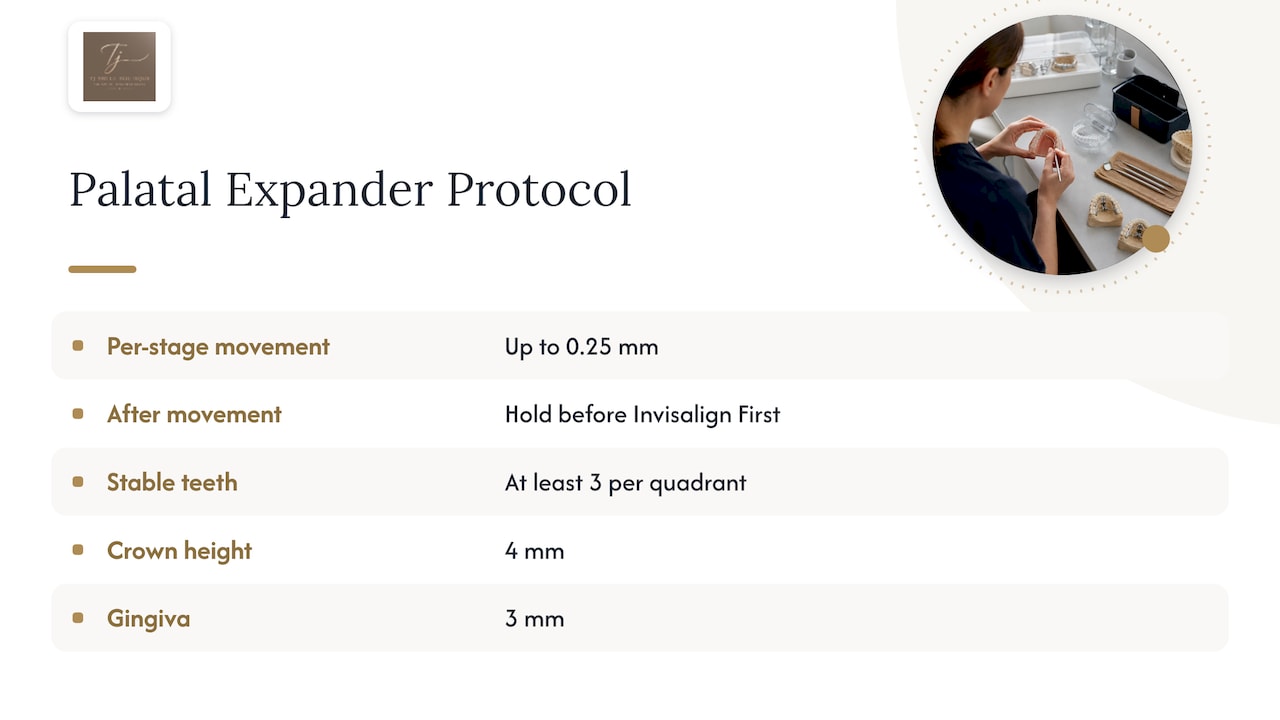
For younger patients, there is a newer option. The Invisalign Palatal Expander system, premiered in the UK in March 2025, uses staged removable expanders retained by bonded attachments. Movement is in small increments of up to 0.25 mm per stage, followed by a holding phase before Invisalign First treatment continues. A 2024 Journal of Clinical Orthodontics protocol describes who it is designed for: patients with at least three stable teeth per quadrant, 4 mm of clinical crown height and 3 mm of gingiva.
The practical message: if your consultation shows a skeletal problem, you will hear it plainly and be pointed to the right kind of specialist care. If the issue is dental, an aligner plan with expansion is often entirely suitable.
Keeping the width after treatment
Expansion only lasts if you retain it. A 2026 clinician’s guide to retention in Dentistry describes a practical protocol: removable full-coverage retainers in both arches, worn full time for six months, then at night. A bonded retainer can be added where extra security is wanted, for example after closing spaces or correcting significant rotations. The same piece reports that the British Orthodontic Society advises long-term retention, with the discussion held at the start of treatment and included in written consent.
We treat retainers as part of the treatment, not an afterthought. Your retainers are fitted at the end of your aligners, and a Retainer Review costs £35 so wear and fit can be checked later.
Perspective: why we plan arch width carefully
Most people who ask us about a narrow smile are not asking for a new jaw. They want teeth that sit comfortably, a smile that looks fuller, and a result that stays put.
That is why we begin with the arch, not the aligner. We measure what is tooth and what is bone, plan the expansion tooth by tooth, and build in the margin that the research tells us to allow. Because every case is led personally by me from consultation to completion, the plan you see is the plan I am accountable for.
Our fully digital workflow lets you see the intended arch shape before you start, and flexible appointments, including evenings and weekends, make review visits easy to fit around work. Expansion is one tool among several, and when it is the right one, it can transform how a smile looks and feels.
Dr Tashfeen Jamil BDS, MFDS RCS Ed, AssocFCGDent - GDC 286427
Invisalign at TJ Smile Studio
If you are wondering whether your arch can be widened, the first step is a conversation and a digital assessment. An Invisalign consultation with us costs £50, and Invisalign treatment starts from £1800. You can see the full list of fees on our pricing page.
Read more about Invisalign at our Glasgow studio, or compare it with other routes in Invisalign vs braces. If crowding is your main concern, we can also look at the wider picture of your smile at the same visit.
FAQ
Can Invisalign fix a narrow smile?
In many mild to moderate cases, yes. Aligners widen the arch by a few millimetres, mostly at the premolars, which fills the corners of the smile and reduces crowding. The amount depends on your teeth, gums and bone, so it is confirmed at a consultation.
Is arch expansion with Invisalign permanent?
The result is held by retention. Standard practice is full-time retainer wear for around six months, then night-time wear, often long term. Without retainers, teeth can drift back towards their old position.
Can Invisalign expand a narrow palate in an adult?
Not the bone itself. Aligners tip teeth and widen the arch, but an adult palate is a fused skeletal structure. If a skeletal problem is found, you will be referred for specialist assessment.
Does expansion make teeth look like they are sticking out?
The aim is a balanced, natural arch, so expansion is kept to a modest, planned amount. Research suggests limiting widening to around 2 to 3 mm per quadrant to reduce the risk of relapse and gum recession, and we plan within that kind of range.
Do I need attachments for expansion?
Often, yes. Attachments give the aligner grip for more controlled movement. They are small, tooth-coloured and removed and polished at the end of treatment.
Sources
- Clinical outcomes of arch expansion with Invisalign: a systematic review (BMC Oral Health, 2023)
- The predictability of transverse changes with Invisalign (2017)
- Arch expansion with the Invisalign system: efficacy and predictability (PLOS One, 2020)
- Predicting transversal dental arch expansion outcomes with clear aligners (Progress in Orthodontics, 2026)
- Maxillary arch development with clear aligners: a scoping review (2025)
- Invisalign Treatment Planning Guide (Align Technology)
- Opinion piece on orthodontic tooth movement (British Dental Journal, 2013)
- A revolutionary approach to palatal expansion (British Dental Journal, 2025)
- Protocol for the Invisalign Palatal Expander (Journal of Clinical Orthodontics, 2024)
- After Invisalign: a clinician’s guide to retention (Dentistry, 2026)
Recommended
- Clear Aligners for Crowding
- Can Invisalign fix an open bite, or do
- What to expect from Invisalign aligner treatment
This article is general information, not personal dental advice. What’s right for your teeth depends on a clinical examination — the condition of your enamel, gums, bite and any existing dental work — and no article can assess that. Outcomes vary between patients, and all treatment at TJ Smile Studio is subject to assessment and clinical suitability.
- Dr Tashfeen Jamil BDS, MFDS RCS Ed, AssocFCGDent, PGDip Restorative and Aesthetic Dentistry — GDC registration 286427
This article is general information, not personal dental advice. What's right for your teeth depends on a clinical examination — the condition of your enamel, gums, bite and any existing dental work — and no article can assess that. Outcomes vary between patients, and all treatment at TJ Smile Studio is subject to assessment and clinical suitability.
Clinically reviewed by Dr Tashfeen Jamil BDS, MFDS RCS Ed, AssocFCGDent, PGDip Restorative and Aesthetic Dentistry — GDC registration 286427, Principal Dentist at TJ Smile Studio, 1 Spiersbridge Way, Thornliebank, Glasgow G46 8NG.
If you have dental pain, swelling or an injury, call the practice on 07728 808510. Out of hours in Scotland, call NHS 24 on 111.