26 September 2026 · TJ Smile Studio
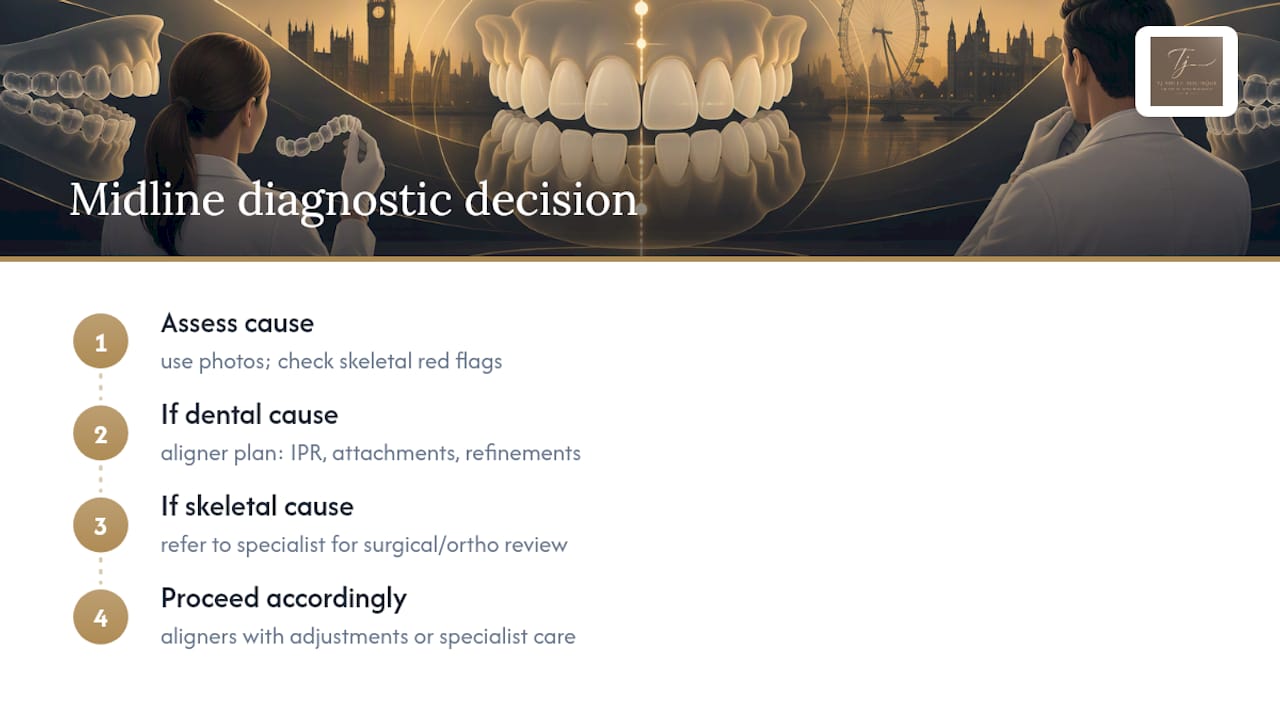
Invisalign Midline Correction: UK Clinician Checklist for Surgery Risk
UK clinician led guide on when Invisalign can fix dental midline shifts, when referral or surgery is needed, and what to ask at consultation.
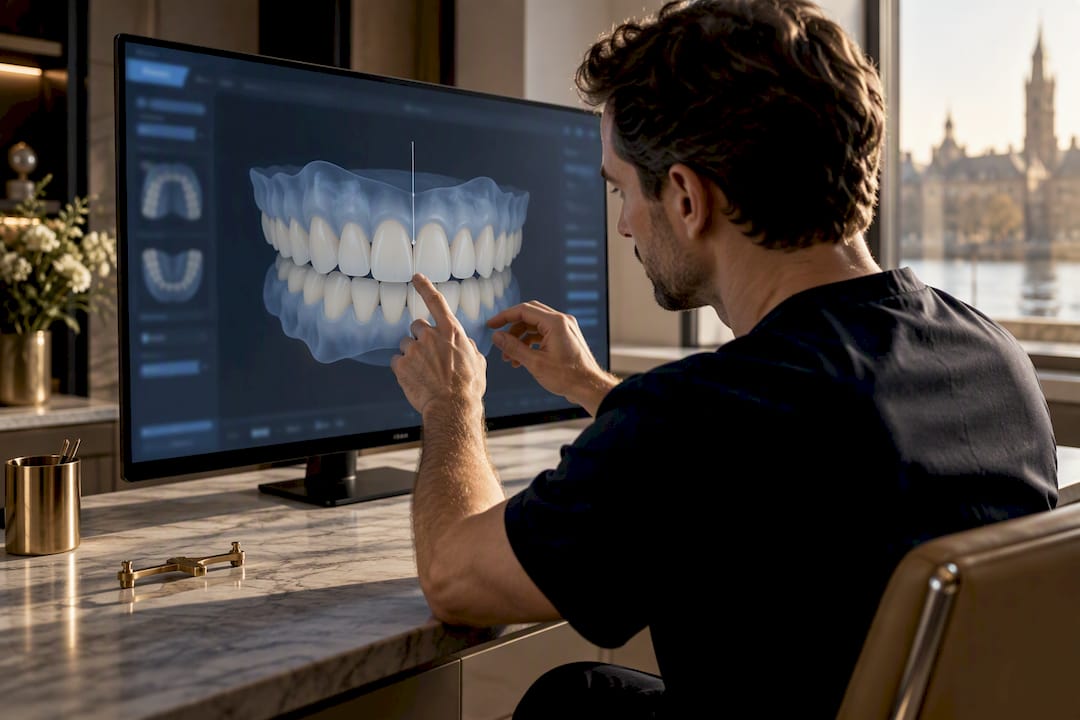
Invisalign can often correct a dental midline shift when the cause sits in the teeth themselves, but it has real limits when the jaw is the source of the problem. If your midline discrepancy comes from crowding, drifted teeth, or an old restoration, aligners are frequently a suitable option and can be explored further with clinics like Yoyime Clinic offering dental and aesthetic care. If a scan or clinical exam points to skeletal asymmetry, you need an assessment from a registered orthodontic specialist before assuming any aligner system will get you there.
TL;DR:
- Invisalign works best for dental midline shifts caused by teeth misalignment, but cannot correct cases involving jaw asymmetry or skeletal issues.
- Proper diagnosis requires scans, photographs, and bite assessments, as skeletal discrepancies often need specialist intervention or surgery.
- Clinicians frequently use overcorrection, attachments, elastics, and strict wear schedules to improve predictability in dental-based cases.
- Alignment timelines vary widely; full-time wear of aligners and potential refinement stages are essential for achieving accurate results.
- Treatment success relies on early assessment, clear communication about causes, and collaboration with specialists when skeletal involvement is suspected.
Table of Contents
- What the dental midline is and why it matters
- Common causes of midline shift: dental versus skeletal
- When Invisalign is likely to fix the midline
- When Invisalign alone is unlikely to be enough
- How Invisalign moves the midline: mechanics, predictability and refinements
- What to expect: consultation, timeline, wear time and retention
- A clinician’s view on getting midline correction right
- Getting your midline assessed at TJ Smile Studio
- Sources
- FAQ
What the dental midline is and why it matters
The dental midline is the imaginary vertical line between your two upper front teeth, and separately between your two lower front teeth. In an ideal bite, both lines meet and align with the centre of your face, known as the facial midline. When they do not, the mismatch can be dental (the teeth have drifted) or skeletal (the jaw itself is off-centre), and the distinction changes everything about treatment.
You can get a rough sense of which applies with a few checks:
- Smile in a mirror and see whether your upper midline lines up with the centre of your nose.
- Bite together and check whether your chin appears to point to one side.
- Note whether your bite feels uneven or whether chewing favours one side.
A clinician will confirm this with photographs, models or scans, and a bite assessment, rather than relying on the mirror test alone.
Common causes of midline shift: dental versus skeletal
Most midline shifts fall into one of two categories, and working out which one applies is the first job at any consultation.
- Dental causes: crowding, tooth loss on one side, a shifted filling or crown, or habits such as long-term thumb-sucking.
- Skeletal causes: jaw asymmetry, congenital differences in jaw growth, or old trauma that altered bone position.
- Red flags for skeletal involvement: a visibly deviated chin, a major mismatch in how the back teeth meet, or a midline shift that gets more obvious as the mouth opens wider.
Any of these red flags is a reason to ask for a specialist referral before starting treatment, since aligners are not designed to move the jawbone itself.
When Invisalign is likely to fix the midline
Clear aligners tend to do well with mild to moderate midline deviations that stem from tooth position rather than bone structure. The British Orthodontic Society notes that aligners are most appropriate for mild-to-moderate dental irregularities, with more severe or skeletal cases often needing fixed appliances or combined treatment instead.
Several tools improve predictability once a case is confirmed as dental in origin:
- Interproximal reduction (IPR): small amounts of enamel are removed between teeth to create space for movement.
- Composite attachments: small tooth-coloured shapes bonded to the teeth give the aligner extra grip for controlled rotation and tipping.
- Elastics: worn between upper and lower aligners, these help correct bite discrepancies alongside the midline shift.
- Overcorrection with refinement aligners: the plan deliberately moves teeth slightly past the target position, since a second set of aligners is often needed to fine-tune the result.
Wear time matters as much as the plan itself. Aligners only move teeth when they are actually on the teeth, which is why full-time wear, generally full-time wear, at least most of the day and night, is non-negotiable for predictable results.
Pro Tip: Take a photo of your smile from straight ahead before starting treatment; it gives you and your clinician an easy reference point to track midline movement across the course of care.
When Invisalign alone is unlikely to be enough
Skeletal midline discrepancies sit outside what any aligner system, including Invisalign, is built to correct, because the problem lies in the position of the jawbone rather than the teeth. Moving teeth cannot reposition the underlying skeleton, so these cases usually need either growth modification in younger patients, orthognathic surgery in adults, or a combined surgical-orthodontic plan.
Other scenarios also tend to push treatment beyond aligners alone:
- Cases needing tooth extraction to resolve severe crowding before the midline can be addressed.
- Large arch-width discrepancies that require more force or control than aligners typically provide.
- Bites where the back teeth do not meet correctly, which usually calls for fixed braces or a hybrid approach.
Getting to the right answer means a proper diagnostic workup: photographs, study models or digital scans, and often a radiograph to assess jaw relationships, followed by collaborative planning between a general dentist and an orthodontic specialist where needed.
How Invisalign moves the midline: mechanics, predictability and refinements
Invisalign works from a digital scan of your teeth, which is used to plan a series of small, staged movements across a sequence of custom aligners. Each aligner nudges the teeth slightly further towards the final planned position, and the BOS aligners fact sheet confirms that full-time wear, day and night except for meals, is required for the staged movement to work as planned.

A study comparing predicted versus achieved anterior tooth movements found mean accuracy for anterior alignment is reported as moderate in one cohort, with intrusion movements notably harder to achieve than planned. That gap between the digital plan and the real-world result is exactly why clinicians build in a margin for error rather than expecting the first set of aligners to finish the job.
In practice, this shows up as several routine adjustments:
- Attachments and elastics to increase control over difficult movements.
- Deliberate overcorrection, moving teeth slightly past the target so the final position lands where it should.
- A refinement stage, effectively a second round of aligners based on a fresh scan partway through treatment.
Practitioners commonly plan for overcorrection precisely because predicted and achieved movements frequently diverge, and building refinements into the plan from the outset tends to shorten the overall path to a stable result.
What to expect: consultation, timeline, wear time and retention
A first appointment for a suspected midline issue typically involves photographs, a digital scan, a clinical bite check, and sometimes a radiograph to rule out skeletal involvement. From there, treatment for a straightforward dental midline shift often runs on a timeline the clinician sets out during planning, though extractions, poor aligner wear, or an underlying skeletal component will all extend it.
- Diagnosis and planning: scans, photographs and a bite assessment confirm whether the case is suitable for aligners.
- Active treatment: staged aligners are worn for generally full-time wear, at least most of the day and night, with attachments or elastics as needed.
- Refinement: a follow-up scan and a further set of aligners fine-tune any movements that fell short of the original plan.
- Retention: once the midline is corrected, a retainer holds the result in place.
Retention is not optional. NHS retention guidance notes that removable vacuum-formed retainers are widely used and that patients are generally advised to keep wearing some form of retainer long term, since teeth can drift back without one. Anyone wanting a fuller sense of the day-to-day treatment path can read more in our aligner treatment guide.
A clinician’s view on getting midline correction right
Midline correction gets treated as a cosmetic detail when it is really a diagnostic question first. The clinicians who get it right are the ones who spend real time working out whether they are looking at a dental problem or a skeletal one, because the wrong assumption wastes months of a patient’s time in aligners that were never going to solve the underlying issue.
At TJ Smile Studio, every Invisalign case is planned personally by Dr Tashfeen Jamil, using a fully digital workflow that maps out tooth movements before treatment starts and allows same-day adjustments where suitable. That level of direct clinical involvement matters more for midline cases than for most other aligner work, because the assessment has to catch skeletal red flags early rather than after several months of aligners.
At consultation, it is worth asking direct questions: what is causing the midline shift, is IPR or an attachment plan involved, how many refinement stages are anticipated, and what happens if the case turns out to need a specialist referral instead. A clinician who cannot answer those clearly, or who offers only one treatment path without explaining alternatives, is worth a second opinion, a point the British Orthodontic Society makes directly in its own patient guidance.
Pro Tip: Bring any old dental photographs to your consultation; a clinician comparing your smile over several years can often spot whether a midline shift is recent (more likely dental) or long-standing (worth checking for a skeletal component).
— Dr Tashfeen Jamil BDS, MFDS RCS Ed, AssocFCGDent - GDC 286427
Getting your midline assessed at TJ Smile Studio
If you have read this far because you suspect a midline problem, the next useful step is a proper assessment rather than more searching. TJ Smile Studio in Glasgow offers an Invisalign Consultation at £50, led personally by Dr Tashfeen Jamil, using digital scans to work out whether your case is a dental shift that aligners can address or one that needs a different route entirely.
The clinic’s fully digital workflow means your scan, plan and any attachment or refinement strategy are mapped out from the first visit, with flexible evening and weekend appointments for anyone fitting this around work. Invisalign treatment at TJ Smile Studio starts from £1,800, and readers who want to compare cosmetic options first can see the full range on the treatments page. Book an Invisalign Consultation to find out where your midline shift sits and what it will take to correct it.
This article is general information, not a substitute for advice from a qualified doctor. Consult a qualified healthcare professional about your own circumstances before acting on anything here.
Sources
- Clear aligners - British Orthodontic Society (BOS)
- Study on predicted vs achieved anterior tooth movements with clear aligners
- Orthodontic retainer guidance — NHS England (Q&A)
- Practitioner-level insight on overcorrection strategies in clear aligner therapy
FAQ
How long does it take to correct a midline?
Timelines vary by case, since a mild dental shift with good compliance moves faster than one needing extractions, extensive IPR or a skeletal work-up. Your clinician can give a specific estimate only after scans and a clinical exam confirm the cause and the movements needed.
How can I fix a midline discrepancy?
The right fix depends entirely on the cause: dental shifts often respond to clear aligners using attachments, IPR and elastics, while skeletal discrepancies usually need a specialist referral and sometimes surgery. A proper diagnosis, including photographs, scans and a bite check, comes before any treatment decision.
Can midline shift be corrected?
Many dental midline shifts can be corrected with clear aligners or fixed braces once the cause is confirmed, though BOS guidance notes that severe or skeletal cases may need fixed appliances or combined treatment instead. Not every midline can be fully corrected without surgery when the jaw itself is asymmetric.
What is the 30 minute rule for Invisalign?
This is not a standard clinical term used in orthodontic guidance, and definitions circulating online vary. What is consistently recommended is full-time wear, generally full-time wear, at least most of the day and night, with aligners removed only for eating, drinking anything other than water, and cleaning your teeth.
Recommended
This article is general information, not personal dental advice. What’s right for your teeth depends on a clinical examination — the condition of your enamel, gums, bite and any existing dental work — and no article can assess that. Outcomes vary between patients, and all treatment at TJ Smile Studio is subject to assessment and clinical suitability.
- Dr Tashfeen Jamil BDS, MFDS RCS Ed, AssocFCGDent, PGDip Restorative and Aesthetic Dentistry — GDC registration 286427
This article is general information, not personal dental advice. What's right for your teeth depends on a clinical examination — the condition of your enamel, gums, bite and any existing dental work — and no article can assess that. Outcomes vary between patients, and all treatment at TJ Smile Studio is subject to assessment and clinical suitability.
Clinically reviewed by Dr Tashfeen Jamil BDS, MFDS RCS Ed, AssocFCGDent, PGDip Restorative and Aesthetic Dentistry — GDC registration 286427, Principal Dentist at TJ Smile Studio, 1 Spiersbridge Way, Thornliebank, Glasgow G46 8NG.
If you have dental pain, swelling or an injury, call the practice on 07728 808510. Out of hours in Scotland, call NHS 24 on 111.