
23 August 2026 · TJ Smile Studio
Invisalign IPR: what it is, why it's used, and is it safe?
Discover how Invisalign IPR can create space, improve your smile, and ensure safety during treatment. Learn more about this key process.
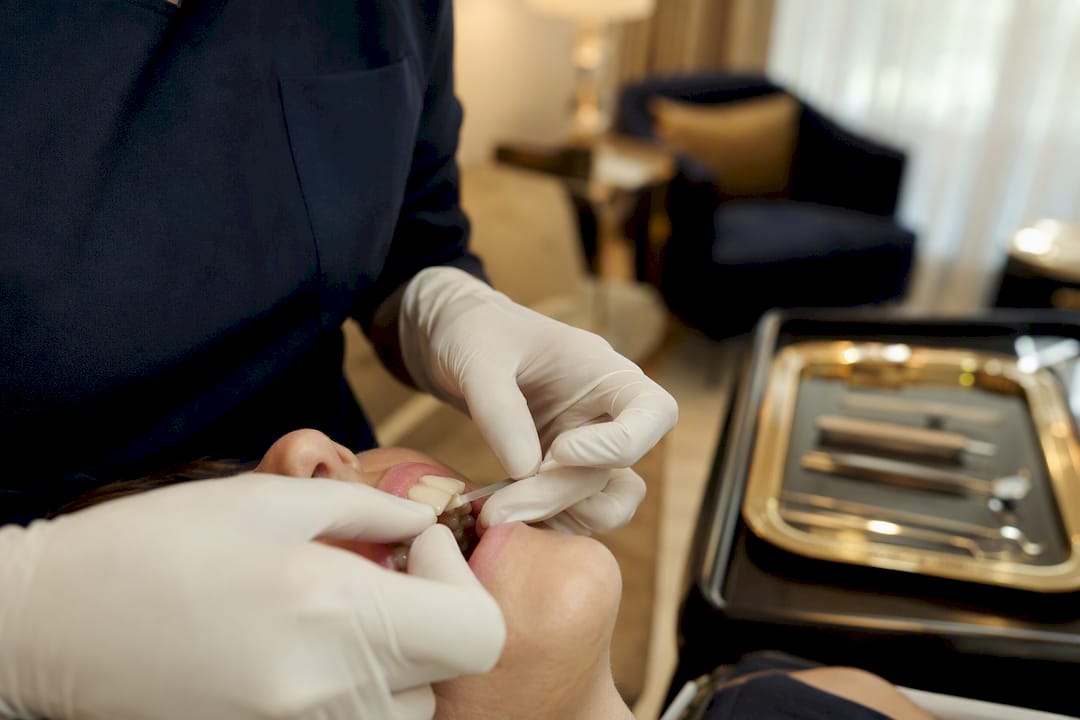
Interproximal reduction (IPR) is a routine, low-risk adjunct to Invisalign, used in most moderate cases to create space and refine how teeth meet. It is not something to fear, but it is also not something to wave through without questions. When performed by a trained clinician, measured properly, and finished with polishing, IPR carries minimal risk to enamel or gum health. A 2011 study cited in a wider review of long-term IPR outcomes found that just 2.5% of stripped tooth surfaces developed early decay, against 2.4% of surfaces that were never touched. The detail on amounts, technique, and aftercare follows below.
Key Takeaways
IPR works safely with Invisalign when it’s planned digitally, measured with gauges in the chair, and finished with polishing and fluoride.
| Point | Details |
|---|---|
| IPR is routine, not risky | Enamel removal between contacts creates space and refines fit, with no meaningful increase in decay risk when done to protocol. |
| Amounts are small and calculated | Anterior contacts typically lose 0.2 to 0.3mm, posterior up to 0.5mm, tracked against a per-patient plan. |
| Planned and actual amounts differ slightly | Studies show an average 0.15mm shortfall between p-IPR and i-IPR, smaller when gauges and burs are used. |
| Aftercare matters | Polishing and topical fluoride or CPP-ACP after IPR reduce roughness and support remineralisation. |
| TJ Smile Studio measures, not estimates | The clinic plans IPR digitally through ClinCheck and checks amounts in the chair with calibrated gauges before finishing and polishing. |
Table of Contents
- What is interproximal reduction (IPR) and when do dentists plan it?
- Why IPR is used with Invisalign: the treatment goals behind it
- How IPR is performed: instruments and technique
- How much enamel does IPR actually remove?
- Is IPR safe? What the evidence actually shows
- What to expect after IPR: comfort and aftercare
- Who is suitable for IPR, and who should think twice?
- Why planned IPR and actual IPR don’t always match
- TJ Smile Studio’s approach to Invisalign IPR
- A dentist’s view on IPR at consultation
- Getting Invisalign with properly measured IPR in Glasgow
- Sources
What is interproximal reduction (IPR) and when do dentists plan it?
IPR means shaving a small amount of enamel from the sides of teeth, where one tooth touches the next, to create extra room or adjust how the contact points sit. It is one of the more misunderstood parts of Invisalign interproximal reduction planning, mostly because patients hear “filing your teeth” and picture something far more invasive than what actually happens.
Dentists reach for IPR for a handful of clear reasons:
- Mild to moderate crowding, where extraction would be overkill
- Bolton discrepancies, where upper and lower tooth widths don’t match proportionally
- Black triangles between teeth, which IPR helps close alongside reshaping
- Fine-tuning contacts during the later stages of treatment
There’s an important distinction worth knowing before your consultation: p-IPR is what’s planned in the digital software (ClinCheck, in Invisalign’s case) before treatment starts, while i-IPR is what actually gets carried out in the chair. The two numbers rarely match exactly, and that gap matters more than most patients realise.
Why IPR is used with Invisalign: the treatment goals behind it
Clinicians turn to IPR for outcomes that are otherwise hard to achieve without extraction or expansion:
- Creating space to resolve crowding without removing a tooth
- Reshaping slightly disproportionate teeth for a more balanced smile
- Tightening contact points so teeth grip each other better after treatment, reducing relapse
- Closing black triangles that opened as teeth straighten
IPR isn’t a one-off event dropped into the middle of treatment. It’s usually staged, a little at a time, across several aligner stages rather than removed in one sitting. Research on refinement-phase planning found that IPR shows up substantially in the second half of treatment too, not just at the start, with roughly two in five prescriptions occurring during refinement stages rather than the initial plan. That pattern reflects how aligner treatment actually behaves. Teeth don’t move in a straight line to their final position, so space needs often shift as treatment progresses.
How IPR is performed: instruments and technique
Invisalign tooth shaping via IPR follows a fairly standard sequence, though the exact tools vary between clinicians and cases.
- Assessment and marking. The clinician checks radiographs and the digital plan to confirm which contacts need reduction and by how much.
- Soft-tissue protection. A wedge or matrix strip shields the gum from the instrument.
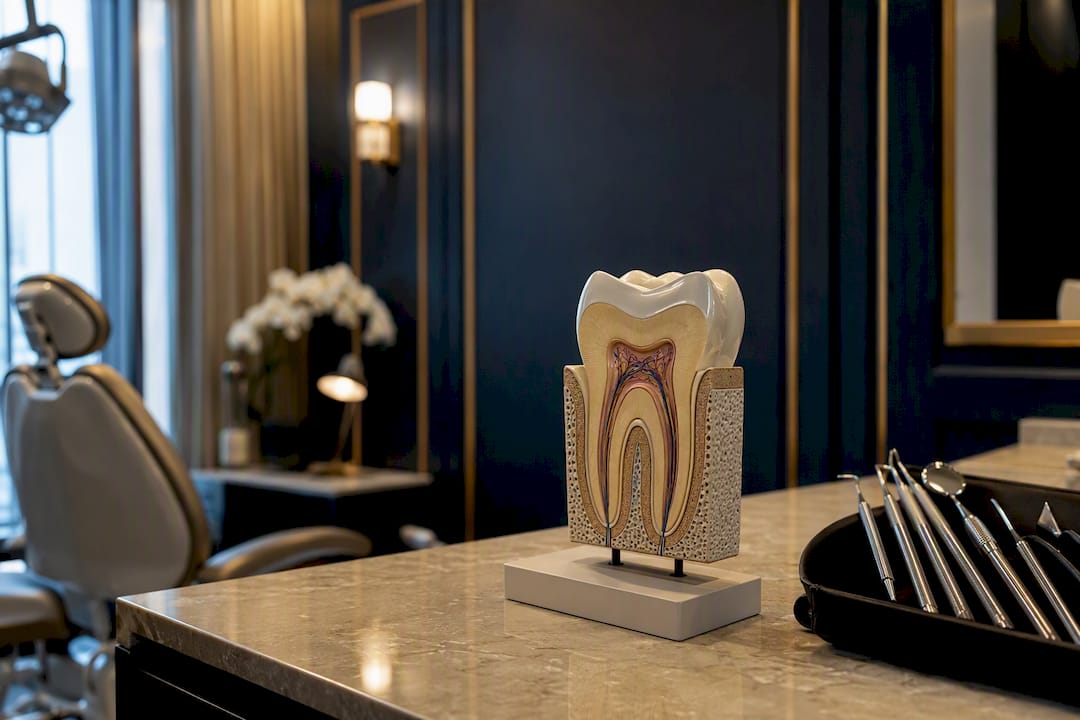
- Reduction. This is done with diamond-coated strips, discs on a slow-speed handpiece, or oscillating segmental systems, chosen based on the tooth surface and the amount required.
- Measurement. A calibrated gauge checks the gap against the planned figure, rather than relying on guesswork.
- Cooling. Water spray keeps pulp temperature down during any rotary instrumentation, protecting the nerve inside the tooth.
- Finishing and polishing. Ultra-thin finishing strips or discs smooth the enamel surface, removing any roughness that could trap plaque.
- Remineralisation. A topical fluoride or CPP-ACP application supports the enamel surface immediately afterwards.
Pro Tip: Ask your clinician whether they use a measuring gauge during IPR, not just a bur or strip by feel. Cohort data shows that clinics using gauges alongside burs consistently produce results closer to the planned amount, which means a better-fitting aligner series and fewer surprises at refinement.
Manual strips give more tactile control on tight anterior contacts, whereas burs and discs tend to be faster and more predictable on posterior teeth where access is harder. Neither method is universally “better.” The right choice depends on the tooth, the amount needed, and the clinician’s preference.
How much enamel does IPR actually remove?
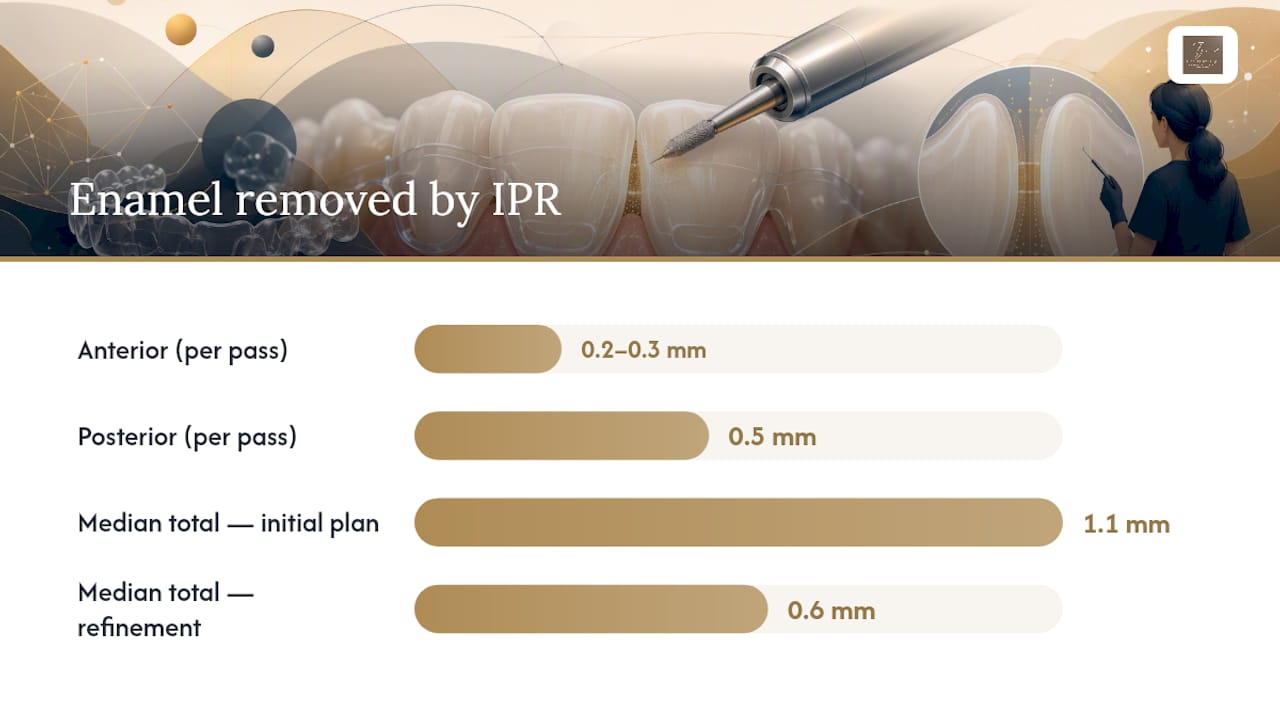
The numbers here are smaller than most patients expect. On anterior teeth, a typical IPR pass removes around 0.2 to 0.3mm per contact. Posterior contacts, where enamel is thicker, can tolerate up to roughly 0.5mm. Spread across a full arch, that adds up to enough space to resolve mild to moderate crowding without pulling a tooth.
Per-patient totals follow a pattern too. A quantitative analysis of digital treatment plans found a median of 1.1mm of IPR prescribed per patient in the initial plan, dropping to 0.6mm in refinement, with the lower front teeth the most frequently targeted region. Clinicians work within a safety margin that keeps total reduction well under the point where enamel thickness becomes a concern, and this is calculated per contact, not guessed.
Is IPR safe? What the evidence actually shows
The short answer: yes, when it’s planned properly and finished with polishing and fluoride. That answer deserves more than a nod, though, because “is IPR safe” is one of the most searched concerns around this procedure, and the evidence base, while not perfect, is reassuring.
The most cited figure comes from a study tracking stripped versus non-stripped posterior surfaces over the long term. It found 2.5% of stripped surfaces developed early-stage decay lesions, compared with 2.4% of surfaces that were never reduced, a gap so small it suggests IPR itself isn’t driving decay risk when done to protocol, according to the long-term outcomes review.
Systematic reviews on IPR consistently conclude the procedure carries no clinically meaningful risk to periodontal health or caries rates when performed to protocol, though the evidence base leans on non-randomised studies and would benefit from more prospective trials.
That caveat matters. Much of the research on interproximal reduction Invisalign practices comes from observational cohorts and in-vitro enamel testing rather than large randomised trials, a limitation acknowledged in a systematic review of dental and periodontal effects. Short-term sensitivity after IPR is real and reasonably common, but it tends to settle within days, not months. The safeguards, polishing and fluoride chief among them, are what keep the risk profile as low as the data suggests.
What to expect after IPR: comfort and aftercare
Is IPR painful with Invisalign? Most patients describe mild, brief sensitivity rather than pain, particularly to cold, and it usually fades within a few days as the enamel surface settles.
A few things help that process along:
- Polishing at the time of the procedure smooths the enamel and reduces plaque-trapping roughness
- A topical fluoride or CPP-ACP application straight after IPR supports remineralisation of the treated surface
- Avoiding very cold or acidic foods for a day or two eases transient sensitivity
- Ordinary brushing and flossing continue as normal, IPR doesn’t change your hygiene routine
Contact your clinician if you notice a sharp or rough edge on a tooth, sensitivity that’s still bothering you after a week or two, or any change in how your bite feels. These aren’t common, but they’re easy to fix quickly when caught early rather than left.
Who is suitable for IPR, and who should think twice?
IPR works best on patients with solid oral hygiene, no active decay near the contact points, and enough enamel thickness to spare. A dentist will check these before including it in your plan, not after.
Certain situations call for caution or a different approach entirely:
- Thin enamel or visibly worn contact points, where there’s little margin to remove safely
- Existing fillings or restorations on the proximal surface, which change how the tooth responds to reduction
- Active gum disease, where the priority is treating that first
- Cases needing more space than IPR alone could safely provide, where expansion or extraction becomes the better route
A comparison of cosmetic and orthodontic approaches helps explain why dentists weigh IPR against expansion or extraction rather than defaulting to one method for every case.
Why planned IPR and actual IPR don’t always match
The gap between what’s planned in the software and what happens in the chair is the part of Invisalign IPR vs traditional braces discussions that gets skipped most often. A prospective study measuring the difference found an average shortfall of 0.15mm between p-IPR and i-IPR, with lower canines and back-tooth surfaces the hardest contacts to treat accurately.
Pro Tip: Ask specifically how your clinician records IPR after it’s done, not just before. Some practices note the actual amount removed against the plan; others don’t, and that’s the difference between a checked result and an assumed one.
A short list worth raising at consultation:
- Which instrument will be used on which teeth, and why
- Whether a gauge confirms the amount removed
- Whether IPR is staged across treatment or delayed until teeth have partly aligned (sometimes called round-tripping)
TJ Smile Studio’s approach to Invisalign IPR
At TJ Smile Studio, IPR is planned through the same digital ClinCheck workflow used to design your aligner series, then measured and recorded in the chair rather than estimated by eye.
The approach includes:
- Digital space analysis before any enamel is touched
- Calibrated gauges to check amounts against the plan
- Polishing and fluoride application immediately after every IPR visit
- Flexible appointment scheduling built around a genuine consent conversation, not a rushed one
A dentist’s view on IPR at consultation
IPR gets more anxious questions than almost any other part of aligner treatment, usually because patients hear “removing enamel” and assume it’s irreversible in a worrying way. Done properly, it’s a controlled, measured procedure with a strong safety record. What I try to get across in consultation isn’t reassurance for its own sake. It’s that consent should cover exactly how much is planned, why, and how it will be checked afterwards. Get those three answers, and the rest of the decision becomes straightforward.
— Tashfeen
Getting Invisalign with properly measured IPR in Glasgow
If you’ve read this far, you already know the questions worth asking before treatment starts, and that’s exactly the conversation TJ Smile Studio builds into every Invisalign consultation.
Rather than a quick scan and a standard plan, your visit includes a full digital space analysis, a look at whether IPR, whitening, or composite bonding might work better for your specific case, and a clear breakdown of exactly how much enamel reduction (if any) your plan calls for before you agree to anything. For patients wanting a broader cosmetic result alongside straighter teeth, the clinic’s digital smile makeover service combines aligner planning with wider aesthetic changes in one coordinated digital workflow.
Book a consultation through the Invisalign page to get your space analysis and a plan that shows you the numbers, not just the promise.
Sources
- Interproximal enamel reduction and long‑term outcomes (MDPI)
- Quantitative evaluation of implemented interproximal enamel reduction during aligner therapy (PMC)
- Interproximal reduction in the refinement phase of Invisalign treatment (Am J Orthod Dentofacial Orthop, 2024)
This article is general information, not a substitute for advice from a qualified doctor. Consult a qualified healthcare professional about your own circumstances before acting on anything here.
Recommended
This article is general information, not personal dental advice. What's right for your teeth depends on a clinical examination — the condition of your enamel, gums, bite and any existing dental work — and no article can assess that. Outcomes vary between patients, and all treatment at TJ Smile Studio is subject to assessment and clinical suitability.
Clinically reviewed by Dr Tashfeen Jamil BDS, MFDS RCS Ed, AssocFCGDent, PGDip Restorative and Aesthetic Dentistry — GDC registration 286427, Principal Dentist at TJ Smile Studio, 1 Spiersbridge Way, Thornliebank, Glasgow G46 8NG.
If you have dental pain, swelling or an injury, call the practice on 07728 808510. Out of hours in Scotland, call NHS 24 on 111.