
23 September 2026 · TJ Smile Studio
Invisalign for Overbite: UK evidence shows 0.4–3.8mm bite opening
An evidence‑led UK explainer on using Invisalign for overbites. Read clinical results (0.4–3.8mm bite opening), realistic timelines, likely refinements...
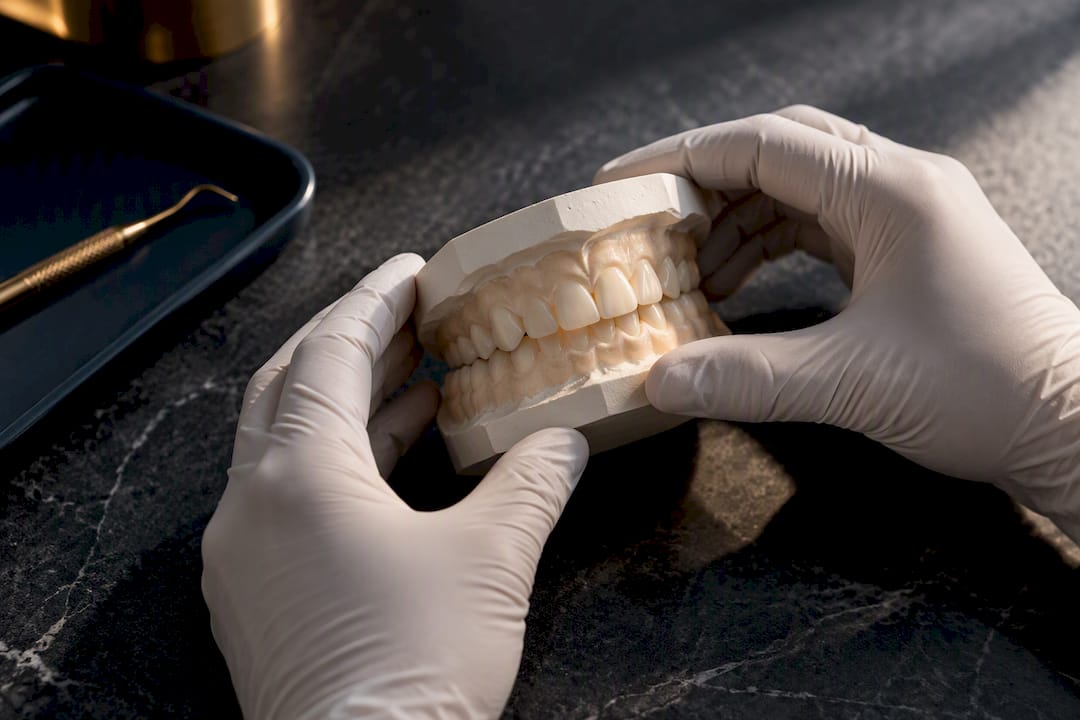
Invisalign can correct many mild to moderate overbites, particularly dentoalveolar cases where teeth, rather than jaw position, cause the excess overlap. Skeletal overbites, where the jawbones themselves are misaligned, often need fixed braces or orthognathic surgery instead. Expect near full-time wear, a real chance of refinement aligners, and a specialist assessment before anyone can confirm you’re a good candidate.
TL;DR:
- Invisalign is effective mainly for dentoalveolar overbites, but skeletal cases usually require braces or surgery, making accurate diagnosis crucial.
- Treatment duration typically ranges from 12 to 24 months for moderate cases, with around 22 hours daily aligner wear needed for predictable results.
- Success depends heavily on retainer compliance, as relapse is common if retainers are skipped, especially in the first several months.
- Patients with severe skeletal discrepancies, deep bites linked to jaw issues, or severe crowding requiring extractions are generally not suitable candidates for Invisalign alone.
Table of Contents
- What is an overbite and when does it need treatment?
- How effective are clear aligners for overbite correction?
- Who is a good candidate for Invisalign overbite treatment?
- What does Invisalign treatment for overbite actually involve?
- What are the risks and how do you protect your teeth during treatment?
- Why specialist planning makes the difference in outcomes
- How TJ Smile Studio assesses and treats overbites
- Does correcting an overbite with Invisalign change speech or chewing?
- Will your bite stay corrected after treatment finishes?
- Living with Invisalign: diet, habits and daily compliance
- What people get wrong about Invisalign and overbite correction
- Book an Invisalign consultation at TJ Smile Studio
- Sources
- FAQ
What is an overbite and when does it need treatment?
An overbite is simply the vertical overlap between your upper and lower front teeth when you bite together. A healthy bite covers roughly a third of the lower incisors. Anything beyond that starts tipping into “deep bite” territory, and dentists measure the exact overlap in millimetres or as a percentage of tooth coverage to decide how severe it is.
Left untreated, a pronounced deep bite can cause real problems over time.
- Excessive wear on the lower front teeth as they grind against the roof of the mouth
- Gum irritation or damage where lower teeth bite into the upper palate tissue
- Jaw joint discomfort from the altered bite pattern
- Increased strain that can accelerate general tooth erosion
Dentists also separate two distinct causes. A dentoalveolar overbite comes from how the teeth sit in the jawbone, which aligners can often address. A skeletal overbite comes from the jawbones themselves being disproportionate, which usually sits outside what any aligner system, including Invisalign, can fix on its own.
How effective are clear aligners for overbite correction?
Recent systematic review evidence gives a genuinely useful answer here, and it’s more nuanced than most marketing pages suggest. Clear aligners work well for mild to moderate dentoalveolar deep bites, but the quality of the underlying evidence is still considered low, and outcomes vary noticeably between patients.
The numbers behind the promise: a 2024–2025 systematic review found aligners produced bite opening of between 0.4mm and 3.8mm, with the accuracy of the originally planned correction often less than half of the intended movement across the studies reviewed.
That accuracy gap matters. It means that for every 100 planned movements, the aligner system might only deliver somewhere between a third and a half of what was mapped out on screen. A separate review comparing clear aligners against traditional fixed braces found fixed appliances sometimes achieve better objective scores for certain tooth movements, though the reviewers stopped short of calling aligners ineffective, just less predictable for some cases.
What does this mean practically?
- Expect your treatment plan to include built-in refinement stages from the outset
- Don’t judge success against the first digital preview alone
- Ask your dentist how they’ve adjusted the plan to account for known shortfall
- Understand that “effective” doesn’t mean “exact” when it comes to deep bite correction
The clinical takeaway is straightforward: plan for staged refinements rather than treating the first ClinCheck simulation as gospel, and go in with realistic expectations about how many aligner sets the full course might involve.
Who is a good candidate for Invisalign overbite treatment?
Good candidates tend to share a few traits: an adult with a dentoalveolar overbite, mild to moderate crowding, and generally healthy gums and teeth. If your bite issue comes from tooth position rather than jaw structure, and your case doesn’t involve extractions, aligners have a realistic shot at meaningful improvement.
Some cases sit outside that window.
- Major skeletal discrepancies where the upper and lower jaw sit in noticeably different positions
- Very deep bites combined with jaw-position problems rather than purely dental ones
- Severe crowding that would normally require tooth extraction to create space
- Cases where previous orthodontic treatment has already failed to hold
Clinicians triage these cases with a mix of visual examination, bite records, and often a full set of X-rays or a 3D scan to map the actual skeletal relationship, not just what’s visible from the front.
Pro Tip: Ask specifically whether your overbite is dentoalveolar or skeletal at your first consultation. That single distinction tells you more about your realistic outcome than almost anything else discussed that day.
What does Invisalign treatment for overbite actually involve?
The process follows a fairly consistent path, though the length varies a lot depending on how deep the bite is and how much crowding needs sorting alongside it.
- Digital scan and assessment. A 3D scan feeds into ClinCheck software, which maps out a proposed sequence of tooth movements for your dentist to review and adjust.
- Treatment planning and consent. You’ll see a simulation of the projected outcome and discuss realistic timelines, likely attachments, and costs before committing.
- Active wear phase. NHS guidance notes that adult orthodontic treatment commonly runs 6 to 30 months, with many moderate overbite cases falling in the 12 to 24 month range. Aligners typically need to be worn around 22 hours a day to work as intended.
- Attachments and auxiliaries. Small tooth-coloured attachments, and occasionally elastics, help the aligners grip and apply the right force for bite correction specifically.
- Refinements. A follow-up scan and a fresh batch of aligners often follow the main sequence, because that accuracy gap discussed earlier is the rule rather than the exception for deep bite cases.
- Retention. Once your teeth reach their final position, a retainer, usually worn nightly, helps prevent the bite from slowly drifting back.
A recent 2026 study on ClinCheck predictability found only around half of the planned deep bite correction was actually achieved in one patient sample, reinforcing why refinement phases are built into most treatment plans rather than treated as a failure or setback.
What are the risks and how do you protect your teeth during treatment?
Aligners are generally gentler on gum tissue than traditional metal brackets, but they still carry real risks if hygiene slips. The most common issues are demineralisation (those chalky white spots on enamel), tooth decay from trapped plaque, gum inflammation, and, less commonly, some root resorption during active movement.
- Brush after every meal before reinserting your aligners, not just morning and night
- Clean the aligners themselves daily, not just your teeth
- Floss more often than you might normally, since trapped debris under aligners accelerates decay risk
- Contact your dentist promptly for severe pain, a loose attachment, or a lost aligner rather than skipping ahead in the sequence
Good oral hygiene during aligner treatment genuinely reduces most of these risks, and it’s one of the few variables entirely within your control.
Why specialist planning makes the difference in outcomes
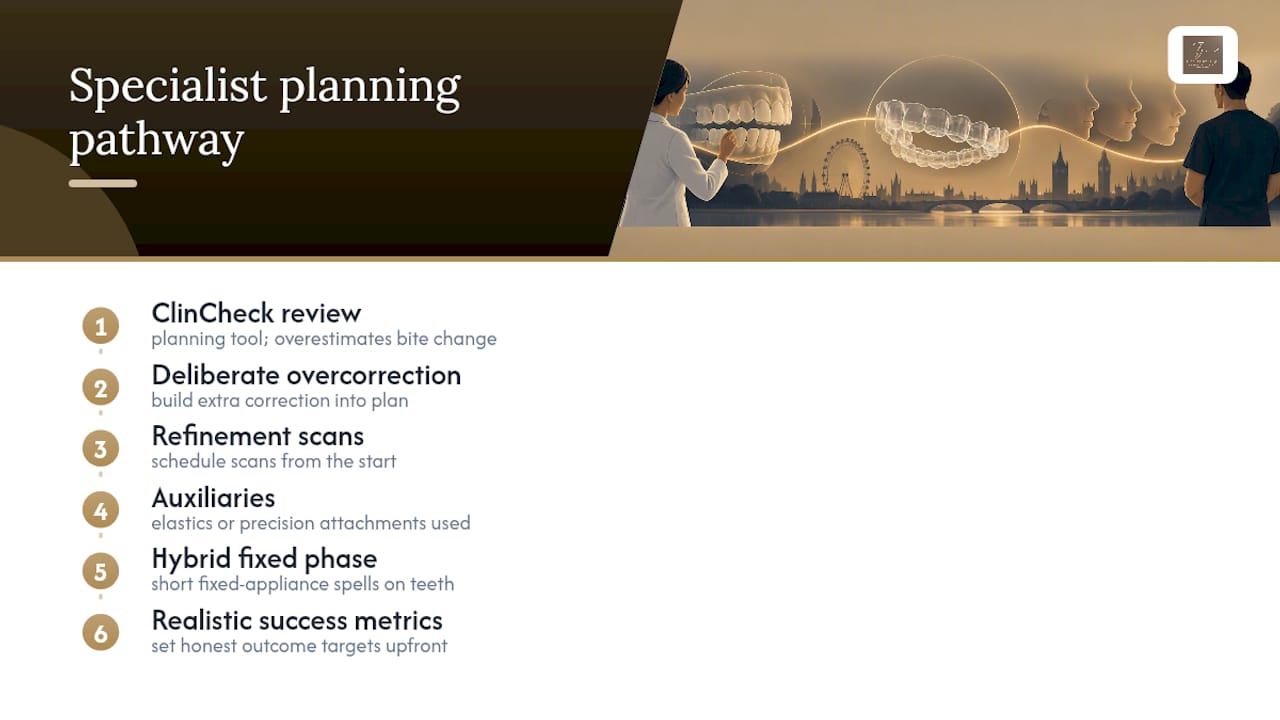
ClinCheck software is a planning tool, not a guarantee, and it consistently overestimates how much deep bite correction will actually happen without intervention. Experienced clinicians compensate by building in deliberate overcorrection and scheduling refinement scans from the start rather than reacting to a disappointing result later.
Where aligners alone fall short, specialists bring in auxiliaries: elastics to help close the bite vertically, or precision attachments that apply more targeted force. Some cases benefit from a hybrid approach, blending aligner phases with short spells of fixed appliances on specific teeth. Good planning also means setting honest success metrics up front and making sure you understand what “finished” will realistically look like, including how digital treatment planning improves predictability across the whole process.
How TJ Smile Studio assesses and treats overbites
Overbite assessments use a fully digital workflow to map your bite from the first visit, including a 3D scan, a clear discussion of your case type, and a written plan rather than a vague estimate.
A consultation covers your dental history, a review of your goals and concerns, and a realistic conversation about likely timelines and cost before anything is booked. You leave knowing exactly what your treatment would involve, and whether Invisalign is genuinely the right route for your bite.
Does correcting an overbite with Invisalign change speech or chewing?
Most patients notice a temporary lisp or slight speech change in the first week or two of wearing new aligners, simply because the tongue needs to adjust to the extra plastic against the palate. This settles quickly as your mouth adapts, and it’s rarely a lasting issue once you’re used to the aligners.
Chewing function tends to follow a similar pattern: a short adjustment period, then improvement. As a deep bite corrects and the vertical overlap reduces, many patients find chewing actually becomes more comfortable, since the lower teeth are no longer striking against the palate or wearing unevenly against the uppers. Attachments can feel slightly odd against the tongue at first, particularly ones placed on back teeth used heavily in chewing, but this usually fades within days rather than weeks.
It’s worth flagging that speech and chewing changes are almost always transitional rather than permanent side effects of treatment. If persistent discomfort or a lasting speech change shows up partway through treatment, that’s worth raising with your dentist rather than assuming it will resolve on its own, since it could indicate an attachment placement issue or a bite adjustment that needs reviewing.
Will your bite stay corrected after treatment finishes?
Occlusion stability after overbite correction depends heavily on one thing: retainer compliance. Teeth sit in bone and soft tissue that continues to remodel for months after active treatment ends, and that natural process is exactly why relapse happens when retainers get skipped.
Most clinicians advise a phase of near-full-time retainer wear for the first several months, then a gradual step down to nightly wear that many patients continue indefinitely. Long-term studies on retention consistently point toward night-time retainer use as the most reliable way to protect the result, given how significant the biological tendency toward relapse can be even years after treatment. Skipping retainers, particularly in the early months, is the single most common reason a corrected bite drifts back toward its original position.
The practical message is simple: the aligner phase gets your bite to where it needs to be, but retention is what keeps it there. Treat a retainer as part of the treatment, not an optional afterthought once the aligners come out.
Living with Invisalign: diet, habits and daily compliance
Because aligners come out for eating, there’s no list of forbidden foods the way there is with fixed braces. That said, treatment success hinges almost entirely on wear discipline, and that’s where most people underestimate the day-to-day demands.
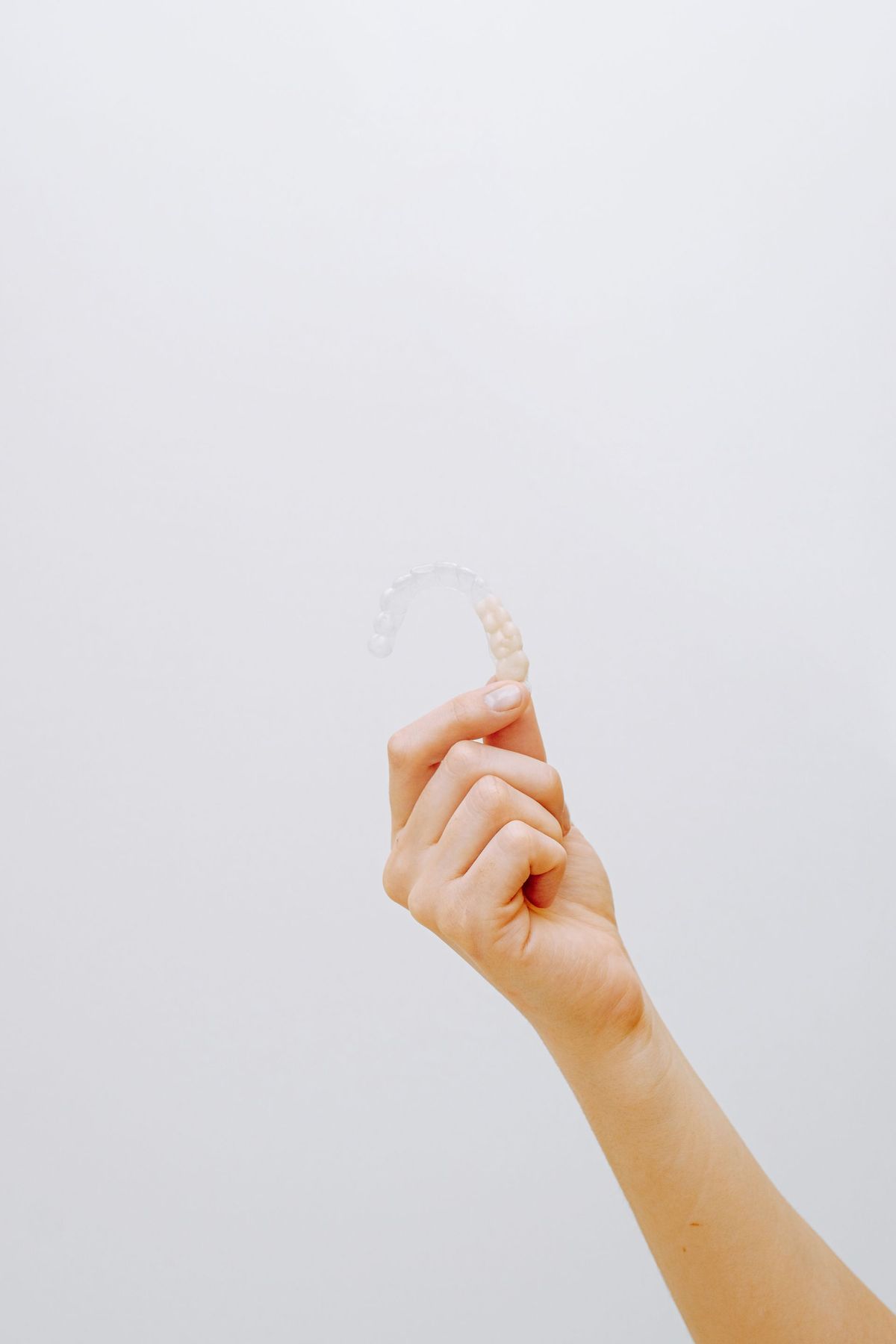
Hitting close to 22 hours of daily wear means eating, drinking anything but water, and cleaning your aligners fit into a fairly tight routine. Skipping that target regularly is one of the fastest ways to slow progress or undermine the accuracy of an already imperfect plan. Coffee and red wine drinkers need to be particularly disciplined about removing aligners before drinking, both to protect the aligners from staining and to avoid trapping sugars or acids against the teeth for hours at a time.
Snacking habits often need a small adjustment too, since constantly popping aligners in and out to graze throughout the day chips away at your daily wear total without you quite noticing. Most patients settle into a rhythm within the first couple of weeks: structured mealtimes, a cleaning routine that becomes automatic, and a travel case that goes everywhere with them. It’s a lifestyle adjustment rather than a hardship, but it is a genuine one worth planning for before you commit.
What people get wrong about Invisalign and overbite correction
The biggest misconception is treating the ClinCheck preview as a finished result rather than a starting proposal. Patients see that polished animation and assume it’s what they’ll get, when the evidence points to something closer to a third to a half of that planned movement landing accurately on the first pass. That gap isn’t a failure of the technology. It’s a predictable feature of how deep bite mechanics work, and any clinician who doesn’t discuss it upfront is doing their patient a disservice.
Conventional advice often oversells aligners as interchangeable with braces for every bite problem, when the honest picture is more selective. Dentoalveolar overbites respond well. Skeletal discrepancies frequently don’t, no matter how motivated the patient is about wear compliance. Where I’d push back hardest against the general narrative is on refinements: they get framed almost apologetically in some clinics, as though needing a second round of aligners means something went wrong. In deep bite cases specifically, refinements are close to standard practice, not a sign of a poor plan.
What should patients prioritise first? Getting an honest read on whether their case is dental or skeletal, before anything else gets discussed.
— Dr Tashfeen Jamil BDS, MFDS RCS Ed, AssocFCGDent - GDC 286427
Book an Invisalign consultation at TJ Smile Studio
One reported advantage for overbite treatment is continuity of care, with a lead clinician managing every stage from the first digital scan through to refinements and retention planning, which is important in deep bite cases where outcomes must be closely tracked.
An Invisalign consultation costs £50 and gives you a proper digital assessment of whether your overbite is a good match for aligner treatment, alongside a written plan rather than a rough estimate. Come prepared with your dental history, any previous orthodontic treatment, and a clear idea of your budget and timeline expectations, since Invisalign treatment starts from £1,800. You’ll get a transparent picture of what’s achievable, an honest discussion of alternatives if aligners aren’t the right fit, and full pricing details before you commit to anything. Booking that first consultation is the fastest way to find out where your case actually sits.
This article is general information, not a substitute for advice from a qualified doctor. Consult a qualified healthcare professional about your own circumstances before acting on anything here.
Sources
- Effectiveness and accuracy of clear aligners in treatment of deep bite: a systematic review - PubMed
- Efficacy of clear aligner therapy over conventional fixed appliances in controlling orthodontic movement: A systematic review - PubMed
- Braces - NHS
- Predictability of Clear Aligner Therapy in deep bite correction - PubMed
- Clear aligners - British Orthodontic Society
FAQ
Is Invisalign worth it for an overbite?
For mild to moderate dentoalveolar overbites, yes, aligners genuinely work, though systematic review evidence shows the accuracy of the planned correction often lands between 33% and 48.88%, meaning refinements are the norm rather than the exception. Whether it’s “worth it” for you depends on your specific bite type, which only a specialist assessment can confirm.
Who is not suitable for Invisalign overbite treatment?
Patients with major skeletal discrepancies, very deep bites tied to jaw-position problems, or severe crowding needing extractions are generally poor candidates for aligners alone. British Orthodontic Society guidance is clear that these cases usually need fixed braces or, in more extreme cases, orthognathic surgery.
What happens if an overbite goes untreated?
An untreated deep bite can cause accelerated wear on the lower front teeth, gum tissue damage from the bite pattern, and ongoing jaw discomfort over time. The severity varies hugely between individuals, which is why an assessment matters even for bites that feel manageable day to day.
How long will Invisalign take to fix an overbite?
NHS guidance puts adult orthodontic treatment at roughly 6 to 30 months depending on complexity, with many moderate overbite cases falling somewhere in the 12 to 24 month range once refinements are included. Full-time wear of around 22 hours a day is essential to hit those timelines.
How much does Invisalign for overbite cost?
At TJ Smile Studio, Invisalign treatment starts from £1,800, with an initial Invisalign consultation priced at £50. Exact costs depend on the complexity of your case and how many refinement stages your bite correction needs, and full current pricing is available on the pricing page.
Recommended
This article is general information, not personal dental advice. What’s right for your teeth depends on a clinical examination — the condition of your enamel, gums, bite and any existing dental work — and no article can assess that. Outcomes vary between patients, and all treatment at TJ Smile Studio is subject to assessment and clinical suitability.
- Dr Tashfeen Jamil BDS, MFDS RCS Ed, AssocFCGDent, PGDip Restorative and Aesthetic Dentistry — GDC registration 286427
This article is general information, not personal dental advice. What's right for your teeth depends on a clinical examination — the condition of your enamel, gums, bite and any existing dental work — and no article can assess that. Outcomes vary between patients, and all treatment at TJ Smile Studio is subject to assessment and clinical suitability.
Clinically reviewed by Dr Tashfeen Jamil BDS, MFDS RCS Ed, AssocFCGDent, PGDip Restorative and Aesthetic Dentistry — GDC registration 286427, Principal Dentist at TJ Smile Studio, 1 Spiersbridge Way, Thornliebank, Glasgow G46 8NG.
If you have dental pain, swelling or an injury, call the practice on 07728 808510. Out of hours in Scotland, call NHS 24 on 111.