07 October 2026 · TJ Smile Studio
When Invisalign Fixes a Crossbite: UK Clinician Criteria and Costs
UK clinician explains when Invisalign can fix crossbites, signs you need more than aligners, plus £50 consult and treatment from £1,800.
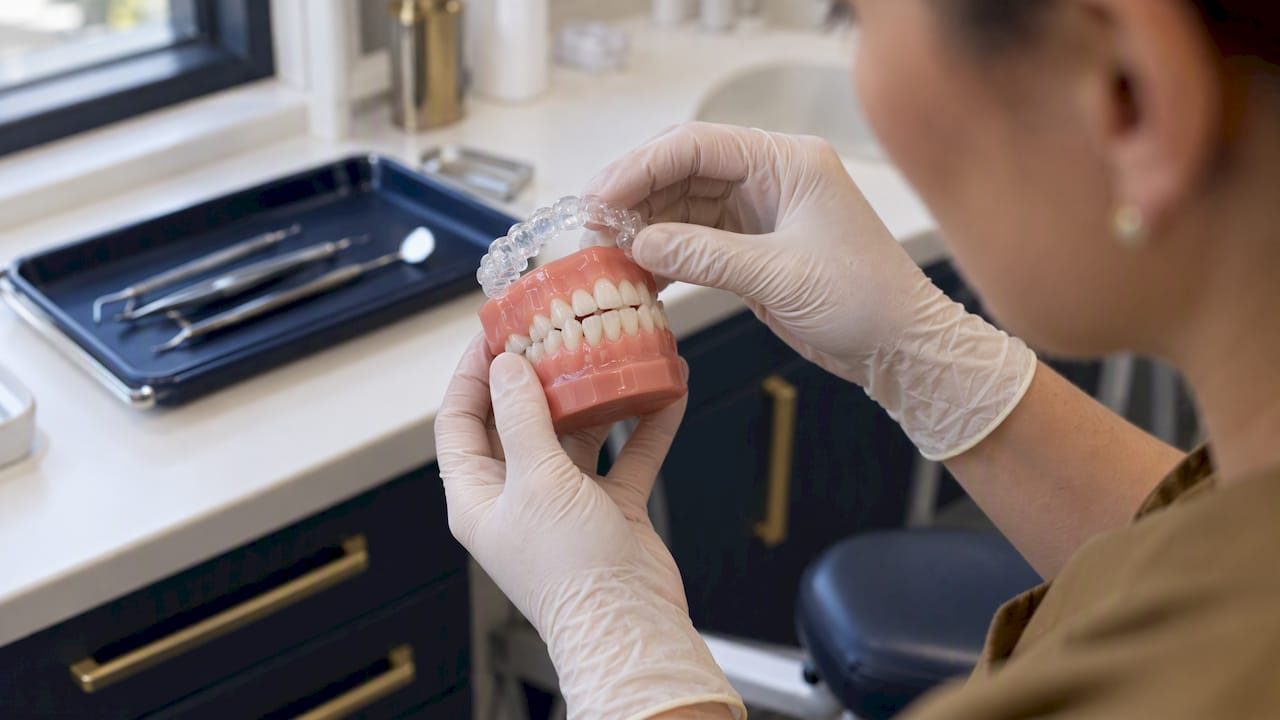
Invisalign can correct many mild to moderate dental crossbites by tipping, rotating and expanding teeth into a better bite, though it is not a reliable fix for crossbites caused by jaw mismatch. The British Orthodontic Society advises that an orthodontist or a dentist with recognised enhanced skills should confirm whether your crossbite is dental or skeletal before you start. The rest of this guide covers who is a good candidate, how treatment actually unfolds, and what to do when aligners alone are not enough.
TL;DR:
- Ask an orthodontist or dentist with recognized enhanced skills to determine whether the crossbite comes from teeth or jaw structure before choosing aligners.
- A visible jaw shift when closing, severe reverse overjet, significant crowding, or inconsistent wear can signal that aligners alone will not suffice.
- Treatment begins with scans, photographs, and sometimes radiographs; aligners are usually changed every one to two weeks, and refinements may extend treatment.
- After correction, retainers are typically needed for life, often worn nightly; daily cleaning and protection from heat help preserve them.
- Growing patients may benefit from a palatal expander for true jaw widening, while adults with severe skeletal discrepancies may need fixed appliances or surgery.
Table of Contents
- What a crossbite is and how clear aligners correct it
- Who is a good candidate for Invisalign crossbite correction
- The Invisalign crossbite treatment process, step by step
- Outcomes, risks and keeping your result with retention
- When you need more than Invisalign alone
- A clinician’s view on assessing and planning crossbite cases
- A practical checklist for your Invisalign crossbite consultation
- How we approach Invisalign for crossbite at TJ Smile Studio
- FAQ
- Sources
What a crossbite is and how clear aligners correct it
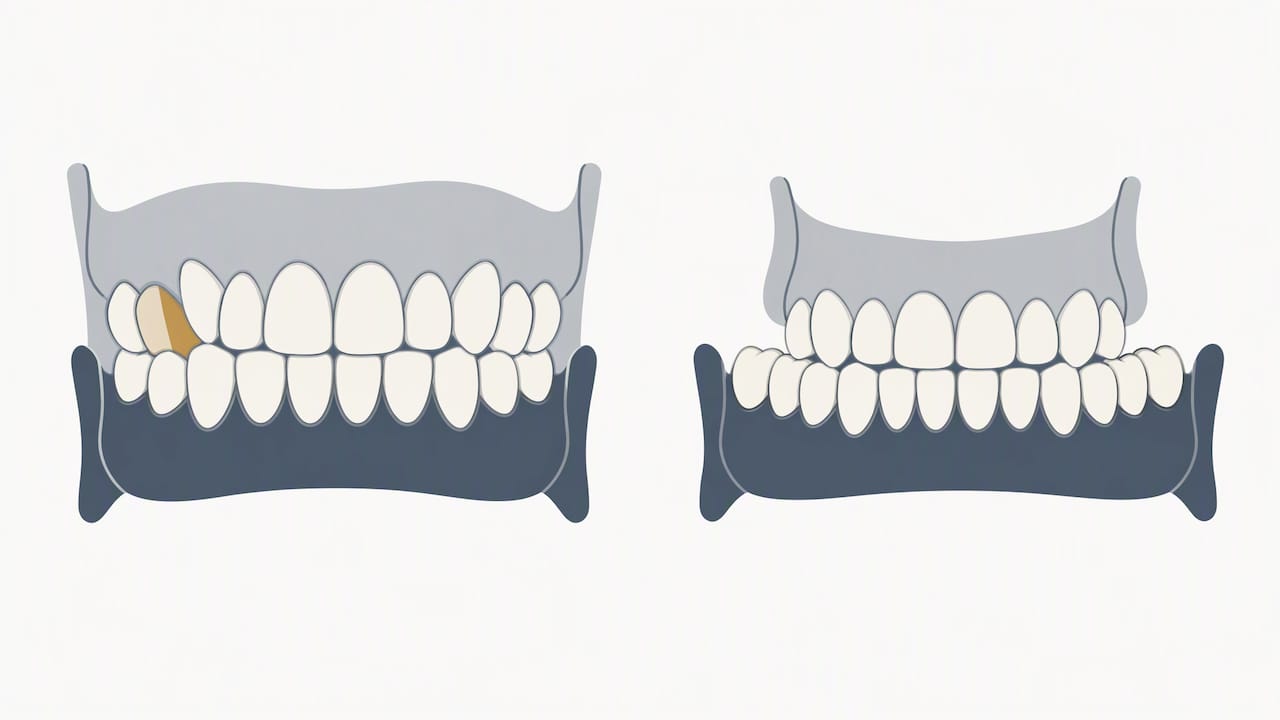
A crossbite happens when one or more upper teeth sit inside the lower teeth when you bite together, rather than slightly overlapping them as they should. There are two broad types. An anterior crossbite affects the front teeth, often making the lower teeth look like they protrude past the uppers. A posterior crossbite affects the back teeth, usually on one or both sides, and can cause a visible jaw shift to one side when you close your mouth. Left untreated, crossbites can wear teeth unevenly, strain the jaw joint and, in children, affect how the jaw grows.
Invisalign treats crossbites with a sequence of custom aligners that each move teeth a fraction of a millimetre, building up to the full correction over the course of treatment. For a dental crossbite, this typically means:
- Tipping and rotating misaligned teeth into a corrected position using precisely shaped aligner plastic
- Attachments, small tooth-coloured bumps bonded to teeth, which give the aligner extra grip for harder movements like rotation or extrusion
- Interproximal reduction (IPR), a light reshaping between teeth to create space where crowding is blocking correction
- Elastics or precision cuts on the aligners themselves to apply directed force, particularly for crossbites involving a shifted jaw position
Where expansion is needed across the arch, aligners widen the dental arch mostly by tipping teeth outward rather than by moving the underlying bone. A 2025 systematic review and meta-analysis found that clear aligner therapy can produce clinically meaningful transverse arch expansion and correct anterior crossbites in growing patients, with high patient satisfaction. The review’s authors noted considerable variation between studies and said larger trials are still needed before firmer conclusions can be drawn.
That distinction between dental tipping and true skeletal widening matters more in adults than in growing patients, because an adult’s jawbone no longer responds to orthodontic forces the way a child’s does. Aligner-only mechanics work well for teeth that are simply angled or rotated wrong. They struggle when the underlying bone structure, rather than the teeth, is the source of the misalignment.
Who is a good candidate for Invisalign crossbite correction
Not every crossbite responds the same way to clear aligners, and age is one of the biggest variables. In growing patients, the upper jaw still has a mid-palatal suture that has not fully fused, which is why interceptive aligner systems such as Invisalign First can sometimes achieve genuine skeletal widening rather than just tipping teeth. Adults no longer have that flexibility, so treatment leans more heavily on dental movement and, where needed, auxiliary appliances.
The first thing a clinician needs to establish is whether your crossbite is dental or skeletal:
- Check for facial asymmetry. A visible shift of the chin or jaw to one side when biting down often points to a skeletal component.
- Look at the bite relationship. A severe reverse overjet, where the lower front teeth sit noticeably ahead of the uppers even at rest, suggests more than a simple dental problem.
- Assess crowding. Significant crowding that would normally need extractions changes the treatment plan and sometimes rules out aligner-only correction.
- Consider compliance. Aligners only work if you wear them for the prescribed hours each day, so a pattern of inconsistent wear is itself a disqualifying factor.
- Review jaw growth status. In a growing patient, a specialist will usually want to assess remaining growth before committing to a particular appliance.
Warning signs that you may need more than Invisalign include a jaw that visibly shifts on closing, a bite that only aligns when you posture your jaw forward or sideways, or a diagnosis that involves a skeletal discrepancy severe enough to warrant surgical discussion. The British Orthodontic Society is clear that aligners suit mild to moderate dental irregularity well, but more severe or skeletal problems often need auxiliaries or fixed appliances instead.
Pro Tip: Ask whichever clinician assesses you to show you, on a model or scan, exactly which teeth will move and which will not. A plan that cannot explain this clearly is a plan worth questioning.
The Invisalign crossbite treatment process, step by step
Correcting a crossbite with Invisalign follows a fairly predictable sequence, though the number of aligners and the total time varies with the severity of the case.
It starts with an assessment and full set of diagnostics: photographs, a 3D digital scan of your teeth, and sometimes radiographs to check root positions and jaw relationships. The clinician records your bite relationship, any jaw shift on closing, and the degree of crowding or spacing, since all of this determines whether a dental or skeletal crossbite is more likely.
From there, the stages generally look like this:
- Digital planning (ClinCheck): a software simulation maps out every stage of tooth movement from start to finish, letting you and your clinician see the intended result before any aligners are made
- Active aligner sequence: a series of aligners, usually worn for one to two weeks each, gradually move teeth according to the plan
- Attachment placement and optimisation: attachments are bonded partway through where extra movement control is needed, often for rotations or expansion
- Mid-treatment review: your clinician checks that teeth are tracking as planned and not lagging behind the aligner shape
- Refinements: a further set of aligners, planned from a new scan, corrects any movements that did not go exactly to plan
- Retainer delivery: once the bite is corrected, retainers are fitted to hold the new position
Mild dental crossbites can sometimes resolve within a few months of active aligner wear, while cases needing attachments, IPR and one or more rounds of refinement often run longer. Refinements are a normal part of treatment rather than a sign of failure. Teeth do not always move at exactly the rate a digital simulation predicts, and a second or third round of aligners is common for crossbite cases specifically because transverse movement is harder to control than simple straightening.
Outcomes, risks and keeping your result with retention
Clear aligners correct dental crossbites predictably in many cases, but it is worth being realistic about the ceiling on what tooth movement alone can achieve. A corrected bite relationship through dental tipping is not the same as a corrected skeletal relationship, and a crossbite with a genuine jaw-width or jaw-position discrepancy will usually relapse towards its original shape unless the skeletal component was also addressed.
A 2025 systematic review reported high patient satisfaction with clear aligner correction of anterior crossbites in growing patients, alongside measurable arch expansion, though the authors flagged inconsistency between studies. That inconsistency is a reason to treat any single outcome figure as indicative rather than guaranteed for your own case.
Known risks with clear aligner treatment generally include; it is also important to avoid nicotine pouches during orthodontic treatment, as advised in guidance on nicotine pouches with braces.
- Mild root resorption, a shortening of the root tip that can occur with any orthodontic tooth movement, aligners included
- Gum health changes, since attachments and aligner edges can trap plaque if hygiene slips
- Attachment loss, which can slow or stall tracking until attachments are rebonded
- Tracking failures, where teeth do not follow the digital plan closely enough, usually resolved with refinement aligners
Retention is not optional. NHS guidance notes that retainers are typically needed for life to prevent relapse, and UK retainer care leaflets used in practice give the same message: long-term, often nightly, wear is standard advice, alongside straightforward care such as cleaning retainers daily and keeping them away from heat. A British Orthodontic Society patient fact sheet also notes that each aligner in an active sequence can function as a short-term retainer if an appointment is delayed, which is a useful safety net but not a substitute for a proper retention plan once treatment finishes.
When you need more than Invisalign alone
Some crossbites need a combined approach from the outset, and a good treatment plan says so early rather than discovering it halfway through a course of aligners.
- Fixed braces give more direct control over root position and are sometimes used alongside or instead of aligners for complex rotations or severe crowding
- Palatal expansion devices (RPE or MSE), fixed to the roof of the mouth, achieve true skeletal widening in growing patients in a way aligners cannot replicate
- Temporary anchorage devices (TADs), small screws that act as fixed anchor points, allow more demanding tooth movements that aligners alone cannot generate reliably
- Orthognathic surgery, reserved for adults with a skeletal jaw discrepancy too severe for any appliance to correct, repositions the jaw itself
A typical combined plan might use a palatal expander first in a growing patient, followed by aligners to fine-tune individual tooth positions, or TADs alongside aligners in an adult case needing more anchorage than the aligner plastic can provide on its own. UK referral guidance for orthodontics includes specific scoring for crossbite severity, and more complex cases are often flagged for multidisciplinary assessment rather than treated by any single appliance type. Deciding between aligners, a combined plan, or Invisalign versus traditional braces generally comes down to how much of the problem sits in the teeth versus the bone.
A clinician’s view on assessing and planning crossbite cases
I am Dr Tashfeen Jamil, BDS, MFDS RCS Ed, AssocFCGDent, GDC 286427, and crossbite cases are among the ones where a careful diagnosis matters more than the appliance chosen. At TJ Smile Studio, every Invisalign case starts with a full digital scan and photographic record, which lets us build a ClinCheck simulation showing the intended movement stage by stage before any aligners are manufactured.
That bespoke staging is what lets us flag, during the consultation itself, whether a crossbite looks purely dental or has a skeletal component that needs a different conversation. We do not promise a fixed number of aligners or a guaranteed finish date at the first visit, because refinements are a normal part of most crossbite cases and the honest answer depends on how your teeth respond once treatment starts.
— Dr Tashfeen Jamil BDS, MFDS RCS Ed, AssocFCGDent - GDC 286427
A practical checklist for your Invisalign crossbite consultation
A useful consultation gives you more than a quote. Bring any previous dental records or photographs of your bite, and ask these questions:
- Is my crossbite dental, skeletal, or a mix of both?
- Can I see a ClinCheck or equivalent simulation of the planned movement?
- How many aligners and review visits should I expect, and how likely is a refinement stage?
- What happens if my teeth are not tracking as planned?
- What retainer will I need afterwards, and for how long?
A clinician who answers these clearly, rather than in generalities, is giving you a plan rather than a sales pitch.
How we approach Invisalign for crossbite at TJ Smile Studio
We start every Invisalign case with an Invisalign Consultation priced at £50, which includes the digital scan and photographic assessment we use to work out whether your crossbite is dental, skeletal, or needs a combined approach before we commit to a plan.
From there, we build your ClinCheck simulation and talk you through exactly which teeth will move, how many aligners we expect to need, and where attachments or auxiliaries are likely. Our Invisalign treatment starts from £1,800, and we are upfront when a case looks like it needs input beyond aligners alone, including referral where a skeletal or surgical assessment is the more honest route.
We offer personalised care with continuity, planning and reviewing each case from first scan to final retainer, with flexible appointment options including evenings and weekends.
- Invisalign Consultation: £50, includes full digital assessment
- Invisalign treatment: from £1,800, bespoke staging and ClinCheck planning
- Flexible scheduling: evening and weekend appointments available
If you are weighing aligners against other options, our Invisalign versus braces comparison is worth a read first. Book an Invisalign Consultation to get a clear answer on your own crossbite.
FAQ
Can you correct crossbite with Invisalign?
Yes, in many cases, particularly when the crossbite is dental rather than skeletal. The British Orthodontic Society notes that a specialist assessment should confirm this before treatment starts, since aligners suit mild to moderate irregularity better than severe jaw mismatches.
What disqualifies you from Invisalign?
Severe skeletal jaw discrepancies, significant crowding that would normally need extractions, and a history of inconsistent aligner wear can all make Invisalign unsuitable on its own. A British Orthodontic Society assessment is the way to find out which category your case falls into.
Which teeth are hardest to move with Invisalign?
Rotations of rounded teeth such as canines, and movements that need genuine bodily root repositioning rather than simple tipping, tend to be the most demanding for aligners. This is one reason attachments, IPR and sometimes auxiliary appliances feature in crossbite plans specifically.
How long does Invisalign take to correct crossbite?
Treatment length depends on severity and whether refinements are needed, with milder dental crossbites generally resolving faster than cases needing attachments and multiple refinement rounds. A 2025 systematic review found that growing patients treated for anterior crossbite with clear aligners achieved good outcomes, though exact timelines varied between the studies reviewed.
Sources
- Clear aligners - British Orthodontic Society (BOS)
- Orthodontics - NHS
- Systematic review on clear aligners in adolescent interceptive orthodontics (PubMed)
- Care of your retainers - QVH NHS leaflet
Recommended
This article is general information, not personal dental advice. What’s right for your teeth depends on a clinical examination — the condition of your enamel, gums, bite and any existing dental work — and no article can assess that. Outcomes vary between patients, and all treatment at TJ Smile Studio is subject to assessment and clinical suitability.
- Dr Tashfeen Jamil BDS, MFDS RCS Ed, AssocFCGDent, PGDip Restorative and Aesthetic Dentistry — GDC registration 286427
This article is general information, not personal dental advice. What's right for your teeth depends on a clinical examination — the condition of your enamel, gums, bite and any existing dental work — and no article can assess that. Outcomes vary between patients, and all treatment at TJ Smile Studio is subject to assessment and clinical suitability.
Clinically reviewed by Dr Tashfeen Jamil BDS, MFDS RCS Ed, AssocFCGDent, PGDip Restorative and Aesthetic Dentistry — GDC registration 286427, Principal Dentist at TJ Smile Studio, 1 Spiersbridge Way, Thornliebank, Glasgow G46 8NG.
If you have dental pain, swelling or an injury, call the practice on 07728 808510. Out of hours in Scotland, call NHS 24 on 111.