13 October 2026 · TJ Smile Studio
Invisalign Attachment Types: Why Similar Teeth Get Different Shapes
See how Invisalign attachment shapes relate to planned tooth movement, why similar teeth can get different designs, and what to expect during treatment.
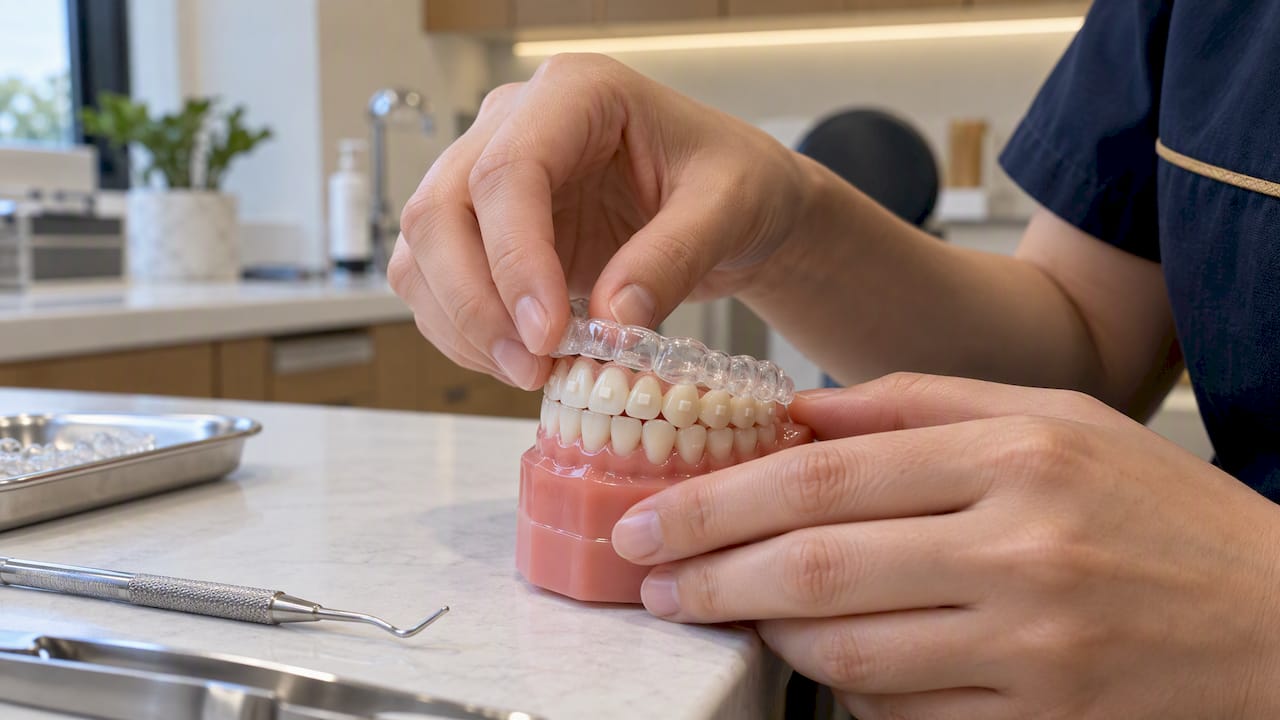
Invisalign attachments are small, tooth-coloured composite shapes bonded to specific teeth to help the aligner grip and apply controlled force. Different attachment shapes can be selected to support planned tooth movements. Clinical research also distinguishes between optimised (software-designed) and conventional (clinician-placed) attachments.
TL;DR:
- Research suggests attachments improve anterior root torque, rotation, and sideways tooth movement, but evidence for extrusion and intrusion remains limited.
- Optimised designs do not consistently outperform conventional ones; clinicians may adjust attachment shape or position during refinements when teeth do not track as planned.
- If an attachment comes off between appointments, contact your clinician for advice about your aligner instead of making treatment changes yourself.
- Because attachments add texture to tooth surfaces, brush and floss carefully, and ask your clinician whether extra cleaning tools would help.
Table of Contents
- Common attachment shapes and what each shape does
- Optimised (ClinCheck or SmartForce) versus conventional attachments
- How attachments are placed, worn and removed
- Attachments versus buttons: how they differ and when each is used
- Visibility, speech and day-to-day care for attachments
- Clinician perspective: when attachments matter and the role of refinement
- Patient-specific customisation considerations for attachment types
- Potential impact of attachments on oral hygiene practices
- Compatibility of different attachment types with various Invisalign aligner designs
- What the evidence actually tells us about attachments
- How we approach attachments and Invisalign planning at TJ Smile Studio
- FAQ
- Sources
Common attachment shapes and what each shape does
Attachments are not one-size-fits-all. Your clinician selects a shape based on the exact movement a tooth needs to make, and the position of that attachment relative to the tooth’s centre of resistance changes how the force is delivered.
- Rectangular attachments are one shape a clinician may consider when planning tooth movement.
- Vertical or vertical-rectangular attachments may be considered as part of an individual movement plan.
- Bevelled attachments are one shape a clinician may consider when planning tooth movement.
- Rounded or ellipsoidal attachments are another shape that may be used in an individual treatment plan.
A comprehensive review of clear aligner attachments confirms that shape, size and placement all affect how efficiently a tooth responds to aligner forces. Patients with similar-looking rotations may receive different attachment plans based on their clinician’s assessment. This is why attachment maps can look so different from one Invisalign case to the next, even when the starting problem looks similar on the surface.
Optimised (ClinCheck or SmartForce) versus conventional attachments
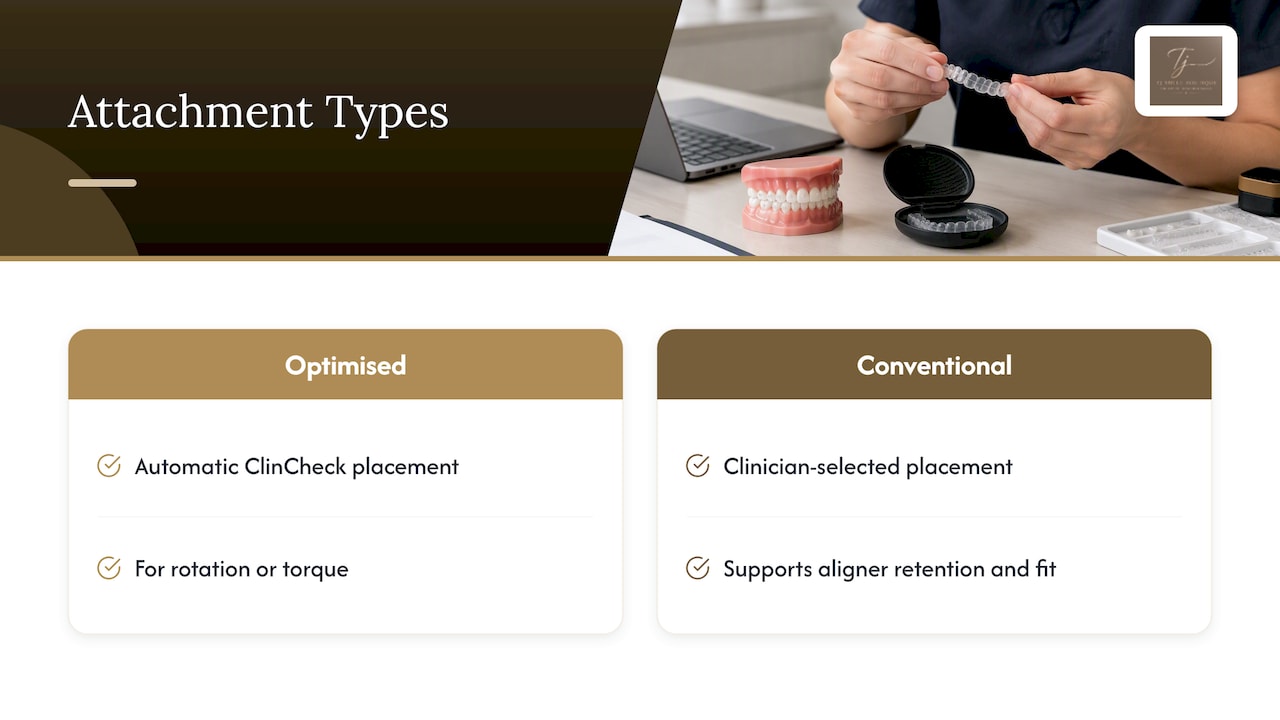
Optimised attachments, sometimes called SmartForce features, are placed automatically by ClinCheck software when the treatment plan calls for a specific movement such as rotation or torque. Conventional attachments are chosen and placed by the clinician, often to improve aligner retention and fit rather than to drive a particular biomechanical outcome, according to guidance on Invisalign attachments.
Research on composite attachments shows they generally improve outcomes for anterior root torque, rotation and mesio-distal movement, though evidence for extrusion and intrusion remains more limited according to a systematic review. Whether optimised designs outperform conventional ones depends heavily on the movement being attempted and the individual case, rather than one approach being categorically better.
In practice, this means your clinician may adjust attachment shape or position during a refinement scan if a movement is not tracking as planned. Attachments are a starting point in the biomechanical plan, not a fixed feature.
How attachments are placed, worn and removed
Placement involves bonding composite attachments to selected teeth, and a clinician checks that the aligner seats over them.
Attachments are usually added early in treatment and often stay in place across several aligner stages, which allows the aligner to fully seat and keep expressing the planned movement. Our blog on attachment removal explains why some stay on until near the end of treatment. Removal involves polishing away the composite, as described in our step-by-step removal guide.
Pro Tip: If an attachment comes off between appointments, contact your clinician for advice about your aligner.
Attachments versus buttons: how they differ and when each is used
Buttons and attachments serve different purposes in an aligner plan. Ask your clinician which features your treatment requires.
Your clinician can explain whether buttons and elastics are part of your treatment plan. Attachments, by contrast, are planned wherever specific teeth need rotation, extrusion, torque or controlled tipping, regardless of whether elastics are involved at all.
Visibility, speech and day-to-day care for attachments
Attachments are made from tooth-coloured composite, though how noticeable they are varies. Some patients may notice a change in speech while adjusting to their aligners.
- Follow your clinician’s advice on caring for your attachments.
- Attend review appointments so your clinician can assess your treatment.
Our overview of what to expect from aligner treatment covers daily wear routines alongside attachment care.
Clinician perspective: when attachments matter and the role of refinement
Attachments can widen the range of movements treatable with clear aligners, though the effectiveness depends on the movement and treatment plan.
That said, software-optimised attachments are a strong starting point, not a substitute for clinical judgement. I regularly review ClinCheck plans and adjust attachment design where a tooth’s root length, adjacent contacts or bite relationship suggest a different shape will track better. Refinements may be used to adjust the treatment plan as teeth respond. A bespoke, digitally planned approach matters more than any single attachment shape in isolation.
Patient-specific customisation considerations for attachment types
Attachment design is never generic. Your clinician weighs tooth shape, root length, enamel surface area and the specific movement required before choosing a shape and position for each tooth.
Tooth characteristics and the movement required can influence the clinician’s choice of attachment. The clinician considers the tooth and surrounding teeth when planning attachment placement.
Your clinician can discuss how the proposed attachment plan fits into your digital treatment plan. This individualised planning is part of why two people with seemingly similar misalignments can end up with quite different attachment maps across their treatment.
Potential impact of attachments on oral hygiene practices
Attachments add texture to the tooth surface, so careful cleaning is important. This makes consistent, careful brushing more important during the weeks attachments are in place.
Careful brushing and flossing can help keep teeth clean during treatment. Ask your clinician for advice on cleaning around attachments. Your clinician can advise whether additional cleaning tools may be useful.
Review appointments allow your clinician to assess your treatment and discuss cleaning. Good hygiene habits during treatment also help your teeth and gums look their healthiest once your attachments come off and your new smile is revealed.
Compatibility of different attachment types with various Invisalign aligner designs
Attachment shapes are designed to work within the aligner material itself, with the plastic moulded to fit precisely around each attachment’s contours. This means the attachment and the aligner function as a single mechanical system rather than two separate elements.
Attachment choices depend on the treatment plan. The attachment plan depends on the movements required and the individual case.
Your clinician can explain how attachments fit with your aligner plan. Your clinician reviews this fit at each stage, adjusting attachment shape or aligner design together if a movement is not progressing as expected.
What the evidence actually tells us about attachments
Research indicates attachments generally improve effectiveness for anterior root torque, rotation and mesio-distal movement, while evidence for extrusion and intrusion is limited. Whether optimised designs outperform conventional ones depends on the case. Treating attachments as a guaranteed fix for any movement oversimplifies what the data shows.
What matters more than the specific shape is whether your clinician is actively monitoring how each attachment is performing and adjusting the plan through refinements when needed. A patient should prioritise finding a clinician who reviews progress critically, rather than assuming a ClinCheck plan will proceed exactly as first proposed. Attachments are a tool within a biomechanical plan, not the plan itself.

How we approach attachments and Invisalign planning at TJ Smile Studio
Every Invisalign plan we create is led personally by Dr Tashfeen Jamil, from your first consultation through to the final refinement. 
An Invisalign consultation with us can help you explore your treatment options. If you are ready to find out what attachment plan your smile needs, book an Invisalign consultation with us.
FAQ
Which type of aligners are best for my case?
The best aligner and attachment plan depends on your specific movements, so a clinician needs to assess your bite and teeth before recommending one. Attachments generally improve effectiveness for anterior root torque, rotation and mesio-distal movement according to research on composite attachments, though the evidence does not establish that optimised attachments are always more effective.
Why do I have so many Invisalign attachments?
A higher number of attachments usually reflects more complex movements planned across multiple teeth, such as several rotations or torque corrections happening at once. Each attachment is tied to a specific movement, so a busier attachment map often means a more ambitious treatment plan rather than anything going wrong.
Are there different types of Invisalign attachments?
Yes, common shapes include rectangular, bevelled, rounded or ellipsoidal, and vertical designs, each suited to different movements like rotation, extrusion or root torque. Attachments are also categorised as optimised, placed automatically by ClinCheck software, or conventional, placed by the clinician for retention and fit.
Can Invisalign treatment work without attachments?
Whether treatment can proceed without attachments depends on the movements required and the clinician’s assessment. Attachments may help with movements such as rotation and root torque, based on clinical reviews of attachment effectiveness.
Are Invisalign attachments noticeable to other people?
Attachments are made from tooth-coloured composite designed to blend with your natural enamel, so they are generally not obvious in everyday conversation. You may feel their texture with your tongue initially, but most patients adapt within a few days.
Sources
- Pubmed
- Clear Aligner Attachments: A Comprehensive Review
- Effects of Composite Attachments on Orthodontic Clear Aligners Therapy: A Systematic Review - PubMed
- A guide to Invisalign attachments - Dentistry
This article is general information, not personal dental advice. What’s right for your teeth depends on a clinical examination — the condition of your enamel, gums, bite and any existing dental work — and no article can assess that. Outcomes vary between patients, and all treatment at TJ Smile Studio is subject to assessment and clinical suitability.
- Dr Tashfeen Jamil BDS, MFDS RCS Ed, AssocFCGDent, PGDip Restorative and Aesthetic Dentistry — GDC registration 286427
This article is general information, not personal dental advice. What's right for your teeth depends on a clinical examination — the condition of your enamel, gums, bite and any existing dental work — and no article can assess that. Outcomes vary between patients, and all treatment at TJ Smile Studio is subject to assessment and clinical suitability.
Clinically reviewed by Dr Tashfeen Jamil BDS, MFDS RCS Ed, AssocFCGDent, PGDip Restorative and Aesthetic Dentistry — GDC registration 286427, Principal Dentist at TJ Smile Studio, 1 Spiersbridge Way, Thornliebank, Glasgow G46 8NG.
If you have dental pain, swelling or an injury, call the practice on 07728 808510. Out of hours in Scotland, call NHS 24 on 111.