
12 November 2026 · TJ Smile Studio
Intraoral Scanning Benefits: What Digital Impressions Mean for You
Intraoral scanning replaces putty impressions with a quick 3D scan. See the real benefits for comfort, planning, Invisalign and veneers, and what affects accuracy.
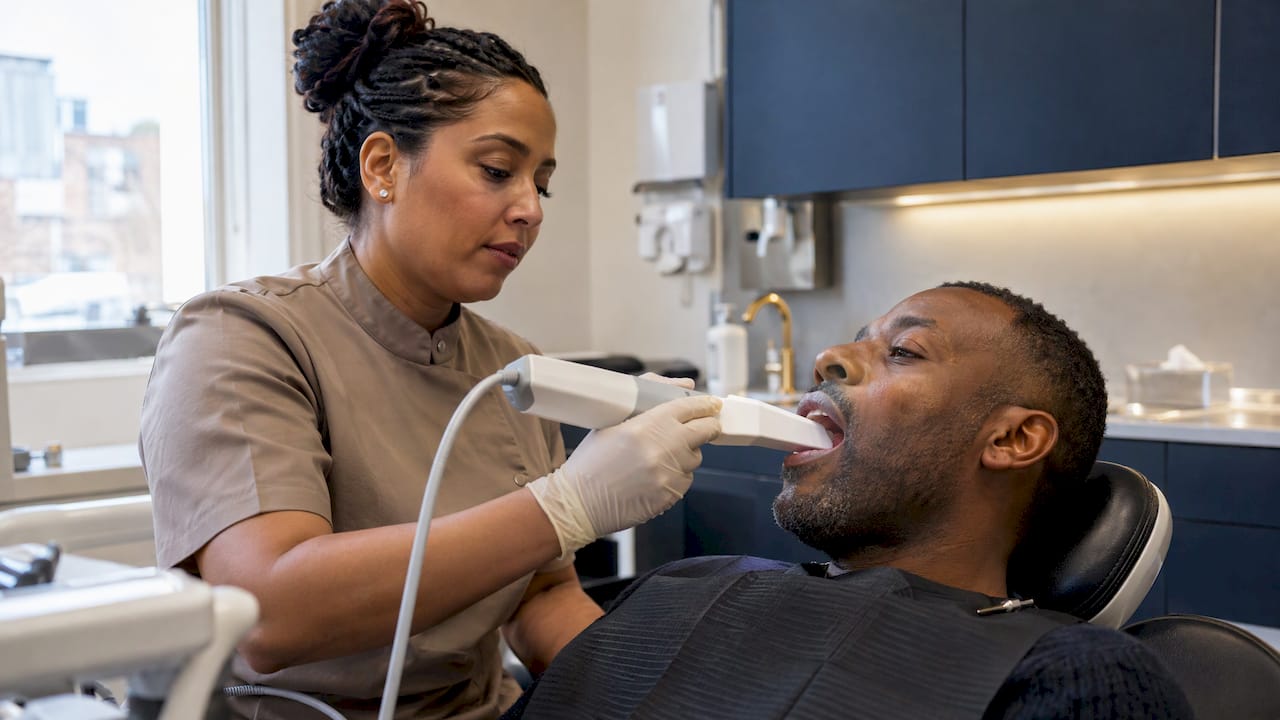
Intraoral scanning replaces the trays of putty with a small handheld camera that builds a 3D model of your teeth in minutes. For you, the main benefits are a more comfortable appointment, clearer treatment planning, a preview of what is proposed, and a faster route from consultation to finished work, sometimes within a single visit. Below we explain how it works, what the research says, and what it means for veneers, bonding and Invisalign.
TL;DR
- An intraoral scanner captures your teeth with light and software, so most people avoid gagging on impression material.
- The 3D model helps your dentist plan Invisalign, veneers and bonding, and helps you see and understand the proposal.
- Digital files can go to a laboratory instantly, or feed same-day restorations, which saves chair time.
- Accuracy depends on the dentist’s skill, healthy gums and good scanning technique, not just on the device.
- At TJ Smile Studio in Glasgow, a Smile Consultation is £50 and starts the digital planning process.
Table of Contents
- What an intraoral scanner actually does
- Benefit 1: A more comfortable appointment
- Benefit 2: Planning that is specific to your teeth
- Benefit 3: Seeing and understanding the plan
- Benefit 4: Faster workflows and fewer stages
- Benefit 5: Tracking changes over time
- What affects accuracy
- How scanning fits the treatments we offer
- What to expect at your scanning appointment
- Our perspective
- Start with a scan-led consultation in Glasgow
- Common questions
- Sources
What an intraoral scanner actually does
An intraoral scanner is a handheld device, roughly the size of an electric toothbrush head on a wand. As it passes over your teeth and gums, it projects light and records the reflected surface data. Software aligns and stitches that data in real time into a three-dimensional digital impression, which appears on a screen as you watch.
A 2024 academic review describes the same principle: optics, imaging sensors and software algorithms combine to produce a seamless digital model, with real-time feedback to the operator. That feedback matters. If the dentist misses an area, the screen shows the gap and they can rescan it on the spot, rather than discovering a flawed mould after you have left.
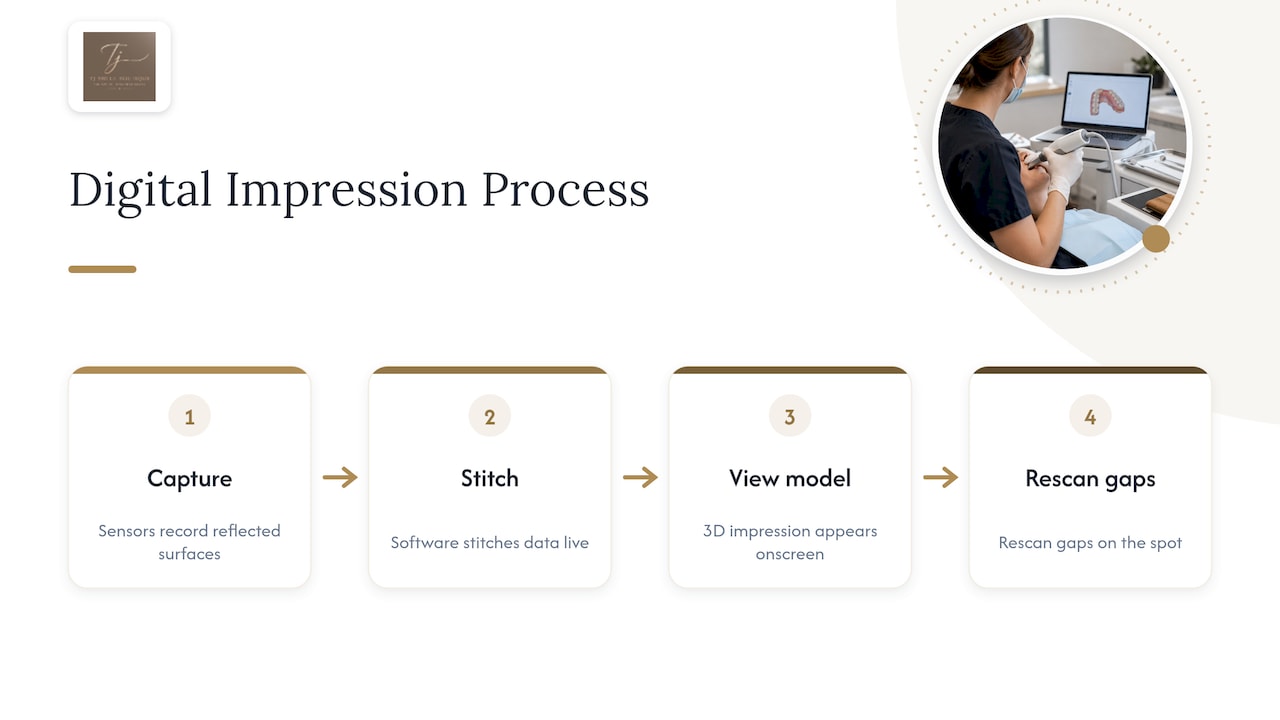
The result is a file, not a physical object. That one difference explains most of the benefits below.
Benefit 1: A more comfortable appointment
Traditional impressions use trays filled with alginate or similar material that sets in your mouth. Trays and moulds can cause anxiety and unease, particularly for people with a strong gag reflex. Anyone who has sat with a tray of cold, setting paste at the back of their throat will recognise the description.
A scanner has no setting time and no bulk filling your mouth. A review of patient-reported experiences found that comfort assessments mostly favoured digital methods. The same review noted that studies disagreed on how long patients felt the process took, so the clearest gain is in how it feels rather than a guaranteed shorter scan.
If you dislike dental appointments, or have avoided cosmetic work because you remember impressions, this is the benefit you will notice first.
Benefit 2: Planning that is specific to your teeth
A digital model gives your dentist a precise, rotatable record of your bite, spacing, tooth shape and alignment. It can be measured, adjusted and compared in ways a stone model on a shelf cannot.
For straightening, scanners create detailed 3D models used to build personalised Invisalign strategies. For cosmetic work, the same source explains that clinicians can adjust tooth proportions and contours to design a customised smile makeover on the model. Our guide to the digital smile makeover shows how that planning looks in practice.
This is also where treatment becomes personal rather than off the shelf. Two people asking for “straighter, whiter teeth” can need completely different plans, and the scan is what shows the difference.
Benefit 3: Seeing and understanding the plan
A 3D model on a screen is far easier to discuss than a verbal description. Scanners let clinicians show you the 3D model of your teeth, which improves patient engagement and makes treatment pathways clearer.
This matters because cosmetic dentistry is visual. Being able to see the proposed changes before committing helps you ask better questions and decide with confidence. The link between how we feel about our smile and wider wellbeing is real for many people, and resources on mental health and confidence explore that side of the decision. A clear preview takes some of the uncertainty out of it.
If you want a plain walkthrough of the stages from first visit to final result, our step by step smile makeover process covers it.
Benefit 4: Faster workflows and fewer stages
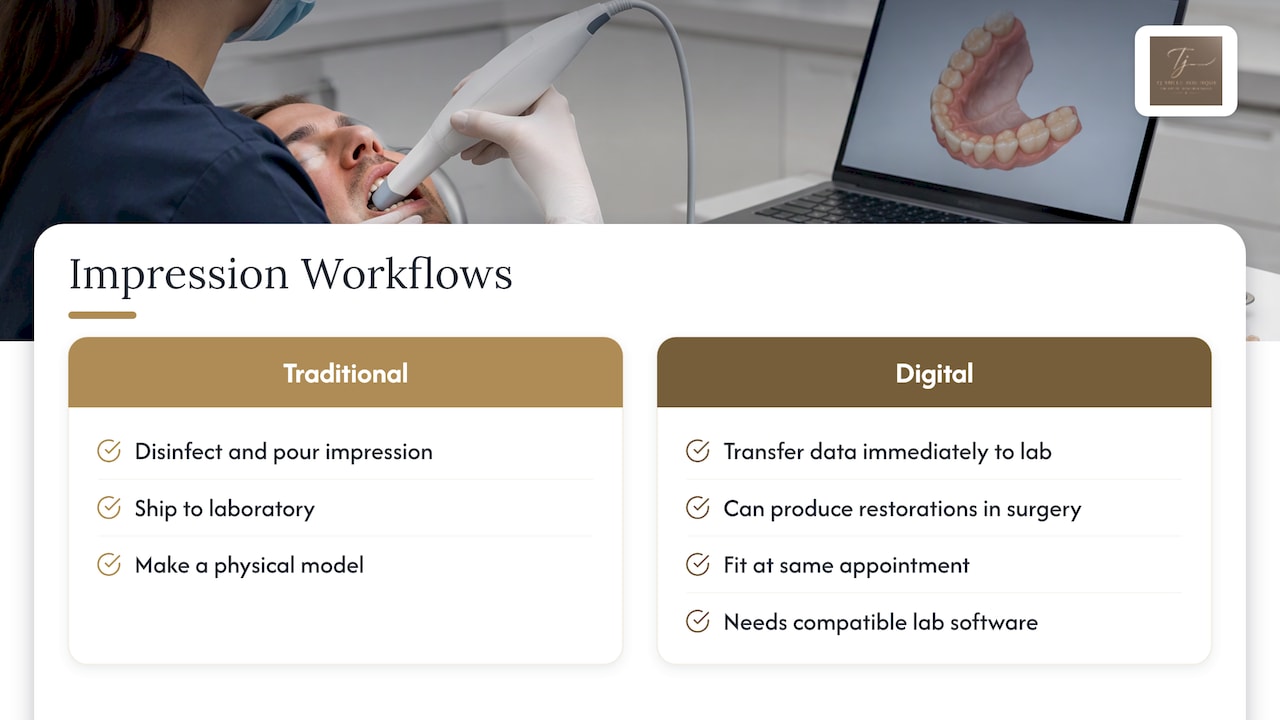
Putty impressions have to be disinfected, poured, shipped to a laboratory and turned into models. Digital impressions skip most of that. They can be transferred immediately to a digitally enabled laboratory, or restorations can be produced in the surgery and fitted at the same appointment, saving chair time.
Supplier guidance makes a similar point: the data can be sent electronically to dental laboratories for restorations, sleep appliances and implants, replacing the conventional impression workflow. The same page notes that instant sharing depends on an open scanner, validated workflows and compatible laboratory software, so the benefit comes from the whole system being set up properly.
For a busy professional, fewer physical stages can mean fewer visits. We have written about how removing steps from a digital dentistry workflow adds up, and about 3D printing veneers for Glasgow patients.
Benefit 5: Tracking changes over time
Once your teeth are on file, a later scan can be compared with an earlier one. Manufacturer documentation describes how one scan serves as a reference and another for comparison, with the overlay showing differences in colour. That can help clinicians visualise and measure tooth movement, soft and hard tissue changes, tooth-substance loss and plaque build-up.
For aligner patients, this makes progress easy to monitor, and it supports retainer checks afterwards. Our article on Invisalign tracking explains how progress is followed, and evidence-backed Invisalign refinements covers what happens if teeth need fine-tuning.
What affects accuracy
A scanner is a tool, and results depend on how it is used. Research shows digital scans have well-documented accuracy for single-tooth and short-span scans, and that accuracy can be affected by stitching, field of view, saliva, soft-tissue movement, restoration materials and patient movement.
Two practical points follow for you as a patient:
- Healthy gums help. A good optical impression depends on the preparation, your oral hygiene and healthy soft tissues. Bleeding gums make it harder to capture clean edges, so good home care before a scan pays off.
- The operator matters. Published findings reflect an experienced examiner following the supplier’s guidelines, and usability depends on the dentist’s learning curve. Ask who will carry out your scan and how often they do so.
In short, the best results come from a skilled clinician using the technology in a workflow they know well. That is one reason we keep every case under one clinician’s care, as explained below.
How scanning fits the treatments we offer
| Treatment | How the digital scan helps | Our published price |
|---|---|---|
| Invisalign | 3D model for a personalised aligner plan and progress tracking | From £1,800 |
| Same-Day Hybrid Veneers | Digital design that supports a single-visit transformation for many patients | From £2,995 |
| Veneers | Planned shape and proportions before treatment | From £399 per tooth |
| Composite bonding | Precise record of the teeth being reshaped | From £200 per tooth |
Full mouth rehabilitation and Same Day Smile are planned individually, so we do not publish a price for them. If you are weighing options, our comparisons of same-day and traditional veneers and Invisalign versus braces help you narrow down.
What to expect at your scanning appointment
- A short conversation. We discuss what you want to change and any concerns about comfort.
- The scan. The wand moves across your upper and lower teeth and your bite. Most people find it far easier than a tray, and you can see the model appear on screen.
- Review on screen. We look at the model together, so you can see what is possible for your teeth.
- A tailored plan. Your treatment options and costs are explained before you decide anything.
There is nothing to prepare beyond normal brushing and flossing. If you have sensitive gums, let us know so we can be gentle.
Our perspective
We treat the scan as the foundation of the whole treatment, not a gadget. Every case at TJ Smile Studio is led personally by one clinician, from consultation to completion, so the person who captures your digital record is the person who designs and delivers your result.
A fully digital workflow lets us plan around your lifestyle. Many patients can leave with a new smile in one visit, and we offer evening and weekend appointments for those who cannot take time out of work.
The technology serves a bespoke approach: your goals, your face, your bite. Scanning gives us the detail, and clinical judgement turns it into a result that looks like you.
Dr Tashfeen Jamil BDS, MFDS RCS Ed, AssocFCGDent - GDC 286427
Start with a scan-led consultation in Glasgow
If you are considering veneers, bonding or Invisalign, the first step is a conversation and a clear look at your teeth. A Smile Consultation at TJ Smile Studio is £50, and an Invisalign Consultation is also £50. You can see every published fee on our pricing page.
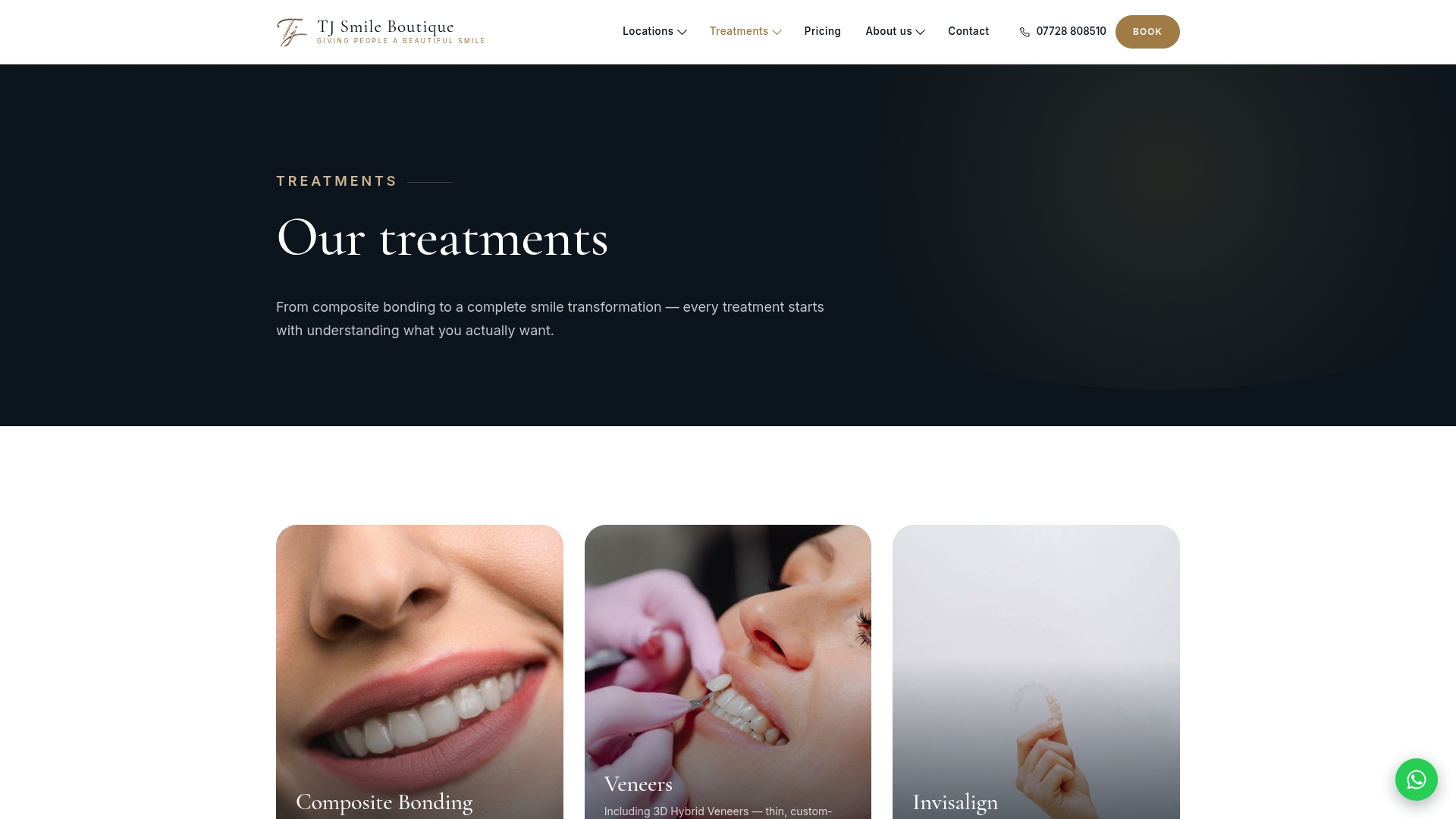
If you have a chipped or damaged tooth that needs attention, an Emergency Cosmetic Appointment is £75. To explore the whole range, visit TJ Smile Studio.
Common questions
Is intraoral scanning painful?
No. The scanner is a smooth handheld wand that does not touch your teeth with pressure. Most people find it much more comfortable than putty impressions, especially if they gag easily. Tell your dentist beforehand if you have sensitive gums.
Is a digital scan more accurate than a traditional impression?
For single teeth and short spans, the evidence shows well-documented accuracy, and the live screen lets the dentist rescan any gap. Results depend on healthy gums, good technique and an experienced operator, so the clinician matters as much as the device.
Does scanning mean I can have treatment in one visit?
It makes that possible for suitable treatments because the digital file can feed in-surgery production or go straight to a laboratory. Whether your case suits one visit depends on your teeth and the plan agreed at consultation.
Do I need a scan for Invisalign?
Invisalign plans are built from a 3D model of your teeth, which a scan provides. It also lets your dentist show you the proposed pathway and compare your teeth over time. Our Invisalign for UK adults guide explains the treatment in full.
How much does a consultation cost?
A Smile Consultation or an Invisalign Consultation at our Glasgow studio is £50 each. Treatment costs are explained once your plan is agreed.
Sources
- How an intraoral scanner works, 3Shape
- Intraoral Scanners: Mechanism, Applications, Advantages (PMC)
- Dentistry’s guide to intraoral scanners, Dentistry.co.uk
- Patient-reported experiences and preferences with intraoral scanners (PubMed)
- Intraoral scanning: options for a new future, British Dental Journal
- Top reasons to invest in an intraoral scanner, Dentsply Sirona
- Digital Intraoral Monitoring, Dentsply Sirona
- Complete arch accuracy of six intraoral scanning devices (PubMed)
- Intraoral scanners in dentistry: a review of the current literature
- Accuracy of commercial intraoral scanners (PMC)
- The Role of Mental Health in Beauty and Confidence
Recommended
This article is general information, not personal dental advice. What’s right for your teeth depends on a clinical examination — the condition of your enamel, gums, bite and any existing dental work — and no article can assess that. Outcomes vary between patients, and all treatment at TJ Smile Studio is subject to assessment and clinical suitability.
- Dr Tashfeen Jamil BDS, MFDS RCS Ed, AssocFCGDent, PGDip Restorative and Aesthetic Dentistry — GDC registration 286427
This article is general information, not personal dental advice. What's right for your teeth depends on a clinical examination — the condition of your enamel, gums, bite and any existing dental work — and no article can assess that. Outcomes vary between patients, and all treatment at TJ Smile Studio is subject to assessment and clinical suitability.
Clinically reviewed by Dr Tashfeen Jamil BDS, MFDS RCS Ed, AssocFCGDent, PGDip Restorative and Aesthetic Dentistry — GDC registration 286427, Principal Dentist at TJ Smile Studio, 1 Spiersbridge Way, Thornliebank, Glasgow G46 8NG.
If you have dental pain, swelling or an injury, call the practice on 07728 808510. Out of hours in Scotland, call NHS 24 on 111.