10 November 2026 · TJ Smile Studio
Full Mouth Rehabilitation in Glasgow: Process, Costs and Who Needs It
What full mouth rehabilitation involves, who needs it, the stages, UK costs and how worn teeth are assessed in Glasgow, explained by Dr Tashfeen Jamil's studio.
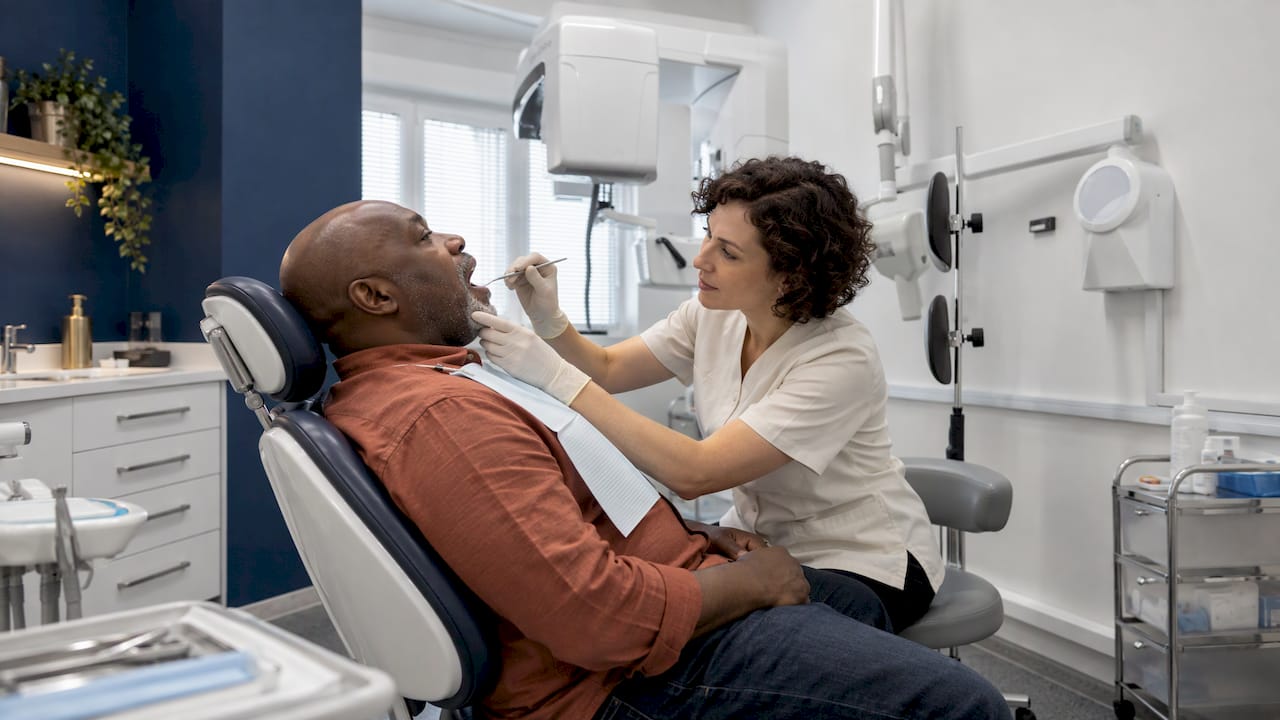
Full mouth rehabilitation is a planned, individual programme that rebuilds worn, damaged or failing teeth so that your teeth, gums, bite and jaw joints work together again. It is not one procedure. It is a sequence of treatments, designed around a diagnosis, and it usually costs thousands of pounds in the UK private market. If you live in or around Glasgow and your teeth are worn, cracked, missing or uncomfortable to bite with, this guide explains what the work involves, how it is planned, what affects the price and how to tell whether you need it at all.
TL;DR
- Full mouth rehabilitation (also called occlusal rehabilitation or full mouth reconstruction) restores the whole dentition and bite in planned phases, not in one sitting.
- It is considered for severe tooth wear, repeated fractures, missing teeth, bite collapse or jaw problems. Mild wear without symptoms is often just monitored.
- One 2026 UK price guide puts full-mouth rehabilitation at £15,000 to £40,000, depending on the case. It is a guide, not a quote.
- Good planning starts with a thorough assessment, control of the cause of the damage, then a trial of the new bite before anything is made permanent.
- At TJ Smile Studio, Dr Tashfeen Jamil leads every treatment. A Smile Consultation costs £50.
Table of Contents
- What full mouth rehabilitation actually means
- Who may need it
- Do you need full mouth rehabilitation at all?
- How worn teeth are assessed
- The stages of a full mouth rehabilitation
- What treatments may be included
- How much does full mouth rehabilitation cost?
- Why plan it with one clinician
- Start with a consultation in Glasgow
- FAQ
- Sources
What full mouth rehabilitation actually means
The academic definition is helpful because it shows how much more than cosmetics is involved. The literature describes it as an individualised treatment in which the entire dentition is reconstructed and restored to optimise the health of the teeth, gums, bite and the wider chewing system. A second overview adds that the aim is not only to rebuild worn teeth but to keep the teeth, supporting tissues, chewing muscles and jaw joint working in harmony.
So the goal has three parts:
- Health: disease in the teeth and gums is treated first and kept under control.
- Function: you can bite, chew and speak comfortably, and the forces on your teeth are shared sensibly.
- Appearance: tooth shape, length, colour and smile line are planned deliberately, not left to chance.
Full mouth rehabilitation, reconstruction and restoration
Dentists use these terms almost interchangeably. “Rehabilitation” and “reconstruction” both describe a whole-mouth plan; “restoration” is the word patients most often search. What matters is not the label but whether the plan covers the whole bite rather than one tooth at a time.
What “occlusal rehabilitation” adds
Occlusal means “to do with the bite”. Occlusal rehabilitation is the part of the plan that deals with how your upper and lower teeth meet. The literature classifies this as either a conformative approach or a reorganised approach. In plain terms, a conformative plan rebuilds teeth within the bite you already have. A reorganised plan changes the bite itself, for example because it has collapsed through wear or because the jaw position is causing problems.
Who may need it
The same occlusal-concepts overview lists the situations in which a reorganised approach is considered: loss of vertical dimension, repeated fracture or failure of teeth and restorations, severe bruxism, too little space for restorations, occlusal trauma, unacceptable function or appearance, temporomandibular disorders and developmental anomalies.
In everyday terms, you might be a candidate if:
- your front teeth have shortened, look flat or have become translucent at the edges;
- several fillings, crowns or veneers have chipped or failed;
- you grind or clench and wake with a sore jaw or headaches;
- teeth are missing or you have been told some cannot be saved;
- your bite feels “off” and your teeth seem to be sinking together;
- you dislike how your smile looks and function is also compromised.
The same literature notes that success depends heavily on the cause, the diagnosis and the scientific approach, and that a multidisciplinary approach is essential in many situations. That can mean your dentist working with a hygienist, a periodontist, an endodontist or a laboratory technician.
Grinding, jaw pain and the bite
If grinding is part of your story, treating the teeth alone is rarely enough. Jaw pain has its own causes and its own professionals, and a guide such as teeth grinding and jaw pain: what helps and who to see is a sensible companion read while your dentist works out how much of your problem is wear and how much is muscle or joint strain. A protective splint is often part of a rehabilitation plan, and we explain our view of why in the perspective below.
Do you need full mouth rehabilitation at all?
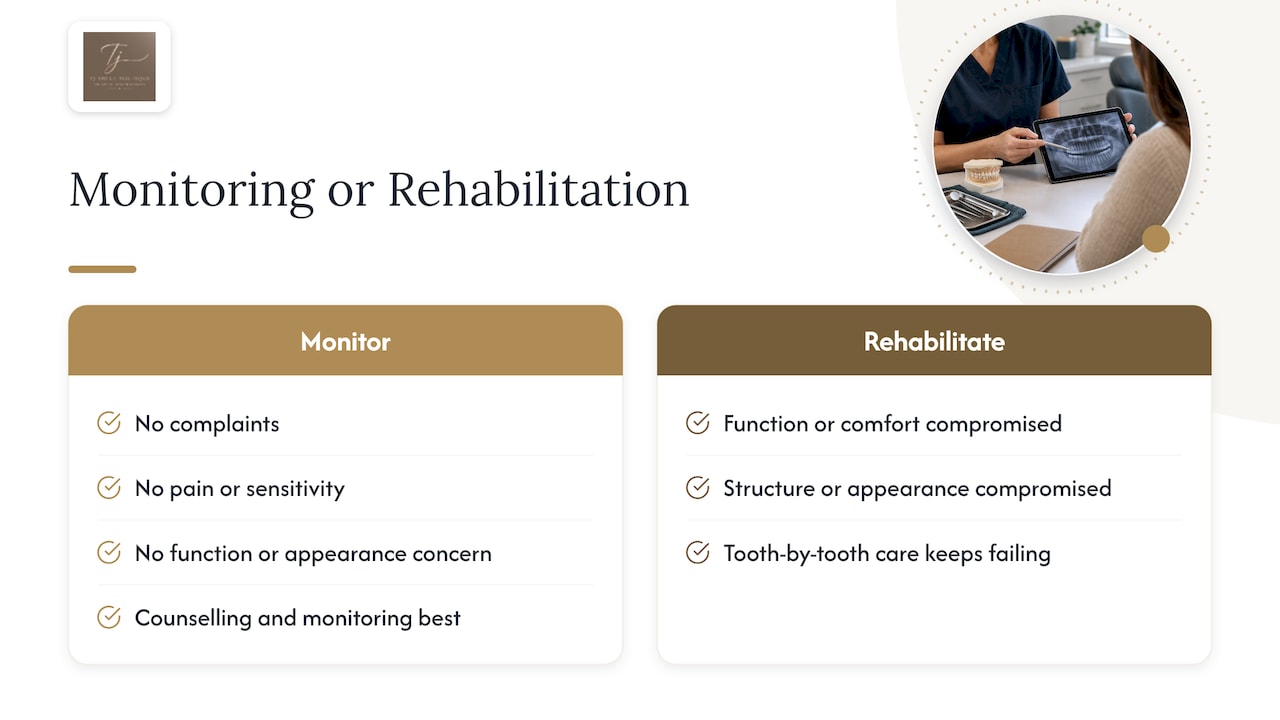
Not everyone with worn teeth does. A 2018 paper on the Radboud tooth wear philosophy concludes that restorative treatment is not always indicated even in severe wear, and that if the patient has no complaints, counselling and monitoring is probably the best option. UK guidance agrees: the Royal College of Surgeons of England recommends active monitoring where there is no pain, sensitivity or concern about function or appearance.
That is why the first step is a proper assessment, not a quote. Many people find a sealed, bonded or monitored approach is enough for early wear; our article on when to monitor, seal or restore explains the thinking. Full mouth rehabilitation is for cases where function, comfort, structure or appearance have reached the point that a tooth-by-tooth approach would keep failing.
How worn teeth are assessed
A British Dental Journal article from August 2023 states that planning for tooth wear needs a comprehensive assessment: the patient’s chief complaint, a thorough history, clinical examination, special tests and clinical diagnoses, followed by a holistic planning process with the patient involved throughout.
In practice, expect the following.
Your history and what bothers you
Your dentist will ask what you want to change, what hurts, what you eat and drink, whether you grind, whether you have reflux, and what dental work you have had. Acid from diet or reflux and grinding are different causes with different solutions.
Scoring and diagnosing the wear
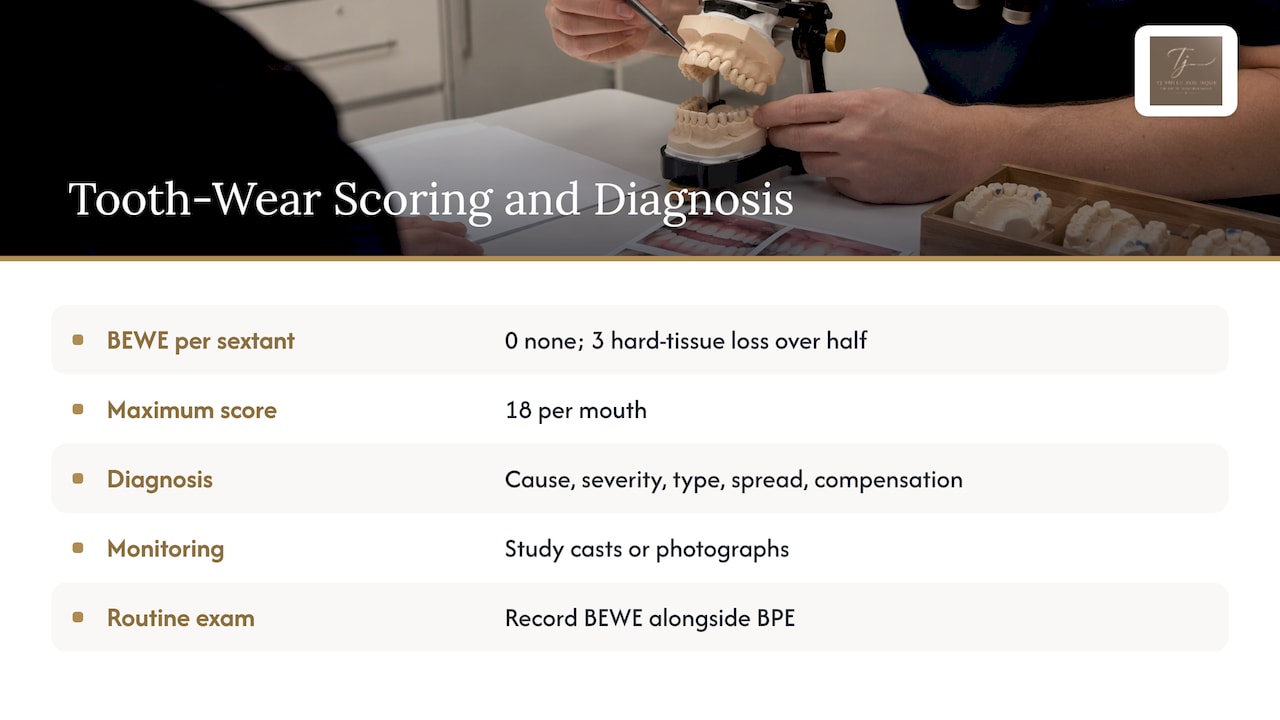
The Basic Erosive Wear Examination (BEWE) scores each sextant of the mouth from 0 (no sign of erosive wear) to 3 (hard tissue loss over half the surface), giving a maximum mouth score of 18, and should ideally be recorded alongside the BPE gum screening at routine examinations. The British Society for Restorative Dentistry guidelines say a tooth wear diagnosis should describe cause, severity, whether it is physiological or pathological, localised or generalised, and compensated or not. The same guidelines recommend monitoring with study casts or photographs.
Digital records
We use a fully digital workflow, so scans and photographs of your teeth and bite become the baseline for planning and for comparing later. Our piece on digital bite analysis and avoiding rework explains why we want the bite understood before any material touches a tooth.
The stages of a full mouth rehabilitation
There is no single universal protocol, but the phases are consistent across the literature. A phased framework describes Phase I disease control, such as treating decay, gum disease and root canal problems and removing teeth that cannot be restored, followed by diagnostic records and a wax-up, provisional restorations, definitive rehabilitation and then maintenance reviews.
| Phase | What happens | Why it matters |
|---|---|---|
| 1. Assessment and records | History, examination, scans, photographs, bite records | Establishes the diagnosis and the cause |
| 2. Stabilisation | Treat decay and gum disease, manage the cause of wear, splint if needed | Restorations placed on an unstable mouth tend to fail |
| 3. Design and trial | Digital or wax design, then a mock-up you can see and feel | You approve shape and bite before anything is permanent |
| 4. Provisional stage | Temporary restorations tested for comfort and function | Allows adjustments and checks the new bite |
| 5. Definitive restorations | Bonded composite, ceramic, veneers, crowns, or replacements for missing teeth | The long-term result |
| 6. Maintenance | Reviews, polish, protective splint, hygiene visits | Protects the investment |
Why the cause is dealt with first
The Royal College of Surgeons guidance states that restorative management of erosive wear should be preceded by, or accompany, preventive measures, and that the causes should be identified and brought under control before definitive restorative treatment begins. In Scotland, a Greater Glasgow and Clyde decision tree for dentists describes identifying and eliminating the source, starting a preventive programme and referring moderate or severe cases onward. We follow the same logic: stabilise, then rebuild.
The mock-up and the trial period
A UK clinician-oriented publication argues that a staged plan is crucial and that a diagnostic wax-up or mock-up clarifies the proposed bite scheme and sequence before definitive work. For you, that means seeing the planned result and wearing it before committing. A clinical case report on severe tooth wear likewise describes provisional restorations and monitoring through an occlusal splint during the stages.
How long does it take?
Timescales depend on how much disease needs treating first, how many teeth are involved and whether the bite is being changed. A straightforward case may move quickly; a case involving gum treatment, root canal work or replacing missing teeth takes longer. The phased approach is deliberate: it allows progressive assessment, mid-course corrections and earlier spotting of complications, and it spreads the cost and the commitment. We will give you a timeline after your assessment, not before.
What treatments may be included
A rehabilitation plan draws on a menu of options. Which ones you need depends on your diagnosis.
- Bonded composite: a tooth-coloured material added directly to teeth. The Radboud paper states that minimally invasive and adhesive strategies are preferred for severe wear patients treated at an increased vertical dimension. See our page on composite bonding in Glasgow and our article on composite bonding for enamel erosion.
- Veneers and ceramic restorations: for shape, length and colour where more cover is needed. Our veneers page and same-day versus traditional veneers comparison show the options.
- Crowns: where a tooth is heavily broken down.
- Replacing missing teeth: implants, bridges or dentures, where teeth are absent.
- Gum, root canal and preventive care: the Phase I work that makes everything else last.
- Occlusal splints: the BSRD guidelines explain that splints may be soft, hybrid or hard, with selection depending on the severity of wear and cost, and that hard acrylic splints are expensive but more effective for severe wear and severe jaw joint dysfunction.
An honest note on lifespan: the Radboud paper reports that clinical evidence for restorative protocols is limited to five-year follow-up for direct composites and that restorations can have a limited lifetime in patients with severe wear from grinding and erosion. That is exactly why protection and maintenance sit inside the plan, not after it.
How much does full mouth rehabilitation cost?
Because every mouth is different, full mouth rehabilitation is not sold at a fixed price. One 2026 UK price guide states that full-mouth rehabilitation runs from £15,000 to £40,000 and stresses that it is case-dependent and not a quote. That range is a national private-market guide; it is not a Glasgow price list and it is not our price.
What moves the figure:
- Number of teeth and arches treated. One arch costs less than two.
- Materials. Bonded composite, ceramic veneers, crowns and implants sit at very different price points.
- Preparatory treatment. Gum therapy, root canals and extractions are added before the rebuild.
- Replacing missing teeth. Implants are the largest single driver in most large plans.
- Splints and maintenance. Protective appliances and review visits.
- Laboratory work and design time.
We do not publish a price for full mouth rehabilitation, because quoting before a diagnosis would be guesswork. What we can say plainly is what our published building blocks cost: a Smile Consultation is £50, composite bonding starts from £200 per tooth, veneers from £399 per tooth and Same-Day Hybrid Veneers from £2,995. Some larger packages can be financed, and some treatments need a non-refundable booking deposit. After your assessment you will receive a written plan, phase by phase, so you can decide with the full picture.
Why plan it with one clinician
Whole-mouth work goes wrong when the plan is split between people who never compare notes. Professor Robert Stone, writing in the British Dental Journal, emphasises that restorative care for tooth wear depends on a systematic, holistic and thorough approach that also manages expectations about outcomes, longevity and the risk of failure. Continuity helps that happen.
Our perspective
Most people who come to us about worn or failing teeth ask for a new smile. What they really need first is an explanation. Why are the teeth wearing? Is it grinding, acid, a bite that has shifted, or all three? Until that is answered, any restoration, however beautiful, is a gamble.
That is why every treatment at TJ Smile Studio is personally led by me, from the first consultation through to completion. The person who diagnoses your bite is the person who designs and delivers the result, so nothing is lost between planning and treatment.
Our fully digital workflow lets you see the proposed design before we commit to it, and for suitable cases it means a transformation can be delivered in far fewer visits. We favour minimally invasive, adhesive options wherever your diagnosis allows, and we build protection, such as a splint and maintenance reviews, into the plan, because a rehabilitated mouth deserves to last.
We also offer evening and weekend appointments, because a plan that spans several phases has to fit around your working life.
Dr Tashfeen Jamil BDS, MFDS RCS Ed, AssocFCGDent - GDC 286427
Start with a consultation in Glasgow
If you recognise your own teeth in this guide, the useful next step is an assessment. At TJ Smile Studio in Glasgow, Dr Tashfeen Jamil will examine your teeth and bite, talk through what you want to change and explain which of the options above apply to you, including whether monitoring or a smaller treatment is enough. Our full mouth rehabilitation service is planned around a digital design you can review.
A Smile Consultation costs £50. If you would like to see how a digital preview works first, read about our digital smile makeover, or browse all our treatments. You can book through our website.
FAQ
What procedures are included in full mouth rehabilitation?
There is no fixed list. A plan can include gum and root canal treatment, fillings, bonded composite, veneers, crowns, replacement of missing teeth and a protective splint. Which of these you need depends on your diagnosis, and the work is delivered in phases.
How much does full mouth rehabilitation cost in Glasgow?
There is no single Glasgow price, because each plan is different. One 2026 UK guide puts the national private range at £15,000 to £40,000, and says it is not a quote. We give a written, phase-by-phase plan after a £50 Smile Consultation.
Is full mouth rehabilitation the same as occlusal rehabilitation?
Not quite. Full mouth rehabilitation covers the whole dentition, while occlusal rehabilitation is the bite-related part of that plan. The literature describes it as either conformative or reorganised, depending on whether the existing bite is kept or changed.
Can worn teeth just be monitored?
Often, yes. Where there is no pain, sensitivity or concern about function or appearance, active monitoring is the recommended approach. Restoration is considered when symptoms, structural damage or appearance justify it.
How long does full mouth rehabilitation last?
It depends on the materials, your bite and whether the cause of wear is controlled. Evidence for direct composite protocols is limited to five-year follow-up, and splints and regular reviews are used to protect the work.
Sources
- Deciphering the opinions in full mouth rehabilitation (2020)
- Occlusal Concepts in Full Mouth Rehabilitation: An Overview (2014)
- A guide to managing tooth wear: the Radboud philosophy (2018)
- Tooth Wear Guidelines for the BSRD (2018)
- Clinical guidelines for dental erosion, Royal College of Surgeons of England (2021)
- Treatment planning for patients with tooth wear, British Dental Journal (2023)
- Recommendations and guidelines for dentists using the BEWE (2020)
- GDP Advice / Decision Tree Management of Toothwear, Greater Glasgow and Clyde (2020)
- Full Mouth Rehabilitation (2025)
- Full mouth rehabilitation for a patient with generalised tooth wear (2024)
- Full-mouth reconstruction in modern practice, Dentistry (2025)
- Dental Implant Cost UK 2026
- Teeth Grinding and Jaw Pain: What Helps and Who to See
Recommended
- Same Day Smile Makeover in Glasgow
- Composite Bonding Cost in Glasgow
- From £1,800: Invisalign Cost in Glasgow
- Single Visit Smile
This article is general information, not personal dental advice. What’s right for your teeth depends on a clinical examination — the condition of your enamel, gums, bite and any existing dental work — and no article can assess that. Outcomes vary between patients, and all treatment at TJ Smile Studio is subject to assessment and clinical suitability.
- Dr Tashfeen Jamil BDS, MFDS RCS Ed, AssocFCGDent, PGDip Restorative and Aesthetic Dentistry — GDC registration 286427
This article is general information, not personal dental advice. What's right for your teeth depends on a clinical examination — the condition of your enamel, gums, bite and any existing dental work — and no article can assess that. Outcomes vary between patients, and all treatment at TJ Smile Studio is subject to assessment and clinical suitability.
Clinically reviewed by Dr Tashfeen Jamil BDS, MFDS RCS Ed, AssocFCGDent, PGDip Restorative and Aesthetic Dentistry — GDC registration 286427, Principal Dentist at TJ Smile Studio, 1 Spiersbridge Way, Thornliebank, Glasgow G46 8NG.
If you have dental pain, swelling or an injury, call the practice on 07728 808510. Out of hours in Scotland, call NHS 24 on 111.