
29 September 2026 · TJ Smile Studio
Act Within 60 Minutes: UK Clinic Steps to Save a Cracked Front Tooth
Rinse, control bleeding, and see a dentist today. UK advice covers the 60 minute reimplant window, safe pain relief, diagnosis, and same day clinic repairs.
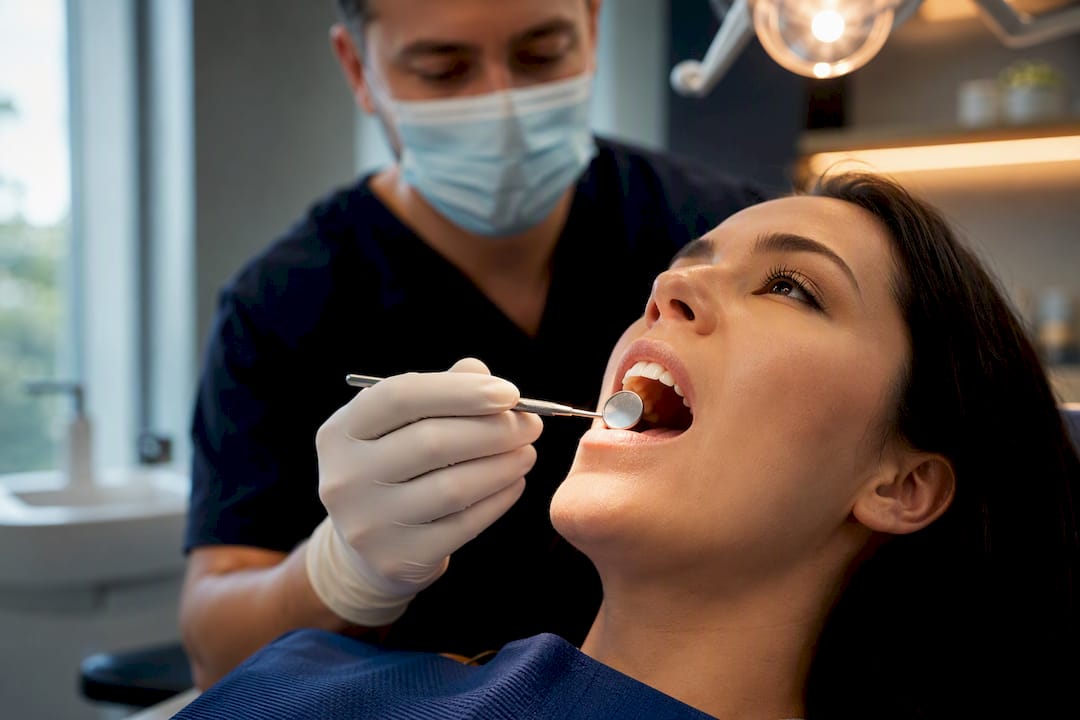
If your front tooth is cracked, rinse your mouth with warm water, control any bleeding with clean gauze, and get a dentist to look at it today rather than waiting. A knocked-out tooth or a crack with visible pulp exposure is a genuine emergency: the sooner a dentist stabilises it, the better your chances of keeping it. For smaller chips, the tooth can usually wait a day or two, but you should still get it checked before it worsens.
TL;DR:
- A knocked-out tooth must be seen by a dentist within 60 minutes for the highest chance of successful re-implantation.
- Storing a knocked-out fragment in milk helps preserve root cells and increases the likelihood of reattachment.
- Standard X-rays often miss cracks, but a bite test, transillumination, and 3D CBCT scans improve diagnosis accuracy.
- Small chips are fixable with composite bonding, while deeper cracks may require root canals, crowns, or extractions, affecting long-term survival.
- Urgent signs include severe pain, swelling affecting breathing, or dislodged teeth, necessitating immediate professional care.
Table of Contents
- Step-by-step immediate care for the first minutes and hours
- What not to do after a cracked front tooth
- How dentists diagnose a cracked front tooth and limits of tests
- Treatment options for a cracked front tooth and likely outcomes
- Managing pain and swelling safely while waiting for care
- When to seek urgent or emergency dental care
- Clinic perspective: assessing and repairing front teeth on the same day
- Planning your follow-up visit and long-term outlook
- Getting your front tooth fixed at TJ Smile Studio
- Sources
- FAQ
Step-by-step immediate care for the first minutes and hours
What you do in the first hour matters more than most people realise. Handle the tooth gently, avoid touching the root surface if a fragment has come away, and work through these steps in order.
- Rinse your mouth gently with warm water or warm saline to clear debris and blood.
- Press a clean piece of gauze or a damp tea bag against any bleeding area for 10 to 15 minutes.
- If a fragment has broken off, pick it up by the crown (the white part), not the root end.
- Store the fragment in milk, or in your own saliva if milk is not available, never in water, since water can damage the root surface cells needed for reattachment, according to NHS guidance.
- Cover any sharp edge with orthodontic wax or sugar-free chewing gum to stop it cutting your lip or tongue until you are seen.
- If the whole tooth has come out, try to gently reinsert it into the socket, and if that is not possible, keep it in milk and get to a dentist immediately.
For a fully knocked-out adult tooth, aim to have it seen by a dentist within 60 minutes, since re-implantation success drops sharply the longer the tooth is out of the socket, according to NHS England clinical guidance.
Pro Tip: Keep a small carton of milk in the fridge if you play contact sport or have children who do, so you are never caught without a safe storage option.
What not to do after a cracked front tooth
A few common reactions can turn a fixable crack into a bigger problem. Avoid these while you wait for professional care.
- Do not use superglue, nail glue or any household adhesive to stick a fragment back on, since these are toxic if swallowed and interfere with proper bonding later.
- Do not apply oil of cloves, aspirin or other painkillers directly onto the tooth or gum, as this can burn the soft tissue without easing the pain.
- Avoid chewing on the affected side and steer clear of very hot, cold or hard foods that can trigger sharp pain or worsen the crack.
- Do not try to re-implant a knocked-out baby tooth, since doing so can damage the permanent tooth developing underneath.
How dentists diagnose a cracked front tooth and limits of tests
Cracks are notoriously hard to pin down, partly because they can be invisible on a standard X-ray. A dentist will usually start with a bite test, asking you to bite on a small stick or tooth-sleuth to see if a specific area of the tooth triggers sharp pain on release, a sign strongly associated with cracks according to research on diagnosing cracked teeth. Transillumination, shining a bright light through the tooth to reveal a crack line as a shadow, and staining with methylene blue dye are also common, often combined with magnification loupes or a dental microscope.
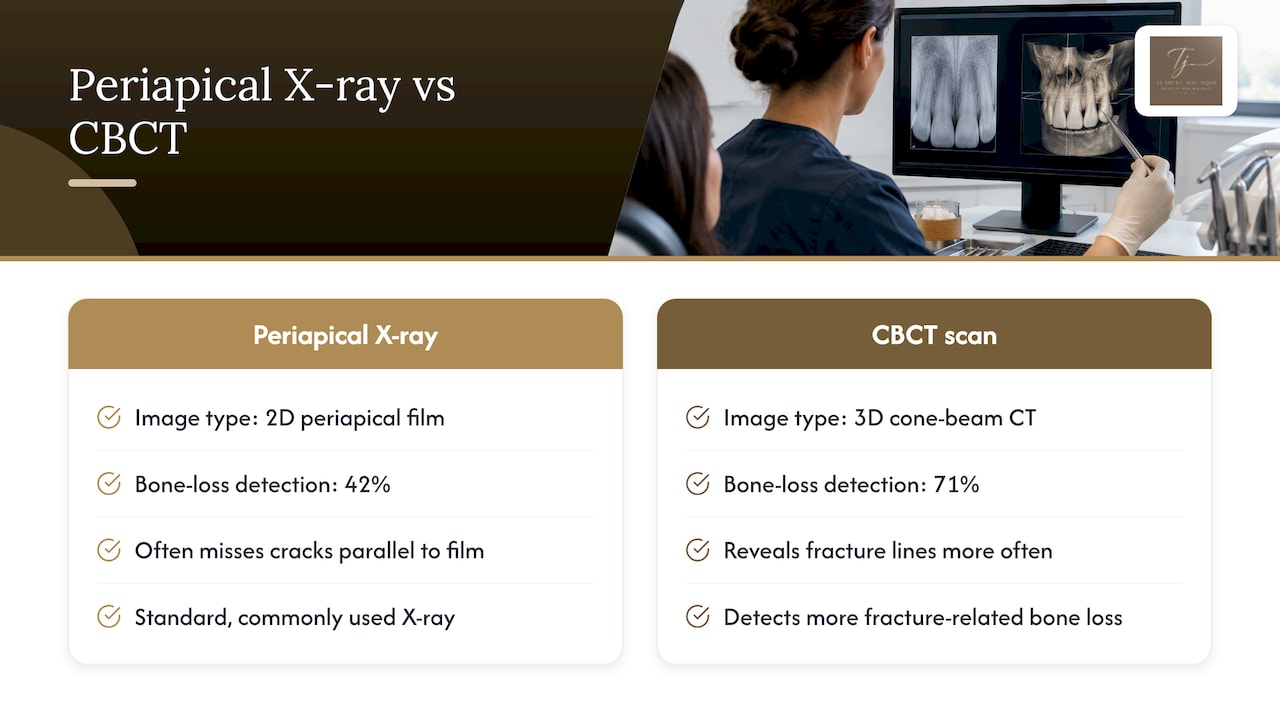
Two-dimensional periapical radiographs, the standard bitewing-style X-ray, often miss cracks that run parallel to the film or that have not yet caused bone changes. Cone beam CT (CBCT) scans, which build a 3D image, detect more fracture-related bone loss and reveal fracture lines more often than periapical films in comparison studies, picking up bone loss patterns in 71% of cases versus 42% for standard X-rays, according to imaging research published in JADA. Beyond imaging, your dentist will check pulp vitality, measure gum probing depths around the tooth and assess how much healthy tooth structure remains before deciding whether the tooth is worth restoring.
Treatment options for a cracked front tooth and likely outcomes
Treatment depends almost entirely on how deep the crack runs and whether it has reached the nerve.
- A small chip in the enamel is often fixed with composite bonding, a same-visit repair that reshapes the edge of the tooth with tooth-coloured resin.
- A crack that reaches the pulp usually needs root canal treatment to remove the damaged nerve tissue, followed by a crown or full-coverage restoration to protect what is left of the tooth.
- When a crack extends below the gumline or splits the root, the tooth may be unrestorable, and extraction followed by an implant, bridge or denture becomes the realistic path, a scenario covered in planning for full mouth rehabilitation.
Survival after root canal treatment for a cracked tooth decreases over time, with studies indicating functionality declines between 5 and 10 years, according to peer-reviewed research on cracked tooth survival. That gap between short-term and long-term success is exactly why early, appropriate restorative work matters: cracks tend to propagate over time, and placing a protective restoration promptly reduces that risk and improves the odds of keeping the tooth, according to research on early stabilisation.
Managing pain and swelling safely while waiting for care
Paracetamol and ibuprofen are the standard first-line options for dental pain, and UK guidance recommends trying one before combining both. Paracetamol can be taken as 1 to 2 tablets up to four times a day, to a maximum of 8 tablets in 24 hours, while ibuprofen is usually taken as 400mg up to three times a day with or after food, according to dosing advice from FHFT/NHS. If you are pregnant, have asthma, kidney problems, or take other regular medication, check with a pharmacist before taking ibuprofen.
A cold compress held against the cheek for 10 to 15 minutes at a time can ease swelling, and sticking to a soft, lukewarm diet reduces strain on the tooth. Keep brushing gently around the area rather than avoiding it altogether. If pain is severe, worsening or not controlled by these measures, that is itself a reason to seek same-day care rather than waiting it out.
When to seek urgent or emergency dental care
Some signs mean you should not wait for a routine appointment.
- A tooth that has been completely knocked out needs professional attention within 60 minutes for the best chance of saving it, according to NHS England guidance.
- Severe, uncontrolled pain, visible pink or bleeding tissue in the centre of the tooth, or swelling that is spreading into the face or neck all warrant same-day assessment.
- Any swelling affecting your breathing or swallowing is a medical emergency and needs immediate attention, not just a dental appointment.
- For significant fractures without these red flags, NHS urgent dental services generally aim to see patients within 24 hours.
If you are unsure where to go, call NHS 111 or use NHS pages on finding an NHS dentist in an emergency, and describe the injury clearly: whether the tooth is loose, whether a piece has broken off, and whether you can see or feel exposed nerve tissue.
Clinic perspective: assessing and repairing front teeth on the same day
Cracked and chipped front teeth can be assessed using a fully digital workflow that facilitates same-day treatment where the tooth allows it. A typical emergency visit starts with a clinical exam and digital scan to map the extent of the damage, followed by temporary protection of any exposed area. Depending on what the scan and exam show, that might lead straight to composite bonding on the day, or into planning for a same-day hybrid veneer once any urgent issue is stabilised. Costs depend on what the tooth actually needs, and follow-up reviews are built into the plan so the repair is checked and polished rather than left to fend for itself.
Planning your follow-up visit and long-term outlook
Before you leave any appointment, ask how long the repair is expected to last, what maintenance it needs, and whether monitoring is genuinely appropriate or whether a small crack should be restored now while it is simple. A temporary fix should have a clear date for the definitive restoration, not an open-ended “wait and see”.
— Dr Tashfeen Jamil BDS, MFDS RCS Ed, AssocFCGDent - GDC 286427
Getting your front tooth fixed at TJ Smile Studio
A cracked front tooth rarely needs to mean weeks of self-consciousness while you wait for a slot. Emergency cosmetic appointments are available to assess and protect the tooth quickly, with potential for same-day repair where the damage allows it.
- Composite bonding can rebuild small chips in a single visit and is often a common starting point for a front-tooth crack.
- Same-Day Hybrid Veneers cover more significant damage while protecting the tooth underneath, planned and fitted using digital workflows.
- Veneers can offer a longer-term cosmetic solution once any underlying issues have been resolved.
- Full Mouth Rehabilitation may be considered where a tooth cannot be saved and wider restorative planning is needed.
If your front tooth is cracked or chipped, book an Emergency Cosmetic Appointment or check current pricing to see which repair fits your situation.
Sources
- NHS England » Clinical guidance: unscheduled urgent and non-urgent dental care
- Ibuprofen and paracetamol advice (FHFT / NHS)
- Survival of cracked teeth after endodontic treatment (PubMed)
- CBCT vs periapical radiographs for detecting cracked teeth (JADA, 2024)
- NHS — Knocked-out tooth
This article is general information, not a substitute for advice from a qualified doctor. Consult a qualified healthcare professional about your own circumstances before acting on anything here.
FAQ
Can a cracked front tooth be fixed?
Most cracked front teeth can be treated, with options ranging from composite bonding for small chips to veneers, root canal treatment and crowns for deeper cracks. The right choice depends on how far the crack extends and whether it has reached the nerve.
Is it common for front teeth to crack?
Front teeth are frequently affected by chips and cracks from falls, sports injuries and biting hard objects, though exact frequency varies by age group and cause. Diagnosis can be difficult since some cracks do not show up clearly on standard X-rays, according to research on detecting cracked teeth.
How much does it cost to repair a broken front tooth?
Costs depend entirely on the treatment needed: composite bonding at TJ Smile Studio starts from £200 per tooth, while veneers start from £399 per tooth. An Emergency Cosmetic Appointment to assess the damage is £75.
How long can you leave a cracked tooth for?
A knocked-out tooth needs professional care within about 60 minutes for the best chance of saving it, according to NHS England guidance. A smaller crack without severe pain or swelling should still be checked within a day or two, since cracks can worsen if left untreated.
Recommended
This article is general information, not personal dental advice. What’s right for your teeth depends on a clinical examination — the condition of your enamel, gums, bite and any existing dental work — and no article can assess that. Outcomes vary between patients, and all treatment at TJ Smile Studio is subject to assessment and clinical suitability.
- Dr Tashfeen Jamil BDS, MFDS RCS Ed, AssocFCGDent, PGDip Restorative and Aesthetic Dentistry — GDC registration 286427
This article is general information, not personal dental advice. What's right for your teeth depends on a clinical examination — the condition of your enamel, gums, bite and any existing dental work — and no article can assess that. Outcomes vary between patients, and all treatment at TJ Smile Studio is subject to assessment and clinical suitability.
Clinically reviewed by Dr Tashfeen Jamil BDS, MFDS RCS Ed, AssocFCGDent, PGDip Restorative and Aesthetic Dentistry — GDC registration 286427, Principal Dentist at TJ Smile Studio, 1 Spiersbridge Way, Thornliebank, Glasgow G46 8NG.
If you have dental pain, swelling or an injury, call the practice on 07728 808510. Out of hours in Scotland, call NHS 24 on 111.