
26 October 2026 · TJ Smile Studio
Cosmetic Dentistry Finance in the UK: Your Options
How to spread the cost of cosmetic dentistry in the UK: 0% plans, loans, credit checks, risks and alternatives, with real Glasgow treatment prices.

You can spread the cost of private cosmetic dental work through a finance plan arranged by your clinic. If you are accepted, the clinic is paid directly and you repay in fixed monthly instalments. Short plans are often interest-free. Longer ones usually carry interest, so the monthly figure falls but the total you repay rises. This guide explains how each route works, what to check before you sign, and what it means for treatments such as veneers, Invisalign, bonding and whitening.
TL;DR
- Cosmetic treatment is usually private, so you pay for it yourself. Finance, savings or a mix of the two are the realistic ways to spread the cost.
- A 0% plan costs no more than the treatment price but runs over a shorter term. A loan with interest gives lower monthly payments and a higher total.
- Before signing, check the APR, the total amount repayable, the term, early-settlement terms and what happens if your treatment plan changes.
- Only borrow what you could still repay if your circumstances changed, and ask for a written plan and cost before you apply.
- At TJ Smile Studio in Glasgow, published prices start at £399 per tooth for veneers and from £1,800 for Invisalign, so you can work out a monthly figure before you come in.
Table of Contents
- Why cosmetic dentistry usually needs private payment
- How dental finance works
- The main ways to pay in instalments
- 0% finance versus a loan with interest
- Who qualifies, and what about credit checks
- What to check before you sign
- The risks, stated plainly
- Alternatives to borrowing
- What treatments cost at TJ Smile Studio
- Our perspective
- Plan your smile and your budget together
- FAQ
- Sources
Why cosmetic dentistry usually needs private payment
GOV.UK explains that dental care in the UK is generally either NHS or private, and cosmetic treatment such as tooth whitening will usually need to be paid for privately. The same page says NHS treatment will likely be cheaper than private treatment, which is worth remembering if your problem is clinical rather than cosmetic.
That is why finance matters here. A smile makeover is rarely a £50 decision. Veneers, aligners and full mouth work are costs of hundreds or thousands of pounds, and many people would rather pay across a year than drain their savings.
A note on charges: the NHS figures you may see quoted, such as £27.90 for Band 1, £76.60 for Band 2 and £332.10 for Band 3, are England’s standard charges. Scotland sets its own, and in any case they do not cover purely cosmetic work.
How dental finance works
The process is simpler than most people expect.
- Consultation and plan. You are examined, your goals are discussed and the clinic gives you a treatment plan with a cost.
- Application. You apply through the clinic, usually online and often in minutes. Patients typically apply after the treatment plan is finalised.
- Decision. The lender assesses your application. If you are accepted, the clinic is paid directly.
- Repayment. You repay a fixed amount each month. Terms run from 3 months to 5 years, depending on what the clinic offers and your circumstances.
Dental finance is regulated credit used for eligible private treatment. The Financial Conduct Authority’s consumer credit rules cover areas such as credit broking, creditworthiness assessments and pre-contract disclosure, which is why a lender must assess affordability and show you the terms before you commit.
The main ways to pay in instalments
Patients commonly use interest-free dental payment plans, low-rate patient loans, personal loans, subscription or membership plans and 0% purchase credit cards. Here is how they compare in practice.
| Option | Typical term | What it costs | Best for |
|---|---|---|---|
| 0% dental plan | Short, often 6 to 12 months, sometimes up to 36 depending on the amount | Treatment price only, if you pay on time | Treatments you can clear within a year or so |
| Low-rate patient loan | Longer, up to several years | Interest on top of the price | Larger packages where a lower monthly payment matters |
| Personal loan | Set by lender | Interest, rate depends on your credit profile | Borrowers who prefer to shop around |
| 0% purchase credit card | Length of the promotional period | Nothing during the offer, then a standard rate | Disciplined borrowers who will clear it in time |
| Saving up | Your own timeline | Nothing | Anyone who can wait |
The 0% option is usually the cheapest if you can afford the higher monthly figure. Interest-free plans tend to be shorter, often up to 36 months depending on the amount borrowed, while interest-bearing options cover longer terms.
Buy now, pay later
Some clinics and retailers offer short-term deferred payment products. MoneyHelper’s guidance is that Buy Now, Pay Later is a form of short-term borrowing and needs careful thought about affordability and your ability to meet repayments. Treat it like any other credit.
0% finance versus a loan with interest
With 0% finance you repay only the treatment cost in fixed monthly instalments, with no added interest, usually over a short term. An interest-bearing loan spreads the cost over a longer period, which lowers each payment but increases the total repaid.
Here are two illustrations. They are arithmetic examples, not finance offers.
Example 1: a 0% plan. Invisalign at our published starting price of £1,800, repaid over 12 months with no interest, comes to £150 a month and £1,800 in total.
Example 2: a loan with interest. Suppose you borrowed £3,000 at a representative 12.9% APR over 36 months. That would be roughly £100 a month and about £3,600 in total, so around £600 more than the treatment price. Your own rate depends on your circumstances and the lender.
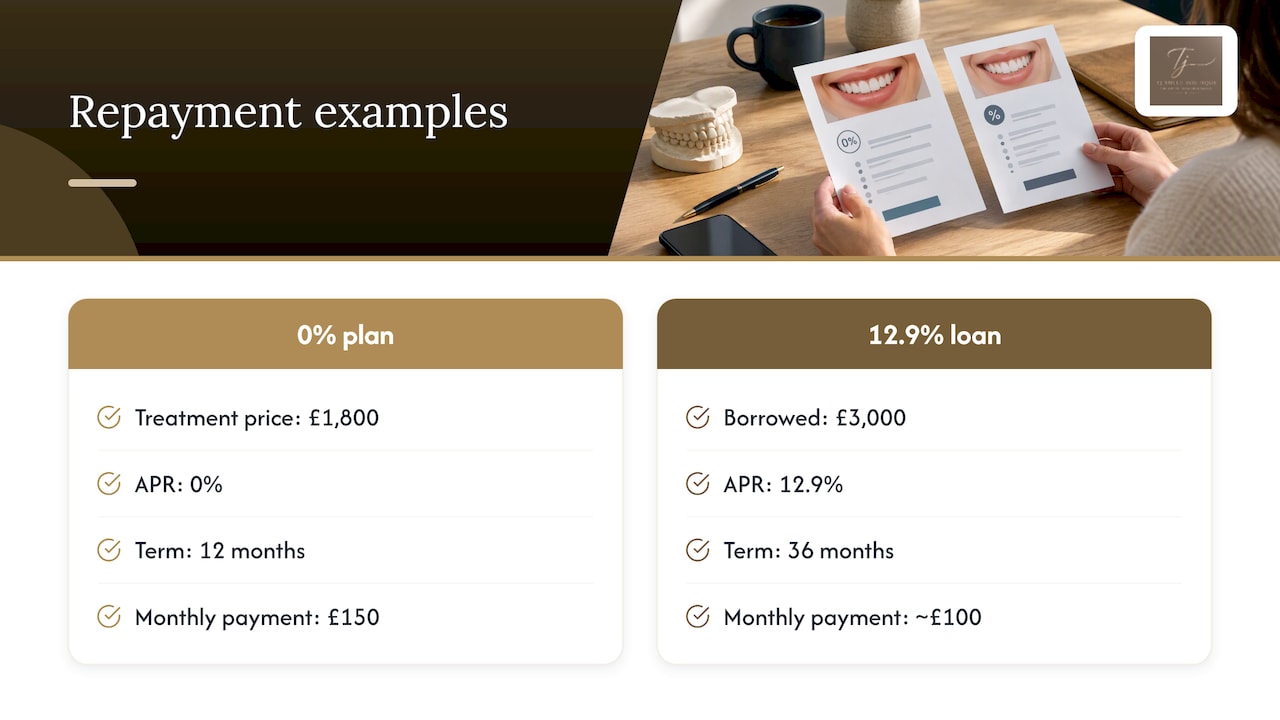
The lower payment looks friendlier, but you pay for that comfort. If you can manage the higher monthly payment of a shorter 0% plan, you will normally end up better off.
What APR actually tells you
The FCA defines APR as the rate of the total charge for credit, expressed as an annual percentage of the total amount of credit. In plain terms, it lets you compare the yearly cost of different loans on a like-for-like basis. A 0% APR means the credit costs nothing extra if you keep to the agreement.
Who qualifies, and what about credit checks
Acceptance depends on the lender’s assessment of your income, existing commitments and credit history. Many providers require applicants to be UK residents aged 18 or over, but conditions differ, so ask your clinic.
There are two kinds of check to understand:
- Soft check. Often used to see whether you are likely to be eligible. MoneyHelper explains that a soft check does not affect your credit score, unlike the hard check done at the final application stage.
- Hard check. Leaves a mark on your credit file when you complete the application.
Credit reference agencies compile information on how you manage credit, and a good score can help you qualify for cheaper rates and more offers. If your score is modest, it is sensible to avoid several full applications in quick succession. Ask for an eligibility check first.
Some treatments may also need a deposit. Some of our treatments require a non-refundable booking deposit, and we will tell you before you commit, so you know what is paid up front and what could be financed.
What to check before you sign
Before signing any agreement, check the APR, the total amount repayable, the term length, early-settlement terms and what happens if treatment is altered. That last point matters in cosmetic work, where a plan can evolve once your teeth are prepared or your design is refined.
Also ask for:
- A written treatment plan with costs. GOV.UK says to get a written plan that sets out costs and whether treatment is NHS or private, and to ask for a likely cost when prices are given as ranges or unavailable.
- Proof of registration. You can verify dental professionals on the General Dental Council register, as the same GOV.UK guidance points out.
- Clarity on missed payments. Know what fees or interest apply if you are late.
- Clarity on cancelling. Find out what happens to the agreement if you stop treatment.
For whitening in particular, the General Dental Council advises patients to research carefully, understand the risks and ask for a written treatment plan and cost estimate before agreeing to start.
The risks, stated plainly
Finance is a useful tool, but it is a debt. The main risks are:
- An interest-bearing loan costing more than the treatment price.
- Fees or interest if you miss payments.
- Damage to your credit file if you fall behind.
- Repayments becoming unaffordable if your circumstances change.
The practical answer is to treat it as a commitment and build a buffer into your budget so repayments stay manageable if your income dips. If you are already struggling with debt, speak to a free debt adviser before taking on more credit rather than after.
If something goes wrong with private treatment, the Dental Complaints Service can help resolve complaints, but it cannot compel a dental professional to respond in a particular way or accept liability. A clear written plan at the start is your best protection.
Alternatives to borrowing
Save and phase the work. Many cosmetic plans can be staged. You might start with whitening or bonding and move to veneers later. A phased plan costs the same overall but removes the need for credit.
Dental insurance. Do not count on it. MoneyHelper notes that policies commonly exclude cosmetic work such as whitening, and may have waiting periods, annual claim limits and exclusions for pre-existing problems. The same page describes self-insuring by saving, and dental payment plans that spread routine-care costs through monthly payments.
Choose the right treatment for the budget. Different treatments solve different problems at very different prices. If you are weighing options, our comparisons of composite bonding against veneers, composite against porcelain veneers and teeth whitening against veneers set out the cost and trade-offs.
What treatments cost at TJ Smile Studio
Finance is easier when the price is not a mystery. These are the prices we publish at our Glasgow studio, and the full price list is on our pricing page.
| Treatment | Published price |
|---|---|
| Smile Consultation | £50 |
| Invisalign Consultation | £50 |
| Composite bonding | from £200 per tooth |
| Veneers | from £399 per tooth |
| Invisalign | from £1,800 |
| Same-Day Hybrid Veneers | from £2,995 |
| Bespoke Home Teeth Whitening | £299 |
| Professional In-Office Teeth Whitening | £399 |
| In-Office + Home Teeth Whitening | £499 |
| Emergency Cosmetic Appointment | £75 |
Additional teeth are priced individually: £245 per tooth for additional composite bonding, £199 for additional edge bonding and £350 for an additional 3D hybrid veneer. Same Day Smile and Full Mouth Rehabilitation are planned individually, so there is no published price. We quote after the consultation.
To see how a monthly figure can look, take our starting prices as an illustration. Six bonded teeth at the £200 starting price come to £1,200, which over 12 months at 0% would be £100 a month. Same-Day Hybrid Veneers from £2,995 over 10 months at 0% would be £299.50 a month. Whether a plan like that is available to you depends on the lender and your application.
Our perspective
We see the same pattern again and again. People decide they want a new smile, then spend months worrying about the cost before they ever book. The better order is the reverse: get a clear plan first, then decide how to pay.
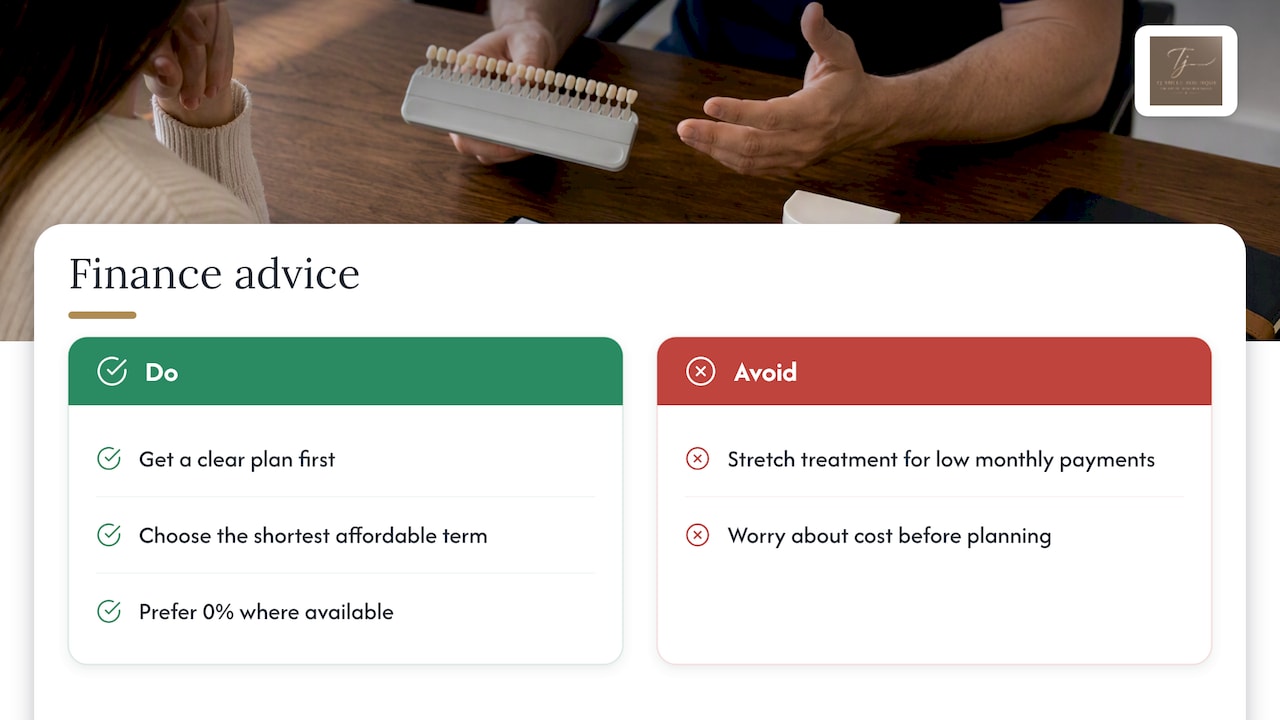
That is why every treatment at TJ Smile Studio starts with a consultation and a plan led personally by Dr Jamil, so the person who designs your smile is the person who quotes it. Our digital workflow lets us show you the design and agree the scope before treatment, which keeps the final cost close to the quote. For many patients, same-day treatment also means fewer appointments and fewer days off work, and we offer evening and weekend slots for busy people.
Our honest advice on finance is this. Choose the shortest term you can comfortably afford, prefer 0% where it is available, and never stretch to a bigger treatment just because the monthly figure looks small. A good result at a price you can sustain beats an ambitious one you resent paying for. We can talk through payment options, including financing larger packages, at your consultation, with no pressure to commit.
— Dr Tashfeen Jamil BDS, MFDS RCS Ed, AssocFCGDent - GDC 286427
Plan your smile and your budget together
If you are in Glasgow or nearby, such as Clarkston, Shawlands or Pollokshaws, a Smile Consultation costs £50. You leave with a clear idea of what is right for you and what it costs. If you are leaning towards straightening, the Invisalign consultation works the same way, and Invisalign starts from £1,800. For a dramatic change in one visit, see our Same-Day Hybrid Veneers.
FAQ
Can I get 0% finance for cosmetic dentistry?
Often, yes, if your clinic offers it and you are accepted. 0% plans are usually over shorter terms, and you repay only the treatment price if you keep up with payments. Your lender decides based on your circumstances, so ask the clinic about eligibility before you plan around it.
Will applying for dental finance affect my credit score?
A soft eligibility check does not affect your score, but the hard check at the final application stage does leave a record. Ask which type of check is being used before you apply. Avoid making several full applications at once.
Is cosmetic dental work available on the NHS?
Generally not. Purely cosmetic treatment such as whitening usually has to be paid for privately. The NHS covers treatment that is clinically necessary, so if you have a health problem as well, ask your dentist which parts might qualify.
Does dental insurance pay for veneers or whitening?
Usually not. Policies commonly exclude cosmetic work and may have waiting periods and annual limits. Read the policy wording carefully before relying on it.
What happens if I miss a repayment?
You may face fees or interest, and the missed payment can be recorded on your credit file. If you think you will struggle, contact the lender early and, if debts are building up, seek free advice from a debt charity.
Sources
- Choosing and paying for dental care, GOV.UK
- Help with NHS dental costs, NHSBSA
- How treatment finance works, Chrysalis Finance
- Dental finance explained, Kandoo
- Finance for dental work, Kandoo
- Cosmetic dentistry finance explained, Kandoo
- Shopping and paying safely online, MoneyHelper
- How to improve your credit score, MoneyHelper
- Do you need dental insurance, MoneyHelper
- FCA Handbook: annual percentage rate of charge
- FCA Consumer Credit sourcebook (CONC)
- Considering tooth whitening, General Dental Council
- What we can help with, Dental Complaints Service
Recommended
- Step by Step Smile Makeover Process
- Adult Orthodontics Options in the UK
- Veneers for Gaps
- Bonding for Gaps in the UK
This article is general information, not personal dental advice. What’s right for your teeth depends on a clinical examination — the condition of your enamel, gums, bite and any existing dental work — and no article can assess that. Outcomes vary between patients, and all treatment at TJ Smile Studio is subject to assessment and clinical suitability.
- Dr Tashfeen Jamil BDS, MFDS RCS Ed, AssocFCGDent, PGDip Restorative and Aesthetic Dentistry — GDC registration 286427
This article is general information, not personal dental advice. What's right for your teeth depends on a clinical examination — the condition of your enamel, gums, bite and any existing dental work — and no article can assess that. Outcomes vary between patients, and all treatment at TJ Smile Studio is subject to assessment and clinical suitability.
Clinically reviewed by Dr Tashfeen Jamil BDS, MFDS RCS Ed, AssocFCGDent, PGDip Restorative and Aesthetic Dentistry — GDC registration 286427, Principal Dentist at TJ Smile Studio, 1 Spiersbridge Way, Thornliebank, Glasgow G46 8NG.
If you have dental pain, swelling or an injury, call the practice on 07728 808510. Out of hours in Scotland, call NHS 24 on 111.