
31 October 2026 · TJ Smile Studio
Composite Bonding Longevity: How Long It Lasts and Why
How long does composite bonding last? Realistic UK lifespans, what wears it down, how to make it last longer and when to repair it, with Glasgow prices.
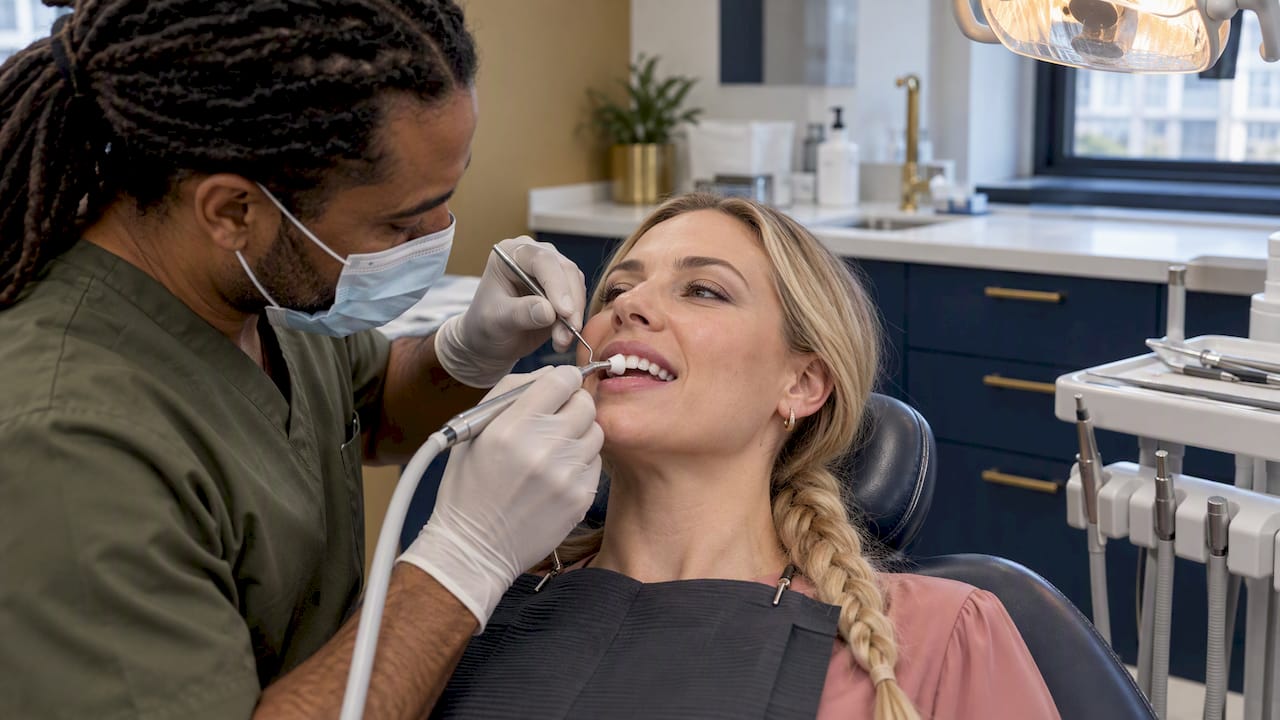
Composite bonding typically lasts somewhere between three and ten years, and most UK sources put the realistic middle at around five to seven. Dentistry magazine reported in 2025 that three to seven years is typical. Where your own bonding lands depends on which tooth it sits on, how you bite, what you eat and drink, and how often a dentist checks and polishes it. This guide explains the numbers, the reasons behind them, and what you can do to push your result towards the longer end.
TL;DR
- Expect roughly 3 to 7 years from composite bonding before it needs a polish, repair or replacement. Some bonding lasts longer, some less.
- Chipping, staining, wear and edges coming away are normal ageing for composite, not a sign that something went wrong on day one.
- Grinding, nail or pen biting, smoking, frequent sugary or acidic drinks and missed check-ups shorten the life of bonding the most.
- Regular polishing and small repairs are cheaper and gentler on your teeth than waiting until the bonding fails.
- Porcelain veneers generally last longer, but bonding is the lower-cost, more reversible choice for many smiles.
Table of Contents
- How long does composite bonding last?
- What affects how long bonding lasts?
- Does composite bonding wear, chip or stain?
- Composite bonding versus veneers: which lasts longer?
- How to make composite bonding last longer
- Signs your bonding needs attention
- What bonding costs in Glasgow, and what upkeep adds
- Our view: durability starts with an honest plan
- Thinking about bonding in Glasgow?
- FAQ
- Sources
How long does composite bonding last?
The honest answer is a range, not a single number. Different sources, looking at different teeth and different patients, report different figures:
- A University of Bristol dental patient leaflet says composite build-ups for worn teeth last on average five to six years, with a risk of fracture, discolouration and chipping, and a need for long-term maintenance.
- Dentistry magazine reports three to seven years, and notes bonding is more prone to chipping, wear and staining than porcelain veneers or crowns.
- An aesthetic dentist quoted by Dentistry in 2023 described about five years as the usual expectation, with staining and chipping the usual complaints.
If you are searching for the composite bonding lifespan so you can plan, a sensible working assumption is five years before the first significant refresh, with polishing in between. Treat anything beyond that as a bonus rather than a promise.
What the clinical research shows
Lab and clinic studies of composite fillings are a useful guide, even though most of them are about fillings rather than cosmetic work on front teeth.
- A 2021 systematic review of 75,637 direct composite restorations on front teeth found annual failure rates from 0% to 27.11%, and survival rates from 28.6% to 100%. Fracture was the main reported reason for failure. That enormous spread tells you that technique, materials and the patient matter far more than any average.
- A 2019 systematic review reported survival of 90.7% at three years, 89.5% at five years, 89.3% at seven years and 75.6% at ten years for composite restorations. It also found too little information on direct veneers and on restorations involving the corners of front teeth.
- For back teeth, a meta-analysis found annual failure rates of 1.8% at five years and 2.4% after ten, mainly from decay and fracture.
Put together: most composite survives the first five to seven years in some form, and the odds of needing work rise steadily after that. Note that survival in these studies often counts repaired restorations as survivors, which is exactly how bonding is maintained in real life.
What affects how long bonding lasts?
No two mouths are alike, which is why the studies vary so widely. These are the factors that count.
Your tooth and your bite
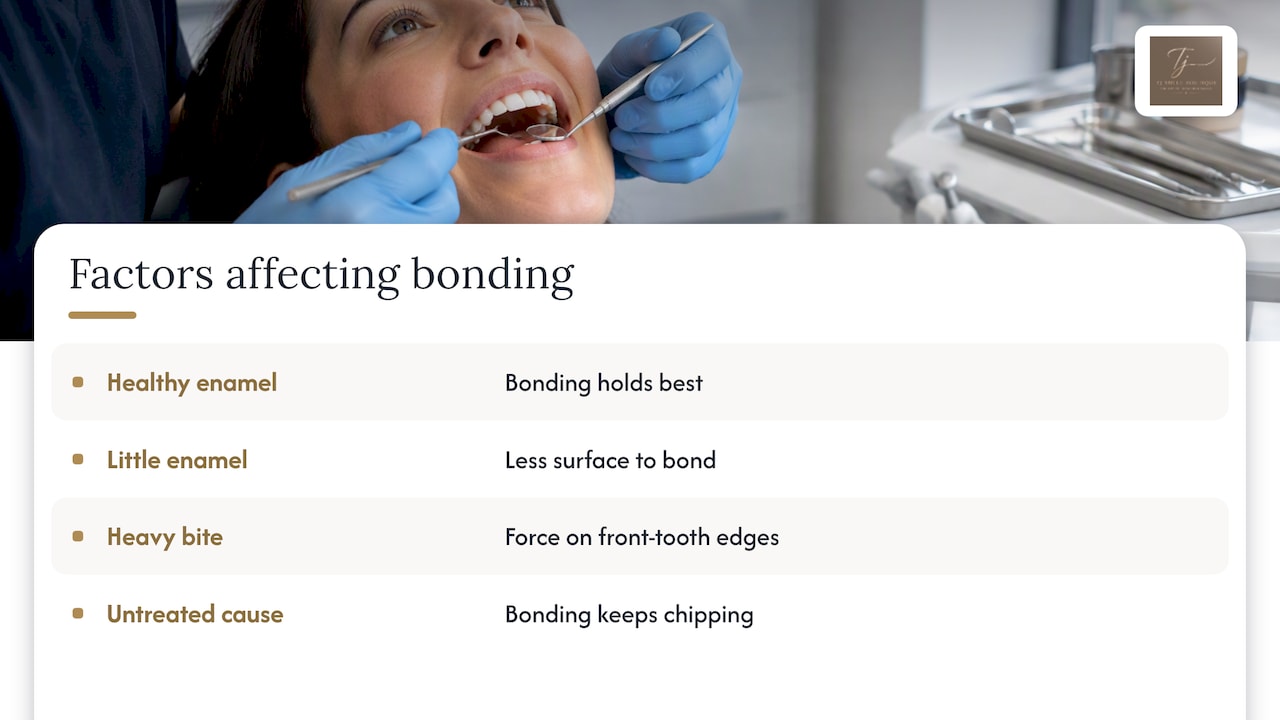
The General Dental Council (GDC), the UK dental regulator, says the outlook for bonding can be affected by insufficient enamel and by inadequate assessment of the hard tissues, gum health, tooth wear, the bite and the aesthetic zone. Bonding holds best on healthy enamel. It struggles where there is little enamel left to bond to, or where the bite puts heavy force on the edges of the front teeth.
The same GDC guidance warns that premature failure, repeated rebonding and unresolved bite problems are reasons treatment can keep failing. In plain terms: if the cause of the problem, such as a heavy bite or grinding, is not dealt with, the bonding will keep chipping however well it is placed.
Habits and health
The 2019 review linked smoking, frequent drinks, grinding (bruxism), dry mouth and low resistance to decay with a higher risk of composite failure. The posterior-composite meta-analysis found that people at medium or high risk of decay had roughly two to three times the failure risk.
In day-to-day terms the biggest culprits are:
- Clenching or grinding, especially at night
- Biting nails, pens, ice or packaging
- Tea, coffee, red wine and smoking, which stain composite
- Frequent sugary or acidic snacks and drinks, which raise decay risk around the edges
- Skipping dental check-ups
Technique and materials
The 2021 review found that failure was linked to adhesive technique, the type of composite and whether the restoration was a replacement, as well as the time needed to make it. Bonding is a hand-sculpted treatment, so the skill of the dentist and the care taken in preparing the tooth surface are part of the lifespan equation. That is one reason we plan each case carefully before any material goes on a tooth.
Does composite bonding wear, chip or stain?
Yes, and any dentist who tells you otherwise is not being straight with you. The GDC says patients should be told that composite may stain, lose gloss, wear, chip or fracture, and may decay or come away from the tooth, and that regular polishing, refurbishment, repair or replacement may be needed.
That is not a flaw unique to one clinic. It is how resin behaves in a mouth that chews, grinds and drinks coffee every day. Natural enamel is harder and less porous than composite resin, so bonding gradually picks up surface stain and loses its mirror shine. A polish often brings much of that back.
Many cosmetic results work this way. Anything that sits on or in the body and is exposed to daily wear needs upkeep, whether that is a Botox top-up schedule or a bonded tooth. What matters is knowing the maintenance rhythm before you commit.
Composite bonding versus veneers: which lasts longer?
Porcelain is harder, more stain-resistant and generally longer-lived than composite, but it costs more per tooth and removes more tooth structure in most cases. Leeds Teaching Hospitals NHS Trust says well-cared-for crowns or veneers normally last around eight to ten years, depending on check-ups, brushing, cleaning between teeth and a low-sugar diet.
| Composite bonding | Porcelain veneers | |
|---|---|---|
| Typical lifespan | About 3 to 7 years in UK sources | Around 8 to 10 years or more with good care |
| Stain resistance | Lower, can be polished | Higher |
| Repairability | Often repaired in a single visit | Usually replaced if damaged |
| Tooth preparation | Often little or none | Usually some enamel removal |
| Cost at TJ Smile Studio | From £200 per tooth | Veneers from £399 per tooth |
The cheaper, quicker option is not automatically the worse value. If you are not ready to commit to porcelain, or you want to correct one chipped edge, bonding can be an excellent choice. If you want to compare in detail, our guides on composite bonding versus veneers and composite versus porcelain veneers go through the trade-offs, and our article on veneer lifespan covers the longer-term end.
How to make composite bonding last longer
Nothing makes bonding permanent, but a few habits make a measurable difference.
Daily care
NHS guidance on composite fillings recommends brushing twice daily with fluoride toothpaste, cleaning between your teeth, keeping sugary and acidic foods and drinks to mealtimes, and seeing your dentist regularly. The same page notes that composite can stain over time.
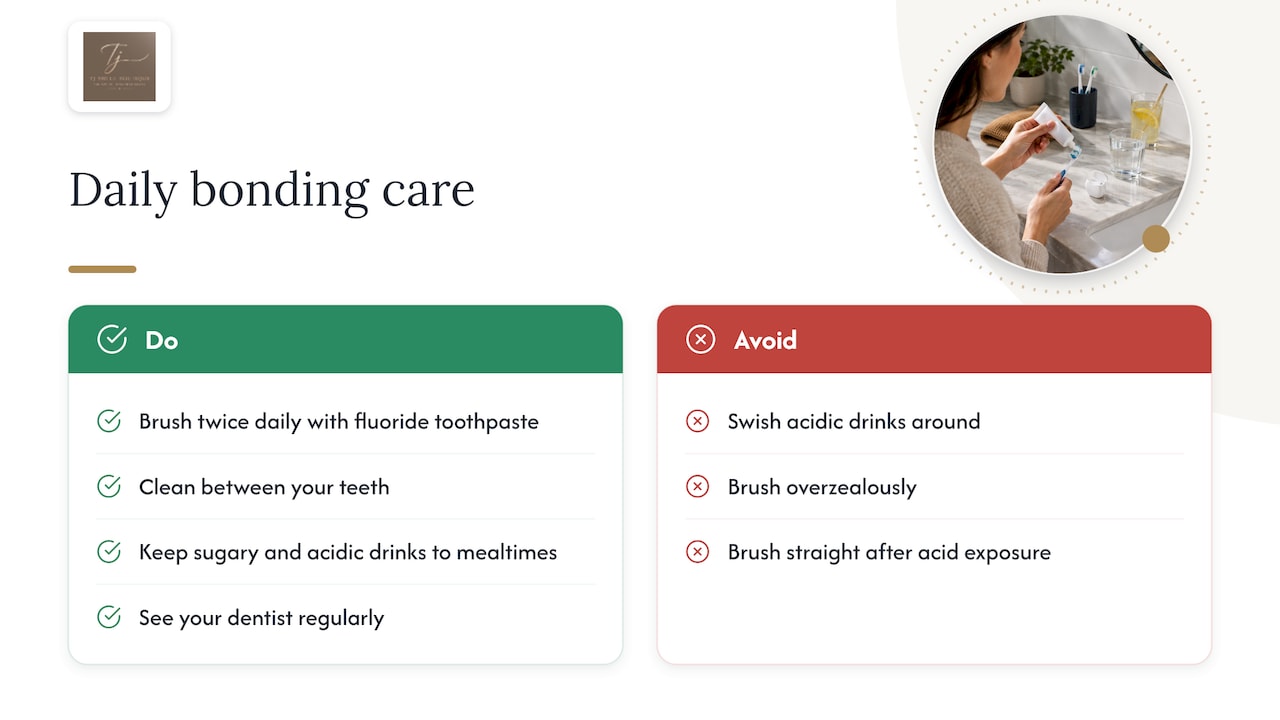
The British Society for Restorative Dentistry adds that you should limit acidic drinks to mealtimes, avoid swishing them around, avoid overzealous brushing, and not brush straight after acid exposure, all to reduce tooth wear. Use a soft brush and gentle pressure around bonded edges.
Habits to change
- Stop biting things. The BSRD recommends habit control for pen, pencil and nail biting. Open packets with scissors, not your front teeth.
- Protect against night-time grinding. The same guidance recommends a night guard for night-time grinding, and a full-coverage hard acrylic splint for established grinders. If you wake with a tight jaw or have flattened edges, tell your dentist before having bonding done.
- Go easy on stain. You do not have to give up coffee, but rinsing with water afterwards and keeping your polish appointments helps.
- Be careful with very hard foods. Ice, hard sweets and crusty bites with your front teeth are the usual causes of chips.
Check-ups and polishing
The cheapest way to extend bonding is to have it looked at before small problems become big ones. At TJ Smile Studio, a Composite Bonding Review is £45 and Composite Polish & Maintenance is £95. A small chip or rough edge caught early is a quick fix rather than a rebuild.
Signs your bonding needs attention
Book a visit if you notice any of the following, in line with the GDC’s list of what bonding can do over time:
- Staining or dullness that brushing does not shift
- A rough or sharp edge, or a visible chip
- A line or ledge where the bonding meets the tooth
- Bonding that feels loose or has come away
- Sensitivity, or darkening at the margin that could suggest decay
What happens next depends on the problem. A peer-reviewed review of repairing restorations says staining at the edge of front-tooth composite can often be managed by refinishing or refurbishing, while heavy penetrating stain may need complete replacement. Limited wear on a biting surface may be treated by resurfacing if there is enough space, whereas wear involving a side surface between teeth may need a different restorative approach.
If a small piece has chipped, you do not always need to start again. Our guide to composite bonding repair explains how a repair visit works, and a Composite Repair Assessment at our clinic costs £75.
What bonding costs in Glasgow, and what upkeep adds
Longevity is partly a cost question: what you pay up front, and what you pay to keep it looking right. Our published prices at TJ Smile Studio are:
| Treatment | Price |
|---|---|
| Smile Consultation | £50 |
| Composite Bonding | From £200 per tooth |
| Additional Composite Bonding, per tooth | £245 per tooth |
| Additional Edge Bonding, per tooth | £199 per tooth |
| Composite Bonding Review | £45 |
| Composite Polish & Maintenance | £95 |
| Composite Repair Assessment | £75 |
It helps to think in terms of cost per year. If bonding lasts five to seven years with a polish along the way, the maintenance is a small fraction of the original outlay. The full list is on our pricing page.
Our view: durability starts with an honest plan
The GDC says durability and informed consent cannot be separated: patients need a realistic explanation of maintenance, limitations and possible failure before choosing bonding. We agree with that, and it shapes how we work.
When we plan bonding, the first question is not how to make the teeth look different, but why the teeth look the way they do. A chipped edge from a one-off accident is a very different case from edges worn down by grinding. Without a plan for the cause, you are paying for a repair that will wear out again.
Because every treatment is led personally by one dentist, the person who assesses your bite is the person who shapes your bonding, and the person who sees it when you come back for review. That continuity matters for longevity, because small changes are easier to spot when the same eyes see them each time.
We also think bonding is sometimes the wrong answer. If you have heavy wear, a deep bite or very little enamel, we will say so and talk through alternatives, including veneers, rather than promise you something that will not hold. Our aim is that you know the likely lifespan, the upkeep and the cost before you say yes.
— Dr Tashfeen Jamil BDS, MFDS RCS Ed, AssocFCGDent - GDC 286427
Thinking about bonding in Glasgow?
If you want to know how long bonding would last on your own teeth, the most reliable answer comes from an examination of your bite and enamel. Our Smile Consultation is £50 and covers your goals, your options and a clear price. We offer composite bonding in Glasgow from £200 per tooth, with evening and weekend appointments for busy diaries.
If you would rather compare first, see how bonding stacks up against teeth whitening and veneers, or read about bonding for enamel erosion.
FAQ
How long does bonding last on front teeth?
Most UK sources give three to seven years, with five as a common middle point. Front teeth take less chewing force than back teeth, but edges are exposed to biting, nails and accidents. Your bite and habits decide where you land in that range.
Can composite bonding last 10 years?
Sometimes, particularly small, well-placed bonding on healthy enamel in someone with a gentle bite and good habits. One systematic review reported 75.6% survival at ten years for composite restorations in general. Do not plan on ten years, but it is not impossible, especially with regular polishing.
Does bonding last longer than a filling?
Not necessarily. Bonding and white fillings use the same type of material, so they age in similar ways. Bonding for cosmetic changes is often thin or sits on an edge, which makes chips more likely than in a filling.
Can chipped bonding be repaired?
Often, yes. Small chips and rough edges can frequently be repaired or refinished, while heavy staining or larger failures may call for replacement. At our clinic, a Composite Repair Assessment is £75.
Is bonding or a veneer better for longevity?
Porcelain veneers last longer on average, with NHS guidance putting well-cared-for veneers at eight to ten years or so. Bonding costs less to start with and is easier to repair. The right choice depends on how many teeth you are treating, your bite and your budget.
Sources
- Composite build-ups for tooth wear, University of Bristol patient leaflet
- Long-term survival and reasons for failure in direct anterior composite restorations, 2021 systematic review
- The long-term results of teeth restoration with composite, systematic review
- Longevity of posterior composite restorations, systematic review and meta-analysis
- Composite bonding: communicating the pros and cons, Dentistry
- The dark side of composite bonding, Dentistry
- Bonding boom: composite bonding insights for dental professionals, General Dental Council
- Dental fillings, Sussex Community NHS Foundation Trust
- Tooth Wear Guidelines, British Society for Restorative Dentistry
- Factors influencing repair of dental restorations with resin composite
- Crowns, Leeds Teaching Hospitals NHS Trust
- How long Botox lasts
Recommended
- Composite Bonding for Enamel Erosion
- Composite Bonding in Glasgow
- From £75: Same Day Composite Bonding
- Invisalign vs Composite Bonding
This article is general information, not personal dental advice. What’s right for your teeth depends on a clinical examination — the condition of your enamel, gums, bite and any existing dental work — and no article can assess that. Outcomes vary between patients, and all treatment at TJ Smile Studio is subject to assessment and clinical suitability.
- Dr Tashfeen Jamil BDS, MFDS RCS Ed, AssocFCGDent, PGDip Restorative and Aesthetic Dentistry — GDC registration 286427
This article is general information, not personal dental advice. What's right for your teeth depends on a clinical examination — the condition of your enamel, gums, bite and any existing dental work — and no article can assess that. Outcomes vary between patients, and all treatment at TJ Smile Studio is subject to assessment and clinical suitability.
Clinically reviewed by Dr Tashfeen Jamil BDS, MFDS RCS Ed, AssocFCGDent, PGDip Restorative and Aesthetic Dentistry — GDC registration 286427, Principal Dentist at TJ Smile Studio, 1 Spiersbridge Way, Thornliebank, Glasgow G46 8NG.
If you have dental pain, swelling or an injury, call the practice on 07728 808510. Out of hours in Scotland, call NHS 24 on 111.