
11 November 2026 · TJ Smile Studio
Clear Aligners Aftercare: Cleaning, Storage and Smell
How to clean and store clear aligners, stop stains and Invisalign smell, and know when to call your dentist. A practical daily routine from a Glasgow clinic.
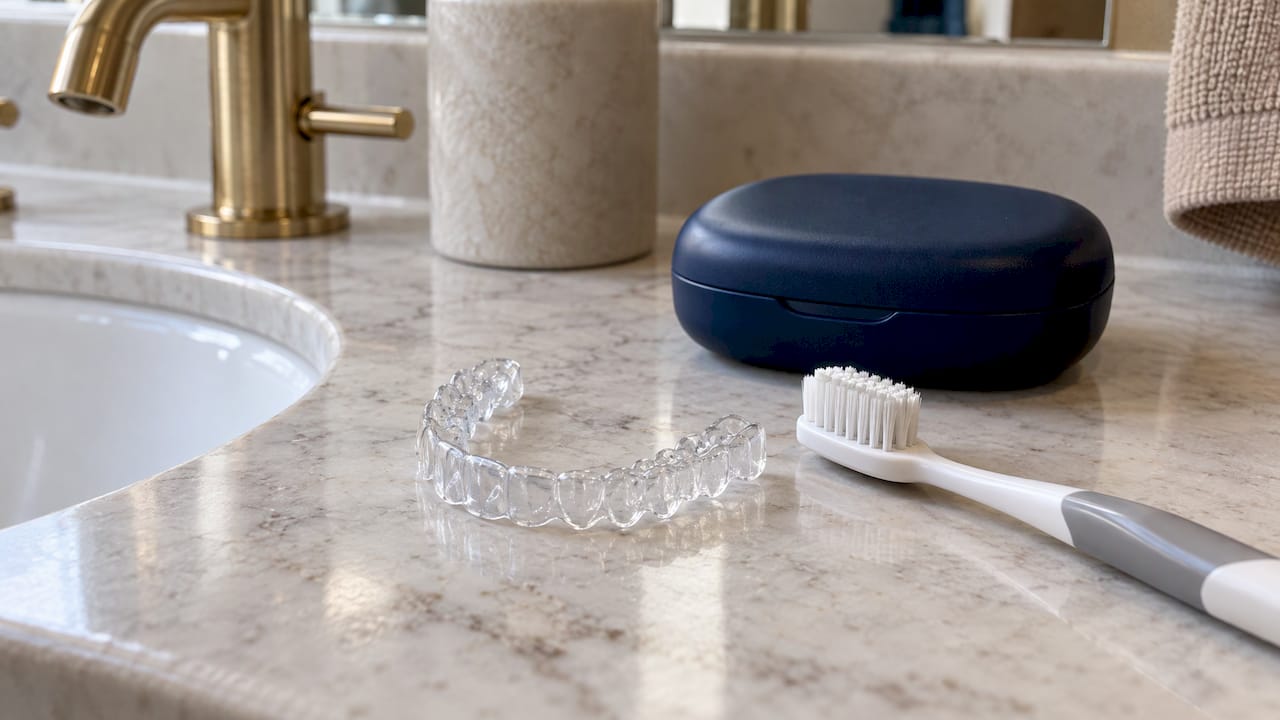
Looking after clear aligners comes down to four habits. Rinse them every time they come out. Clean them with a soft brush and a cleaner made for aligners. Keep them in their case whenever they are not in your mouth. Take them out for anything except plain water. Do those four things and most stains, cloudiness and smells never get started.
Below is the full routine: what to use, what to avoid, how to deal with a smell that has already set in, and when a problem is worth a call to your dentist. It applies to Invisalign and to most other removable clear aligners, but always follow the written instructions your own provider gave you.
TL;DR
- Rinse aligners in cool or lukewarm water whenever you take them out, and brush them gently with a soft toothbrush when you clean your teeth.
- Soak them regularly in a cleaner designed for aligners, such as Invisalign Cleaning Crystals. Rinsing with water alone does not remove established biofilm.
- Never use hot water, abrasive toothpaste or mouthwash soaks, and never wrap aligners in a tissue or leave them loose in a pocket.
- Remove aligners before eating or drinking anything other than water, then brush before putting them back.
- A smell that stays after a proper clean, or an aligner that is cracked or no longer fits, needs a call to your dentist.
Table of Contents
- Your daily aligner routine
- Why rinsing alone is not enough
- What to avoid when cleaning aligners
- Storage: where aligners go when they are out
- Food, drink and stains
- Invisalign smell: why it happens and what to do
- When to call your dentist
- Aftercare when treatment ends
- Our perspective
- Thinking about Invisalign in Glasgow?
- FAQ
- Sources
Your daily aligner routine
A routine only works if it is short enough to follow on a busy day. This is the version we suggest to patients.
- Take them out properly. Remove the aligners with clean hands, then rinse them straight away so saliva and food film do not dry onto the plastic.
- Eat and drink with them out. Water is the only exception (more on that below).
- Brush your teeth before they go back in. Putting aligners over teeth with food on them holds that food against the enamel for hours.
- Clean the aligners. Invisalign UK advises cleaning aligners whenever you brush your teeth and using its Cleaning Crystals for a deeper clean.
- Rinse and fit. Rinse thoroughly with cool water before inserting them.
- Case, every time. When they are out, they go in the case, not on a napkin or in a pocket.
The instructions supplied with another aligner system follow the same pattern: clean before insertion, rinse thoroughly with cool water afterwards, use an aligner-specific product once a week or as needed, and store them in the case provided.
Why rinsing alone is not enough
Aligners sit against your teeth for most of the day, and a thin film of bacteria, called biofilm, builds up on the plastic. A 2023 peer-reviewed review reports that rinsing with water alone is insufficient for optimal cleaning, and that combining mechanical cleaning with a chemical method appears most successful for reducing that biofilm.
In plain terms: brushing lifts the deposits, and a soak reaches what the brush misses. A 2022 systematic review found that no single cleaning method has been proven best, and that randomised controlled trials are lacking, though it also found that combining mechanical and chemical methods can control biofilm. So the sensible approach is a two-part habit rather than a hunt for a miracle product.
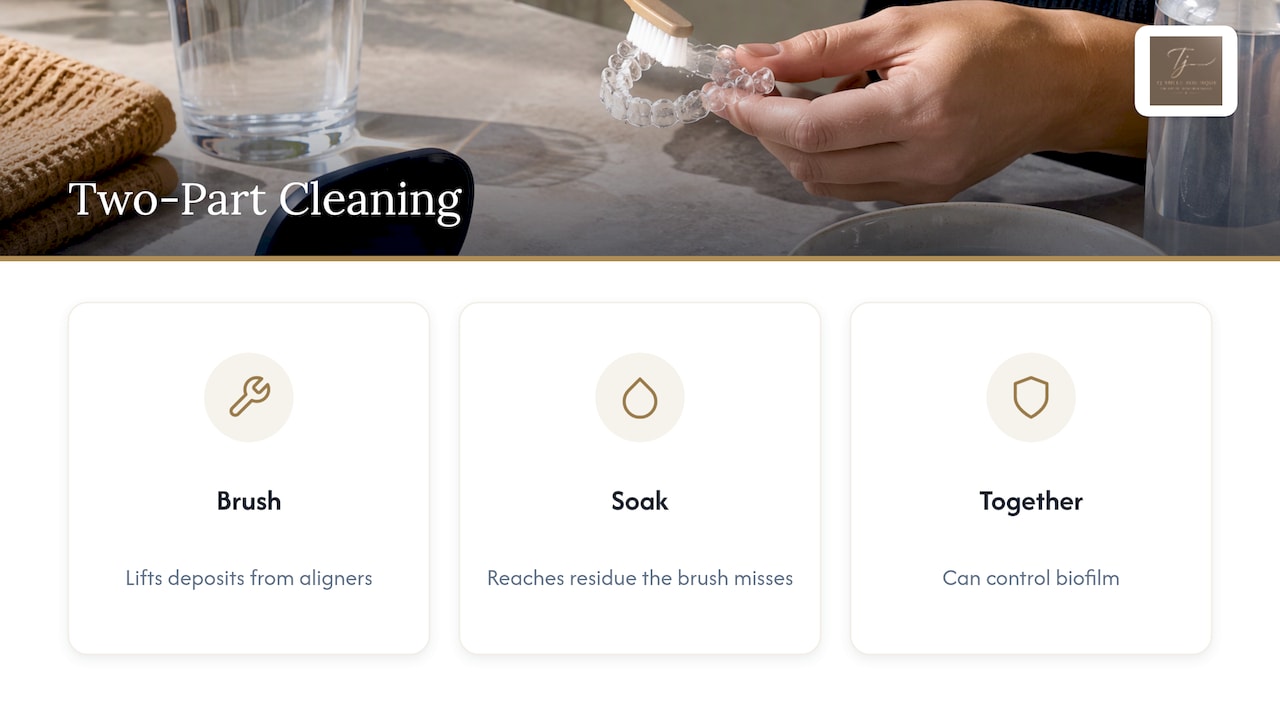
Brushing the aligners
Use a soft toothbrush kept just for your aligners, and brush gently on both the inside and outside surfaces. Pay attention to the edges and the dips where your tooth tips sit, because that is where film collects. Hard bristles and firm scrubbing scratch the plastic, and scratches hold stains and bacteria.
Soaking the aligners
A soak dissolves what the brush leaves behind. Use a product made for clear aligners and follow the packet. As a guide, one UK aligner-cleaning tablet’s instructions say the solution should be discarded after one use, the tablets and solution kept away from children, and different cleaners never mixed. The same instructions describe it as a cleaner, not a disinfectant or sterilising product, so it does not replace brushing your own teeth.
What to avoid when cleaning aligners
Most damage to aligners comes from well-meant cleaning. Instructions for one clear aligner system warn against hot water, denture cleaner, abrasive toothpaste and soaking in mouthwash, because these can roughen the surface or leave it dull or cloudy.
| Do | Avoid |
|---|---|
| Cool or lukewarm water | Hot or boiling water, including “sterilising” in the kettle |
| Soft brush kept for aligners | Hard bristles or scouring pads |
| A cleaner made for aligners | Mouthwash soaks, abrasive or whitening toothpaste |
| A clean, ventilated case | Tissues, napkins, loose pockets |
| Fresh solution every soak | Reusing yesterday’s solution or mixing cleaners |
If you are unsure whether a product suits your aligners, ask your dentist before you use it. Different aligner brands use different materials, and the instructions that came with yours are the final word.
Storage: where aligners go when they are out
Most lost and cracked aligners were last seen wrapped in a napkin. Invisalign UK says that tissues and pockets should not be used for storage, and that its cases are designed to keep aligners secure and hygienic.
A few practical habits help:
- Keep a case in your work bag, your coat and your car, so you are never tempted to improvise.
- Rinse the case with water and a little mild soap now and then, and let it dry. A damp, closed case is a very good place for odour to build.
- Never put aligners down next to a hot drink or on a radiator.
- Keep them out of reach of pets. Dogs find them irresistible.
Food, drink and stains
The rule is simple: remove aligners before eating or drinking anything other than water. Invisalign UK lists coffee, tea, red wine, cola, curry, soy sauce and balsamic vinegar as possible sources of staining, and advises rinsing and brushing your teeth after having them.
Water needs a footnote. Invisalign UK says room-temperature water is the only drink recommended while wearing aligners, and hot water may affect them. That rules out a cup of tea “just with the aligners in”, and it rules out ice-cold or fizzy drinks sipped through the afternoon.
For a Glasgow working day, that usually means:
- Take the aligners out for your coffee, put them in the case, and brush or at least rinse your mouth before they go back in.
- Plan lunch so you can brush. A travel toothbrush in your desk drawer removes the excuse.
- Evening wine or curry: aligners out, teeth brushed, aligners cleaned, then back in for the night.
If you worry about eating while in treatment, our guide to eating with Invisalign without cutting corners covers meals, snacks and timing in more detail.
Invisalign smell: why it happens and what to do
A smell from aligners is almost always the same cause: bacteria and food residue sitting on warm, damp plastic that has not been cleaned thoroughly enough. Dry mouth overnight, snacking with aligners in, and storage in a closed damp case all make it worse.
Stop it before it starts
- Clean the aligners every time you brush, and soak them regularly rather than waiting for a smell.
- Brush your teeth and tongue before the aligners go back in.
- Take aligners out for everything except water.
- Let the case dry out and rinse it often.
- Keep up with your normal hygiene visits, because gum or tooth problems can cause breath odour that ends up blamed on the aligners.
If a smell is already there
- Rinse the aligners in cool water and brush every surface gently, including the edges.
- Soak them in a fresh solution of a cleaner made for aligners, following its instructions.
- Rinse well afterwards so no taste lingers.
- Wash the case with mild soap and water and let it dry fully.
- Do not reach for hot water, mouthwash or strong household products to “kill” the smell, as these can mark the plastic.
If the smell is still there after a thorough clean, or if you also have sore gums, a bad taste that does not shift, or a visible crack, call your dentist. A damaged aligner can trap bacteria in places a brush cannot reach, and persistent odour can come from the mouth rather than the plastic.
When to call your dentist
Some aligner problems can wait for your next appointment. Others should not.
Call promptly if:
- An aligner cracks, splits or loses a piece. An NHS London pharmacy factsheet says to contact the orthodontist at the earliest opportunity for a fractured appliance, because teeth can move back quickly. If your orthodontist cannot be reached, it advises contacting your usual dentist or NHS 111 where appropriate.
- You are tempted to glue a broken part. Do not: the same factsheet says glue can degrade the plastic.
- An aligner no longer seats properly, or you have lost one.
- You have lasting pain, bleeding gums or a smell that will not clear.
Keep your appointments. The General Dental Council says clear aligner care should include good oral hygiene, regular follow-ups and following aligner and retainer instructions, and that patients should receive a written treatment plan. Keep that plan and your cleaning instructions together.
Aftercare when treatment ends
The day your last aligner comes out is not the end of the care. Retainers keep your teeth where they have been moved, and they need the same cleaning and storage habits as your aligners. Our guide to retainers after Invisalign explains how long to wear them and how to look after them.
If your attachments are being removed, the polishing and aftercare stage is the point to ask how to keep the finish smooth and your result stable.
Our perspective
In our experience, aligner problems rarely come from patients who do not care. They come from patients who were never given a simple routine. A cleaner, a brush, a case and a clear rule about drinks are enough for most people, and we would rather you left your consultation knowing that than carrying a long list of products.
Because every treatment here is led personally by one dentist from planning to completion, we can build the routine around your day. A shift worker, a commuter and someone who travels each week do not need the same plan, and we offer evening and weekend appointments so that reviews do not fall away when life gets busy.
Our fully digital workflow also means your aligner plan is mapped out in advance, so you know what the next stage looks like. If a tray cracks, smells or stops fitting, you should not have to wonder whether it matters. Call us, and we will tell you.
Dr Tashfeen Jamil BDS, MFDS RCS Ed, AssocFCGDent - GDC 286427
Thinking about Invisalign in Glasgow?
If you are reading this before starting treatment, or considering clear aligners for the first time, we offer Invisalign at TJ Smile Studio from £1,800, with a plan tailored to your teeth and your schedule. An Invisalign consultation is £50, and it is the place to ask how cleaning, storage and appointments would fit around your week.
See our Invisalign treatment page for what is included, or check our pricing for the consultation and for our £35 retainer review once your treatment is finished.
FAQ
How often should I clean my clear aligners?
Clean them every time you brush your teeth, and rinse them each time you take them out. Add a soak in an aligner cleaner regularly, following the product’s instructions. Rinsing with water alone is not enough to remove established biofilm.
Why do my Invisalign aligners smell?
Usually because bacteria and food residue have built up on the plastic, often from drinking anything other than water with them in, or from storing them in a damp case. Brush, soak in an aligner cleaner and wash the case. If the smell persists, speak to your dentist.
Can I use toothpaste or mouthwash on my aligners?
It is best not to. Instructions for one clear aligner system warn that abrasive toothpaste and mouthwash soaks can make the surface dull or cloudy. Use a soft brush with a gentle cleaner made for aligners, and check your own provider’s instructions.
Can I drink tea or coffee with my aligners in?
No. Invisalign UK recommends room-temperature water as the only drink with aligners in. Take them out for tea and coffee, which can stain them, then rinse or brush before putting them back.
What should I do if my aligner cracks?
Do not glue it. Contact your dentist or orthodontist promptly, because teeth can move back quickly. If you cannot reach them, your usual dentist or NHS 111 can advise where appropriate.
Sources
- Invisalign UK: accessories and cleaning
- Invisalign UK: 7 tips to maintain your aligners
- Invisalign UK: what you can drink during treatment
- OraFit custom clear aligner instructions for use
- Orthocare UK aligner cleaning tablet instructions
- Review: impact of clear aligners on oral health and microbiome (2023)
- Systematic review: cleaning and disinfection protocols for clear orthodontic aligners (2022)
- GDC: clear aligner treatment and complaints
- NHS London pharmacy dental factsheet: fractured appliances
Recommended
This article is general information, not personal dental advice. What’s right for your teeth depends on a clinical examination — the condition of your enamel, gums, bite and any existing dental work — and no article can assess that. Outcomes vary between patients, and all treatment at TJ Smile Studio is subject to assessment and clinical suitability.
- Dr Tashfeen Jamil BDS, MFDS RCS Ed, AssocFCGDent, PGDip Restorative and Aesthetic Dentistry — GDC registration 286427
This article is general information, not personal dental advice. What's right for your teeth depends on a clinical examination — the condition of your enamel, gums, bite and any existing dental work — and no article can assess that. Outcomes vary between patients, and all treatment at TJ Smile Studio is subject to assessment and clinical suitability.
Clinically reviewed by Dr Tashfeen Jamil BDS, MFDS RCS Ed, AssocFCGDent, PGDip Restorative and Aesthetic Dentistry — GDC registration 286427, Principal Dentist at TJ Smile Studio, 1 Spiersbridge Way, Thornliebank, Glasgow G46 8NG.
If you have dental pain, swelling or an injury, call the practice on 07728 808510. Out of hours in Scotland, call NHS 24 on 111.