13 November 2026 · TJ Smile Studio
Bite Reconstruction Explained: Steps, Options and Aftercare
Bite reconstruction (occlusal rehabilitation) explained: who needs it, how the bite is planned, which treatments are used, how long it takes and how to maintain it.
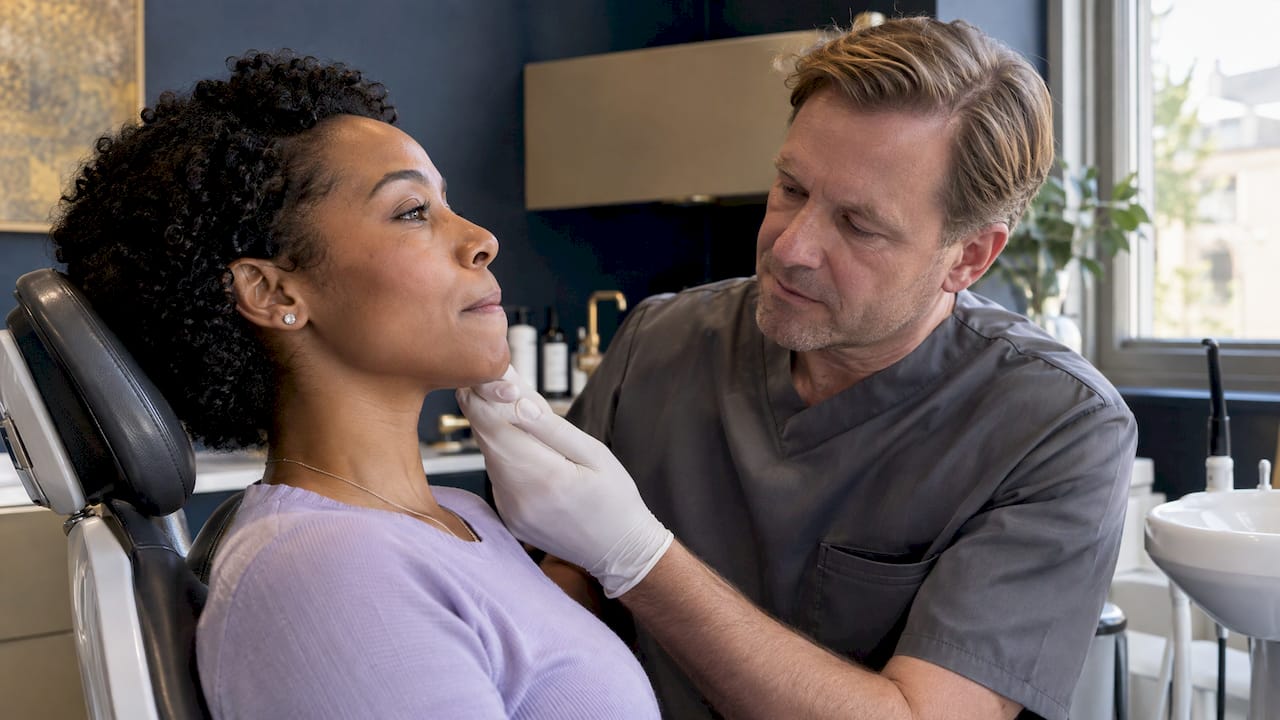
Bite reconstruction, also called occlusal rehabilitation, is a planned programme of dental work that rebuilds how your teeth meet, so that they function comfortably, last longer and look balanced. It can be as modest as building up a few worn teeth, or as extensive as restoring every tooth in the mouth. At TJ Smile Studio in Glasgow, Dr Tashfeen Jamil personally leads each treatment, and our fully digital workflow means that many cosmetic patients complete their treatment in a single visit. A bite plan starts with a consultation, and the right scale of treatment follows from what that assessment shows.
TL;DR
- Bite reconstruction restores the way your teeth meet and work together, not just how they look.
- It is usually considered for heavy tooth wear, repeated fractures, failed restorations, bruxism (grinding) or a bite that has collapsed.
- Planning comes first: records, photographs, models and a digital or wax-up preview of the result before any tooth is touched.
- Treatment ranges from composite build-ups on a few teeth to full-mouth rehabilitation, and the least invasive option that solves the problem is the sensible starting point.
- Long-term success depends on regular reviews and looking after the restorations.
Table of Contents
- What bite reconstruction actually means
- Signs that your bite may need rebuilding
- How the bite is assessed and planned
- Treatment options and how they are chosen
- How long does bite reconstruction take?
- Planning a bite reconstruction with us in Glasgow
- Grinding, clenching and protecting the work
- Risks, adjustment and long-term maintenance
- What bite work costs at TJ Smile Studio
- Our perspective
- FAQ
- Sources
What bite reconstruction actually means
Your “bite” is the way the upper and lower teeth contact each other when you close, chew and move your jaw. Dentists call this the occlusion. A 2019 review of occlusal rehabilitation defines it as restoring the functional integrity of the dental arches, using restorations such as inlays, crowns, bridges and partial dentures, to give orderly contact between the teeth and a stable bite that supports function and aesthetics.
The term overlaps with full mouth rehabilitation. A 2020 review in PMC describes full mouth rehabilitation as an individualised treatment in which the whole dentition is reconstructed to optimise the health of the teeth, gums, bite and jaw system. In everyday conversation, “bite reconstruction”, “occlusal rehabilitation”, “full mouth reconstruction” and “full mouth rehabilitation” are used for closely related ideas. What matters is the scale: some patients need a handful of teeth rebuilt, others need a complete plan.
Signs that your bite may need rebuilding
Nobody needs bite work simply because they have heard of it. It becomes relevant when something is going wrong with the teeth or the way they meet. Common triggers include:
- Short, flattened or worn teeth. Reduced crown height and little or no upper incisor showing when you smile are typical aesthetic concerns listed in Dentistry Online’s guide to managing tooth wear.
- Chipped or broken front teeth. The same article lists chipped or broken upper incisors among the complaints that lead to restorative treatment.
- Sensitivity. Dentine hypersensitivity, where worn enamel exposes the layer beneath, is another common reason patients seek help.
- Fractured teeth or restorations. This includes cracked tooth syndrome, and fillings or crowns that keep failing.
The PMC reviews add further situations where a more thorough reorganisation of the bite is considered: loss of vertical dimension (the bite has closed down), severe bruxism or attrition, too little space between the teeth for restorations, trauma from the bite itself, and temporomandibular disorders. If several of these sound familiar, a bite assessment is a sensible next step.
Our restoring worn teeth guide goes through the visible signs of wear in more detail, and our article on composite bonding for enamel erosion covers one common cause.
How the bite is assessed and planned
Good bite work is decided at the planning stage. Rebuilding teeth without a clear plan for how they will meet is how restorations end up failing early.
A typical planning sequence looks like this:
- History and examination. Your dentist looks at wear patterns, existing restorations, gum health, jaw comfort and your habits, such as grinding or clenching.
- Records. Photographs, radiographs and impressions or scans. A 2023 update in the Journal of Evidence-Based Dental Practice says treatment discussions should refer to clinical notes, photographs, radiographs and study casts.
- Recording the jaw position. Bristol Dental School explains that a facebow records jaw position so that laboratory models can be mounted accurately.
- A preview of the result. The same 2023 update describes reversible planning tools such as diagnostic wax-ups, digital smile design and demonstration models as valuable for planning and for communicating the plan to the patient.
- Transferring the plan to the mouth. Bristol Dental School describes making a stent from the wax-up so the agreed shape can be transferred to your teeth.
This is where a digital workflow earns its place. At TJ Smile Studio, our digital smile makeovers let you see the planned result before treatment begins, and Dr Jamil leads the process from consultation to completion, so the person who plans your bite is the person who carries out the work.
Treatment options and how they are chosen
The central question is how much needs to change. Reviews in the dental literature divide occlusal rehabilitation into two broad approaches. The 2014 PMC overview by Tiwari and colleagues explains that the conformative approach is adopted when only a small amount of restorative work is needed, because the existing bite is kept. The reorganised approach is indicated when the bite itself must change, for instance with loss of vertical dimension, repeated fracture of teeth or restorations, severe bruxism, lack of space for restorations, or temporomandibular disorders.
Localised wear: composite build-ups
When wear affects some but not all teeth, composite build-ups are usually recommended, according to Bristol Dental School. It adds that generalised wear often requires more complex treatment, and that only teeth with enough remaining tooth tissue can be restored this way.
This is the territory of our composite bonding service, which is priced from £200 per tooth. Because bonding adds material rather than removing sound tooth, it fits the direction the evidence points in, which we come back to below.
Reorganising the bite: three levels
Dentistry Online explains that reorganising the occlusion is required when the existing bite relationships are likely to cause early failure of restorations, or when there is no space to place them, and that in most cases this means increasing the occlusal vertical dimension to create room. It identifies three main options, in order of increasing invasiveness and complexity:
| Option | What it involves | Typical situation |
|---|---|---|
| Dahl-type treatment | Restoring the front teeth, then monitoring the back teeth as they move to re-establish contact | Localised wear with limited space at the front |
| Full-arch rehabilitation | Restoring all the teeth in one arch (upper or lower) | Extensive wear or damage affecting one arch |
| Full-mouth rehabilitation | Restoring both arches in a coordinated plan | Generalised wear, failed restorations, or complex function problems |
The choice depends on how many teeth are affected, how much tooth structure remains, how you bite and grind, and what you want to change about your smile.
Why additive approaches matter
A 2021 review of occlusal philosophies by Kelleher, Ooi and Blum concluded that many traditional occlusal teachings involved serious destruction of sound tooth tissue without delivering many of their purported benefits. It contrasts the biological and structural costs of subtractive procedures with the proven advantages of minimally destructive additive techniques.
In practical terms, that supports starting with the most conservative treatment that will reach your goal. Composite bonding and thin veneers add to your teeth rather than cutting them back heavily. Our guide on when to monitor, seal or restore sets out how we think about that decision, and our comparison of composite bonding and veneers helps you weigh up the two most common cosmetic routes.
Bonding or veneers for the visible teeth
Once the bite is stable, the front teeth can be shaped for appearance as well as function. Composite bonding is priced from £200 per tooth, and veneers from £399 per tooth. Our Same-Day Hybrid Veneers start from £2,995. If you are choosing between materials, our guides to composite versus porcelain veneers and same-day versus traditional veneers cover the practical differences.
How long does bite reconstruction take?
The honest answer is that it depends on the scale of the plan.
- A few worn teeth built up with composite. Bristol Dental School says the build-up phase is completed either in one long appointment or split over two. Planning visits come before that.
- Dahl-type treatment. Dentistry Online notes that after the front teeth are restored, the back teeth are monitored for compensatory movement for up to 18 months while contact is re-established.
- Full-mouth rehabilitation. The same source describes it as very complex, requiring diligent planning and execution, and representing a significant financial commitment.
So a single-visit result is realistic for the right cosmetic case, particularly where the work is additive and the bite is already sound. A complete rehabilitation is a staged programme. Our digital workflow helps by letting the plan be made precisely in advance, and we offer flexible appointment times, including evenings and weekends, so that a staged plan fits around work.
Planning a bite reconstruction with us in Glasgow
If you suspect your bite needs attention, the starting point is a Smile Consultation, which costs £50. It is where your teeth, your bite and your goals are assessed and the realistic options are explained. Dr Jamil leads every treatment personally, so the plan you agree is the plan he delivers.
For wider plans, our full mouth rehabilitation service is planned individually after consultation, which is why it has no published price. For cosmetic cases where one visit is enough, our Same Day Smile service uses the digital workflow to complete the work in a single appointment. If a larger package suits you, finance is available, and some treatments require a non-refundable booking deposit, which we explain at consultation.
Smile Consultations at TJ Smile Studio are £50, with evening and weekend appointments available. You can see every treatment and price on our pricing page.
Grinding, clenching and protecting the work
Bruxism is one of the main reasons restorations fail, so it deserves its own plan. Leeds Teaching Hospitals NHS Trust explains in its patient guidance on clenching and grinding that a dental splint, sometimes called a biteguard, is worn over the teeth while you sleep, helps protect them from wear or fracture, and can ease bruxism pain. It also states that splints should be made by a dentist, because a poorly fitting one can cause problems with the teeth or gums.
The same page describes two main types. A soft splint is made from a slightly flexible material, and some people find it makes them clench or grind more. A hard-plastic stabilisation splint is made so that the teeth meet evenly against its biting surface.
Grinding also has other treatment routes that are discussed in the wider literature, such as masseter Botox and night guards, which target the muscle activity behind the damage. Whatever route is taken for the habit itself, the teeth that have been rebuilt still need a plan for protecting them. Our article on veneers and bruxism explains why this matters before cosmetic work is done on teeth under heavy load.
Risks, adjustment and long-term maintenance
Bite work changes how your teeth meet, so you should know what to expect.
The first weeks. Bristol Dental School explains that because only worn teeth are built up, some teeth, usually the back ones, will temporarily not meet afterwards. Most patients get used to this within one to two weeks. The untreated teeth then erupt until they meet again, which usually takes 6 to 7 months, but up to 24 months in some patients.
How long the work lasts. The same source says composite build-ups on worn teeth last 5 to 6 years on average and are at risk of fracture, discolouration and chipping, so long-term maintenance is required. A review appointment is arranged to check that the bite settles. Our article on composite bonding longevity sets out what helps bonding last.
Informed agreement. The 2023 update in the Journal of Evidence-Based Dental Practice states that all options, including no treatment, should be presented before a strategy is agreed. Patients should understand the implications, possible complications and expected life of the restorations, and accept that success depends heavily on their own oral health maintenance.
What a review covers. The same update says an initial review should assess your biological and functional response to the restorations, oral hygiene, gum health, comfort and aesthetics, and should check for excess luting material. Long-term reviews include radiographic monitoring at intervals that are justified for the individual patient.
We publish prices for the upkeep that composite work typically needs: a Composite Bonding Review is £45, Composite Polish & Maintenance is £95, a Composite Repair Assessment is £75, and a Retainer Review is £35. Having these costs in view before you start makes it easier to budget for the full life of the treatment.
What bite work costs at TJ Smile Studio
Prices as published on our site are:
| Treatment | Price |
|---|---|
| Smile Consultation | £50 |
| Composite Bonding | from £200 per tooth |
| Additional Edge Bonding | £199 per tooth |
| Additional Composite Bonding | £245 per tooth |
| Veneers | from £399 per tooth |
| Additional 3D Hybrid Veneer | £350 per tooth |
| Same-Day Hybrid Veneers | from £2,995 |
| Emergency Cosmetic Appointment | £75 |
| Full Mouth Rehabilitation | planned individually after consultation |
A full rehabilitation is assessed case by case, because the number of teeth, the materials and the stages all differ from one patient to another.
Our perspective
Patients often arrive asking for a better smile and leave understanding that the smile and the bite are one problem. Teeth that are worn, chipped or crowded rarely fail in isolation, and cosmetic work that ignores how the teeth meet is work that is less likely to last.
Our approach is to plan first and to be as conservative as the situation allows. Where bonding or a thin veneer will restore function and appearance, there is no reason to do more. Where the whole bite needs attention, a coordinated plan across the whole mouth gives the best chance of a stable, comfortable result.
That is why every treatment at TJ Smile Studio is personally led by me, from the first consultation to completion. Our digital workflow lets us design the result with you in advance, and for many cosmetic cases it means treatment can be completed in one visit. For larger plans, we stage the work around your life, including evening and weekend appointments.
If you are unsure whether your teeth need a small adjustment or a full plan, a consultation is the right place to find out.
Dr Tashfeen Jamil BDS, MFDS RCS Ed, AssocFCGDent - GDC 286427
FAQ
Is bite reconstruction the same as full mouth reconstruction?
The terms overlap heavily. Bite reconstruction and occlusal rehabilitation focus on how the teeth meet, while full mouth rehabilitation describes restoring the whole dentition. Some plans involve only a few teeth, others involve both arches, so the scale is set by your assessment rather than the name.
Is bite reconstruction painful?
Treatment is carried out with comfort in mind, and building up worn teeth with composite is typically done with minimal preparation. Your bite can feel different for a short time afterwards, and Bristol Dental School says most patients adjust within one to two weeks. Your dentist will arrange a review to check that the bite settles.
Can a bite be rebuilt in one visit?
Sometimes. For localised cosmetic work using composite or hybrid veneers, one appointment can be enough, as with our Same Day Smile service. Bristol Dental School notes that composite build-ups are completed in one long appointment or split over two. Full-mouth rehabilitation is a staged programme.
How long do the results last?
It depends on the materials, how you bite and how well the work is maintained. Bristol Dental School reports an average of 5 to 6 years for composite build-ups on worn teeth, with maintenance needed. Regular reviews and protecting the teeth from grinding help the work last.
How much does it cost in Glasgow?
A Smile Consultation at TJ Smile Studio is £50. Composite bonding starts from £200 per tooth and veneers from £399 per tooth. Full mouth rehabilitation is planned individually, so the cost is confirmed after your consultation.
Sources
- Occlusal Rehabilitation: A Review (2019)
- Deciphering the opinions in full mouth rehabilitation (PMC, 2020)
- Prosthodontips: managing toothwear, Dentistry Online (2021)
- Composite build-ups for tooth wear, Bristol Dental School
- Indirect Restorations: An Update (2023)
- Occlusal Concepts in Full Mouth Rehabilitation: An Overview (PMC, 2014)
- Facts and Fallacies About Occlusal Philosophies for Full Mouth Rehabilitation (2021)
- Clenching and grinding your teeth (bruxism), Leeds Teaching Hospitals NHS Trust
- Masseter Botox vs night guard for teeth grinding
Recommended
- 1.3–1.79 mm Overbite Reduction With
- Full Mouth Rehabilitation in Glasgow
- Can Invisalign fix an open bite, or do
- Composite Bonding in Glasgow
This article is general information, not personal dental advice. What’s right for your teeth depends on a clinical examination — the condition of your enamel, gums, bite and any existing dental work — and no article can assess that. Outcomes vary between patients, and all treatment at TJ Smile Studio is subject to assessment and clinical suitability.
- Dr Tashfeen Jamil BDS, MFDS RCS Ed, AssocFCGDent, PGDip Restorative and Aesthetic Dentistry — GDC registration 286427
This article is general information, not personal dental advice. What's right for your teeth depends on a clinical examination — the condition of your enamel, gums, bite and any existing dental work — and no article can assess that. Outcomes vary between patients, and all treatment at TJ Smile Studio is subject to assessment and clinical suitability.
Clinically reviewed by Dr Tashfeen Jamil BDS, MFDS RCS Ed, AssocFCGDent, PGDip Restorative and Aesthetic Dentistry — GDC registration 286427, Principal Dentist at TJ Smile Studio, 1 Spiersbridge Way, Thornliebank, Glasgow G46 8NG.
If you have dental pain, swelling or an injury, call the practice on 07728 808510. Out of hours in Scotland, call NHS 24 on 111.